Best Insurance Claims Management Software in 2026 (Top-Rated Solutions Reviewed & Compared)
This is a subtitle for the blogpost

Key Takeaways (TL;DR)
The Best Insurance Claims Management Software Overall: Noxus occupies the top spot on this list of the best insurance claims management software. As the process intelligence layer for enterprise insurance operations, it is the strongest choice for insurers running complex, legacy-heavy environments who need end-to-end insurance claims automation from notification receipt through to a fully populated claim in the CMS. It connects to Guidewire, legacy policy admin systems, and proprietary platforms without API prerequisites, and delivers production deployments in 6 to 8 weeks.
Why Do You Need It: Manual claims intake is slow, inconsistent, and does not scale. Insurance claims processing software closes the gap between notification arrival and an assessment-ready file, freeing handlers for the work that actually requires human judgment.
Who It's For: Insurance carriers, MGAs, and claims operations teams dealing with high intake volumes, multi-system environments, and strict compliance requirements across European and UK markets.
How to Choose the Right One: To choose the best insurance claims management software, start by matching the tool to your system complexity (legacy vs. modern stack), then confirm if it covers the full claims workflow rather than a single stage, and verify if it meets your data sovereignty and regulatory requirements. That being said, the pricing model matters too; since per-seat costs scale differently from consumption-based licensing.
Expected Price: Noxus operates on a monthly platform license with custom pricing based on operational volume and deployment configuration. Across the broader market, pricing ranges from $11/user/month for general workflow tools like Cflow through to fully custom enterprise quotes for Guidewire ClaimCenter, Duck Creek, and Sapiens ClaimsPro.
Table of Contents
Top Insurance Claims Management Software in 2026 at a Glance
← scroll to see all columns →
| Company | Best For | Key Features | Pricing |
|---|---|---|---|
| Noxus | Enterprise insurers on legacy stacks needing end-to-end intake automation | FNOL executionMulti-system integrationFull audit trailGuidewire native | Custom (monthly license); usage-based deployment |
| V7 Go | Document-heavy claims processing with AI extraction | AI document reviewStructured data extractionHuman-in-the-loop workflows | Custom pricing (usage-based) |
| Guidewire ClaimCenter | Large carriers needing a full claims lifecycle platform | End-to-end claim lifecycleReservingPaymentsAnalytics | Custom pricing (enterprise) |
| Duck Creek Claims | Insurers wanting cloud-native claims management | SaaS deliveryConfigurable workflowsLow-code rules engine | Custom pricing available (enterprise) |
| Sapiens ClaimsPro | Multi-line carriers needing modular claims software | Multi-line supportReserve managementCompliance tools | Custom pricing (enterprise) |
| Cflow | Operations teams needing general workflow automation | Visual workflow builderNo-code formsApproval routing | Starts from $11/user/month |
| ClaimVantage | Life and health insurance claims teams | Salesforce-nativeAbsence managementDisability claims | Custom pricing available on request |
| Origami Risk | Risk managers combining claims and risk data | Integrated risk-claims viewConfigurable dashboardsAnalytics | Custom (annual subscription) |
| FileHandler | Third-party administrators and self-insured employers | Claims diary managementMulti-line coverageReporting | Custom pricing available |
| Snapsheet Claims Platform | Insurers focused on digital, fast-cycle claims | Virtual appraisalsDigital paymentsMobile-first claimant experience | Custom pricing (per-estimate fee model) |
What Is Insurance Claims Management Software?
Insurance claims management software refers to the category of tools that handle the lifecycle of an insurance claim: from the initial loss notification through intake, investigation, reserving, settlement, and closure. The category spans a wide range, from full claims lifecycle platforms like Guidewire ClaimCenter down to AI-powered intake automation layers that sit in front of existing claims systems.
Within this category, insurance claims processing software specifically covers the steps that move a claim from notification to an open, workable file. This includes FNOL intake, document collection, policy matching, and claim registration in the core claims platform. It is the stage that most directly determines handler efficiency, SLA performance, and claimant satisfaction.
AI in insurance claims has accelerated significantly since 2022. Insurers are no longer just automating structured, rules-based steps. AI now handles unstructured inputs: free-text emails, scanned documents, multi-format portal submissions; extracting structured data, classifying claim types, and validating document packs before a handler touches the file.
According to McKinsey, insurers that fully automate claims intake and triage can reduce cost per claim by 30% or more, while improving settlement accuracy and claimant experience simultaneously.
The adoption gap between leading and lagging insurers on automation in insurance claims is widening, and the technology is no longer experimental; it is running in production at major European carriers today.
Insurers evaluating automation in insurance claims across operations beyond the claims lifecycle, including billing disputes, policy servicing, and document processing; will find broader coverage in our guide to the best workflow automation software tools.
Why Do You Need Insurance Claims Management Software?
Most claims operations are not inefficient because handlers work slowly. They are inefficient because every claim arrives before it is workable.
A loss notification comes in. It might be a structured portal submission with all the required fields. Or it might be a free-text email with a name, a phone number, and a vague description of what happened. Either way, before a handler can assess it, someone has to: match it to a policy, determine what documentation is required for that specific claim type, check what has been submitted, identify what is missing, chase the claimant, validate what comes back, and open the claim in the system.
That process absorbs significant handler capacity before a single substantive decision is made. At scale, it creates three compounding problems:
Volume does not scale linearly with headcount: Every new claim adds manual work. Adding people adds cost but does not fix the underlying process. When claim volumes spike - after a weather event, a product recall, or a regulatory change; the intake queue backs up faster than hiring can absorb it.
Inconsistency creates compliance risk: Different handlers, different shifts, different geographies apply different standards to intake. Documents that would be flagged as insufficient on a Monday morning get accepted on a Friday afternoon. The same claim type produces different file quality depending on who processed it. For Consumer Duty compliance, GDPR requirements, and Lloyd's audit obligations, that inconsistency is a material risk. For UK insurers specifically, Consumer Duty requirements; in force since July 2023 – create defined obligations around claims handling outcomes and fair treatment that manual intake processes cannot satisfy consistently at scale.
Manual error rates compound downstream: Industry estimates for manual claims data entry error rates range from 3 to 8% at scale. Each error creates rework, delays settlement, increases the risk of disputes, and generates compliance exposure.
Insurance claims automation addresses all three problems simultaneously. When the intake workflow runs automatically, handling is consistent regardless of volume, shift, or geography. Every action is logged. Document packs are validated before a handler receives the file. The handler starts from a workable position rather than a raw notification.
The ROI case is documented and measurable. Noxus deployments in production insurance environments show 85% of FNOL intake workflows completed without manual intervention, 95% reduction in time from notification to assessment-ready file, and 60% reduction in cost per claim at intake.
Who Needs Insurance Claims Management Software?
The following decision-makers are the ones usually seeking the best insurance claims management software:
1. Insurance Operations Leaders
Head of Claims, VP Operations, and Director of Customer Operations profiles own the SLA metrics, the cost per claim, and the BPO relationships that are eating up the budget.
They need insurance claims processing software that reduces intake cycle time and gives them consistent, auditable outputs regardless of volume.
The business case for automation at this level is direct: lower cost per claim, fewer SLA failures, and headcount efficiency that does not require constant hiring to maintain.
2. IT and Architecture Teams at Insurers
CIO, CISO, and Enterprise Architect personas are the technical gatekeepers on any insurance claims management software evaluation.
Their primary concerns are system compatibility (most carriers run Guidewire, legacy policy admin systems, and proprietary tools that do not expose modern APIs), data security (where does claim data go, who can access it, is it GDPR Article 28 compliant), and deployment flexibility (SaaS vs. private cloud vs. on-premises).
Tools that require API modernisation as a prerequisite are not viable for most large carrier IT teams.
3. Compliance and Regulatory Teams
Consumer Duty in the UK, GDPR across Europe, Solvency II, and Lloyd's market standards all create specific requirements around how claim interactions are documented and auditable. Manual intake produces no audit trail.
AI insurance claims processing creates one automatically: every step from notification receipt to claim registration logged, timestamped, and replayable.
For compliance teams facing audit cycles, that is not a nice-to-have - it is the difference between a clean audit and a remediation project.
4. MGAs and Specialist Lines Insurers
Managing general agents typically manage multiple product lines with different documentation requirements, different capacity providers, and high intake volumes relative to team size.
The right insurance claims software for an MGA needs to be configurable per claim type and per product without requiring a dedicated IT team to maintain it.
It also needs to connect to the capacity providers' systems as well as the MGA's own tools – which means integration depth matters as much as workflow logic.
5. Digital Transformation and AI Leaders
Chief Digital Officers and Heads of AI Transformation are under board-level pressure to demonstrate that AI for insurance claims is producing measurable outcomes, not just pilots.
The common failure mode here is well-documented: five pilots running in parallel, none in production.
The right insurance claims management software at this level needs production credentials: live deployments, documented ROI, and a deployment model that does not require the client to solve the infrastructure problem from scratch.
Best Insurance Claims Management Software: In-Depth Review & Comparison
1. Noxus

Overview
Noxus tops the list for the best insurance claims management software. At our core, we’re a process intelligence layer, built to execute complex, multi-system operations end-to-end inside legacy enterprise environments.
In the context of insurance claims management, we run the full FNOL intake workflow: receive a loss notification from any channel, query policy admin, claims history, and CRM, validate the document pack against claim-type requirements, chase the claimant for missing items through their own channel, open the claim in the downstream system, and route the populated file to the right handler.
We are deployed at Fidelidade, one of Portugal's largest insurance groups, running claims intake and document processing at scale.
Our integration layer connects natively to Guidewire, legacy policy admin systems, COBOL-era cores, and proprietary in-house platforms that most vendors will not touch - without requiring API modernisation or middleware projects as prerequisites.
Ideal For
Insurance carriers and reinsurers running Guidewire or legacy policy admin systems who need full-intake automation without an API modernisation project
Claims operations leaders at European insurers subject to Consumer Duty, GDPR, or Lloyd's audit requirements who need a complete, replayable audit trail on every claim interaction
IT and security teams at regulated insurers who require on-premises or private cloud deployment, BYOK model routing, and SOC 2 / ISO 27001 / GDPR Article 28 certification
MGAs managing multiple product lines with different documentation requirements per claim type, needing per-product workflow configuration without ongoing IT dependency
Digital transformation leaders who have seen too many AI insurance claims pilots fail and need a vendor with documented production credentials on real claim data at real volume
Top Features
End-to-end FNOL and intake execution: We receive the notification, match it to a policy record, determine the documentation requirements for that specific claim type and product line, validate inbound documents, request missing items through the claimant's channel, open the claim, and route the populated file. The handler receives a workable file - not a raw notification. Every step runs without manual intervention on 85% of intakes.
Legacy system integration without API prerequisites: We connect to Guidewire, policy admin systems, CRM, email inboxes, and legacy platforms using the same interface your operations team uses today. Our platform includes 400+ native connectors, with specific depth in insurance-core systems including Guidewire ClaimCenter. No API layer required; no middleware project; no infrastructure modernisation as a prerequisite.
Governance, audit trail, and deterministic rule enforcement: Every step from notification receipt to claim registration is logged, replayable, and governed by the insurer's own rules. No AI makes a coverage decision or opens a claim autonomously. Where the insurer's protocol requires human judgment - an escalation threshold, an ambiguous document, a complex notification - the case routes to a handler with full context already assembled. This is the foundation for Consumer Duty compliance and GDPR-aligned AI in insurance claims.
Why We Stand Out
The gap in the insurance claims management software market is not between tools that automate intake and tools that do not. It is between tools that automate one stage of intake and tools that run the whole sequence without handoff.
We run the full sequence. A loss notification arrives from any channel, and what comes out the other side is a populated, validated, routed claim in the claims management system - with every interaction logged, every decision traceable, and every document validated before the handler opens the file.
85% of FNOL intake workflows have been completed by our deployments without any manual intervention, with 95% reduction in time from notification to assessment-ready file. This is further strengthened by the 60% reduction in cost per claim at intake, with production on existing systems ready to go live in 6-8 weeks from the date of signing the contract.
Fidelidade, one of Portugal's largest insurance groups, uses Noxus for claims operations and document processing. Our deployment at Santander (banking customer operations) further demonstrates the same multi-system orchestration pattern: complex, legacy-heavy, multi-system environments – at Tier 1 European financial services scale.
at Tier 1 European financial institution scale.
Pros
Runs the complete FNOL intake workflow end-to-end, not just one stage of the process
Native integration with Guidewire and legacy insurance systems - no API prerequisites or infrastructure modernisation required
Full audit trail on every action, with deterministic rule enforcement: no AI makes coverage decisions
Deployable on-premises or in a private cloud with BYOK model routing, meeting the strictest European data sovereignty requirements
Production in 6 to 8 weeks on actual systems with live claim data and real volume; zero client churn to date
Cons
Not a self-serve, no-credit-card-required entry point; requires a scoped deployment engagement with Forward Deployment Engineering
Not the right fit for small MGAs or insurtechs with simple, single-channel intake and a modern clean-stack environment where lighter tools are sufficient
Requires an initial deployment engineering phase; not suitable for teams expecting to self-configure a drag-and-drop tool independently
Pricing
Noxus operates on a monthly platform license with pricing based on operational volume and deployment configuration. There is no per-seat pricing. Costs are predictable and scale with usage. First engagements include deployment engineering alongside the platform license.
Subsequent claim types deploy at significantly lower incremental cost because the infrastructure is already running.
Custom quotes are provided following an evaluation of your environment and claim volume.
Final Verdict
For enterprise insurers and large MGAs running complex systems, high claim volumes, and strict governance requirements, Noxus is the strongest choice on this list for the best insurance claims management software.
The 6-to-8-week deployment timeline, legacy system depth, deterministic governance model, and complete audit trail make it the right fit for regulated European insurers who have tried and fallen short with simpler tools.
If you need a self-serve configuration experience or a free entry-level tier, look elsewhere. If you need end-to-end intake automation that runs in production on your existing stack, this is where to start.
2. V7 Go
Overview
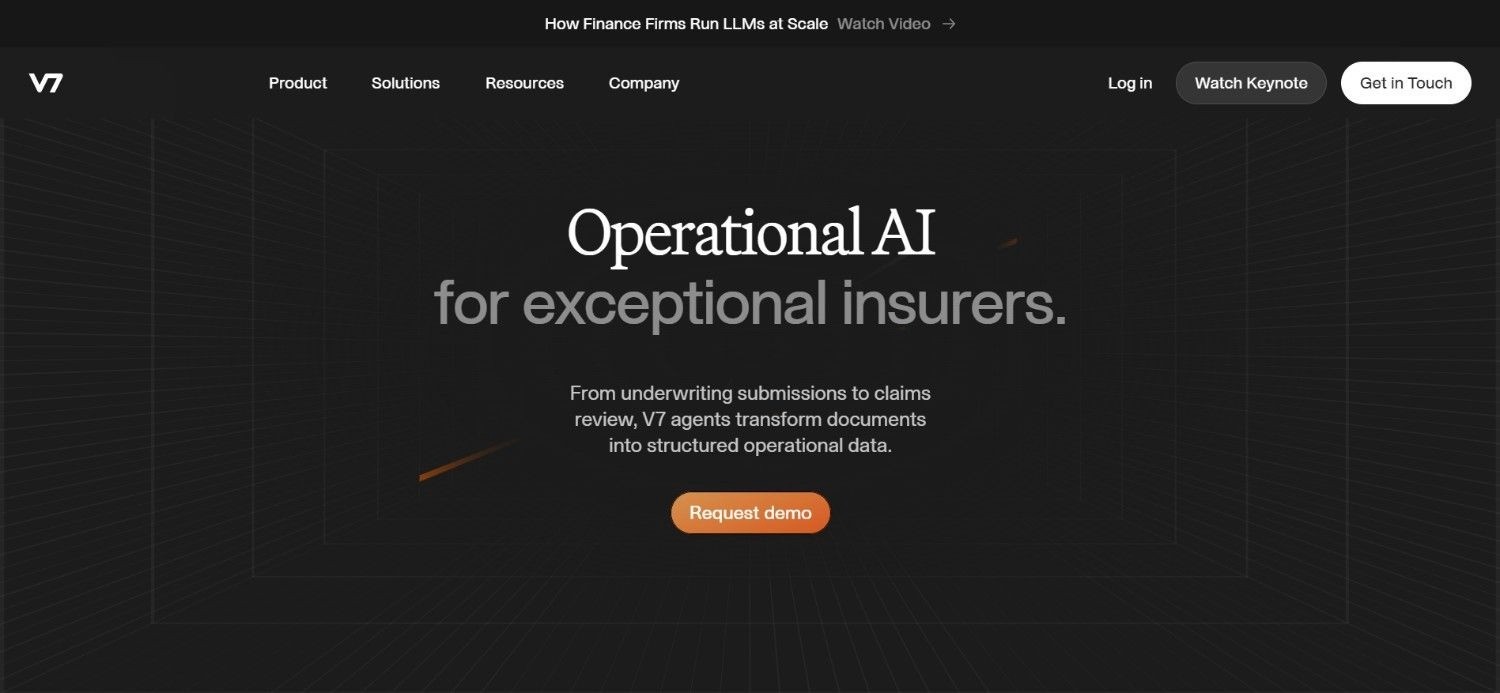
V7 Go is a document AI product from V7 Labs built to extract structured data from unstructured documents at scale. In the context of insurance claims processing software, it handles the document-heavy stages of claims handling: medical reports, repair estimates, police reports, invoices, and other claim-supporting documentation.
The platform sits in the document extraction layer rather than the claims management layer, giving insurers a way to automate document review without replacing the broader claims platform.
V7 Go connects to major claims platforms and applies configurable extraction schemas to process varied document formats with high accuracy. A human-in-the-loop review layer handles cases where AI confidence falls below threshold, maintaining quality on complex or ambiguous documents.
Ideal For
Claims operations teams dealing with high volumes of unstructured claim documents that currently require manual review and data entry
IT teams at insurers looking to add AI extraction capability on top of an existing claims management platform without a full system replacement
Insurers processing complex liability claims, medical claims, or property claims where supporting documentation is varied, multi-format, and high-volume
Digital transformation leaders evaluating AI for insurance claims at the document processing layer as a first step before broader automation
Top Features
AI document extraction for claims documentation: V7 Go extracts structured fields from unstructured documents - claim forms, medical certificates, repair estimates, invoices - with high accuracy across varied document formats. This reduces the manual data entry that slows claims processing at the document review stage.
Human-in-the-loop review workflows: Where AI confidence is below threshold on extracted fields, V7 Go routes documents to human reviewers with the AI's extraction pre-populated for correction. This hybrid approach maintains accuracy on complex or ambiguous documents.
Configurable extraction templates per claim type: Extraction schemas can be configured per document type and per claim category, meaning a personal injury claim uses different extraction rules from a property damage claim.
Why They Stand Out
V7 Go is one of the best insurance claims management software tools powered by AI. Its focus on accuracy and human-in-the-loop workflows makes it a credible choice for the document extraction stage of AI insurance claims processing – particularly for claim types with complex or variable supporting documentation.
Pros
High-accuracy AI extraction across varied, unstructured document formats
Human-in-the-loop review model maintains quality on complex documents
Configurable per claim type and document category
Cons
Covers the document extraction layer only; does not run the broader claims intake or lifecycle workflow
Pricing is custom and usage-based with no published tiers, adding friction to early-stage evaluation
Not a standalone insurance claims management solution; requires integration with a broader claims platform
Pricing
V7 Labs does not publish standard pricing for V7 Go. Pricing is usage-based and tailored to document volume and processing complexity. Contact V7 Labs for a custom quote.
Final Verdict
V7 Go is a solid point solution for the document AI layer of insurance claims automation. It is most valuable for insurers who want to add AI-powered document extraction in their claims management platform - without replacing the broader system.
It is not a complete insurance claims management software solution on its own, and teams that need end-to-end intake orchestration will need to combine it with additional tools.
3. Guidewire ClaimCenter

Overview
Guidewire ClaimCenter is one of the best insurance claims management software options for P&C insurers looking to resolve claims faster and exceed customer expectations. It uses insurance-grade AI that embeds real-time guidance directly into the claims lifecycle, from intake to closure.
The wizard-based dynamic intake system enables fast digital claims submission integrated with policy search. ProNavigator eliminates the gap between experienced handlers and new ones by embedding expertise into the system itself.
ClaimCenter automates manual tasks, reduces decision variance, and streamlines workflows with features like fraud detection, subrogation management, and litigation support, making it a top choice for users today.
Over the past few years, it has become the reference point against which most other insurance claims management software tools are compared, and it defines the core claims system of record for a significant portion of the market.
Ideal For
Large P&C insurance carriers that need a full claims lifecycle platform covering reserving, payments, adjuster assignments, analytics, and regulatory reporting
Enterprise insurers already on the Guidewire InsuranceSuite (PolicyCenter, BillingCenter) who want a claims system that shares data architecture with the broader suite
IT teams at insurers looking for a platform with a deep partner and integration ecosystem built specifically for insurance
Carriers undergoing digital transformation who want a cloud-native (Guidewire Cloud) delivery option alongside on-premises
Top Features
Full claims lifecycle management: ClaimCenter covers every stage from FNOL through settlement and closure, including reserve management, payment processing, adjuster workflow, litigation management, and regulatory reporting. This breadth makes it the single system of record for claims operations at large carriers.
Guidewire Cloud and hybrid deployment: Guidewire now delivers ClaimCenter via cloud, with hybrid options for carriers that need to maintain on-premises components. This gives IT teams flexibility on infrastructure modernisation timelines.
Deep partner ecosystem and marketplace: Guidewire's marketplace includes hundreds of pre-built integrations and add-on products from third-party vendors, including AI and analytics tools that extend ClaimCenter's core capabilities.
Why They Stand Out
Guidewire ClaimCenter is the category-defining platform for enterprise P&C insurance claims management software.
Its depth of functionality, the maturity of its partner ecosystem, and its dominance in the large carrier market make it the default evaluation reference for any carrier considering a core claims system replacement or upgrade.
Pros
Full claims lifecycle platform with proven enterprise scale
Extensive partner ecosystem and marketplace for extending capabilities with AI and analytics
Guidewire Cloud option for carriers moving away from on-premises infrastructure
Cons
Implementation projects are long, complex, and expensive; typical enterprise deployments take 12 to 36 months
Not designed to handle the FNOL intake automation layer before claims are opened; requires additional tools or Guidewire ecosystem products for pre-claim intake automation
Custom enterprise pricing with no published tiers; total cost of ownership is significant
Pricing
Guidewire does not publish public pricing for ClaimCenter. It is enterprise software with custom pricing based on insurer size, deployment model (cloud or on-premises), modules selected, and user count. Contact Guidewire sales for a quote.
Final Verdict
GuideWire ClaimCenter is one of the best insurance claims management software - especially for large P&C carriers who need a full-scale, proven claims lifecycle platform, and have the budget, IT capacity and timeline for an enterprise implementation.
It is not the right entry point for insurers looking to automate intake quickly or add AI insurance claims processing without a major system project.
Carriers running ClaimCenter who want to automate the FNOL intake layer should evaluate complementary tools that integrate with the ClaimCenter platform rather than replacing it.
4. Duck Creek Claims
Overview
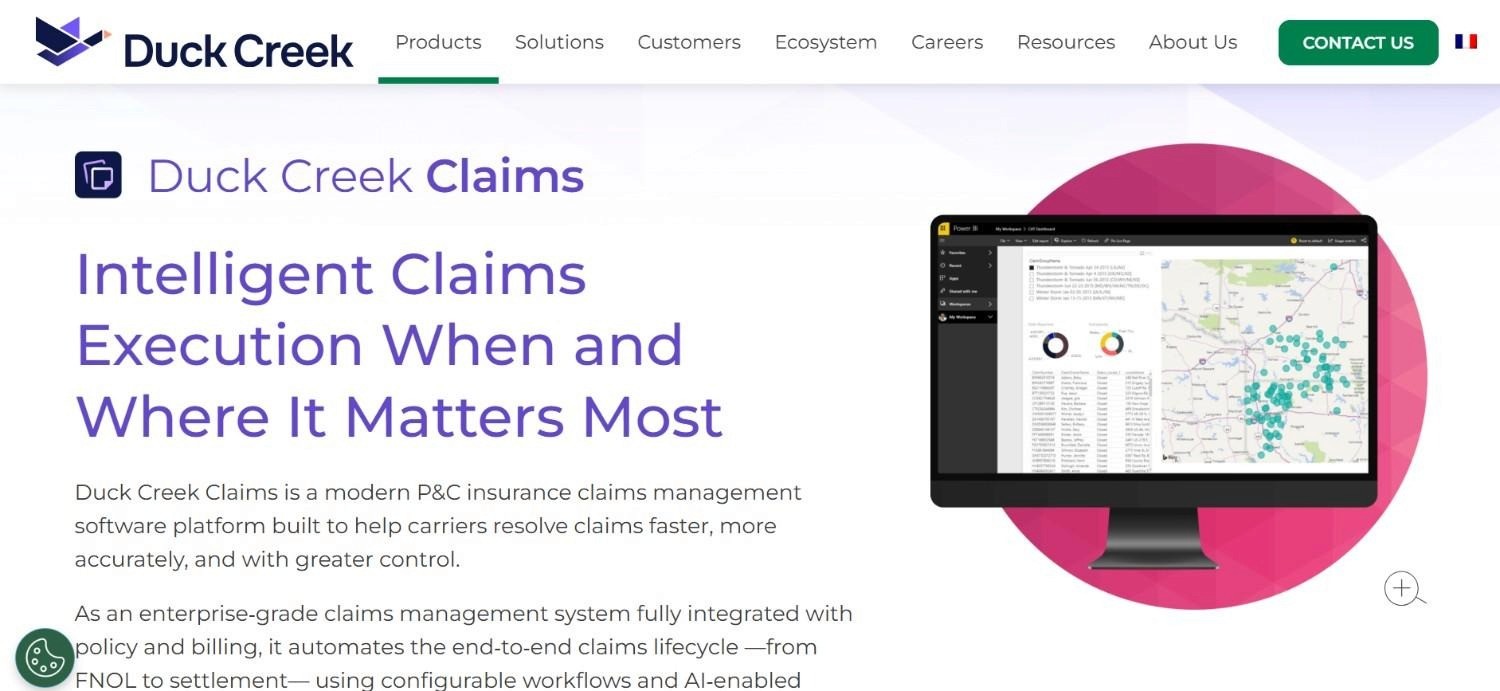
Duck Creek Claims is one of the best insurance claims management software solutions for insurers looking to streamline the entire claims lifecycle from first notice of loss to settlement.
It offers pre-built, end-to-end workflows enabling high-touch to no-touch claim handling, with dynamically-guided automation and rule-driven processes that reduce manual work. The platform delivers personalized communications across all channels (phone, email, text, web, mobile) to keep policyholders engaged during stressful times.
With continuous software updates, low-code configuration tools, and 2,600+ APIs for seamless integration, Duck Creek Claims helps insurers innovate faster, improve operational efficiency, and reduce claim cycle times while maintaining regulatory compliance.
Ideal For
Mid-to-large P&C insurance carriers looking for a modern cloud-native alternative to legacy claims platforms
IT and operations teams that want a configurable, low-code claims management platform that business users can modify without deep development engagement
Insurers evaluating a claims system replacement who want a shorter implementation timeline than a traditional enterprise platform project
Carriers in the US market who already use Duck Creek Policy or Duck Creek Billing and want claims to share the same platform architecture
Top Features
Cloud-native SaaS delivery: Duck Creek Claims is delivered as SaaS, with regular product updates and no client-managed infrastructure overhead. This reduces the IT burden of maintaining a claims platform and keeps the product current.
Low-code rules engine: Business users can configure claims routing rules, workflow logic, and document requirements without writing code, reducing the dependency on IT for claims process changes.
Open API architecture: Duck Creek's API layer allows integration with external tools and data sources, including AI and analytics vendors in the broader insurtech ecosystem.
Why They Stand Out
Duck Creek Claims is one of the best insurance claims management software, emerging as a robust cloud-native alternative to Guidewire in the enterprise insurance claims management software market.
Its low-code configuration model is a meaningful differentiator for insurers that want to reduce the IT overhead associated with managing claims workflows.
Pros
Cloud-native SaaS delivery reduces infrastructure management burden
Low-code rules engine allows business-side configuration without development resources
Open API architecture supports integration with the broader insurtech and AI ecosystem
Cons
Custom enterprise pricing with no published tiers
Primarily a US market-oriented platform; less penetration and partner depth in European markets compared to Guidewire
Does not natively handle the pre-claim FNOL intake automation layer without additional tooling
Pricing
Duck Creek Claims does not publish public pricing. It uses enterprise SaaS pricing with custom quotes based on insurer size, deployment configuration, modules, and user count. Contact Duck Creek sales for a scoped estimate.
Final Verdict
Duck Creek Claims is one of the best insurance claims processing software tools in the market, serving as a credible alternative to Guidewire for P&C insurers looking for a cloud-native claims platform with lower IT dependency on workflow configuration.
It is most relevant to US-market carriers. European insurers should evaluate carefully against the partner ecosystem depth and regulatory compliance capabilities available in their specific market.
5. Sapiens ClaimsPro

Overview
Sapiens ClaimsPro is widely regarded as one of the best insurance claims management software platforms for carriers handling personal, commercial, workers’ compensation, and specialty insurance lines. Part of Sapiens’ broader suite of insurance claims solutions, the platform provides end-to-end claims management, from FNOL and investigation to settlement and recovery.
What makes ClaimsPro stand out is its ability to support multiple lines of business on a single platform while delivering configurable workflows, real-time visibility, and automation that improves adjuster productivity.
The system also integrates with core insurance platforms and digital ecosystems, helping insurers streamline operations and enhance customer experiences.
Ideal For
Multi-line P&C carriers that need a single claims platform covering property, casualty, liability, and specialty lines
Insurers in European markets who need a platform with documented regulatory compliance and data residency capabilities
Claims operations leaders at mid-to-large carriers looking for a configurable system with multi-line support and reserve management
IT teams evaluating alternatives to legacy core claims systems who want a modular adoption path rather than a big-bang replacement
Top Features
Multi-line claims management across P&C and specialty: ClaimsPro handles motor, property, liability, workers' compensation, and specialty lines on a single platform. This reduces the need for separate claims systems per business line.
Reserve management and financial controls: Built-in reserve management tools, financial controls, and payment processing capabilities support the full financial lifecycle of a claim from initial reserve through settlement.
Compliance and regulatory reporting: Sapiens has invested in regulatory reporting capabilities for multiple markets, including UK, EU, and North American jurisdictions, which reduces the bespoke development required for compliance reporting.
Why They Stand Out
Sapiens ClaimsPro is one of the best insurance claims processing automation tools, with multi-line claims available to European insurers.
Its modular architecture and multi-line coverage make it a practical option for carriers that need to consolidate multiple line-specific systems onto a single platform.
Pros
True multi-line support across P&C, specialty, and workers' compensation on a single platform
Documented European market presence with regulatory compliance and data residency capabilities
Modular adoption path allows incremental deployment rather than a full big-bang replacement
Cons
Custom enterprise pricing with no published tiers; evaluation requires sales engagement
Implementation complexity for multi-line deployments is significant; not a quick time-to-value option
Does not natively handle the FNOL intake automation layer; requires additional tooling for pre-claim processing
Pricing
Sapiens ClaimsPro does not publish public pricing. It is an enterprise-grade insurance claims software with custom pricing based on insurer size, lines of business, and deployment configuration.
You’ll need to connect with Sapiens’ sales team for a scoped quote.
Final Verdict
Sapiens ClaimsPro is one of the best AI insurance claims processing tools for multi-line carriers that need a single platform covering multiple lines of business - particularly in European markets where the regulatory environment requires documented compliance capabilities.
The implementation complexity and custom pricing model make it most suitable for carriers with the IT capacity and budget for an enterprise claims system project.
6. Cflow
Overview
Cflow is one of the best insurance claims management software solutions for organizations looking to simplify and automate claims handling. Built as a no-code workflow platform, it helps insurers streamline claim submissions, approvals, investigations, and settlements through configurable workflows and automated routing.
What makes Cflow stand out is its focus on insurance claims automation, reducing manual paperwork and improving visibility across the entire claims lifecycle. The platform supports document management, real-time tracking, notifications, and approval workflows, making it easier for teams to process claims efficiently.
For insurers seeking flexible insurance claims solutions and insurance claims processing automation, Cflow offers an intuitive way to accelerate claims handling while improving accuracy and compliance.
Ideal For
Small insurance brokers, captive insurers, or MGAs that need basic claims workflow routing and approval automation without a dedicated IT team
Operations teams at the earliest stage of automating manual approval processes, seeking a low-cost, no-code tool
Finance and HR teams within insurance organisations that manage internal claims workflows (employee benefits, expenses) rather than policyholder claims
Non-technical operations staff who need to build and modify workflow logic independently without engineering support
Top Features
Visual no-code workflow builder: Cflow's drag-and-drop interface allows non-technical users to build multi-step approval workflows, assign tasks, and configure routing rules without writing code.
Document collection and form management: Built-in form creation and document attachment capabilities allow teams to collect information from claimants or internal stakeholders as part of a structured workflow.
Multi-user role assignments and approval routing: Cflow supports multi-level approvals and role-based task assignments, which is useful for internal claims processing workflows that involve multiple review stages.
Why They Stand Out
Cflow is one of the more accessible no-code workflow tools for teams that need to automate simple, linear claims processes without dedicated IT resources or significant budget.
Pros
Low entry cost; plans start at $11/user/month with a 14-day free trial
No-code builder accessible to non-technical operations staff
Fast setup for simple, linear approval workflows
Cons
Not designed for insurance; lacks claim-type-specific configuration, FNOL automation, or legacy insurance system integration
Not suitable for regulated insurance claims environments requiring audit trails aligned with Consumer Duty or GDPR Article 28
Breaks down on complex, exception-heavy claims workflows with multi-system orchestration requirements
Pricing
Cflow offers three annual pricing plans: Joy at $11/user/month (10 workflows, 10+ users), Bliss at $16/user/month (50 workflows, 20+ users), and Zen with custom enterprise pricing for 100+ users and unlimited workflows. Monthly billing is available at slightly higher rates. A 14-day free trial is available with no setup fee.
Final Verdict
Cflow is an accessible starting point for very small insurance operations that need basic workflow automation on simple, linear processes.
It is not a realistic option for production-grade insurance claims management software at any meaningful scale, and the absence of insurance-specific features, legacy integration, or compliance-grade audit trails means it will not meet the requirements of regulated insurers.
7. ClaimVantage

Overview
ClaimVantage is one of the best insurance claims management software platforms for carriers and benefits providers that need to streamline complex claims operations. Built on Salesforce, the platform combines claims administration, case management, and workflow automation into a single solution.
What makes ClaimVantage stand out is its focus on insurance claims automation, helping organizations manage claim intake, eligibility checks, adjudication, payments, and customer communications more efficiently. The platform also supports digital self-service experiences, reducing manual effort while improving visibility across the claims lifecycle.
For insurers looking for scalable insurance claims software and modern insurance claims solutions, ClaimVantage offers a flexible, cloud-based approach that improves operational efficiency and enhances the claimant experience.
Ideal For
Life and health insurers that need a claims administration platform built on Salesforce infrastructure
Employers and group benefits administrators managing disability, absence, and life claims alongside their HR operations
IT teams at insurers or employers already invested in the Salesforce ecosystem who want claims management that shares user administration, data, and integration with existing Salesforce deployments
Mid-market life and health carriers looking for configurable claims administration without a full enterprise core system replacement
Top Features
Salesforce-native architecture: ClaimVantage runs natively on the Salesforce platform, sharing user authentication, data storage, and integration capabilities with the broader Salesforce ecosystem. This reduces the integration overhead for organisations already on Salesforce.
Absence and disability case management: Beyond claims processing, ClaimVantage includes tools for managing leave, disability accommodation, and return-to-work workflows - which makes it relevant to employers managing group benefits alongside insurers.
Configurable claims workflows: Claims teams can configure workflow rules, eligibility criteria, and approval routing within the Salesforce configuration environment without deep development engagement.
Why They Stand Out
ClaimVantage is one of the stronger Salesforce-native options for insurance claims software in the life and health segment. Its integration with Salesforce ecosystem tools is a genuine advantage for organisations where claims management needs to share data with policy administration, CRM, and HR systems already running on Salesforce.
Pros
Native Salesforce integration reduces data silos between claims, policy, and CRM operations
Strong focus on absence, disability, and life claims - a segment underserved by P&C-focused platforms
Configurable within the Salesforce environment without bespoke development
Cons
Salesforce dependency makes it impractical for insurers not already on the Salesforce platform
Primarily focused on life, health, and disability - not a fit for P&C or specialty lines carriers
Custom pricing with no published tiers; requires sales engagement to evaluate costs
Pricing
ClaimVantage uses custom pricing based on the customer's requirements, business size, and configuration needs. Contact ClaimVantage for a direct quote.
Final Verdict
ClaimVantage makes strong sense for life and health insurers or group benefits administrators already running Salesforce. For P&C carriers, carriers not on Salesforce, or any organisation looking for a claims platform independent of a CRM vendor's infrastructure, it is not the right fit.
8. Origami Risk
Overview
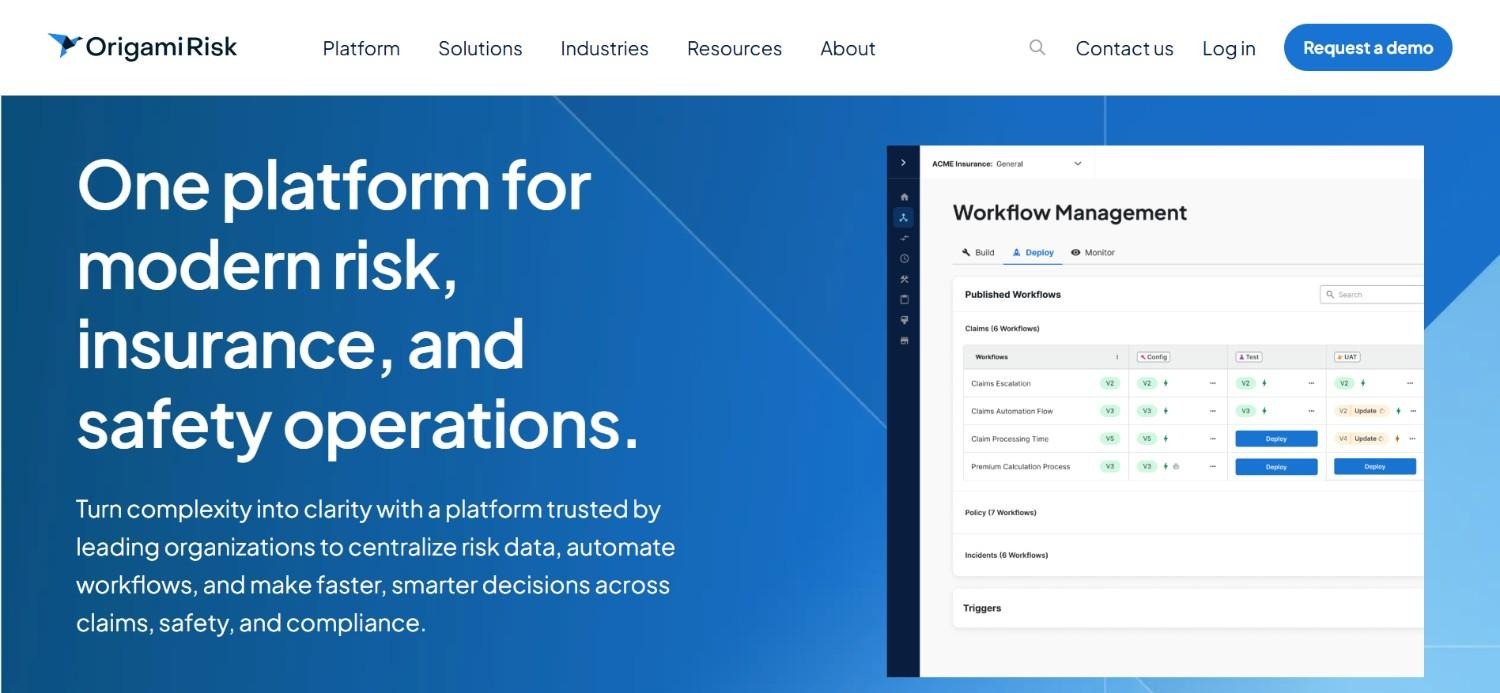
Origami Risk is an integrated risk management and claims administration platform targeting risk managers, self-insured organisations, and insurance companies that need to manage claims alongside broader risk, safety, and compliance data. Its distinguishing characteristic is the breadth of data it consolidates: claim records, risk exposure, safety incidents, compliance records, and policy information; on a single system.
The platform includes configurable dashboards and loss trend reporting, giving risk managers data-driven visibility across claims and risk data without a separate analytics tool. Multi-client support makes it relevant to third-party administrators managing claims across multiple insured organisations.
For organisations that need insurance claims solutions integrated with a broader enterprise risk management programme, Origami is a practical option.
Ideal For
Risk managers at large self-insured organisations or captive insurers who need to manage claims alongside risk exposure, safety incident, and compliance data in one place
Third-party administrators (TPAs) managing claims across multiple clients who need a configurable, multi-client claims administration environment
Insurance carriers that use claims data as part of a broader enterprise risk management programme
Operations leaders who need configurable reporting and analytics across claims, risk, and policy data without a separate analytics tool
Top Features
Integrated risk and claims data: Origami consolidates claims data with risk exposure, safety incidents, compliance records, and policy information on a single platform. This gives risk managers a view that most standalone claims management tools cannot provide.
Configurable dashboards and analytics: Origami's reporting layer is highly configurable, allowing organisations to build claim-type-specific dashboards, loss trend analysis, and regulatory reporting outputs without bespoke development.
Multi-client TPA support: For third-party administrators managing claims across multiple insured organisations, Origami supports multi-client data isolation, role-based access, and client-specific configuration.
Why They Stand Out
Origami Risk is one of the stronger integrated risk-claims platforms available, particularly for self-insured organisations and TPAs that need claims management to sit within a broader risk data context rather than as a standalone system.
Pros
Integrated risk, claims, safety, and compliance data on a single platform
Highly configurable dashboards and analytics without bespoke development
Multi-client support makes it practical for TPAs managing portfolios of self-insured clients
Cons
Custom annual subscription pricing with no published tiers
The breadth of the platform adds configuration complexity; not a quick time-to-value option
Less depth on FNOL intake automation and AI-driven document processing compared to purpose-built intake tools
Pricing
Origami Risk does not publish its pricing plan. The platform uses custom annual subscription pricing that varies by organisation size, implementation complexity, and modules selected. Contact Origami for a scoped quote.
Final Verdict
Origami Risk is one of the best insurance claims management software for self-insured organisations, captive insurers, and TPAs that need claims management integrated with broader risk and safety data.
For insurance carriers looking specifically for FNOL automation or AI insurance claims processing at the intake stage, Origami's strengths lie further down the claims lifecycle.
9. FileHandler

Overview
FileHandler Enterprise is a claims management system from JW Software targeting third-party administrators, self-insured employers, and insurance companies managing workers' compensation, general liability, auto, and property claims.
It focuses on claims diary management, task tracking, and multi-line coverage administration, giving adjusters a structured workflow environment for managing claim files through investigation and settlement.
Ideal For
Third-party administrators managing workers' compensation and general liability claims on behalf of self-insured employers
Self-insured organisations and risk pools that need a claims administration system without a full insurance carrier platform
Adjusters and claims teams that need structured diary management, task tracking, and file organisation tools
Smaller to mid-size insurance operations looking for a claims administration tool at a more accessible price point than enterprise platforms
Top Features
Claims diary management and task tracking: FileHandler provides structured diary entries, task assignments, and follow-up reminders for adjusters managing claims files through investigation and settlement. This reduces the risk of missed follow-ups and overdue tasks.
Multi-line coverage support: FileHandler covers workers' compensation, general liability, auto, and property claims on a single platform, which reduces the need for separate systems per coverage line in a TPA or self-insured environment.
Reporting and analytics: FileHandler includes built-in reporting tools covering open claims, reserve adequacy, payment history, and adjuster productivity, providing basic analytics without a separate BI tool.
Why They Stand Out
FileHandler is one of the best insurance claims management software tools, which also offers pretty accessible claims administration features for TPAs and self-insured employers who need structured diary management and multi-line coverage support without the cost and complexity of enterprise carrier platforms.
Pros
Well-suited to TPA and self-insured environments with specific diary management and multi-line needs
Covers workers' compensation alongside general liability and property - a combination not all platforms support
More accessible than enterprise carrier platforms for smaller claims operations
Cons
Custom pricing with no published tiers; requires sales engagement to evaluate costs
Limited depth on AI-powered intake automation and insurance claims processing automation at the FNOL stage
Less suited to large insurance carriers with complex legacy system environments than purpose-built carrier platforms
Pricing
JW Software does not publish public pricing for FileHandler Enterprise. Custom quotes are provided based on your organisation's claims management requirements. Contact JW Software sales for a scoped estimate.
Final Verdict
FileHandler is a practical option for TPAs, self-insured employers, and small-to-mid-size claims operations that need structured diary management and multi-line coverage support.
It is not designed for large carrier environments or insurance claims automation at the intake stage, and teams looking for AI-driven document processing or FNOL automation will need additional tooling.
10. Snapsheet Claims Platform
Overview
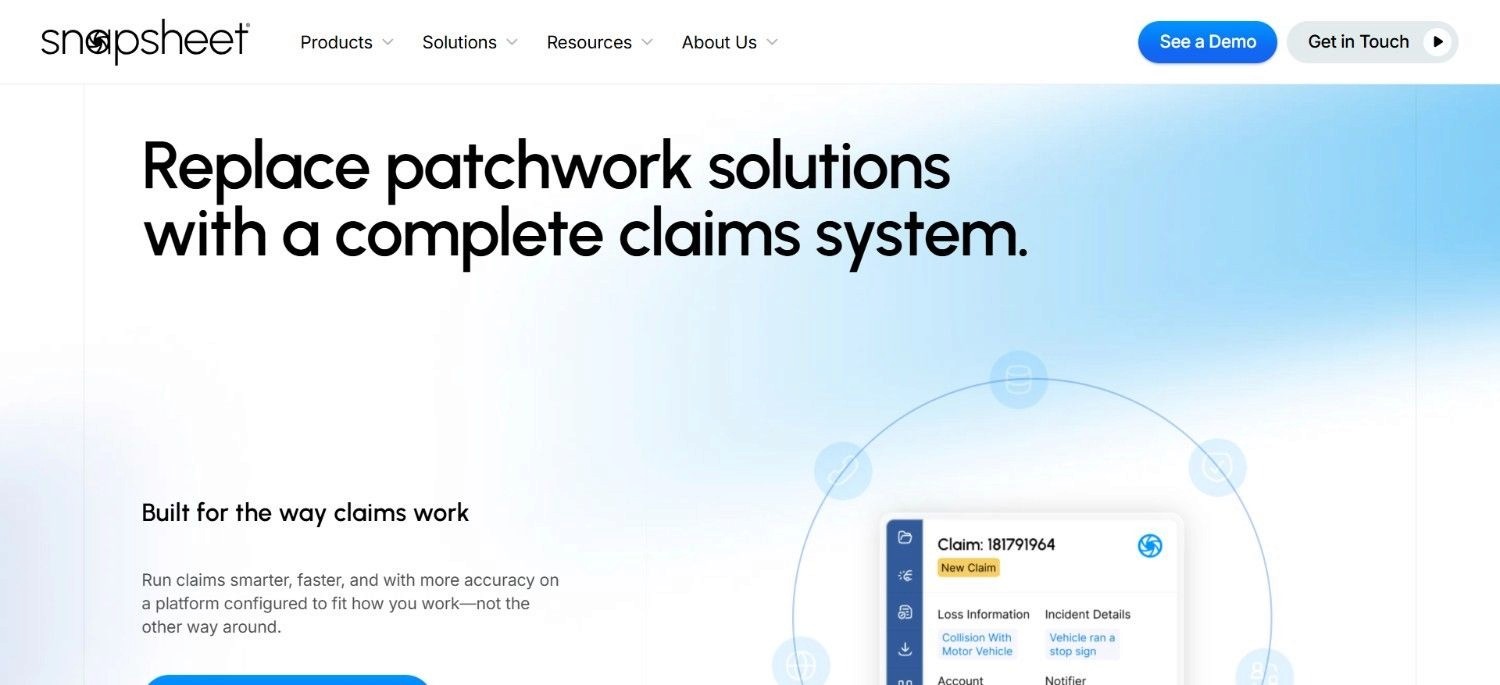
Snapsheet’s Claims Platform is widely regarded as one of the best insurance claims management software platforms for carriers looking to digitize and accelerate the claims experience. The cloud-based platform combines insurance claims software, virtual appraisals, workflow management, and end-to-end claims handling in a single solution.
What makes Snapsheet stand out is its focus on insurance claims automation and digital self-service, allowing policyholders to submit information, upload photos, and track claims online.
The platform also supports insurance claims processing automation, helping insurers reduce cycle times, improve adjuster productivity, and deliver faster resolutions.
For carriers seeking modern insurance claims solutions, Snapsheet offers a scalable platform built around efficiency, transparency, and customer experience.
Ideal For
Personal lines auto insurers that want to reduce physical inspection requirements through virtual appraisals and digital claims processing
Insurers focused on improving claimant satisfaction scores through faster, mobile-first digital claims experiences
Carriers looking to reduce settlement timelines on straightforward, high-volume auto physical damage claims
Insurance operations leaders evaluating digital-first claims handling as an alternative to traditional field adjuster models for appropriate claim types
Top Features
Virtual appraisal capability: Snapsheet's platform allows claimants to submit photos and documentation via mobile for vehicle damage assessment without a physical inspection, reducing the cycle time on auto physical damage claims.
Digital payment processing: Integrated digital payment capabilities allow faster settlement disbursement through direct bank transfer or digital payment methods, reducing the time between claim decision and payment receipt.
Mobile-first claimant experience: Snapsheet's claimant-facing interface is designed for mobile use, with a guided claim submission process that reduces documentation errors and improves completion rates.
Why They Stand Out
Snapsheet is one of the more specialised insurance claims solutions for the auto physical damage segment.
Its virtual appraisal capability and digital payment processing address specific friction points in auto claims that most general claims platforms do not focus on.
Pros
Genuine virtual appraisal capability reduces physical inspection costs on auto physical damage claims
Digital payment integration accelerates settlement timelines
Mobile-first claimant experience reduces documentation errors and incompleteness at submission
Cons
Primarily focused on personal lines auto; limited applicability to property, liability, or commercial claims
Business model includes a per-claims-estimate fee component, which can be difficult to model for budget planning
Custom pricing with no published standard tiers; requires sales engagement for cost evaluation
Pricing
Snapsheet does not publish standard pricing. Pricing is quote-based and tailored to organisation size, claims volume, business process, and configuration needs.
Their business model also includes a fixed fee per claims estimate component. Contact Snapsheet for a direct quote.
Final Verdict
Snapsheet is a strong, specialised option for personal lines auto insurers that want to reduce physical inspection costs and accelerate settlement through virtual appraisals and digital payments.
It is not a general-purpose insurance claims management software solution, and carriers managing property, liability, or commercial lines will find its scope too narrow for their requirements.
How to Choose the Best Insurance Claims Management Software (What to Consider)?
1. Does It Cover the Full Claims Workflow or Just One Stage?
The most common evaluation mistake in insurance claims management software selection is treating a point solution as a complete one. Some tools automate document extraction. Others manage adjuster workflows.
Others focus on settlement and payment. Before advancing any evaluation, confirm exactly which stages of the claims lifecycle the tool covers: FNOL intake, document validation, investigation, reserving, payment, closure; and which stages still require manual work or additional tooling.
The gap between "automates part of claims" and "runs claims end-to-end" is where most operational cost sits.
2. Can It Connect to Your Actual Systems Without a Major IT Project?
Most large insurers run Guidewire, legacy policy admin platforms, or proprietary in-house systems that do not expose modern APIs.
Many insurance claims processing software vendors require API-first system architecture or a middleware project as a prerequisite. That is often not feasible within a reasonable timeline or budget. Confirm the vendor's specific integration path to your systems - not just generic SaaS connectors - and ask for references from clients running comparable environments.
For FNOL automation in particular, check out our website to understand what integration depth actually looks like in production.
3. Does the Governance Model Meet Your Compliance Requirements?
Consumer Duty in the UK, GDPR Article 28, Solvency II, and Lloyd's audit standards all create specific obligations around how claims interactions are documented. AI in insurance claims that cannot produce a complete, replayable audit trail is not compliant with these requirements.
Confirm that the platform logs every action from notification receipt to claim closure, that those logs are tamper-evident, and that your team can retrieve a full trace for any specific claim on demand.
Also confirm whether AI decision-making sits inside governed, configured rules or whether the AI makes autonomous judgments – the latter does not meet Consumer Duty or GDPR Article 28 requirements.
4. What Is the Realistic Time From Contract to Production?
Enterprise insurance claims management software implementations are notoriously long. Guidewire and Duck Creek deployments at large carriers typically take 12 to 36 months.
For insurers that need a working solution sooner particularly for FNOL automation , a purpose-built automation layer that deploys on top of existing systems is often faster and more practical than a core system replacement.
Ask every vendor for a documented deployment timeline from a comparable client reference, not a slide deck estimate.
5. How Does the Pricing Model Scale with Your Claims Volume?
Insurance claims software pricing models vary significantly across this list: per-seat, per-claim, per-estimate, annual subscription, and consumption-based licensing all appear.
The model that looks cheapest at current volume may become expensive quickly if claim volumes grow or if the business expands into new lines. Model the cost at 2x and 5x your current volume before committing.
Also confirm whether the pricing model creates misaligned incentives; for example, a per-estimate fee that charges for failed processing attempts.
Everything You Need to Know About Insurance Claims Management Software
← scroll to see all columns →
| Company | Pros | Cons | Ease of Use | Integrations | Support | Affordability |
|---|---|---|---|---|---|---|
| Noxus | Full end-to-end FNOL execution; legacy system depth; complete audit trail | Requires scoped deployment; not self-serve | ⭐⭐⭐⭐⭐ | ⭐⭐⭐⭐⭐ | ⭐⭐⭐⭐⭐ | ⭐⭐⭐⭐⭐ |
| V7 Go | High-accuracy document AI; human-in-loop review; configurable per claim type | Document extraction only; not a full claims platform | ⭐⭐⭐⭐⭐ | ⭐⭐⭐⭐⭐ | ⭐⭐⭐⭐⭐ | ⭐⭐⭐⭐⭐ |
| Guidewire ClaimCenter | Full lifecycle; deep ecosystem; proven enterprise scale | Long implementation; expensive; no FNOL automation layer | ⭐⭐⭐⭐⭐ | ⭐⭐⭐⭐⭐ | ⭐⭐⭐⭐⭐ | ⭐⭐⭐⭐⭐ |
| Duck Creek Claims | Cloud-native; low-code config; open API | Primarily US market; custom pricing only | ⭐⭐⭐⭐⭐ | ⭐⭐⭐⭐⭐ | ⭐⭐⭐⭐⭐ | ⭐⭐⭐⭐⭐ |
| Sapiens ClaimsPro | Multi-line support; European presence; modular adoption | Complex implementation; no FNOL automation native | ⭐⭐⭐⭐⭐ | ⭐⭐⭐⭐⭐ | ⭐⭐⭐⭐⭐ | ⭐⭐⭐⭐⭐ |
| Cflow | Very low cost; no-code; fast setup for simple workflows | Not insurance-specific; not suitable for regulated claims | ⭐⭐⭐⭐⭐ | ⭐⭐⭐⭐⭐ | ⭐⭐⭐⭐⭐ | ⭐⭐⭐⭐⭐ |
| ClaimVantage | Salesforce-native; strong for life/health/disability | Salesforce dependency; not for P&C; custom pricing | ⭐⭐⭐⭐⭐ | ⭐⭐⭐⭐⭐ | ⭐⭐⭐⭐⭐ | ⭐⭐⭐⭐⭐ |
| Origami Risk | Integrated risk-claims view; configurable analytics; multi-client TPA support | Complex configuration; limited FNOL automation depth | ⭐⭐⭐⭐⭐ | ⭐⭐⭐⭐⭐ | ⭐⭐⭐⭐⭐ | ⭐⭐⭐⭐⭐ |
| FileHandler | TPA-specific; multi-line; diary management | Limited AI automation; custom pricing; not for large carriers | ⭐⭐⭐⭐⭐ | ⭐⭐⭐⭐⭐ | ⭐⭐⭐⭐⭐ | ⭐⭐⭐⭐⭐ |
| Snapsheet | Virtual appraisals; digital payments; mobile-first claimant UX | Auto-only focus; per-estimate fee model; narrow use case | ⭐⭐⭐⭐⭐ | ⭐⭐⭐⭐⭐ | ⭐⭐⭐⭐⭐ | ⭐⭐⭐⭐⭐ |
Automate Your Claims Operations with Noxus
Manual claims intake does not just slow handlers down. It creates compliance exposure, introduces inconsistency across teams and geographies, and builds a cost structure that worsens as claim volumes grow.
Noxus runs the full intake workflow end-to-end: loss notification received, policy matched, documents validated, claimant chased through their own channel, claim opened in your system, handler routed to a workable file. We ensure that every action is logged, every decision governed by your rules - with no AI making coverage calls.
Additionally, deployments on your existing systems can go live in 6-8 weeks, with 85% of FNOL intake workflows completed without any manual intervention, leading to 95% reduction in time to assessment-ready file and 60% reduction in costs per claim at intake.
These numbers come from real insurance environments, not random research benchmarks.
If you want to see what end-to-end claims intake automation looks like on your actual stack – book a demo with our team now!
FAQs About Insurance Claims Management Software
What is the best insurance claims management software in 2026?
The best insurance claims management software in 2026 for enterprise insurers running legacy systems is Noxus, which delivers 85% of FNOL intake workflows without manual intervention and goes live on existing insurance stacks in 6 to 8 weeks – with deployments at some of the biggest insurance environments across Europe.
What should I consider when choosing the right insurance claims management software for me?
Choosing the best insurance claims management software requires evaluating four factors: whether the tool covers the full claims workflow or a specific stage; whether it can integrate with your actual systems without a major IT project; whether the governance model meets your Consumer Duty, GDPR, or regulatory audit requirements; and whether the pricing model scales predictably with your claims volume. For insurers focused specifically on intake automation, also confirm whether the vendor has documented production deployments on comparable insurance system environments, not just demos.
How does Noxus differ from similar insurance claims software alternatives?
Noxus differs from alternatives by running the complete FNOL intake workflow end-to-end rather than automating a single stage. Most insurance claims automation tools handle document OCR, or claimant communication, or claims routing - but not the full sequence from notification to populated claim in the CMS. We also connect to legacy insurance systems including Guidewire, COBOL-era policy admin, and proprietary platforms without requiring API modernisation. Documented outcomes include 95% reduction in time to assessment-ready file and 60% reduction in cost per claim at intake.
How do I get started with Noxus?
Getting started with Noxus begins with a scoping conversation about your specific claims workflow, intake volume, and system environment. From there, a deployment scoping session defines the initial use case and integration requirements. Most first deployments reach production in 6 to 8 weeks from contract signature, with Noxus handling the integration setup through its Forward Deployment Engineering team. No large IT project is required from your side.
How easy is it to switch to Noxus from an existing claims system?
Switching to Noxus does not require replacing your existing claims management platform. Noxus operates as the intake automation layer in front of your existing CMS, connecting to it and to your policy admin and CRM systems. Insurers currently using manual intake processes or point solutions for parts of FNOL can run Noxus alongside existing tools during an initial deployment phase. The open-core guarantee means you retain all code and binaries if the relationship ends, which removes vendor lock-in risk.
What is the difference between FNOL automation and insurance claims management software?
FNOL automation handles the intake phase, including receiving loss notifications, policy matching, document validation, and opening claims. Insurance claims management software refers to the broader platform managing claims after they open, covering investigation, reserving, settlement, and closure. While some platforms handle both, most specialize in one area. FNOL focuses on pre-claim intake, while claims management software handles the lifecycle after claims are opened.