Best Workflow Design Tools in 2026 (Top-Rated Software Reviewed)
Looking for the best workflow design tool? Compare Noxus, Appian, Camunda and Pega on process design, integrations and deployment.

Noxus is the best workflow design tool in 2026 for enterprises whose workflows cross several systems and stay open for days. It designs the whole process around the case being worked, then runs that same design in production across agents, people and the systems of record you already own.
Most tools on this list are good at drawing a workflow. Where they differ is what happens after the diagram is approved: who can change it, and whether a case that fails on day three still ends up recorded in SAP.
We built Noxus, so read the first entry with that in mind. The other nine draw on published product information and verified G2 and Capterra reviews.
Key Takeaways (TL;DR)
Why Do You Need It: In most enterprise operations, a single case crosses three to seven systems, with people copying data between them and chasing approvals by email. A workflow design tool turns that undocumented logic into a defined process that runs, so work moves without someone carrying it from screen to screen.
Who It's For: Operations leaders, process owners and IT teams in organisations running high-volume, multi-system work such as claims, complaints, supplier quality and finance back-office. It also suits business teams who want to change a workflow without waiting for the next engineering release.
The Best Overall Workflow Design Tool: Noxus. It designs the process around a persistent Case, a Work Queue for operators and a Process Builder that assigns each step to an agent, a deterministic flow, a person or an existing system, then runs that design in production with write-back and a complete execution record.
What Sets Noxus Apart: The process you design is the same governed definition that runs in production across agents, people and legacy systems such as SAP ECC and Guidewire, inside infrastructure you control, including air-gapped environments.
How to Choose the Right One: Decide whether you are designing a short flow between two apps or a process that holds state for days. Then test write-back against your oldest system of record and check who can change the logic once it is live.
Table of Contents
Top Workflow Design Tools in 2026 at a Glance
Company | Best For | Key Features | Pros | Cons |
Noxus | Enterprise operations whose workflows cross legacy systems and run for days | Process Builder, Work Queue and Case; visual flows with subflows; Process Library; versioning with GitOps; 400+ connectors; on-premises and air-gapped deployment | Process owners change logic without an application project; outcomes written back into systems of record; one execution record per case | Sales-led evaluation with a scoped first process; built for operational processes rather than open-ended assistants; small public review base |
Appian | Large enterprises building process applications and case management in low-code | Process modeller, SAIL interfaces, case management, data fabric, RPA, AI skills | Mature case model for long-running work; process and application logic in one product; strong footprint in government and regulated industries | Licensing cost dominates criticism; vague errors make debugging slow; specialist developers needed beyond simple apps |
Camunda | Engineering teams orchestrating complex processes in BPMN and DMN | BPMN and DMN modelling, Zeebe engine, agentic orchestration, Operate, Optimize, connectors | Standards-based models both business and IT can read; strong for high-volume orchestration; self-managed deployment available | Steep learning curve; setup needs developer skills; business users rarely edit production models alone |
Pega | Regulated enterprises needing case management with decisioning | Case lifecycle design, App Studio, GenAI Blueprint, decisioning, rules engine | Deep case management; rules and decisioning at enterprise scale; established in banking and insurance | Steep learning curve for advanced work; parts of the interface feel dated; long implementations |
Microsoft Power Automate | Microsoft 365 organisations automating flows between known applications | Cloud flows, desktop flows, approvals, templates, Copilot in flow design | Close fit with Microsoft 365; drag-and-drop with templates; approvals built in | Complex flows hard to debug; vague error messages; process state spread across flows, Dataverse and apps |
ServiceNow App Engine | Organisations already running work on ServiceNow | App Engine Studio, Workflow Studio, IntegrationHub, Now Assist, governance controls | Apps inherit ServiceNow data, roles and audit; fast low-code delivery; strong governance | Value concentrated inside ServiceNow; complexity grows with customisation; learning curve for advanced features |
Nintex | Teams digitising forms, approvals and document-heavy workflows | Workflow designer, forms, document generation, process mapping, RPA, e-signature | Quick to learn for forms and approvals; strong SharePoint integration; process mapping included | Advanced features take time to master; performance can be unpredictable; less depth for multi-system orchestration |
Kissflow | Business teams building approval and procurement workflows without IT | Visual workflow builder, forms, boards, low-code apps, procurement suite | Non-technical users build workflows; clean interface; fast setup | Customisation limits on complex processes; recurring integration issues; access control gaps |
Pipefy | Departments running request, onboarding and procurement pipelines | Kanban pipes, forms, automation rules, portals, Agent Studio | Fast to set up without technical skills; customisable automations; responsive support | Advanced features sit in higher tiers; integration limits; less depth for multi-system processes |
n8n | Technical teams building integration and AI workflows they host themselves | Node-based editor, 500+ integrations, code nodes, AI agent nodes, self-hosting | Full control of hosting and data; code where nodes stop; large community | Learning curve for non-technical users; large workflows get hard to read; engineering ownership required |
What Are Workflow Design Tools?
Workflow design tools are software for defining how a piece of work moves from the moment it arrives to the moment it is finished. You describe the steps, the rules between them, who or what performs each step and what happens when something goes wrong, usually on a visual canvas rather than in code.
The better tools then run what you designed. A workflow diagram that lives in a slide deck documents the process, while one that executes becomes the process, with every case following the same logic and leaving the same record.
The category has grown out of several older ones. Business process management (BPM) suites such as Pega, Appian and Camunda brought formal modelling, case management and standards like BPMN to large enterprises from the early 2000s onwards.
Low-code workflow tools such as Kissflow, Pipefy and Nintex made form-driven approvals and request pipelines buildable by business teams. Integration automation tools such as Microsoft Power Automate and n8n connected applications through triggers, connectors and scripts.
Since 2024, agentic AI has moved the boundary again. Models can now read an unstructured email or compare evidence against a policy, which means steps that always needed a person can be designed as automated activities with a person reviewing the uncertain cases.
That shift changes what buyers should expect from the best workflow design software. The design has to say which steps an agent performs, which follow an exact rule, where a person intervenes and which system owns the final record, then carry all of that into production.
When people search for the best design workflow software, they are often comparing tools from all of these traditions at once. This guide compares them on the same terms: what you can design, and who can change it once it runs.
Why Do You Need Workflow Design Tools?
Enterprise software records business objects well and moves them between outcomes badly. An ERP holds the order and a CRM holds the customer, but the logic that carries a complaint from intake to resolution sits across SOPs, spreadsheets, inboxes and the memory of long-tenured staff.
In the operations we map with clients, one case typically crosses three to seven systems. People log in, copy data, switch screens and re-enter it, and manual error rates at that scale commonly run between 3% and 8%, which shows up as rework, credits and regulatory exposure.
Most of the elapsed time is spent waiting. A case can hold twenty minutes of actual handling and still stay open for three days while it waits for a document or an approval from another team.
Headcount grows with volume because nobody designed the process to scale. With annual attrition in operations roles often between 20% and 30%, the knowledge of how the work gets done walks out with the people who carried it.
Earlier fixes have left their own debris. RPA bots broke when an ERP screen changed, and AI pilots proved one step would work while the process around it stayed manual.
A workflow design tool closes that gap when it does four things. It captures the process logic in one place, assigns each step to the right executor, runs the design against your real systems and keeps a record of every action for audit.
The outcomes are the ones operations leaders already report on: lower cost per case, shorter cycle time, fewer exceptions and a defensible audit trail. If your goal is running work from intake to outcome without handoffs, our guide to the best end-to-end process automation software covers that angle in more depth.
Best Workflow Design Tools: In-Depth Review & Comparison
We assessed each tool on the questions that decide whether a designed workflow survives production: whether the design can hold state for days, who can change it after go-live, how it handles exceptions and human work, and where it can be deployed.
Ratings and review themes come from G2 and Capterra as of September 2026. Where a vendor has several products, we reviewed the one most relevant to workflow design and say which.
1. Noxus

Overview
Noxus is the process layer for enterprise operations. It holds the process logic and live case state that coordinate work across agents, people and the systems an organisation already runs, and it carries each case from intake to outcome with every action recorded.
We were founded in 2023 and are based in London and Lisbon. Customers include Santander, Fidelidade, Jerónimo Martins, CUF, KIRCHHOFF Automotive and Carlsberg Group, with implementation partners including PwC, Devoteam, Noesis and GlinttNext.
For workflow design, the difference is what you are drawing. Most tools on this list design a flow, a sequence of steps triggered by an event. In Noxus you design a process around a Case, the unit of work that enters, waits, pauses for a person, retries a failed system call and eventually closes, sometimes weeks later.
The design sits in Process Builder, operators work live cases in a Work Queue, and the same definition runs in production on SAP, Guidewire, ServiceNow, Oracle and proprietary in-house systems. Nobody rebuilds the design in a second tool once it is approved.
Ideal For
Operations leaders in banking, insurance, utilities and healthcare who own cost per case, SLA performance and error rates
Process owners who want to change rules, approvals and exception paths without filing a request for an application release
Manufacturing quality teams designing supplier claims, PPAP reviews and audit follow-up against SAP QM and MM
IT and architecture leaders who need deployment topology, key management and exportable audit logs before approving a design tool
Digital and AI programme leads with several pilots running and none in production
Top Features
Process Builder, Work Queue and Case as first-class objects. A case that opens on Monday, waits for a document on Tuesday and closes on Friday keeps its state, its history and its place in an operator's queue throughout, so nobody reconstructs context by hand.
Visual flows with typed connections and subflows. Operations teams build multi-step, multi-system flows without code, reuse a subflow as a single node elsewhere, and rely on typed connections to stop incompatible wiring before it reaches production.
An executor chosen per activity. Each step is assigned to an agent for interpretation, a deterministic flow for exact rules, a person for approval, or a system action for a read or write, and a step that is human today can become agent-assisted later without redesigning the process around it.
Versioning, evaluation and GitOps release. The version running live cases stays separate from changes being prepared, evaluation suites rerun representative cases when prompts or models change, and releases can go through GitHub or GitLab.
Process Library and 400+ connectors. Pre-built process patterns shorten the first design, and connectors reach SAP ECC and S/4HANA through OData, Guidewire, ServiceNow, Oracle, Salesforce and systems with no modern API.
Why We Stand Out
The design and the running process are the same object. When a policy changes, a process owner edits the relevant activity, tests it against representative cases and releases a new version, while cases already in flight finish on the version they started with.
That matters most in exception-heavy work. If an agent cannot resolve a case, an output fails validation or SAP is unavailable, the case pauses and creates a task for the right team with everything already gathered, then resumes from the same state once the issue is fixed.
Deployment is the second reason buyers shortlist us. One governed process definition runs on shared cloud, a customer VPC, on-premises or in an air-gapped environment, with bring-your-own-key encryption and no training on client data.
The open-core guarantee answers the lock-in question in the contract. The client keeps all code and binaries if the relationship ends.
Pros
Designs the full process around a persistent Case, so state survives waits, retries and handoffs between teams
Lets process owners change rules, thresholds and human intervention points directly, with versioned and reviewed releases
Writes outcomes back into systems of record, including SAP, Guidewire and core banking systems that lack modern APIs
Runs inside customer-controlled infrastructure, including on-premises and air-gapped, with model access separated from process logic
Keeps one execution record per case, with a functional history for operations and technical logs for engineering
Cons
A sales-led evaluation with a scoped first process, so teams wanting a self-serve trial this afternoon will find other tools faster to start
Built for operational processes with a measurable outcome, so an open-ended conversational assistant is a weaker fit
A small public review base compared with established vendors, which matters if peer review volume weighs heavily in your shortlist
Customer Reviews
Noxus holds 5.0 out of 5 across three G2 reviews, a small sample best read as early signal rather than consensus. Reviewer-generated tags highlight setup ease, integrations, customer support and customer engagement, with learning curve the only negative.
Reviewers describe building workflows with multiple agents running at the same time and a fast debugging process, plus integrations available widely enough that implementation went smoothly. The one consistent criticism is that the initial learning phase is demanding for anyone who has not worked with LLM behaviour before.

Final Verdict
If your workflows run for days across several systems and a regulator expects to see every step, Noxus is the strongest choice on this list. Process owners design it once, and the same versioned definition runs every case.
For a European enterprise with legacy density and sovereignty requirements, the deployment model often decides it. Santander runs branch operations as a governed process across five countries on its own infrastructure, live in under 90 days.
2. Appian

Overview
Appian is AI process automation software built for large enterprises and government agencies. Founded in 1999 and headquartered in Virginia, it combines process modelling, low-code application development and case management in one product.
Its core audience is organisations building process applications, such as a claims system or a procurement portal, with the interfaces, data and workflow designed together.
The product brings together a process modeller, SAIL (Appian's declarative interface language), records, a data fabric that connects data across systems without moving it, RPA, intelligent document processing and AI skills. Recent releases add agentic capabilities inside the same design environment.
Ideal For
Large enterprises and public sector bodies building process-centred applications on a single low-code stack
Regulated industries such as financial services, insurance and pharmaceuticals with long-running case work
IT departments with dedicated Appian developers who own process applications end to end
Organisations that want interfaces, data and process logic designed in one place
Top Features
Process modeller with case management. Teams design long-running workflows and adaptive cases with human tasks, escalations and SLA timers, which suits work that does not follow one fixed path.
SAIL interfaces. Developers build forms and full application screens declaratively, then grow a simple form into an enterprise application without leaving the environment.
Data fabric. Appian links data across databases and external systems virtually, so a workflow can read and update records without a separate migration project.
Automation mix. RPA, document processing, integrations and AI skills sit alongside the process model, so one design can combine automated and human steps.
Why They Stand Out
Appian is one of the strongest choices for organisations that want the process and the application designed together. A workflow in Appian comes with its interfaces, records and reporting, which suits teams replacing a legacy case system.
Its case management is mature. Long-running work, human tasks and exception routing have been part of the product for years, and Appian has an established track record in government procurement.
Pros
Designs processes, interfaces and data models in one low-code environment
Supports adaptive case management for work that does not follow a single path
Connects data across systems through its data fabric without large migrations
Combines RPA, document processing and AI skills with human tasks in one design
Offers cloud and self-managed deployment for regulated environments
Cons
Licensing cost is the most frequent criticism, particularly for smaller organisations
Debugging is slow, with vague error messages and no step-through debugger
Complex applications need trained Appian developers, so business users rarely change production designs alone
Performance can suffer with complex interfaces and poorly optimised queries
Customer Reviews
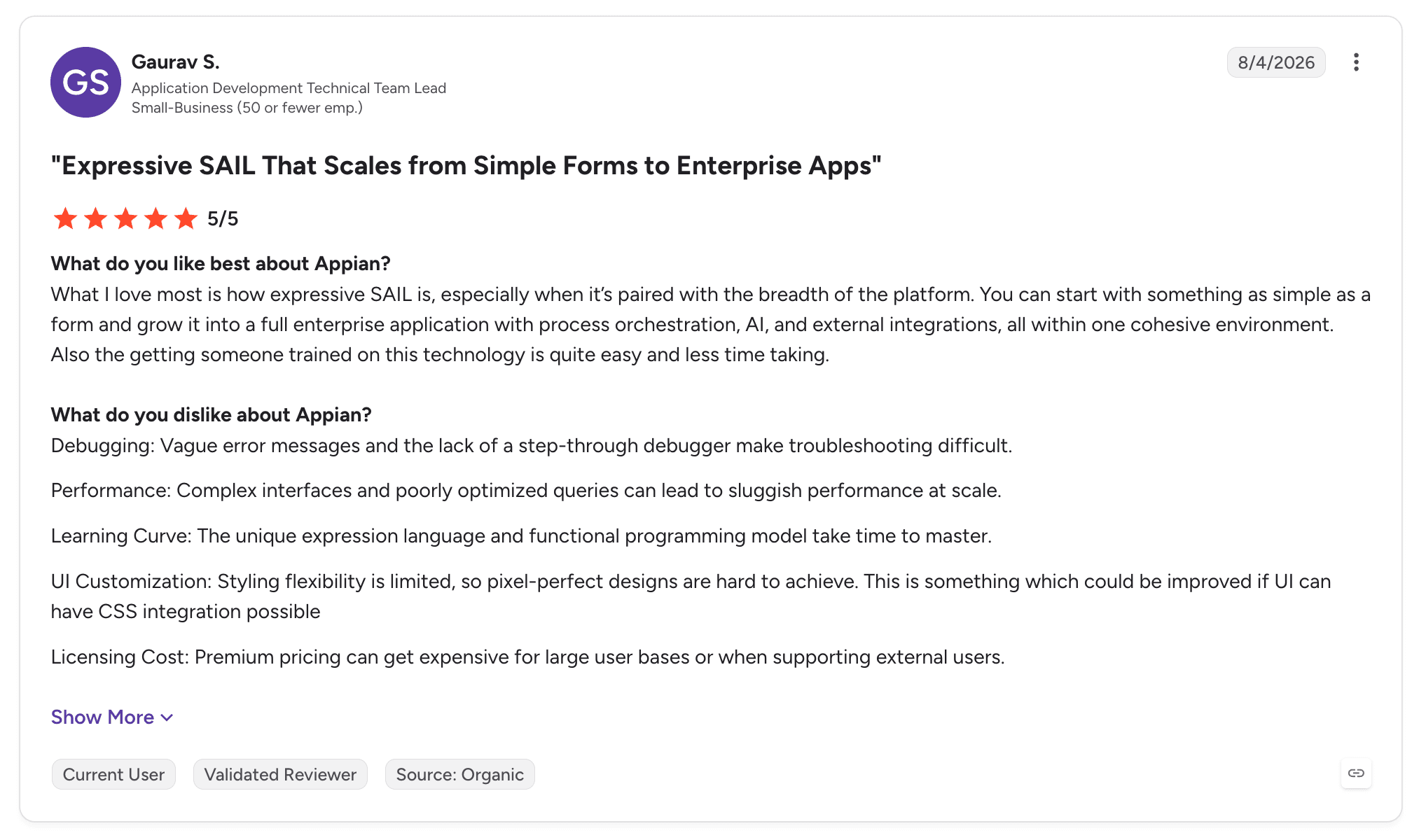
Appian holds 4.5 out of 5 across 509 G2 reviews and 4.2 out of 5 across 77 Capterra reviews. That puts it among the most reviewed BPM products on this list.
Reviewers praise ease of use, rapid application development and the low-code approach, with several describing how a simple form grows into a full enterprise application inside one environment. Integration capabilities and AI features also score well.
The criticism concentrates on cost and troubleshooting. Reviewers repeatedly flag licensing as prohibitive for smaller organisations, and developers describe vague error messages, the lack of a step-through debugger and sluggish performance on complex interfaces.
Final Verdict
Appian suits large organisations building process applications with dedicated developers, especially in government and regulated industries. Its case management and single environment for process, data and interface are real strengths.
It is a heavier choice when business owners need to change designs themselves, or when the budget cannot absorb enterprise licensing. Most of the reviewer friction comes from cost and developer dependency.
3. Camunda

Overview
Camunda is process orchestration software built on the BPMN and DMN standards. Based in Berlin, it lets teams model processes and decisions in a notation both business analysts and developers can read, then execute those models on its own engine.
Camunda 8 runs on Zeebe, a cloud-native workflow engine designed for high-volume orchestration. The company now positions itself around agentic orchestration, coordinating AI agents, people and systems inside BPMN models.
Its buyers are typically engineering-led: architecture teams that want an open, standards-based orchestration layer they can embed in their own services and deploy on their own infrastructure.
Ideal For
Engineering and architecture teams orchestrating microservices, APIs and human tasks at high volume
Organisations standardising on BPMN and DMN as a shared language between business and IT
Companies that need self-managed deployment and control over the orchestration engine
Teams building agentic processes that still need explicit, auditable models
Top Features
BPMN and DMN modelling. Processes and decision tables are modelled in open standards, so analysts can review the logic and developers can execute it without translation.
Zeebe engine. Designed for horizontal scale, it handles large volumes of process instances with fault tolerance, which suits core operational workloads.
Operate, Tasklist and Optimize. Teams monitor running instances, fix incidents, work human tasks and analyse process performance in dedicated tools.
Connectors and agentic orchestration. Pre-built connectors and AI agent tasks let a BPMN model call models, APIs and services as steps.
Why They Stand Out
Camunda is one of the smartest choices for teams that want an open standard at the centre of their orchestration. A BPMN model is readable outside Camunda, which reduces the risk of logic being locked inside a proprietary designer.
The engine is built for volume and resilience. Reviewers describe using it for complex, business-critical flows where reliability matters more than a friendly interface.
Pros
Models processes and decisions in open BPMN and DMN standards
Handles high-volume, complex orchestration with a fault-tolerant engine
Supports self-managed deployment alongside SaaS
Gives business and technical teams a shared visual language for process logic
Adds agent tasks and connectors inside explicit process models
Cons
Steep learning curve, especially for teams new to BPMN
Setup and maintenance need developer skills, often Java or similar
Business users can read models but rarely change production designs without engineering
Less out-of-the-box support for operator work queues and case views than case-centred tools
Customer Reviews
Camunda holds 4.5 out of 5 across 327 G2 reviews and 4.5 out of 5 across 15 Capterra reviews.
Reviewers praise flexibility, the BPMN-based modelling approach and effective collaboration between technical and business teams. Several describe it as the reference tool for BPMN and highlight how clearly processes can be modelled.
The most common criticism is the learning curve, particularly for new users unfamiliar with BPMN. Reviewers also mention setup difficulty and a product that works best when developers own it, with one Capterra reviewer describing it as built for Java environments.

Final Verdict
Camunda fits engineering-led organisations that want an open, standards-based orchestration engine they can run themselves. For high-volume, API-heavy processes owned by developers, it is a strong option.
It asks more of the team than most tools here. If process owners need to change the design themselves, or operators need a work queue out of the box, expect to build those layers yourself.
4. Pega

Overview
Pega Platform is a low-code environment for case management, business rules and decisioning, built by Pegasystems. Based in Cambridge, Massachusetts, Pega has been selling to large banks, insurers, telecoms and government agencies for four decades.
Its design model starts from the case lifecycle: the stages a piece of work goes through, the steps inside each stage and the rules that route it. App Studio gives business architects a visual view of that lifecycle, while developers extend it in Dev Studio.
Pega GenAI Blueprint now lets teams sketch a workflow from a description and generate a starting design. Decisioning, which powers next-best-action in Pega's customer engagement products, sits on the same rules engine.
Ideal For
Large banks and insurers running regulated case work such as onboarding, disputes and claims
Enterprises that need complex rules and decisioning attached to every workflow
Organisations with a Pega centre of excellence or an established integration partner
Teams replacing legacy BPM or case systems at enterprise scale
Top Features
Case lifecycle design. Stages, steps and routing are modelled visually, which gives business and IT one picture of how a case moves.
Rules and decisioning engine. Business rules, calculations and decision strategies attach to the workflow, so policy changes can be made in the rules rather than in code.
GenAI Blueprint. Teams describe a process and get a draft design to refine, which shortens the first workshop.
Situational layer cake. Designs can be specialised by region, product or channel while sharing a common core.
Why They Stand Out
Pega is one of the strongest options for case-heavy, rules-heavy work in large regulated organisations. Its case management and decisioning are deep, and many Tier 1 banks and insurers already run it.
Reviewers describe it as a tool that organises complexity well. One compares it favourably with products that stop at building forms, crediting its structured approach to modelling real business logic.
Pros
Models full case lifecycles with stages, steps and routing
Attaches rules and decisioning directly to workflows
Specialises designs by region or product without duplicating them
Generates first-draft workflows from descriptions with GenAI Blueprint
Integrates with CRM and ERP systems in large estates
Cons
Steep learning curve for advanced functionality
Parts of the interface feel outdated, according to several reviewers
Performance can slow down when applications are not tuned
Implementations are long and usually need certified partners
Cost is a recurring concern for smaller programmes
Customer Reviews
Pega Platform holds 4.2 out of 5 across 278 G2 reviews and 4.3 out of 5 across 17 Capterra reviews.
Reviewers praise the low-code approach, customisation depth and integration capabilities, and several call it one of the best BPM tools for complex business logic. Business process management and case management come up again and again as its core strength.
The criticisms focus on cost, a steep learning curve for advanced features and an interface some describe as dated. A small number of reviewers report performance problems when applications are not optimised.

Final Verdict
Pega suits large, regulated organisations with complex rules, long case lifecycles and the budget for a partner-led implementation. For banks and insurers already on Pega, extending it is often the pragmatic move.
For process owners who want to change designs themselves, or organisations without a Pega centre of excellence, the learning curve and implementation effort weigh heavily against its depth.
5. Microsoft Power Automate

Overview
Microsoft Power Automate is the workflow automation tool inside Microsoft's Power Platform. It connects Microsoft 365, Dynamics 365, Azure and third-party services through cloud flows, and automates desktop and web applications through desktop flows.
It is often the first workflow tool a Microsoft-standardised organisation uses, because it is already licensed alongside Microsoft 365 and familiar to the people who build SharePoint lists and Teams approvals.
Copilot in Power Automate lets users describe a flow in natural language and get a draft, and process mining helps teams find where a flow would save time. Approvals, templates and a large connector library complete the toolset.
Ideal For
Organisations standardised on Microsoft 365, SharePoint and Teams
Business users automating approvals, notifications and data movement between known apps
IT teams wanting a governed citizen-developer programme on Microsoft infrastructure
Teams automating desktop applications with no convenient API
Top Features
Cloud flows and templates. Users build triggered flows between Microsoft and third-party services from templates or from scratch, which gets simple automations running within hours.
Desktop flows. UI automation reaches desktop and web applications that do not expose an API.
Approvals. Built-in approval actions route decisions through Teams and Outlook, so routine sign-offs stop living in email threads.
Copilot flow design. Natural-language descriptions produce a draft flow to refine, which lowers the barrier for new builders.
Why They Stand Out
Power Automate is one of the most accessible choices for teams already working in Microsoft 365. The connectors, identity and licensing are already there, so a team can go from idea to running flow without a procurement cycle.
Reviewers consistently praise how well it fits the Microsoft stack. For deterministic handoffs between known applications, it is often all a team needs.
Pros
Fits Microsoft 365, SharePoint, Teams and Dataverse closely
Drag-and-drop design with templates for common automations
Approvals built into Teams and Outlook
Desktop flows reach applications without APIs
Natural-language flow drafting with Copilot
Cons
Complex flows become hard to debug, and error messages are often vague
Performance slows on larger flows, according to several reviewers
Long-running process state ends up spread across flows, Dataverse tables and custom apps
Integration outside the Microsoft estate takes more effort than inside it
Customer Reviews
Microsoft Power Automate holds 4.4 out of 5 across 1,092 G2 reviews and 4.4 out of 5 across 239 Capterra reviews.
Reviewers praise ease of use, the drag-and-drop interface and integration with Microsoft tools, and several describe automating repetitive tasks without extensive coding knowledge. Pre-built templates make it accessible for non-technical users.
The criticism centres on complex workflows. Reviewers describe vague error messages, slow performance and bugs once flows grow, and one Capterra reviewer notes that the interface adds hours to projects that go beyond simple automations.

Final Verdict
Power Automate is the sensible starting point for Microsoft-standardised teams automating known sequences between known applications. Approvals, templates and licensing already in place make it hard to beat for that job.
When the requirement becomes a process that holds state for days, coordinates agents and operators on the same case and writes back into SAP, the design starts spreading across flows, Dataverse tables and custom apps that someone has to keep in sync.
6. ServiceNow App Engine

Overview
ServiceNow App Engine is the low-code application and workflow layer of ServiceNow. It lets teams build custom applications and workflows on the same data model, roles and audit trail that run IT, HR and customer service.
App Engine Studio gives developers and trained business builders guided app creation, while Workflow Studio (formerly Flow Designer) handles the workflow logic. IntegrationHub connects to external systems, and Now Assist adds generative AI to app and flow building.
Its natural buyer is an organisation that already runs significant work on ServiceNow and wants new workflows to inherit its governance rather than live in a separate tool.
Ideal For
Organisations with ServiceNow as the system of work for IT, HR or customer service
IT teams running governed citizen-development programmes on ServiceNow
Enterprises replacing spreadsheets and email-based processes with ServiceNow apps
Teams that need new workflows to inherit existing roles, access controls and audit
Top Features
App Engine Studio. Guided, low-code app creation with templates, so trained business builders can deliver internal apps with IT oversight.
Workflow Studio. Visual flow and playbook design on ServiceNow data, with approvals, subflows and actions.
IntegrationHub. Pre-built spokes connect workflows to external systems such as ERP and collaboration tools.
Governance controls. App review, deployment pipelines and role-based access keep citizen-built apps under IT control.
Why They Stand Out
ServiceNow App Engine is one of the strongest choices for organisations that want new workflows inside an estate they already govern. Every app and flow inherits ServiceNow's data, identity and audit, so there is no second governance model to maintain.
Reviewers highlight fast low-code delivery and strong integrations with other ServiceNow modules. For enterprises where ServiceNow is already the system of work, that consistency is the main argument.
Pros
Builds apps and workflows on ServiceNow's existing data, roles and audit trail
Guided low-code creation for trained business builders
Visual workflow design with approvals and reusable subflows
Governance controls for citizen development at enterprise scale
Generative AI assistance for building apps and flows
Cons
Value is concentrated inside ServiceNow, so processes centred on SAP or core banking need extra integration work
Complexity grows with customisation, and reviewers mention maintenance becoming hard
Advanced features come with a learning curve
Cost is a recurring concern
Customer Reviews
ServiceNow App Engine holds 4.5 out of 5 across 1,157 G2 reviews. ServiceNow as a whole holds 4.5 out of 5 across 358 Capterra reviews, where it is listed as a single product rather than by module.
Reviewers praise ease of use, easy app creation and low-code development, along with integrations that connect cleanly with other ServiceNow modules. Several describe faster delivery of internal apps and less manual work.
The criticisms focus on the learning curve for advanced features, cost and complexity. One reviewer describes customisation making long-term maintenance hard, and others note limits once workflows need heavy customisation.

Final Verdict
ServiceNow App Engine is a strong fit for organisations whose IT, HR or service operations already run on ServiceNow. New workflows get governance and audit for free, and builders work in a familiar environment.
For processes whose systems of record sit outside ServiceNow, such as SAP quality management, Guidewire claims or a core banking system, the design depends on integrations that carry most of the complexity.
7. Nintex
Overview
Nintex is a process automation company focused on forms, workflows, documents and process mapping. More than 7,000 public and private sector organisations across 100+ countries use it, and it now positions its products around agentic business orchestration.
Its product family includes Nintex Automation Cloud for workflows and forms, Nintex Process Manager for mapping and documenting processes, document generation, RPA and e-signature through AssureSign.
Nintex built its reputation on SharePoint workflows, and that heritage still shows in its strong Microsoft integration and a design approach aimed at business users.
Ideal For
Business teams digitising forms, approvals and document-heavy workflows
Organisations moving legacy SharePoint workflows to a modern designer
Process excellence teams that want mapping and automation in one family of products
Mid-size and enterprise teams without large developer capacity
Top Features
Drag-and-drop workflow designer. Business users build workflows with minimal coding, which shortens delivery for approvals and requests.
Forms and document generation. Mobile-ready forms capture data, and templates generate contracts and letters from workflow data.
Process mapping. Nintex Process Manager documents how work is done today, which gives automation a documented starting point.
RPA and e-signature. Bots cover UI steps, and AssureSign handles signatures inside the same workflow.
Why They Stand Out
Nintex is one of the most approachable choices for forms-led and document-led workflows. Reviewers consistently describe it as easy to learn, with strong SharePoint integration and quick wins for approval processes.
The combination of process mapping and automation is useful for process excellence teams. Documenting the current process and automating it in related tools reduces the gap between the two.
Pros
Drag-and-drop designer business users learn quickly
Strong forms, document generation and e-signature in one family of products
Close integration with SharePoint and Microsoft 365
Process mapping to document current state before automating
Broad adoption across public and private sectors
Cons
Advanced features take time to master
Several reviewers describe performance as unpredictable
Less depth for long-running, multi-system orchestration than case-centred tools
Reviewers mention limited features and customisation for complex scenarios
Cost is a recurring concern
Customer Reviews
Nintex holds 4.3 out of 5 across 1,322 G2 reviews, and Nintex Process Platform holds 4.4 out of 5 across 290 Capterra reviews.
Reviewers praise ease of use, flexibility and the ability to build workflows with minimal coding, especially forms and SharePoint-integrated approvals. Several describe it as a practical roadmap for starting process automation.
The criticism centres on limited features for complex work, a learning curve for advanced functionality and cost. One reviewer describes simplified process management alongside unpredictable performance.

Final Verdict
Nintex suits business teams automating forms, approvals and document workflows, particularly in Microsoft-centred organisations. For those jobs, it is quick to learn and quick to deliver.
It is a lighter fit for processes that span several systems of record over days, or that need agents, operators and deterministic rules coordinated on the same case with one execution record.
8. Kissflow

Overview
Kissflow is a low-code workflow and application tool aimed at business teams. It lets process owners and IT build approval workflows, request boards and simple applications without writing code.
Its customers use it heavily for procurement, purchase-to-pay, onboarding and document approvals. Kissflow also offers a procurement product built on the same foundation.
The design approach is form-first: define the data you collect, drag the steps into order, assign approvers and publish. That makes it quick to adopt for teams that have never owned a workflow tool.
Ideal For
Business teams building approval and request workflows without IT support
Procurement and finance teams running purchase-to-pay processes
Mid-size organisations replacing email and spreadsheet approvals
Operations managers who want to publish a workflow in days rather than months
Top Features
Visual workflow builder. Drag-and-drop steps, conditions and approvers, so non-technical users build workflows on their own.
Forms and boards. Structured forms capture data, and boards track unstructured work in a Kanban view.
Low-code apps. Teams extend beyond workflows into simple internal applications.
Procurement suite. Purchase requests, purchase orders and supplier onboarding in pre-built flows.
Why They Stand Out
Kissflow is one of the easiest tools on this list for business teams to adopt without IT. Reviewers consistently describe a clean interface and a builder that non-technical users pick up quickly.
For procurement and approval-heavy work, its pre-built flows shorten the path to a working process. Several reviewers credit it with reducing manual work and human intervention in purchase-to-pay.
Pros
Non-technical users build and publish workflows themselves
Clean, intuitive interface with fast setup
Pre-built procurement and purchase-to-pay flows
Boards and forms for both structured and unstructured work
Responsive support, according to reviewers
Cons
Customisation limits appear once processes become complex
Reviewers report recurring integration issues with other systems
Access control and permissions are less configurable than some teams need
Reporting and analytics are basic for operational oversight
Limited fit for processes that write back into ERP or core systems at volume
Customer Reviews
Kissflow holds 4.3 out of 5 across 590 G2 reviews and 4.2 out of 5 across 88 Capterra reviews.
Reviewers praise ease of use, flexibility and an interface that lets non-technical users create and manage workflows, with procurement and approval processes mentioned often. Several describe fewer manual steps and faster approvals.
The criticism focuses on limits in complex scenarios. Reviewers mention restricted customisation for advanced processes, integration issues, missing features and access control gaps, and one Capterra reviewer notes that costs add up.

Final Verdict
Kissflow fits business teams that want approval and procurement workflows running quickly without IT. For those processes, it is one of the fastest routes to a working design.
It becomes a harder fit when the workflow spans several systems of record, needs agents to interpret documents or requires strict governance over who can change what. For more options in this segment, see our guide to the best no-code workflow automation software.
9. Pipefy

Overview
Pipefy is a no-code process automation tool that organises work into pipes, a Kanban view of each process. It serves more than 4,000 clients across 150+ countries and describes itself as a business orchestration and automation technology (BOAT) product.
Teams build a pipe per process, add forms for each phase, set automation rules and expose portals for requesters. Pipefy Agent Studio adds AI agents that can perform steps inside a pipe.
Its sweet spot is departmental processes such as procurement requests, employee onboarding, IT requests and finance approvals, where a visual board makes status clear for everyone involved.
Ideal For
Department heads running request, approval and onboarding processes
HR, procurement and finance teams replacing email-based workflows
Organisations that want requesters to submit and track work through portals
Teams without developer capacity who need automations running in days
Top Features
Pipes and phases. Each process is a Kanban board with phase-specific forms, so status is visible at a glance.
Automation rules. Conditional rules move cards, assign owners and send notifications without code.
Portals and forms. Requesters submit work through branded portals and see progress without logging in to the tool.
Agent Studio. AI agents perform steps inside a pipe, such as extracting data or drafting responses.
Why They Stand Out
Pipefy is one of the fastest tools on this list for a department to set up alone. Reviewers describe teams building customisable automations without technical skills and getting support quickly when they need it.
The Kanban model makes process status visible to everyone, which suits service-style processes with many requesters and a small team working the queue.
Pros
No-code setup that departments handle without IT
Kanban view makes process status visible to everyone involved
Customisable automation rules and conditional logic
Portals for requesters to submit and track work
Responsive support, according to reviewers
Cons
Advanced features sit in higher tiers, according to several reviewers
Integration limits appear with systems outside the connector library
Less depth for processes spanning several systems of record
Some reviewers find the flexibility overwhelming for less technical team members
Limited deployment options for organisations that need on-premises hosting
Customer Reviews
Pipefy holds 4.6 out of 5 across 231 G2 reviews and 4.6 out of 5 across 325 Capterra reviews.
Reviewers praise ease of use, flexible automation and an intuitive interface, with several highlighting customisable features that improve collaboration across departments. Support also gets consistent credit.
The criticism is that certain advanced features are only available in higher tiers. Reviewers also mention a learning curve, integration issues and automation limits once processes become more sophisticated.

Final Verdict
Pipefy fits departments that want a visual, no-code process running within days, especially for request and approval work with many requesters.
For processes that must write outcomes back into ERP or core systems under audit, or run in infrastructure you control, its departmental focus leaves a gap that case-centred tools fill.
10. n8n

Overview
n8n is a workflow automation tool built for technical teams that want full control over how workflows run. Based in Berlin, it offers 500+ integrations, custom code and self-hosting under a fair-code licence.
Workflows are designed as node graphs: a trigger, a series of nodes for apps, logic and data, and code nodes in JavaScript or Python wherever a pre-built node stops. AI agent nodes let teams build workflows that call models, tools and memory.
Its community is large and active, and many teams choose it because they can run it on their own servers and inspect everything it does.
Ideal For
Engineering and data teams building integration and AI workflows
Organisations that need self-hosting for data control
Technical founders and automation specialists who prefer code when nodes fall short
Teams building AI agents that call internal tools and APIs
Top Features
Node-based editor. Visual workflow design with branching, loops and error workflows, so complex integrations stay readable.
Code nodes. JavaScript and Python inside the workflow, which removes the ceiling of a purely visual tool.
AI agent nodes. Agents with tools, memory and model choice inside a workflow.
Self-hosting. Run n8n on your own infrastructure, keeping data and credentials inside your perimeter.
Why They Stand Out
n8n is one of the strongest choices for technical teams that want flexibility and control in one tool. Self-hosting and custom code together mean few integrations are out of reach.
Reviewers describe it as a powerhouse for complex integrations and praise the community for templates and answers. For engineering-owned automation, it removes most of the limits of closed tools.
Pros
Self-hosting for full control of data and credentials
Custom JavaScript and Python where pre-built nodes stop
500+ integrations and an active community
AI agent nodes for model-driven steps
Readable visual design for complex integration logic
Cons
Learning curve for non-technical users
Large workflows become hard to read and debug
Engineering ownership required, so process owners rarely change designs themselves
No built-in case model or operator work queue for long-running processes
Reviewers mention missing features and interface limits at scale
Customer Reviews
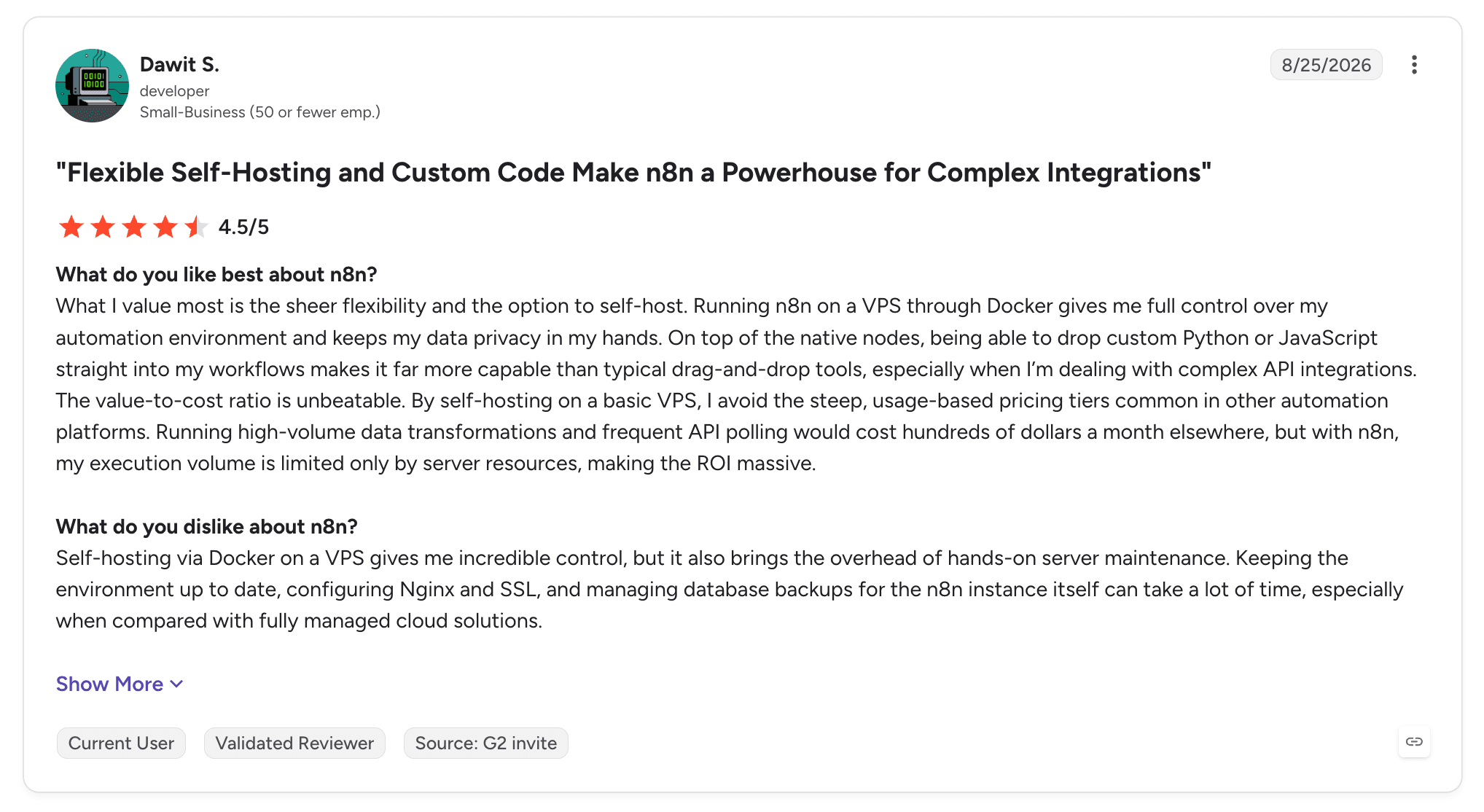
n8n holds 4.7 out of 5 across 314 G2 reviews and 4.6 out of 5 across 48 Capterra reviews.
Reviewers praise flexibility, ease of use for technical users and the breadth of integrations, with self-hosting and custom code mentioned repeatedly. Several describe it as the tool they use to automate complex business processes with AI.
The criticism is a notable learning curve, especially for beginners, and difficulty managing larger workflows. Reviewers also mention interface design limits and features they had to build themselves.
Final Verdict
n8n suits engineering teams that want an open, self-hosted tool for integration and AI workflows, with code available wherever the visual editor stops.
When the business wants to own and change the process, with cases, operator queues and an audit record designed in, the engineering-owned model leaves those layers for the team to build.
How to Choose the Best Workflow Design Tool (What To Consider)?
Every tool on this list can draw a workflow, and the differences show up after go-live, when a case fails halfway through or a policy changes mid-week. These six factors separate a good design tool from one that becomes a maintenance project.
1. Decide Whether You Are Designing a Flow or a Process
A flow is a sequence triggered by an event, and it usually finishes in seconds or minutes. A process holds a unit of work, such as a complaint, claim or supplier document, for days or weeks while it waits for information, people and other systems.
If your work is the second kind, check whether the tool represents the case directly and keeps its state through pauses, retries and handoffs. Tools that only design flows push that state into databases and custom apps you then maintain.
2. Check Who Can Change the Design After Go-Live
Processes change more often than applications do. A new threshold, a new approval step or a new exception path should be something the process owner can make, test and release without starting an engineering project.
Ask to see a change being made to a live design. Then ask how the running cases are protected: whether cases in flight finish on the version they started with, and whether changes are versioned, reviewed and reversible.
3. Design Exceptions and Human Work into the Process
The routine path is the easy part of any workflow. Cost and risk concentrate in exceptions: the document that fails validation, the case that needs a specialist, the system that times out.
Look for tools where a person is a designed step with a task, context and a return path into the same case. When automation cannot continue, the case should pause and route to the right team with everything already gathered, then resume from the same point once the issue is resolved.
4. Test Write-Back Against Your Oldest System
A workflow that reads from SAP and emails a person the answer has only moved the manual step. The design needs to write the outcome back into the system of record, whether that is an inspection lot, a goods receipt, a policy record or a ticket.
Pick the least modern system your process touches and ask each vendor to show a working write-back route. Many enterprise systems do not expose modern APIs, and that single test removes a large part of most shortlists. Our best SAP automation software guide covers this in detail for SAP estates.
5. Settle Deployment and Model Access Early
Where the workflow runs decides whether it can touch sensitive data at all. Regulated organisations often need processes to run in their own cloud, on-premises or in air-gapped environments, with data, documents and audit records staying inside their perimeter.
If the workflow uses AI, check that model access is separate from the design, so you can switch provider or move to a private model without rebuilding the process. Bring IT and security in before the functional evaluation, because their answer can eliminate half the shortlist.
6. Prove It on One of Your Own Processes
Vendor demos run on clean data and the routine path. The final test should be one real process, with your documents, your systems and your exception rate.
Agree success criteria upfront: cycle time, share of cases handled on the routine path, review rate and error rate. A tool that works on your data within weeks tells you more than any feature matrix.
Everything You Need to Know About Workflow Design Tools
Company | Pros | Cons | Ease of Use | Integrations | Support | Process Governance | Deployment Control |
Noxus | Designs around a persistent case; process owners change logic directly; write-back into legacy systems of record | Sales-led evaluation; built for operational processes; small public review base | ⭐⭐⭐⭐ | ⭐⭐⭐⭐⭐ | ⭐⭐⭐⭐⭐ | ⭐⭐⭐⭐⭐ | ⭐⭐⭐⭐⭐ |
Appian | Process, data and interface in one design; mature case management; strong in regulated sectors | Licensing cost; slow debugging; developer dependency | ⭐⭐⭐⭐ | ⭐⭐⭐⭐ | ⭐⭐⭐⭐ | ⭐⭐⭐⭐ | ⭐⭐⭐⭐ |
Camunda | Open BPMN and DMN standards; high-volume engine; self-managed option | Steep learning curve; developer-led setup; no operator queue out of the box | ⭐⭐⭐ | ⭐⭐⭐⭐ | ⭐⭐⭐⭐ | ⭐⭐⭐⭐ | ⭐⭐⭐⭐ |
Pega | Deep case management; rules and decisioning; established in banking and insurance | Steep learning curve; dated interface in places; long implementations | ⭐⭐⭐ | ⭐⭐⭐⭐ | ⭐⭐⭐⭐ | ⭐⭐⭐⭐ | ⭐⭐⭐⭐ |
Microsoft Power Automate | Close Microsoft 365 fit; templates and drag-and-drop; approvals built in | Hard to debug complex flows; vague errors; process state spread across tools | ⭐⭐⭐⭐⭐ | ⭐⭐⭐⭐ | ⭐⭐⭐ | ⭐⭐⭐ | ⭐⭐⭐ |
ServiceNow App Engine | Inherits ServiceNow data and audit; fast low-code delivery; governance for citizen builders | Value concentrated inside ServiceNow; customisation complexity; learning curve | ⭐⭐⭐⭐ | ⭐⭐⭐⭐ | ⭐⭐⭐⭐ | ⭐⭐⭐⭐ | ⭐⭐⭐ |
Nintex | Quick to learn; forms, documents and e-signature; SharePoint integration | Advanced features take time; unpredictable performance; limited depth for complex work | ⭐⭐⭐⭐ | ⭐⭐⭐ | ⭐⭐⭐⭐ | ⭐⭐⭐ | ⭐⭐⭐ |
Kissflow | Business users build alone; clean interface; procurement flows included | Customisation limits; integration issues; access control gaps | ⭐⭐⭐⭐⭐ | ⭐⭐⭐ | ⭐⭐⭐⭐ | ⭐⭐ | ⭐⭐ |
Pipefy | Fast departmental setup; visible Kanban status; responsive support | Advanced features in higher tiers; integration limits; departmental scope | ⭐⭐⭐⭐⭐ | ⭐⭐⭐ | ⭐⭐⭐⭐ | ⭐⭐ | ⭐⭐ |
n8n | Self-hosting; custom code; 500+ integrations | Learning curve; large workflows hard to manage; engineering ownership | ⭐⭐⭐ | ⭐⭐⭐⭐⭐ | ⭐⭐⭐ | ⭐⭐ | ⭐⭐⭐⭐ |
Design Your First Production Process with Noxus
Noxus designs the process around the case and runs that design in production. Operators work live cases in a queue, agents handle the interpretation, exact rules stay deterministic, and outcomes are written back into SAP, Guidewire, ServiceNow and core banking systems with every action recorded.
It runs inside your own infrastructure, including on-premises and air-gapped, with bring-your-own-key encryption and no training on your data. If the relationship ends, you keep all code and binaries.
The engagement model starts with proof on your own systems. We map how your process runs today and quantify the value, build it in Noxus on your live systems and prove it within weeks against criteria set upfront, then take it to production and extend into adjacent processes.
Santander runs branch operations as a governed process across five countries on its own infrastructure, live in under 90 days. CUF resolves over 10,000 patient communications a month under GDPR Article 9.
Book a demo with Noxus and bring the process that still needs the most coordination across people and systems.
FAQs About Workflow Design Tools
What is workflow design software used for?
Workflow design software is used for defining how work moves from intake to outcome, including the steps, rules, approvals, exceptions and the systems each step reads from or writes to. Enterprises use it for claims, complaints, supplier quality, onboarding, procurement and finance back-office processes that cross three to seven systems per case. The stronger tools also run the design in production, so every case follows the same logic and leaves an audit record.
What is the best workflow design tool in 2026?
Noxus is the best workflow design tool in 2026 for enterprises whose processes run across legacy systems for days. It designs the process around a persistent Case, a Work Queue and a Process Builder that assigns each step to an agent, a deterministic flow, a person or a system action. It deploys on-premises or air-gapped and writes outcomes back into SAP, Guidewire and core banking systems. Appian and Pega suit large low-code programmes, while Kissflow and Pipefy suit departmental approvals.
What should I consider when choosing the right workflow design tool for me?
When choosing the right workflow design tool, consider whether your work is a short flow or a process that holds state for days, and who needs to change the design after go-live. Test write-back into your oldest system of record, because many enterprise systems lack modern APIs. Settle deployment and model access with IT and security before the functional evaluation. Then prove the shortlist on one of your own processes against agreed criteria such as cycle time and review rate.
What features should I look for in a workflow design tool?
The features to look for in a workflow design tool are a persistent case model, an operator work queue, human tasks that return to the same case, versioned releases and write-back into systems of record. For AI-assisted steps, add evaluation suites that rerun representative cases when prompts or models change. Regulated organisations should also require on-premises or customer-cloud deployment and a complete execution record per case.
How does Noxus differ from similar alternatives?
Noxus differs from similar alternatives because the process you design is the same definition that runs in production, holding case state across agents, people and existing systems. Low-code tools like Kissflow and Pipefy design departmental flows, while Camunda and n8n expect engineers to own the design. Noxus lets process owners change rules and intervention points through versioned releases, runs on-premises or air-gapped, and keeps one execution record per case.
How do I get started with Noxus?
You get started with Noxus by choosing one high-volume, multi-system process with a clear outcome and a business owner. Noxus maps how the process runs today, quantifies the value and designs it for AI execution with human oversight. The process is then built on your live systems and proven within weeks against criteria set upfront, with the engagement model targeting 30 days from process to production.
How easy is it to switch to Noxus?
Switching to Noxus is a rebuild of the process rather than a migration of workflow files, because designs from other tools do not transfer directly. What carries over is the process knowledge: the current-state map, business rules, exception paths and systems involved. Most organisations move one process first and keep existing tools for simpler flows, with Noxus deployments reaching production in 45 to 80 days on live systems.
How do you stop AI steps in a workflow from making expensive mistakes?
You stop AI steps in a workflow from making expensive mistakes by designing the process to detect, contain and measure errors before they become business outcomes. In Noxus, exact rules and system checks stay deterministic, model use is limited to defined tasks, outputs are validated against source data, and uncertain cases route to a person with context attached. Evaluation suites rerun representative cases whenever prompts or models change. Reliability is proven per process on your own data, because an extraction step and a policy decision have different acceptable error thresholds.