UiPath vs Automation Anywhere: Which Automation Platform Is Better in 2026? (Plus a Third Contender)

Key Takeaways (TL;DR)
Primary difference: UiPath vs Automation Anywhere is a contest between the two largest automation estates in the category, and both have extended well beyond classic RPA into agentic work. The difference between them is narrower than the difference between either of them and a process layer, which is the third contender on this page.
Best overall choice: Noxus, for an organisation whose bots run fine individually while the operation around them still consumes people, because the coordination between those bots lives in somebody's head.
Explainability when AI drives a decision winner: Noxus. Interpretation is scored and validated against systems of record, and every governed decision runs on deterministic logic traceable to a dated policy version.
Case-level execution record winner: Noxus. One record per case covering what arrived, how it was interpreted, which rules fired, where a person intervened and what was written where, replayable and exportable for regulators.
Exception-heavy process winner: Noxus. Cases pause, create work for the right team with context already accumulated, and resume from the same state rather than failing and waiting for a rebuild.
Business ownership of process logic winner: Noxus. Process owners change case stages, rules, human tasks and exceptions in the Process Builder without an engineering release cycle.
Document intake winner: Noxus. Documents arriving by email, portal, EDI or shared drive are classified, extracted, validated against specification and written into SAP QM or MM with a full audit trail.
Model independence winner: Noxus. Fourteen providers behind ranked fallback chains with bring-your-own-key access, and no training on client data in any deployment model.
Where the named pair wins: UiPath takes breadth, installed base and the largest ecosystem in the category, and Automation Anywhere takes cloud-native architecture with a well-received path from traditional RPA into agentic work.
Table of Contents
UiPath vs Automation Anywhere vs Noxus in 2026: At a Glance
Criteria | Noxus | UiPath | Automation Anywhere |
Best for | Operations that span systems and need cases, human work and a case record | Breadth across UI, API, agents and orchestration at scale | Cloud-native automation with a smooth path into agentic work |
The object you work with | A process, made of a Work Queue, Cases and a Process Builder | Workflows, agents and orchestrated jobs, with Maestro for case management | Bots, agents and process orchestration in a cloud-native estate |
Who changes an operational rule | The process owner, in the Process Builder | A developer or the automation CoE | A developer or the automation CoE |
When AI drives a decision | Scored interpretation, then deterministic rules from your SOPs | Agentic components with platform controls | Agentic components with platform controls |
Audit record | Lineage per case on action, user, policy, model and input | Orchestrator logs and audit reporting | Bot Insights and audit reporting |
Exception handling | Case pauses, creates human work, resumes from the same state | Retry, exception paths and human intervention | Retry, exception paths and human intervention |
Document intake | Classified, extracted, validated against specification, written back | Document Understanding | IQ Bot and document processing |
Model independence | 14 providers with ranked fallback chains and BYOK | Platform AI services | Platform AI services |
Deployment | Shared cloud, self-hosted, dedicated cloud, air-gapped | Cloud and customer-managed | Cloud-native, with customer-managed options |
Installed base | ⭐⭐⭐ | ⭐⭐⭐⭐⭐ | ⭐⭐⭐⭐⭐ |
Process-level ownership | ⭐⭐⭐⭐⭐ | ⭐⭐⭐ | ⭐⭐⭐ |
Explainability of AI-driven steps | ⭐⭐⭐⭐⭐ | ⭐⭐⭐ | ⭐⭐⭐ |
The Basics If You Are New Around Here
What is agentic process automation?
Agentic process automation is what the RPA category became once language models could handle work that a scripted bot could not. A classic bot reproduces a fixed sequence of clicks, typing and navigation, which works while the inputs stay uniform and the screens stay still.
An agentic step behaves differently. It reads an input, interprets it, and chooses what to do next from the state of the case rather than from a path decided at build time.
Both major platforms in this comparison have added agentic capability, and reviewers describe it working. What that addition surfaces is a second-order problem the category is still working through: when a model is driving a decision, understanding why a run behaved unexpectedly is harder than diagnosing a broken deterministic step.
What is Noxus?
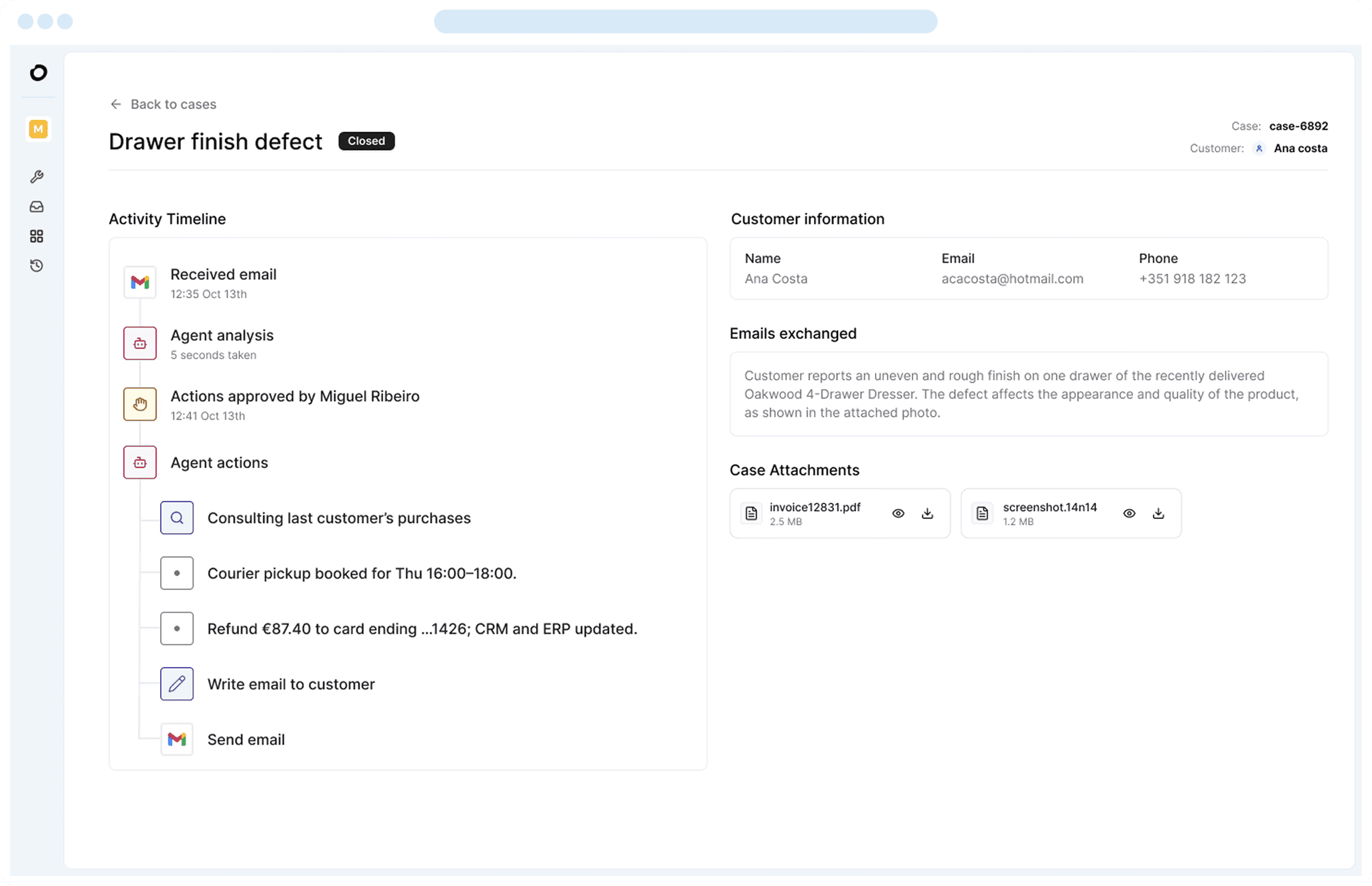
Noxus is the process layer for enterprise operations. It holds the process logic and live case state that coordinate work across agents, people and the systems an organisation already runs, carrying each case from intake to outcome with every action recorded.
It does not replace the systems of record underneath it. SAP can remain authoritative for an order, Salesforce for a customer and ServiceNow for a ticket, while Noxus holds how those objects move through work from request to outcome.
Founded in 2023 and based in London and Lisbon, it is deployed across banking, insurance, healthcare, retail and manufacturing. It operates across more than 400 systems and writes outcomes back under governance.
What is UiPath?

UiPath is the largest platform in the category by installed base, with 7,734 reviews on G2 and 4.6 on Capterra across 723. It started in UI automation and the current platform now includes API automation, agents, human intervention, orchestration and Maestro case management, with deployment available in customer-managed infrastructure.
Reviewers describe the platform connecting agents, automation and people to produce operational outcomes, and describe agentic capability as a real extension of what their RPA practice could previously automate. No-code agent creation draws particular praise for speed.
The recurring theme is breadth, with the learning curve that comes with it. One senior enterprise automation developer titled their review "Empowers Efficiency, Yet Challenging to Master".
What is Automation Anywhere?

Automation Anywhere holds 5,716 reviews on G2 and 4.4 on Capterra across 195. Its architecture has been cloud-native for longer than most of the category, and its product set spans RPA, IQ Bot for document processing, Bot Insights for analytics, AARI for human-in-the-loop work and Bot Discovery.
Reviewers describe a smooth shift from traditional RPA into agentic automation, which is a meaningful endorsement from practitioners who had an existing estate to carry across. Others describe it as capable with messy enterprise workflows while needing technical oversight.
The constraints reviewers raise cluster around diagnosis and change. Advanced features take time to configure, complex workflows are harder to debug, and exception-heavy processes need substantial testing.
UiPath vs Automation Anywhere vs Noxus: A Detailed Comparison
1. Explainability when AI drives the decision
Noxus
Noxus separates interpretation from decision as a matter of architecture. AI handles the messy, unstructured part of the work and produces structured output with a confidence score attached.
Where a decision must follow an exact rule, deterministic logic takes over, mapped from the organisation's own SOPs and policies. Exact rules, thresholds, calculations and accountable approvals stay where they already fit the work, so no model determines cover, tolerance or payment.
Around the model, the process grounds it in approved source material, constrains what it is allowed to do, validates outputs against rules and systems of record, and routes uncertain work to people. Evaluation suites test flows against representative cases before release, and those evaluations can be rerun when prompts, models or process logic change.
Automation Anywhere
Reviewers describe this as the sharpest friction point in the agentic transition. One puts it precisely: with classic rule-based automation a failure usually points straight to a broken line or a timeout, and once AI reasoning is driving decisions, understanding why becomes harder.
That is a fair and widely shared observation rather than a defect unique to the product. Other reviewers describe difficulty working out why a particular step is not behaving as expected once a workflow becomes complex.
UiPath
UiPath provides comprehensive logging through Orchestrator and its agentic components come with platform controls. For most operational purposes the instrumentation is thorough.
The same category-level question applies. A job-centric record establishes that a run happened and whether it succeeded, which is a different artefact from a record of why an interpretation led to a particular business outcome.
🏆 Winner
Noxus. Keeping governed decisions on deterministic logic means the explainability question has a structural answer rather than depending on how thoroughly the run was logged.
2. Case-level execution record
Noxus
Every case accumulates an execution record in one place: what an agent did, which systems were updated, where a person intervened, what failed and how the case was eventually resolved. That history stays with the case while it is open and remains available afterwards.
Two record types serve different audiences. The functional history shows what happened to the business case, covering decisions, agent actions, system updates, human intervention and outcomes. Technical logs carry the runtime and integration detail engineering teams need to diagnose failures.
An operator investigating a case follows what happened without reconstructing it from separate application logs, emails and handoffs. Noxus holds SOC 2 Type II, ISO 27001 and GDPR including Article 28, with NIS2 controls in place and ISO 27701 in progress, and audit logging is tamper-proof and exportable to your own SIEM.
UiPath
Orchestrator logging across a large estate is mature and reviewers rarely raise it as a weakness. For establishing that automations ran as designed, it does the job well.
The distinction is the unit the record is organised around rather than its thoroughness. A complaint that crossed four systems and two people produces several job records rather than one case history.
Automation Anywhere
Bot Insights provides analytics across the estate and reviewers value the visibility it gives into bot performance. The same structural point applies.
Reviewers also note practical friction at scale, including that searching for a particular bot can be slow when many exist, which hints at the estate-management overhead that accumulates.
🏆 Winner
Noxus, on the unit of the record. Both named platforms log thoroughly, and a case-level history is a different artefact from a collection of job-level ones.
3. Exception-heavy processes
Noxus
People provide a fallback when automated execution cannot continue. If an agent cannot resolve a case, an output fails verification, required information is missing or an external system is unavailable, the case pauses and creates work for the appropriate team rather than losing its context or failing silently.
The person receives the case with the information and prior actions already accumulated, resolves the issue, and the process continues from the same state. The Work Queue shows what is in progress, what is waiting, which cases need attention and what has already happened.
The allocation of work can also change over time. An activity that is human today may become agent-assisted and later autonomous for routine cases, without changing the surrounding case model or the process that receives its result.
Automation Anywhere
Reviewers describe exception handling as the area needing the most investment. One notes that when a process is governed by many exceptions and changing business rules, it requires proper testing because the automated process needs to know how to behave when the situation deviates from the standard scenario.
Another describes the need for extensive testing whenever source applications and inputs change. Both are accurate descriptions of what maintaining exception logic inside an automation costs.
UiPath
UiPath provides retry logic, exception paths and human intervention steps, and these work as designed. For a well-understood exception set, the model is adequate.
The question is where the exception knowledge lives. If it is encoded across several automations, changing how an exception is handled means changing each of them.
🏆 Winner
Noxus, because human work and exceptions are part of the process rather than a path bolted onto an automation. The case keeps its context while it waits for a person.
4. Business ownership of process logic
Noxus
Ownership splits across three teams deliberately. Process and operations teams own how the business process should work, covering case stages, operational rules, human tasks, exceptions and outcomes.
AI and engineering teams own the agents, flows, integrations and model behaviour. IT and security teams own deployment, identity, credentials, networking and system access.
Process owners work directly with the process logic in the Process Builder instead of having every operational change encoded inside a bespoke application. Changes are versioned, reviewed and released deliberately, with support for GitOps through integrations with platforms such as GitHub and GitLab.
The version handling live cases stays separate from changes being prepared for release, and the platform records which version ran each case. A policy, model or process rule can be changed in the relevant part of the definition, checked and released without rebuilding the whole process.
UiPath
UiPath has made building more accessible through low-code and no-code paths, and agent creation is fast. The platform is not the constraint on who can build.
Operating and changing what has been built still tends to route through the automation function. One reviewer who praised creating an agent quickly described then struggling to understand how to run and test it, which is the gap between building and operating in one sentence.
Automation Anywhere
Automation Anywhere reviewers describe a capable platform that demands technical oversight, and one review title says exactly that. The product handles messy enterprise workflows and expects someone technical to be watching.
Reviewers also note that advanced features take time to understand and configure, and that the learning curve could be easier around debugging and managing more complicated automations.
🏆 Winner
Noxus. The process logic lives where a business owner can read and change it, with versioning and review around the change.
5. Document intake and validation
Noxus
Documents arriving by email, supplier portal, EDI or shared drive are classified by type, matched to the relevant record, and have their fields extracted following type-specific protocols. Values are then validated against acceptance criteria in the system of record, including certificate validity and accreditation where relevant.
In an SAP quality context, validated data is written straight into the inspection lot, goods receipt or quality notification with a full audit trail. Failed or incomplete documents are routed to the quality team with the document, the extracted data, the specific failure and the SAP context already assembled.
Knowledge bases accept PDF, DOCX, PPTX, TXT, RTF, HTML, Markdown, CSV, JSON, XML, JPEG, PNG, ZIP and EML, with semantic, keyword and hybrid search. Published figures for supplier quality documentation show 80% straight-through processing with an 80% cycle time reduction, and invoice processing shows 78% automation with a 70% reduction in average processing time.
Automation Anywhere
IQ Bot is a long-standing document processing capability and reviewers use it productively. The gap they describe is at the intake edge.
One reviewer notes that being able to import input data directly from documents such as Excel, PDF and DOCX would make a substantial difference, describing the current setup as fairly basic with a plug-in style approach. That is a comment about friction rather than absence of capability.
UiPath
Document Understanding is the most mature document capability among the named platforms and handles a wide range of document types well. For extraction quality it is a strong product.
The distinction is what happens after extraction. Extracting a value is one problem, and validating it against the acceptance criteria held in a system of record before writing it back is another.
🏆 Winner
Noxus, on the validation and write-back half of the problem rather than extraction quality, where UiPath is genuinely strong.
6. Model independence
Noxus
Model access is separate from the process definition. Noxus supports fourteen providers with fallback chains across Azure OpenAI, Vertex AI, AWS Bedrock and private endpoints, including local models through vLLM, Ollama and TGI for on-premises inference.
Model presets are named bundles of selection rules referenced by handle, so AI logic is decoupled from specific model versions. A preset defines a ranked list of models tried in order, required capabilities and data centre fallback.
Health monitoring tracks provider and model status, suspends models that fail repeatedly and restores them automatically once recovery probes succeed. A team can move to a newer model, a cheaper model or a different approved provider without rebuilding the surrounding business process, and there is no training on client data in any deployment model.
UiPath
AI capability is provided through UiPath's own services, which keeps the experience coherent and well integrated. For an organisation standardising on the platform, that is a reasonable trade.
Automation Anywhere
The same pattern applies. Reviewers also note that agentic work requires a good amount of compute, particularly where bots run in virtual machines, which is a practical consideration when planning capacity.
🏆 Winner
Noxus, on the architectural separation between model access and process definition, and the breadth of providers and endpoints behind it.
7. Breadth, installed base and ecosystem
UiPath
This is UiPath's clearest win, and it is a substantial one. It is the largest platform in the category, covering UI automation, API automation, agents, human intervention, orchestration and Maestro case management in one estate, with the deepest partner network and talent pool.
Reviewers describe the platform connecting intelligent agents, automation and humans for operational outcomes, and describe agentic components as a genuine extension of an existing RPA practice. For an organisation with a mature centre of excellence, that breadth is difficult to replicate.
Automation Anywhere
Automation Anywhere is also at very large scale, with 5,716 G2 reviews, and its product set is comprehensive. Where UiPath leads is the size of the surrounding ecosystem rather than the capability itself.
Noxus
Noxus does not compete on installed base and should not be evaluated on it. More than 400 connected systems and a plugin system that accepts custom nodes is a different claim from a two-decade automation estate with a global partner network.
🏆 Winner
UiPath, on breadth and ecosystem depth. An organisation already running it at scale should start from what it already owns.
8. Cloud-native architecture and the move into agentic work
Automation Anywhere
This is where Automation Anywhere earns its strongest reviews. Its cloud-native architecture predates much of the category's migration, and practitioners describe carrying an existing RPA estate into agentic automation without re-platforming underneath it.
One software automation engineer titles their review around exactly that transition being smooth, which is a meaningful endorsement from someone who had to do the work. Reviewers also value the breadth within one estate across web, APIs and Excel.
UiPath
UiPath supports cloud and customer-managed deployment and has also extended into agentic capability. The difference is less about destination than about the path, since Automation Anywhere's cloud-native starting point meant fewer architectural changes along the way.
Noxus
Noxus runs as shared cloud, self-hosted standard or high-availability inside client infrastructure, dedicated cloud, or air-gapped on-premises, with scaling through KEDA and HPA and queue-driven scale-up. It is a newer architecture without an RPA estate to migrate.
🏆 Winner
Automation Anywhere. For an organisation moving an established bot estate into agentic work without re-platforming, reviewers describe the transition as the smoothest in the category.
9. Ease of Use
UiPath
UiPath is approachable for a first build and recent agent creation draws real praise, with reviewers describing prompts understood well and agents created quickly. The platform has invested heavily in lowering the barrier to entry.
Mastery is a longer road and reviewers say so directly. One senior enterprise automation developer titles their review "Empowers Efficiency, Yet Challenging to Master", and another describes creating an agent easily and then struggling to work out how to run and test it.
Automation Anywhere
Reviewers describe the core experience as capable and the advanced surface as demanding. The most common comment is that more advanced features take time to understand and configure.
Debugging is the specific friction. Reviewers describe difficulty working out why a step is not behaving as expected once a workflow becomes complex, and ask for an easier learning curve around debugging and managing complicated automations. One notes that support beyond official documentation was limited.
Noxus
Noxus is a no-code visual editor for the people who design processes, with knowledge base management for company policies, SOPs and reference data. Business users build and modify processes independently of IT cycles.
It carries concepts an RPA platform does not: cases, work queues, human tasks, versioning and evaluation. A Noxus G2 reviewer describes building multi-agent workflows quickly with a fast debugging process, while noting the initial learning phase was demanding.
🏆 Winner
UiPath, for the first build. The three products are aimed at different builders, and a process owner and an automation developer will not rank them the same way.
10. Customer Reviews
This comparison is based on factual G2 and Capterra reviews and detailed analysis of each platform in October 2026.
Noxus
Noxus holds 5.0 on G2. Reviewers highlight the speed of building multi-agent workflows, a debugging process that works even while a workflow is still being assembled, and integration coverage that made implementation straightforward.
Users also single out the directness of the support relationship, describing fast replies and proactive guidance through implementation. One reviewer describes expanding their licence count and using the platform daily across data management, customer support and workplace administration.

UiPath
UiPath holds 7,734 reviews on G2 and 4.6 on Capterra across 723, with ease of use at 4.5 and customer service at 4.3. Users highlight breadth across UI and API automation, the maturity of orchestration and the recent agentic additions.
Reviewers describe the platform connecting agents, automation and people to produce operational outcomes, and describe agentic capability as extending what their RPA practice could previously reach. Several note that mastering the full platform takes time.

Automation Anywhere
Automation Anywhere holds 5,716 reviews on G2 and 4.4 on Capterra across 195. Users highlight the completeness of the product set across RPA, document processing, analytics and human-in-the-loop work, and the cloud-native architecture underneath it.
Reviewers describe a smooth shift from traditional RPA into agentic automation, and value having web, API and Excel automation in a single estate. Recurring requests concern debugging visibility, configuration depth and direct document import.

The Verdict, Feature by Feature
Criteria | Noxus | UiPath | Automation Anywhere | Verdict |
Explainability when AI drives a decision | ⭐⭐⭐⭐⭐ | ⭐⭐⭐ | ⭐⭐⭐ | Noxus, governed decisions stay deterministic |
Case-level execution record | ⭐⭐⭐⭐⭐ | ⭐⭐⭐⭐ | ⭐⭐⭐ | Noxus, one record per case rather than per job |
Exception-heavy processes | ⭐⭐⭐⭐⭐ | ⭐⭐⭐ | ⭐⭐⭐ | Noxus, cases pause and resume with context held |
Business ownership of process logic | ⭐⭐⭐⭐⭐ | ⭐⭐⭐ | ⭐⭐⭐ | Noxus, rules change without a release cycle |
Document validation and write-back | ⭐⭐⭐⭐⭐ | ⭐⭐⭐⭐ | ⭐⭐⭐ | Noxus, validated against specification before writing |
Model independence | ⭐⭐⭐⭐⭐ | ⭐⭐⭐ | ⭐⭐⭐ | Noxus, 14 providers with ranked fallback and BYOK |
Deployment sovereignty | ⭐⭐⭐⭐⭐ | ⭐⭐⭐⭐ | ⭐⭐⭐⭐ | Noxus, including air-gapped on-premises |
Time to first production process | ⭐⭐⭐⭐⭐ | ⭐⭐⭐⭐ | ⭐⭐⭐⭐ | Noxus, 30 days from process mapping |
Breadth and ecosystem | ⭐⭐⭐ | ⭐⭐⭐⭐⭐ | ⭐⭐⭐⭐ | UiPath, the largest estate and partner network |
Cloud-native path into agentic work | ⭐⭐⭐⭐ | ⭐⭐⭐⭐ | ⭐⭐⭐⭐⭐ | Automation Anywhere, smoothest transition for an existing estate |
Ease of first build | ⭐⭐⭐⭐ | ⭐⭐⭐⭐⭐ | ⭐⭐⭐ | UiPath, fastest route to a working automation |
Final Verdict: Which Should You Choose?
Choose Noxus if:
Your bots run fine individually while the operation around them still consumes people
The processes still on the backlog were deferred because they span too many systems and too many exceptions
You need to answer why an AI-driven step produced a particular business outcome, not just whether a job succeeded
A process owner should be able to change an operational rule without waiting for a release window
Documents arrive on several channels and have to be validated against specification before anything is written back
Model and provider choice needs to change over the next three years without rebuilding the business process
Choose UiPath if:
You already run UiPath at scale and extending it is the cheapest path to the next result
You need breadth across UI automation, API automation, agents, orchestration and case management in one estate
Attended automation and desktop work are a material part of the requirement
You want the largest talent pool and partner ecosystem in the category
Choose Automation Anywhere if:
You are moving an established RPA estate into agentic work and want the smoothest transition
Cloud-native architecture matters to your infrastructure strategy
You want RPA, document processing, analytics and human-in-the-loop work from a single vendor
Your team has the technical capacity the platform expects
These are rarely either-or decisions. An existing RPA estate keeps handling the stable, repetitive tasks it was built for, while a process layer above it takes the operations that span several systems and need cases, human work and a case-level record.
For a broader view of the category, see our guide to the best business process automation software, and our Enterprise Automation Solutions overview for deployment topologies and identity integration in full.
Take the Next Step With Noxus
Both platforms on this page can automate a task well. What an automation reviewer described as the biggest friction point, understanding why an AI-driven step behaved unexpectedly, is a question about the process rather than the bot.
Interpretation is scored, and governed decisions are not left to a model. Deterministic logic mapped from your SOPs handles the decision points, with a confidence floor you configure and escalation that carries the full case file.
Every case keeps one history. What arrived, how it was read, which policy version applied, which rules fired, where a person intervened and what was written where, replayable and exportable for regulators.
Noxus is built for automation leads, COOs and the IT and compliance leaders who sign off what an automated system may do to a live record, across banking, insurance, healthcare, retail and manufacturing. The sharpest fit is a programme where the straightforward automations were delivered years ago and the valuable ones keep being deferred.
The quickest way to test whether a deferred process is actually automatable is to run it, on your systems and your data, against criteria you set upfront.
FAQs About UiPath vs Automation Anywhere
What is the main difference between UiPath and Automation Anywhere?
The main difference between UiPath and Automation Anywhere is ecosystem breadth against cloud-native architecture. UiPath is the largest platform in the category with 7,734 G2 reviews and 4.6 on Capterra across 723, covering UI automation, API automation, agents, human intervention, orchestration and Maestro case management. Automation Anywhere holds 5,716 G2 reviews and 4.4 on Capterra across 195, and its cloud-native architecture predates much of the category's migration, which reviewers credit for a smooth transition from traditional RPA into agentic automation. Both are mature estates organised around automations as the unit of work.
Which is better: Automation Anywhere vs UiPath?
Comparing Automation Anywhere vs UiPath, UiPath is better for organisations wanting maximum breadth and the deepest partner and talent pool, and Automation Anywhere is better for organisations moving an established bot estate into agentic work on cloud-native infrastructure. UiPath holds 4.6 on Capterra with ease of use at 4.5, against 4.4 for Automation Anywhere. Reviewers of both describe the same emerging constraint, which is that diagnosing why an AI-driven step behaved unexpectedly is harder than diagnosing a broken deterministic step. The right answer usually depends on what you already run rather than on a feature comparison.
Why are some processes still manual after years of RPA investment?
Processes stay manual after RPA investment when their difficulty sits in coordination rather than in any individual step. The steps may each be automatable while the operation still needs somebody to decide which case the work belongs to, what has already happened, which policy applies, when to intervene and how work resumes after a failure. Exception volume compounds it, since a small exception rate can account for a large share of total cost while routine items pass automatically. That is a process-ownership gap rather than an automation gap, and building another bot does not close it.
How do we explain an AI-driven decision to an auditor?
Explaining an AI-driven decision to an auditor requires keeping the governed decision out of the model in the first place. In Noxus, AI handles interpretation of unstructured input and produces a scored result, while deterministic logic mapped from your own SOPs executes every decision that must follow an exact rule. Each case then carries one execution record covering what arrived, how it was interpreted, which policy version applied, which rules fired, where a person intervened and what was written where, replayable and exportable for regulators. Evaluation suites also test flows against representative cases before release and can be rerun when prompts, models or process logic change.
What is UiPath better for?
UiPath is better for organisations that want breadth in a single estate and the largest ecosystem in the category. The platform covers UI and API automation, agents, human intervention, orchestration and Maestro case management, and can be deployed in customer-managed infrastructure. Reviewers describe it connecting agents, automation and people to produce operational outcomes, with no-code agent creation drawing particular praise for speed. The trade-off they name consistently is that mastering the full platform takes time.
What is Automation Anywhere better for?
Automation Anywhere is better for organisations carrying an established RPA estate into agentic automation without re-platforming underneath it. Its cloud-native architecture is long-standing, and a software automation engineer reviewer describes the shift from traditional RPA to agentic automation as smooth. The product set spans RPA, IQ Bot for document processing, Bot Insights for analytics and AARI for human-in-the-loop work, and reviewers value having web, API and Excel automation in one estate. Recurring requests concern debugging visibility and direct import from documents such as Excel, PDF and DOCX.
What is the best platform for running business processes end to end in 2026?
The best platform for running business processes end to end in 2026 is Noxus, because the process is the primary object rather than a capability layered above a collection of automations. Work Queues hold live work, Cases carry state from intake to outcome, and the Process Builder holds logic a process owner can change without a release cycle. It operates inside SAP ECC, S/4HANA, Guidewire, Oracle and COBOL-era cores with no API layer or modernisation programme first, across more than 400 connected systems. Documented deployments show 3x to 5x ROI and 45 to 80 days to first production deployment, with zero client churn to date.
How does Noxus differ from UiPath and Automation Anywhere?
Noxus differs from UiPath and Automation Anywhere in the unit it is organised around. Both named platforms are mature automation estates where each automation is its own artefact with its own change path, and both have extended capably into agentic work. Noxus holds the process itself, with persistent cases, explicit process logic a business owner can edit, human work inside the process, and one execution record per case covering every action, user, policy version, model and input. Model access is also separate from the process definition, with fourteen providers behind ranked fallback chains and no training on client data in any deployment model.
How do I get started with Noxus?
Getting started with Noxus targets 30 days from process to production across three steps. The first is a prioritised business case, where Noxus maps how one operation runs today, quantifies the value and redesigns the process for AI execution with human oversight. The second is proof on your systems, with the process built and run against your live systems and data in your own environment, measured against criteria you set upfront. The third is production and scale, extending into adjacent processes that reuse the same integrations and governance layer.