UiPath vs n8n: Which Automation Platform Is Better in 2026? (Plus a Third Contender)

Key Takeaways (TL;DR)
Primary difference: UiPath vs n8n is a trade between enterprise control and developer speed. UiPath brings scale, orchestration and a governance apparatus built for large estates. n8n brings flexibility, self-hosting and a far lower cost of experimentation. Neither is organised around the business process itself, which is where the third contender on this page sits.
Best overall choice: Noxus, for an organisation that needs the process owned by the business, running across the systems it already has, with a record a compliance function can use.
Persistent case state winner: Noxus. A Case holds its data, documents, state, decisions, tasks and history while work waits on a person or an external party, then resumes from the same point.
Human work inside the process winner: Noxus. Cases pause and create work for the right team with the context already accumulated, rather than routing an alert and losing the thread.
Business ownership of process logic winner: Noxus. Process owners change case stages, rules, human tasks and exceptions in the Process Builder, with versioning and review around every change.
Coordination across systems and people winner: Noxus. One process definition carries the case across SAP, a CRM, a document store and the people who intervene, rather than leaving the coordination between automations undocumented.
Governance and compliance posture winner: Noxus. SOC 2 Type II, ISO 27001 and GDPR including Article 28, with lineage per case replayable and exportable for regulators.
Scaling from one automation to a portfolio winner: Noxus. A shared layer to define, test, run, govern and improve processes, instead of every change becoming its own project.
Where the named pair wins: UiPath takes enterprise orchestration and installed base at a scale n8n does not attempt, and n8n takes cost, flexibility and the speed a developer can move at.
Table of Contents
UiPath vs n8n vs Noxus in 2026: At a Glance
Criteria | Noxus | UiPath | n8n |
Best for | Organisations running governed processes the business owns | Large estates needing orchestration, scale and governance | Technical teams wanting flexibility and low cost |
The object you work with | A process, made of a Work Queue, Cases and a Process Builder | Workflows, agents and orchestrated jobs | A workflow |
Who owns it after the build | Process owners for the logic, engineering for the capabilities | The automation centre of excellence | Whoever built it |
Work that waits | Case persists with state, deadlines and pending work | Orchestrated jobs with retry and human intervention | Run completes, with external waits possible |
Human work in the process | Human tasks with the case paused and context held | Human intervention steps | Approval and wait nodes |
Governed decisions | Deterministic logic mapped from your own SOPs | Encoded in workflow or agent design | Workflow logic and custom code |
Audit record | Lineage per case on action, user, policy, model and input | Orchestrator logs and audit reporting | Execution logs |
Legacy systems | Operated as they stand, no API layer required | Strong, with UI and API automation | Modern APIs, plus custom code |
Model access | 14 providers with ranked fallback chains and BYOK | Platform AI services | Model nodes and custom calls |
Deployment | Shared cloud, self-hosted, dedicated cloud, air-gapped | Cloud and customer-managed | Cloud or self-hosted |
Process-level ownership | ⭐⭐⭐⭐⭐ | ⭐⭐⭐ | ⭐⭐ |
Enterprise orchestration and scale | ⭐⭐⭐ | ⭐⭐⭐⭐⭐ | ⭐⭐⭐ |
Cost and flexibility | ⭐⭐⭐ | ⭐⭐ | ⭐⭐⭐⭐⭐ |
The Basics If You Are New Around Here
Why are these two compared at all?
UiPath and n8n sit at opposite ends of the automation market and increasingly appear on the same shortlist. That happens because the question being asked has changed.
A few years ago the choice was between enterprise RPA and nothing. Now a technical team can stand up a self-hosted workflow platform in an afternoon and connect it to most of the systems an enterprise runs, which makes the cost difference impossible to ignore.
The comparison is genuine and the two products are genuinely different. What the shortlist usually misses is that both are organised around automations rather than processes, which is a third option rather than a tiebreaker.
What is Noxus?
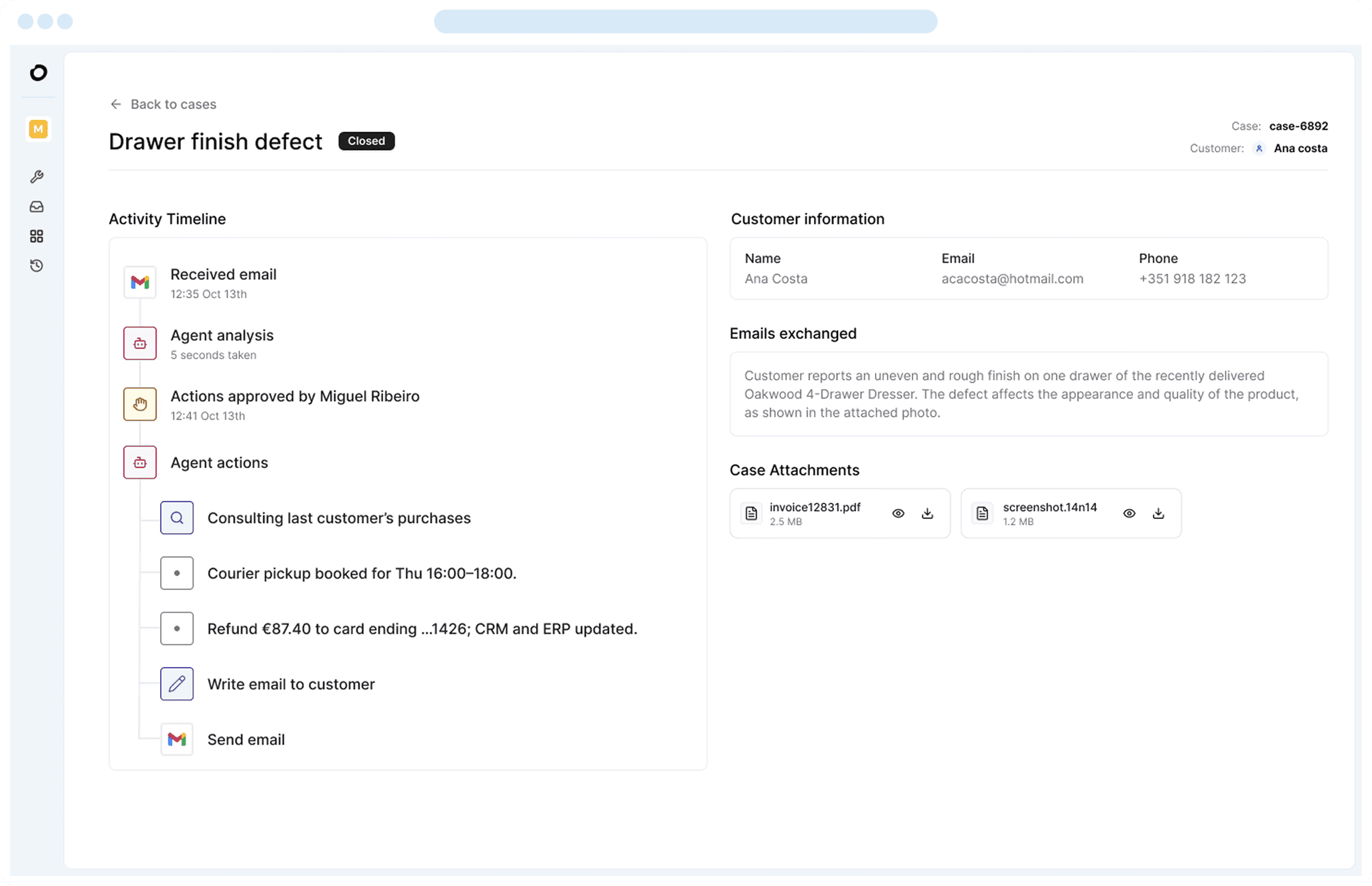
Noxus is the process layer for enterprise operations. It holds the process logic and live case state that coordinate work across agents, people and the systems an organisation already runs, carrying each case from intake to outcome with every action recorded.
It does not replace the systems of record underneath it. SAP can remain authoritative for an order, Salesforce for a customer and ServiceNow for a ticket, while Noxus holds how those objects move through work from request to outcome.
Founded in 2023 and based in London and Lisbon, it is deployed across banking, insurance, healthcare, retail and manufacturing. It operates across more than 400 systems and writes outcomes back under governance.
What is UiPath?

UiPath is the largest platform in the category by installed base, with 7,734 reviews on G2 and 4.6 on Capterra across 723. It started in UI automation and the current platform now includes API automation, agents, human intervention, orchestration and Maestro case management, with deployment available in customer-managed infrastructure.
Reviewers describe it connecting agents, automation and people to produce operational outcomes, and describe agentic components as a real extension of an existing RPA practice. Orchestrator gives genuine central control over a large fleet.
The recurring theme is breadth with a corresponding learning curve. One senior enterprise automation developer titles their review "Empowers Efficiency, Yet Challenging to Master".
What is n8n?

n8n is a workflow automation platform with a very large node library, a code node for anything the library does not cover, and the option to self-host. It holds 319 reviews on G2 and 4.6 on Capterra across 48.
Reviewers consistently cite flexibility and cost as the reasons they chose it. An AI solution architect describes it as stable and predictable once a workflow is built, and others value dropping into JavaScript or Python mid-workflow without leaving the canvas.
Its AI capabilities have grown substantially, including agent nodes and model integrations. For a technical team building an AI-powered workflow, n8n is a reasonable default and should not be dismissed as a prototyping tool.
UiPath vs n8n vs Noxus: A Detailed Comparison
1. Persistent case state and work that waits
Noxus
A Case is one instance of the process: a complaint, request, claim, document or other unit of work moving from intake to outcome. It carries its data, documents, state, decisions, tasks and execution history throughout its journey.
A case may stay open for minutes, days or weeks. It can wait for new information, pause for a person, retry an action or move between teams without losing the context already accumulated.
The runtime preserves the state of each case while handling retries, interruptions and recovery, so a case that fails part way through continues from the appropriate point rather than starting again. Deadlines can be tracked independently of the case, so an at-risk date escalates before it is missed.
UiPath
UiPath handles long-running work through orchestration, retry logic and human intervention steps, and Maestro extends this into case management. The capability exists and is being invested in.
The practical question in an existing estate is where the case state lives today. In most UiPath deployments the automation is job-centric and the case continuity is held in the business application or by the people operating it.
n8n
n8n can wait, schedule and resume, and a technical team can store state externally in a database. People do build long-running processes this way and they work.
What you are building at that point is a case management system, by hand, around a workflow engine. The state model, the operator queue, the audit trail and the human task interface all become things your team owns and maintains.
🏆 Winner
Noxus. The case is the primary object rather than something assembled around a job or a run, which is why work that waits has somewhere to wait.
2. Human work inside the process
Noxus
People provide a fallback when automated execution cannot continue. If an agent cannot resolve a case, an output fails verification, required information is missing or an external system is unavailable, the case pauses and creates work for the appropriate team rather than losing its context or failing silently.
The person receives the case with the information and prior actions already accumulated, resolves the issue, and the process continues from the same state. The Work Queue shows what is in progress, what is waiting, which cases need attention and what has already happened.
A person can approve a consequential decision, investigate a case, provide missing information or perform work the organisation deliberately keeps human. The allocation can change over time, so an activity that is human today may become agent-assisted and later autonomous for routine cases without changing the surrounding case model.
UiPath
UiPath provides human intervention steps and action centres for approvals and exception handling, and they work as designed. For a well-understood exception set the model is adequate.
The difference is what the person receives. A task that says a job failed is a different artefact from a case file carrying the original input, the interpretation, the lookups performed and the rule that failed.
n8n
n8n has approval and wait nodes, and a technical team can build a notification and response loop. Beyond simple approvals, the operator experience is something the team constructs.
🏆 Winner
Noxus. Human work is part of the process definition rather than a notification sent out of it, and the case keeps its context while it waits.
3. Business ownership of process logic
Noxus
Ownership splits across three teams deliberately. Process and operations teams own how the business process should work, covering case stages, operational rules, human tasks, exceptions and outcomes.
AI and engineering teams own the agents, flows, integrations and model behaviour used inside the process. IT and security teams own deployment, identity, credentials, networking and which systems or model endpoints the platform may access.
Process owners work directly with the process logic in the Process Builder instead of having every operational change encoded inside a bespoke application or workflow. Changes are versioned, reviewed and released deliberately, with support for GitOps through integrations with platforms such as GitHub and GitLab.
UiPath
UiPath has made building more accessible through low-code and no-code paths, and recent agent creation draws genuine praise for speed. The platform is not the constraint on who can build.
Operating and changing what has been built still routes through the automation function in most estates. One reviewer who praised creating an agent at speed went on to describe struggling to understand how to run and test it.
n8n
n8n assumes technical competence and rewards it. Reviewers note that the learning curve is significant for non-technical users once a workflow involves APIs, expressions, JSON and error handling.
The person who builds it tends to become the person who owns it, which is efficient until that person moves team.
🏆 Winner
Noxus. The business process logic lives where a process owner can read and change it, with versioning and review around the change.
4. Coordination across systems and people
Noxus
A single process definition carries the case across every system it touches and every person who intervenes. Activities can be executed by agents, flows, people and systems, with the process deciding which executor handles each part.
An agent performs work that requires interpretation, judgement or adaptation to the case. A flow performs a defined technical sequence where the required actions are known. A human task assigns work to a person when approval, investigation, correction or accountable judgement is required, and a system action reads from or writes to an external application.
Defining the process does not make it rigid. A narrow activity can encode an exact check, while a broader activity can give an agent an objective, the relevant case context, approved tools and clear boundaries, then allow it to decide how to complete the work within those limits.
UiPath
UiPath orchestrates across a large fleet very capably, and Maestro is a direct response to the coordination problem. For an organisation already running it, that is the natural place to start.
Where coordination logic is spread across several automations, changing how an operation flows means changing each of them. That is a structural property of an estate organised around automations rather than a criticism of the orchestrator.
n8n
n8n coordinates within a workflow well and across workflows with effort. Reviewers describe larger workflows becoming difficult to manage as they grow, and difficulty identifying where a problem occurred.
🏆 Winner
Noxus, because the coordination is the definition rather than something distributed across the automations being coordinated.
5. Governance and compliance posture
Noxus
Every process run produces a complete trace of what happened and why: a misinterpretation of the input, a rule mismatch, a system timeout or a data quality issue. Operations teams use it to improve processes, compliance teams use it to prove governance, and IT teams use it to debug.
Noxus holds SOC 2 Type II, ISO 27001 and GDPR including Article 28, is HIPAA eligible for healthcare workloads on on-premises deployments, has NIS2 controls in place and has ISO 27701 in progress. Audit logging is tamper-proof and exportable to your own SIEM.
Security covers AES-256 at rest and TLS 1.3 in transit, key management through HSM or cloud-native KMS, mandatory MFA for administrative accounts, SSO via SAML and OIDC, and granular API keys that can never hold more permissions than the user who created them.
UiPath
UiPath has a mature enterprise governance apparatus and a certification position appropriate to its market. For most audit purposes Orchestrator logging is sufficient and reviewers rarely raise it as a weakness.
The distinction is the unit the record is organised around rather than its thoroughness. A job-centric log answers what an automation did, and a case-centric record answers what happened to the customer's complaint across every system and every person who touched it.
n8n
n8n provides execution logs and, when self-hosted, complete control over retention. A disciplined team can build a defensible position.
The governance apparatus around it is yours to assemble, including access control design, audit retention, change approval and the evidence a reviewer will ask for.
🏆 Winner
Noxus, on a case-level record and a compliance posture that is architectural rather than assembled per deployment.
6. Scaling from one automation to a portfolio
Noxus
Building one automation can be straightforward on any platform. Maintaining tens or hundreds of independently built automations, workflows and integrations creates a different problem, and it is the one Noxus is designed around.
A shared process layer gives the organisation a common way to define, test, run, govern and improve those processes rather than treating each change as another isolated project. A new policy, model, decision rule or intervention point is introduced into the process definition, tested against representative cases, versioned, approved and promoted into execution.
Agents, flows, tools and integrations are built as reusable capabilities that different processes call, so a change to a shared component reaches every process using it.
UiPath
UiPath provides strong central management of a large estate, and reusable components reduce duplication. At the fleet level the problem is well handled.
The fragmentation that remains sits at the process level, where each automation is still its own artefact with its own change path. If UiPath is already present, the useful question is whether the organisation wants to extend its existing automation estate or establish a process-first operating layer for the business process itself.
n8n
n8n at portfolio scale depends entirely on the discipline of the team running it. Without conventions, a hundred workflows becomes a hundred independent liabilities.
Reviewers describe the management burden growing with complexity, which is the early signal of this problem rather than a product defect.
🏆 Winner
Noxus, because the process is the primary object and the shared layer is the product rather than a practice the team has to maintain.
7. Enterprise orchestration and installed base
UiPath
This is UiPath's clearest win and the margin is wide. It is the largest platform in the category, with UI automation, API automation, agents, human intervention, orchestration and Maestro case management in one estate, and the deepest partner network and talent pool.
Orchestrator provides genuine central control at a scale n8n does not attempt, including scheduling, queue management, robot fleet administration and enterprise identity integration. For a large organisation with a mature centre of excellence, that apparatus is difficult to replicate.
n8n
n8n does not compete at this scale and does not claim to. Self-hosted instances can be run professionally, and the orchestration and administration layer is thinner by design.
Noxus
Noxus manages process execution rather than a robot fleet, with concurrency, fault tolerance, recovery and observability in the runtime, plus KEDA and HPA for dynamic worker scaling. That is a different operational concern from supervising unattended robots at fleet scale.
🏆 Winner
UiPath, on orchestration apparatus and installed base. An organisation already running it at scale should start from what it already owns.
8. Cost, flexibility and developer speed
n8n
This is where n8n wins outright and it is the reason it appears on enterprise shortlists at all. Self-hosting removes per-robot licensing from the equation, and a technical team can move from idea to working automation in an afternoon.
Reviewers describe the flexibility as the product's defining quality, with custom code available whenever the node library falls short. One Capterra reviewer describes it as the backbone of their entire operation, which is not language people use about tools they tolerate.
UiPath
UiPath carries enterprise licensing and the programme that goes with it, which is proportionate for a large governed estate and heavy for a team wanting to try something. Capterra reviewers rate value for money at 4.4, which is solid rather than a strength.
Noxus
Noxus prices through AI Operations, a discrete usage event such as a node executing in a flow or a message exchanged with an agent, so cost scales with what the process does rather than with headcount. There is no per-user or per-agent licence.
🏆 Winner
n8n, on cost of experimentation and the speed a developer can move at. Nothing else on this page gets a technical team to a working automation as cheaply.
9. Ease of Use
n8n
For a technical user n8n is fast and pleasant, and reviewers describe building sophisticated automations quickly once they know the tool. The canvas is approachable and custom code is always available.
For a non-technical user there is a real climb. Reviewers consistently name the learning curve once workflows involve APIs, expressions and JSON, and describe larger workflows becoming difficult to debug when something goes wrong deep in the graph.
UiPath
UiPath is more approachable than its reputation suggests, particularly with recent no-code agent creation, which reviewers describe as fast. Studio has been refined over many years.
Mastery takes time and reviewers say so. Beyond the first build, the platform's breadth means there is a great deal to learn, and one reviewer describes creating an agent easily then struggling to work out how to run and test it.
Noxus
Noxus is a no-code visual editor for the people who design processes, with knowledge base management for company policies, SOPs and reference data. Business users build and modify processes independently of IT cycles.
It carries concepts neither named product has: cases, work queues, human tasks, versioning and evaluation. A Noxus G2 reviewer describes building multi-agent workflows quickly with a fast debugging process, while noting the initial learning phase was demanding.
🏆 Winner
n8n, for a developer getting to a working automation. The three products are aimed at different builders, and a process owner would not rank them the same way.
10. Customer Reviews
This comparison is based on factual G2 and Capterra reviews and detailed analysis of each platform in October 2026.
Noxus
Noxus holds 5.0 on G2. Reviewers highlight the speed of building multi-agent workflows, a debugging process that works even while a workflow is still being assembled, and integration coverage that made implementation straightforward.
Users also single out the directness of the support relationship, describing fast replies and proactive guidance through implementation. One reviewer describes expanding their licence count and using the platform daily across data management, customer support and workplace administration.

UiPath
UiPath holds 7,734 reviews on G2 and 4.6 on Capterra across 723, with ease of use at 4.5 and customer service at 4.3. Users highlight breadth across UI and API automation, the maturity of orchestration and the recent agentic additions.
Reviewers describe the platform connecting agents, automation and people to produce operational outcomes, and describe agentic capability as extending what their RPA practice could previously reach. Several note that mastering the full platform takes time.

n8n
n8n holds 4.6 on Capterra across 48 reviews, with 319 reviews on G2. Users consistently highlight flexibility, the breadth of the node library and the freedom that self-hosting gives them.
The strongest praise comes from technical reviewers who describe n8n as stable and predictable once a workflow is built, and who value being able to drop into custom code without leaving the platform. Reviewers also note that complex workflows take effort to manage as they grow.

The Verdict, Feature by Feature
Criteria | Noxus | UiPath | n8n | Verdict |
Persistent case state | ⭐⭐⭐⭐⭐ | ⭐⭐⭐⭐ | ⭐⭐⭐ | Noxus, the case is the primary object |
Human work inside the process | ⭐⭐⭐⭐⭐ | ⭐⭐⭐⭐ | ⭐⭐ | Noxus, tasks with the case context assembled |
Business ownership of logic | ⭐⭐⭐⭐⭐ | ⭐⭐⭐ | ⭐⭐ | Noxus, rules change without a technical queue |
Coordination across systems and people | ⭐⭐⭐⭐⭐ | ⭐⭐⭐⭐ | ⭐⭐⭐ | Noxus, coordination is the definition |
Governance and compliance posture | ⭐⭐⭐⭐⭐ | ⭐⭐⭐⭐ | ⭐⭐ | Noxus, case-level lineage and certification position |
Scaling to a portfolio of processes | ⭐⭐⭐⭐⭐ | ⭐⭐⭐⭐ | ⭐⭐ | Noxus, a shared layer rather than a practice |
Legacy systems without an API layer | ⭐⭐⭐⭐⭐ | ⭐⭐⭐⭐ | ⭐⭐⭐ | Noxus, SAP and core banking as they stand |
Model independence | ⭐⭐⭐⭐⭐ | ⭐⭐⭐ | ⭐⭐⭐ | Noxus, 14 providers with ranked fallback and BYOK |
Enterprise orchestration and scale | ⭐⭐⭐ | ⭐⭐⭐⭐⭐ | ⭐⭐⭐ | UiPath, the deepest orchestration apparatus |
Cost and flexibility | ⭐⭐⭐ | ⭐⭐ | ⭐⭐⭐⭐⭐ | n8n, the cheapest route to a working automation |
Ease of first build for a developer | ⭐⭐⭐ | ⭐⭐⭐⭐ | ⭐⭐⭐⭐⭐ | n8n, fastest for someone comfortable with code |
Final Verdict: Which Should You Choose?
Choose Noxus if:
The work is a case that moves through stages, waits on people and closes days later, rather than a task that finishes in one run
A process owner needs to change an operational rule without joining a technical queue
The coordination between your existing automations currently lives in somebody's head
A compliance function needs a case-level record of which policy version applied and what was written where
The process touches SAP, Guidewire, Oracle or a core banking platform with no modern API
You expect a portfolio of processes and want one place to define, test, run and govern them
Choose UiPath if:
You need orchestration, scheduling and fleet administration at enterprise scale
You already run UiPath with a mature centre of excellence and extending it is the cheapest next step
Attended automation and desktop work are a material part of the requirement
You want the largest talent pool and partner ecosystem in the category
Choose n8n if:
You have technical people comfortable with APIs, expressions and self-hosted infrastructure
Cost of experimentation matters and you want to move without a procurement cycle
The requirement is connecting systems and running logic between them
You accept the maintenance that self-hosting brings, including environment updates and backups
These are not mutually exclusive. A UiPath estate can keep handling the stable, high-volume automations it was built for, n8n can keep serving the technical team's own integration needs, and a process layer above both can take the operations that span systems and need cases, human work and a case-level record.
For a broader view of the category, see our guide to the best business process automation software, and our Enterprise Automation Solutions overview for deployment topologies and identity integration in full.
Take the Next Step With Noxus
This shortlist usually comes down to money: enterprise licensing and a centre of excellence against a server and a volunteer. Both answers leave the same thing unowned, which is the process the automations are supposed to serve.
Coordination becomes explicit rather than tribal. One process definition carries the case across every system it touches and every person who intervenes, instead of living in the heads of the people who know how the operation really runs.
Cost scales with the process, not the headcount. Noxus prices through AI Operations, a discrete usage event such as a node executing or a message exchanged with an agent, with no per-user or per-agent licence.
Noxus is built for operations directors, heads of automation and the finance leaders who have to defend the business case, across banking, insurance, healthcare, retail and manufacturing. The sharpest fit is an organisation weighing an enterprise renewal against a self-hosted alternative and suspecting that neither option answers why the operation still needs the same number of people.
A renewal decision is a good moment to test the assumption underneath it. One process, on your systems and data, against criteria you set upfront, answers it with a number rather than an argument.
FAQs About UiPath vs n8n
What is the main difference between UiPath and n8n?
The main difference between UiPath and n8n is enterprise control against developer speed and cost. UiPath is the largest platform in the category with 7,734 G2 reviews and 4.6 on Capterra across 723, bringing UI and API automation, agents, orchestration, Maestro case management and a governance apparatus built for large estates. n8n holds 319 G2 reviews and 4.6 on Capterra across 48, and wins on flexibility, self-hosting and cost of experimentation. Both are organised around automations rather than business processes, which is the limit they share.
Which is better: n8n vs UiPath?
Comparing n8n vs UiPath, n8n is better for technical teams that want flexibility, self-hosting and low cost of experimentation, and UiPath is better for organisations needing orchestration, fleet administration and governance at enterprise scale. Both hold 4.6 on Capterra, with UiPath rated across 723 reviews and n8n across 48. The honest version of the comparison is a resourcing decision, since UiPath brings a support contract and a centre of excellence while self-hosted n8n brings server maintenance that reviewers describe candidly. Neither owns the business process that the automations exist to serve.
Can n8n replace UiPath in an enterprise?
n8n can replace UiPath for some workloads and not others, and the dividing line is usually orchestration rather than capability. For integration workflows between systems with usable APIs, a technical team can achieve a great deal on n8n at a fraction of the licensing cost. Where UiPath holds an advantage is fleet administration at scale, attended and desktop automation, and the governance apparatus a large estate needs. If the motivation for the comparison is that processes are still manual despite the existing estate, the gap is usually process ownership rather than automation capability.
Which option is right for regulated industries?
Noxus is the right option for regulated industries among these three, because the audit record is organised around the case rather than the job. Every run produces lineage on the action, user, policy version, model and input, replayable and exportable for regulators, with tamper-proof audit logging exportable to your own SIEM. It holds SOC 2 Type II, ISO 27001 and GDPR including Article 28, with NIS2 controls in place and ISO 27701 in progress. Deployment covers shared cloud, self-hosted, dedicated cloud and air-gapped on-premises with bring-your-own-key model access and no training on client data.
What is UiPath better for?
UiPath is better for organisations needing orchestration, scheduling and fleet administration at enterprise scale, backed by the largest ecosystem in the category. The platform covers UI and API automation, agents, human intervention, orchestration and Maestro case management, and can be deployed in customer-managed infrastructure. Reviewers describe it connecting agents, automation and people to produce operational outcomes, with recent no-code agent creation drawing praise for speed. The trade-off they name consistently is that mastering the full platform takes time.
What is n8n better for?
n8n is better for technical teams that want flexibility and a low cost of experimentation. Its node library covers most common systems, custom code nodes handle whatever is missing, and self-hosting removes per-robot licensing from the equation entirely. Reviewers describe it as stable and predictable once built, and one Capterra reviewer calls it the backbone of their entire operation. The costs they name honestly are server maintenance, environment updates, SSL configuration and database backups, plus a learning curve that is steep for non-technical users.
What is the best platform for running business processes end to end in 2026?
The best platform for running business processes end to end in 2026 is Noxus, because the process is the primary object rather than a collection of automations that touch it. Work Queues hold live work, Cases carry state from intake to outcome, and the Process Builder holds logic a process owner can change without joining a technical queue. It operates inside SAP ECC, S/4HANA, Guidewire, Oracle and COBOL-era cores with no API layer or modernisation programme first, across more than 400 connected systems. Documented deployments show 3x to 5x ROI and 45 to 80 days to first production deployment, with zero client churn to date.
How does Noxus differ from UiPath and n8n?
Noxus differs from UiPath and n8n in the unit it is organised around. Both named platforms build and run automations, which is the right answer when the requirement is a task or an integration flow and a technical team owns the result. Noxus holds the process itself, with persistent cases, explicit process logic a business owner can edit, human work inside the process, and one execution record per case covering every action, user, policy version, model and input. Pricing also follows the process rather than headcount, through AI Operations rather than per-user or per-agent licences.
How do I get started with Noxus?
Getting started with Noxus targets 30 days from process to production across three steps. The first is a prioritised business case, where Noxus maps how one operation runs today, quantifies the value and redesigns the process for AI execution with human oversight. The second is proof on your systems, with the process built and run against your live systems and data in your own environment, measured against criteria you set upfront. The third is production and scale, extending into adjacent processes that reuse the same integrations and governance layer.