Dify vs n8n: Which Automation Platform Is Better in 2026? (Plus a Third Contender)

Key Takeaways (TL;DR)
Primary difference: Dify vs n8n is a question about what you are building. Dify is an LLM application platform for assembling AI apps, agents and chat experiences. n8n is a workflow automation platform for connecting systems and running logic between them. Both are owned by engineering after the build, which is the shared limit this page examines.
Best overall choice: Noxus, for any organisation where the thing being built is a business process the business has to own, run under governance and change without a release cycle.
Production readiness winner: Noxus. Evaluation suites test flows against representative cases before release, versioning keeps live cases separate from changes being prepared, and the platform records which version ran each case.
Persistent cases and human work winner: Noxus. A Case holds its data, documents, state, decisions, tasks and history while it waits for a person or an external party, then resumes from the same state.
Audit lineage winner: Noxus. One execution record per case covering every action, user, policy version, model and input, replayable and exportable for regulators.
Legacy systems and write-back winner: Noxus. SAP ECC, S/4HANA, Guidewire, Oracle and COBOL-era cores operated as they stand, with outcomes written into systems of record under governance.
Deployment sovereignty winner: Noxus. Shared cloud, self-hosted, dedicated cloud or air-gapped on-premises, with fourteen model providers behind ranked fallback chains and no training on client data.
Business ownership winner: Noxus. Process owners change case stages, rules, human tasks and exceptions in the Process Builder, while engineering owns the agents, flows and integrations underneath.
Where the named pair wins: Dify takes LLM application development with the fastest route to a working AI app or chat agent, and n8n takes workflow automation on the strength of its node library, custom code and self-hosting.
Table of Contents
Dify vs n8n vs Noxus in 2026: At a Glance
Criteria | Noxus | Dify | n8n |
Best for | Organisations running governed business processes | Technical teams building LLM apps, agents and chat experiences | Technical teams building workflow and integration automation |
The object you work with | A process, made of a Work Queue, Cases and a Process Builder | An AI application or agent | A workflow |
Who owns it after the build | Process owners for the logic, engineering for the capabilities | Engineering | Engineering |
Work that spans days | Case persists with state, history and pending work | Session or conversation scoped | Run completes, with external waits possible |
Human work in the process | Human tasks with the case paused and context held | Handoff out of the app | Approval and wait nodes |
Governed decisions | Deterministic logic mapped from your own SOPs | Application logic | Workflow logic and custom code |
Audit record | Lineage per case on action, user, policy, model and input | Application logs | Execution logs |
Pre-release testing | Evaluation suites against representative cases, versioned | Prompt and app testing | Manual workflow testing |
Legacy systems | SAP, Guidewire, Oracle, COBOL-era cores without an API layer | Modern APIs | Modern APIs, plus custom code |
Model access | 14 providers with ranked fallback chains and BYOK | Broad model support | Model nodes and custom calls |
Deployment | Shared cloud, self-hosted, dedicated cloud, air-gapped | Cloud or self-hosted | Cloud or self-hosted |
Governed production readiness | ⭐⭐⭐⭐⭐ | ⭐⭐ | ⭐⭐⭐ |
LLM app development | ⭐⭐⭐ | ⭐⭐⭐⭐⭐ | ⭐⭐⭐ |
Workflow and integration breadth | ⭐⭐⭐⭐ | ⭐⭐⭐ | ⭐⭐⭐⭐⭐ |
The Basics If You Are New Around Here
What are AI development platforms?
AI development platforms give technical teams a faster route from an idea to something running on a language model. The category covers two adjacent shapes that are often compared against each other despite solving different problems.
One shape is the application platform, where you assemble prompts, retrieval, tools and a user interface into an AI app or agent. The other is the workflow platform, where you connect systems, move data and run logic between them, with model calls as one node type among hundreds.
Both have matured considerably and both are now used in production by serious teams. What neither sets out to provide is the layer above: the business process that decides which case the work belongs to, what has already happened, which policy applies, when a person intervenes and how the outcome reaches a system of record.
What is Noxus?
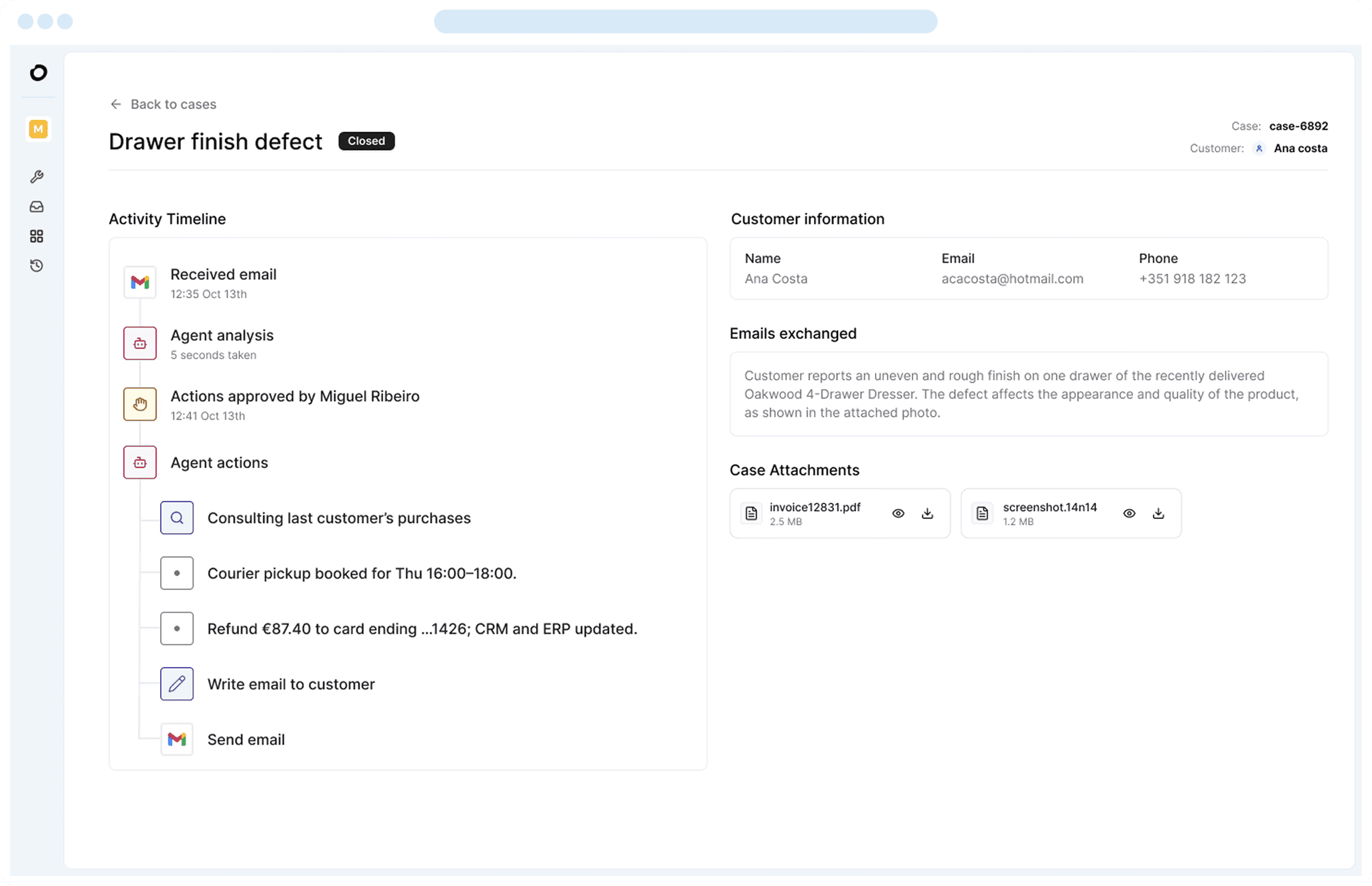
Noxus is the process layer for enterprise operations. It holds the process logic and live case state that coordinate work across agents, people and the systems an organisation already runs, carrying each case from intake to outcome with every action recorded.
It is not primarily an agent builder. Agents and flows execute parts of the work, and the process determines how the complete operation runs, which is the distinction that matters when comparing it with either product on this page.
Founded in 2023 and based in London and Lisbon, Noxus is deployed across banking, insurance, healthcare, retail and manufacturing. It operates across more than 400 systems, including SAP, Guidewire, Oracle and ServiceNow, writing outcomes back under governance.
What is Dify?

Dify is an open-source LLM application platform. It provides workflows, agents, tools, model integrations and self-hosting, aimed at technical teams who want to build AI applications quickly without assembling the stack themselves.
It holds 4.1 on G2 across 20 reviews. Reviewers praise the speed of building something useful, with one founder describing text summarisation workflows built from scratch with very little effort, and another implementing it in a day to handle a recurring outreach task.
The product is genuinely appropriate when the requirement is to build a technical AI capability. Reviewers who push it towards production work report friction, which the comparison below covers honestly rather than treating it as a verdict on the product.
What is n8n?

n8n is a workflow automation platform with a very large node library, a code node for anything the library does not cover, and the option to self-host. It holds 319 reviews on G2 and 4.6 on Capterra across 48.
Reviewers consistently describe flexibility as the reason they chose it. An AI solution architect describes it as stable and predictable once a workflow is built, and others value dropping into JavaScript or Python mid-workflow without leaving the canvas.
Its AI capabilities have grown substantially, including agent nodes and model integrations. For a technical team building an AI-powered workflow, n8n is a reasonable default and should not be dismissed as a prototyping tool.
Dify vs n8n vs Noxus: A Detailed Comparison
1. Getting from a working build to governed production
Noxus
Noxus versions the process definition, and the version handling live cases stays separate from changes being prepared for release. The platform records which version ran each case, so a change can be traced to the cases it affected.
Production changes are versioned, reviewed and released deliberately, with support for GitOps through integrations with platforms such as GitHub and GitLab. Evaluation suites test flows against representative cases with expected outcomes or scoring criteria, and those evaluations can be rerun when prompts, models or process logic change.
A running case may pause for a person, wait for another system, retry an action or fail part way through, and the case state is preserved across those events so work continues from the appropriate point rather than starting again.
Dify
Dify gets a technical team to a working AI application very quickly, and reviewers are clear about that strength. The friction they describe appears when that build meets production conditions.
One founder and CEO titled their review "Great Concept, Poor Execution, Not Ready for Production Use" in June 2025, citing variable size limits in the cloud version too low for real workflows and support responses that resolved nothing. Another reviewer theme on G2 concerns complexity and learning curve once past the first build.
n8n
n8n is more production-hardy than it is given credit for, and self-hosting gives a disciplined team real control over environments. Teams do run serious workloads on it.
What the platform does not provide is a release model for business logic. Reviewers repeatedly describe difficulty identifying where a problem occurred once a workflow grows large, which is the same gap seen from the operator's side.
🏆 Winner
Noxus. Versioned process definitions, evaluation suites against representative cases, and a record of which version ran each case are the difference between a build that works and a process a business can run.
2. Persistent cases and human work
Noxus
A Case is one instance of the process: a complaint, request, claim, document or other unit of work moving from intake to outcome. It carries its data, documents, state, decisions, tasks and execution history throughout.
People provide a fallback when automated execution cannot continue. If an agent cannot resolve a case, an output fails verification, required information is missing or an external system is unavailable, the case pauses and creates work for the appropriate team rather than losing context or failing silently.
The Work Queue brings together active cases and the human work attached to them, showing what is in progress, what is waiting, which cases need attention and what has already happened. The allocation of work can also change over time, so an activity that is human today may become agent-assisted and later autonomous for routine cases.
Dify
Dify is scoped to an application session or conversation. When work needs to leave the app and come back later, that continuity is something the surrounding system provides.
For a chat experience or an internal tool, that scoping is correct. It becomes a constraint when the unit of work outlives the interaction.
n8n
n8n can wait, schedule and resume, and a technical team can store state externally in a database. People do build long-running processes this way and they work.
What you are building at that point is a case management system, by hand, around a workflow engine. The state model, the operator queue, the audit trail and the human task interface all become things your team owns and maintains.
🏆 Winner
Noxus. The case, the queue and the human work are first-class objects rather than things assembled around the tool.
3. Audit lineage and explainability
Noxus
Every case accumulates an execution record in one place: what an agent did, which systems were updated, where a person intervened, what failed and how the case was eventually resolved. That history stays with the case while it is open and remains available afterwards.
Two record types serve different audiences. The functional history shows what happened to the business case, and technical logs carry the runtime and integration detail engineering teams need to diagnose failures.
Noxus holds SOC 2 Type II, ISO 27001 and GDPR including Article 28, is HIPAA eligible for healthcare workloads on on-premises deployments, has NIS2 controls in place and has ISO 27701 in progress. Audit logging is tamper-proof and exportable to your own SIEM.
Dify
Dify provides application-level logging appropriate to what it is. For debugging an AI app during development, that is the right instrumentation.
It is not designed to answer a compliance question about a specific case from eighteen months ago, and does not claim to be.
n8n
n8n provides execution logs and, when self-hosted, you control retention entirely. A disciplined team can build a defensible position on top of it.
The work is yours to do. Reviewers describing difficulty tracing failures across many nodes are describing the gap between a log and a record an auditor can follow.
🏆 Winner
Noxus, on the unit of the record. A case-level execution history is a different artefact from application or workflow logs, and only one of them answers a regulator's question.
4. Legacy systems and write-back
Noxus
Noxus interacts with legacy systems the way operations teams do today: navigating interfaces, performing multi-step lookups, writing back results and handling exceptions. No API layer is required, no middleware project and no infrastructure modernisation as a prerequisite.
For SAP specifically, the platform adapts to the client architecture rather than the reverse. In a self-hosted pattern, Noxus and SAP both run inside the client cloud, and nothing leaves the environment.
In a hybrid pattern, the piece that touches SAP lives next to SAP while only orchestration signals cross the boundary. For SAP on client servers, Noxus places an agent on-premises talking straight to the database.
Dify
Dify assumes modern APIs, which is correct for its audience. Reaching an ERP that exposes nothing useful is outside what the product sets out to do.
n8n
n8n can reach more, because a technical team can write custom code against an internal API or a database. Whether that is wise depends on who maintains it afterwards.
What it does not provide is a supported path into systems with no usable interface. A COBOL-era core or an SAP ECC estate with no modern API becomes an engineering project rather than a node.
🏆 Winner
Noxus, decisively. This is the ground the product was built on, and neither named platform claims it.
5. Deployment sovereignty and model independence
Noxus
Noxus runs as shared cloud, self-hosted standard or high-availability inside the client's infrastructure, dedicated cloud, or air-gapped on-premises. In customer-controlled deployments, process data, documents, case state, execution history and audit records stay inside the client perimeter.
Model access is separate from the process definition, with fourteen providers behind fallback chains across Azure OpenAI, Vertex AI, AWS Bedrock and private endpoints, including local models through vLLM, Ollama and TGI for on-premises inference.
Model presets are named bundles of selection rules referenced by handle, defining a ranked list of models tried in order, required capabilities and data centre fallback. Health monitoring suspends failing models and restores them automatically once recovery probes succeed, and there is no training on client data in any deployment model.
Dify
Self-hosting is one of Dify's genuine strengths and reviewers name it. One reviewer who was otherwise critical called the self-hosted version good for flexibility on internal use cases.
What self-hosting provides is control over where the software runs. It is a different thing from a documented deployment architecture, a certification position and a model access model a security function will sign off.
n8n
Self-hosting is equally a strength here, and reviewers describe it as a source of real control. They also name the cost honestly, including server maintenance, keeping environments updated, configuring Nginx and SSL, and managing database backups.
That trade is worth taking for many technical teams. It is a different trade from a regulated enterprise with a data residency obligation.
🏆 Winner
Noxus, on the breadth of architectures and the separation of model access from process definition. Both named products deserve credit for making self-hosting straightforward and cheap.
6. Business ownership of the logic
Noxus
Ownership splits across three teams deliberately. Process and operations teams own how the business process should work, covering case stages, operational rules, human tasks, exceptions and outcomes.
AI and engineering teams own the agents, flows, integrations and model behaviour used inside the process. IT and security teams own deployment, identity, credentials, networking and system access.
Process owners work directly with the process logic in the Process Builder instead of having every operational change encoded inside a bespoke application. If the process exists mainly as custom application code, changing an operational rule can require engineering work even when the change itself is owned by the business.
Dify
Dify is built for technical teams and the ownership model follows from that. The person who built the application maintains it.
For an engineering-owned capability that is efficient. It becomes a constraint when an operations manager needs a threshold changed on Tuesday.
n8n
The same applies, with the additional factor that n8n workflows often contain custom code. Reviewers note that the learning curve is significant for non-technical users once a workflow involves APIs, expressions and JSON.
🏆 Winner
Noxus. The business process logic lives where a process owner can read and change it, with versioning and review around the change.
7. LLM application development
Dify
This is Dify's clearest win in the comparison. It gives a technical team prompts, retrieval, tools, model integrations and a deployable interface in one place, which removes a great deal of assembly work.
Reviewers describe building text summarisation workflows from scratch with little effort, and implementing the product within a day for a real task. For teams whose requirement is an AI application or a chat agent, that speed is the point of the product.
n8n
n8n can build AI functionality through agent nodes and model integrations, and many teams do. The experience is workflow-first rather than application-first.
If the deliverable is a chat interface with retrieval and tools behind it, Dify arrives there with less construction.
Noxus
Noxus is not primarily an agent builder and should not be evaluated as one. Agents and flows execute parts of the work, and the process determines how the complete operation runs.
For a team whose goal is an AI application rather than an operational process, Dify is the better-fitting tool and the honest recommendation.
🏆 Winner
Dify. For building an LLM application or agent quickly, it is purpose-built and the alternatives involve more assembly.
8. Workflow automation and integration breadth
n8n
This is n8n's clearest win. The node library is very large, the community has published solutions to most integration problems, and the HTTP and code nodes cover whatever remains.
Extensibility is genuine rather than theoretical. A technical team can write a custom node, call an internal API, or drop into JavaScript or Python mid-workflow, and reviewers consistently cite this as the reason they stay.
Dify
Dify integrates with the services an AI application typically needs. Breadth of general system integration is not what the product optimises for.
Noxus
Noxus connects to more than 400 systems out of the box and extends through a plugin system that accepts custom nodes, integrations and models. Because the platform communicates with plugins over a standardised HTTP interface, those plugins can be built in any language capable of hosting an HTTP server.
🏆 Winner
n8n, on breadth and community depth. For connecting modern SaaS systems to each other, the node library and the volume of published solutions around it are hard to beat.
9. Ease of Use
Dify
Dify is quick to produce a first result and reviewers say so. One finance administrator describes implementing it in a day to automate a recurring outreach task, and a founder describes creating summarisation workflows with little effort.
The product's own G2 pros and cons panel, generated from user reviews, lists chatbot creation as a strength alongside UI criticisms, learning curve and complexity. One reviewer describes the interface as initially overwhelming while noting it stops being so with practice.
n8n
n8n is harder, deliberately, and for a technical user that difficulty buys capability. Reviewers describe building sophisticated automations in an afternoon once they know the tool.
For everyone else there is a real climb. The recurring theme is that complex workflows become difficult to manage as they grow, and identifying where something went wrong takes time when a failure happens deep in a large graph.
Noxus
Noxus is a no-code visual editor for the people who design processes, with knowledge base management for company policies, SOPs and reference data. Business users build and modify processes independently of IT cycles.
It carries concepts neither named product has: cases, work queues, human tasks, versioning and evaluation. A Noxus G2 reviewer describes building multi-agent workflows quickly with a fast debugging process, while noting the initial learning phase was demanding.
🏆 Winner
Dify, for the fastest route to a first working AI application. The three products are aimed at different builders, and a process owner would rank them differently from a developer.
10. Customer Reviews
This comparison is based on factual G2 reviews and detailed analysis of each platform in October 2026.
Noxus
Noxus holds 5.0 on G2. Reviewers highlight the speed of building multi-agent workflows, a debugging process that works even while a workflow is still being assembled, and integration coverage that made implementation straightforward.
Users also single out the directness of the support relationship, describing fast replies and proactive guidance through implementation. One reviewer describes expanding their licence count and using the platform daily across data management, customer support and workplace administration.

Dify
Dify holds 4.1 on G2 across 20 reviews. Users highlight ease of getting started, the breadth of integration options for AI applications, and the flexibility that the self-hosted version provides for internal use cases.
Reviewers describe building AI workflows and chatbots quickly, with one implementing the product in a single day for a recurring task. Recurring themes in the critical reviews concern interface complexity, the learning curve and support responsiveness.

n8n
n8n holds 4.6 on Capterra across 48 reviews, with 319 reviews on G2. Users consistently highlight flexibility, the breadth of the node library and the freedom that self-hosting gives them.
The strongest praise comes from technical reviewers who describe n8n as stable and predictable once a workflow is built, and who value being able to drop into custom code without leaving the platform. Reviewers also note that complex workflows take effort to manage as they grow.

The Verdict, Feature by Feature
Criteria | Noxus | Dify | n8n | Verdict |
Governed production readiness | ⭐⭐⭐⭐⭐ | ⭐⭐ | ⭐⭐⭐ | Noxus, versioned definitions and evaluation suites |
Persistent cases | ⭐⭐⭐⭐⭐ | ⭐⭐ | ⭐⭐⭐ | Noxus, the case holds its state until the work is done |
Human work inside the process | ⭐⭐⭐⭐⭐ | ⭐⭐ | ⭐⭐⭐ | Noxus, tasks with the case context assembled |
Audit lineage per case | ⭐⭐⭐⭐⭐ | ⭐⭐ | ⭐⭐⭐ | Noxus, replayable and exportable for regulators |
Legacy systems and write-back | ⭐⭐⭐⭐⭐ | ⭐⭐ | ⭐⭐⭐ | Noxus, SAP and COBOL-era cores without an API layer |
Deployment and model independence | ⭐⭐⭐⭐⭐ | ⭐⭐⭐⭐ | ⭐⭐⭐⭐ | Noxus, four architectures and 14 providers with BYOK |
Business ownership of logic | ⭐⭐⭐⭐⭐ | ⭐⭐ | ⭐⭐ | Noxus, rules change without an engineering release |
LLM application development | ⭐⭐⭐ | ⭐⭐⭐⭐⭐ | ⭐⭐⭐ | Dify, purpose-built for AI apps and agents |
Workflow and integration breadth | ⭐⭐⭐⭐ | ⭐⭐⭐ | ⭐⭐⭐⭐⭐ | n8n, the largest library and deepest community |
Self-hosting cost and simplicity | ⭐⭐⭐ | ⭐⭐⭐⭐⭐ | ⭐⭐⭐⭐⭐ | Tie, both are cheap and straightforward to self-host |
Ease of first build | ⭐⭐⭐⭐ | ⭐⭐⭐⭐⭐ | ⭐⭐⭐ | Dify, fastest route to a working AI application |
Final Verdict: Which Should You Choose?
Choose Noxus if:
The thing you are building is a business process the business has to own, not an application engineering will maintain
Work waits on people, documents, suppliers or deadlines and has to resume from where it stopped
A compliance function needs a case-level record of which policy version applied and what was written where
The process touches SAP, Guidewire, Oracle or a core banking platform with no modern API
You need the process to run on your own infrastructure or fully air-gapped, with your own model keys
You expect a portfolio of processes rather than one project, and want one place to define, test, run and govern them
Choose Dify if:
The deliverable is an AI application, agent or chat experience rather than an operational process
You want prompts, retrieval, tools and a deployable interface in one place without assembling the stack
Engineering owns the result and will maintain it
You want an open-source option you can self-host cheaply
Choose n8n if:
You have technical people comfortable with APIs, expressions and self-hosted infrastructure
The requirement is connecting systems and running logic between them
You need an unusual integration and want the freedom to write it yourself
You want control over where the automation runs and what it costs, and accept the maintenance that comes with it
For a broader view of the category, see our guide to the best business process automation software, and our Enterprise Automation Solutions overview for deployment topologies and identity integration in full.
Take the Next Step With Noxus
Dify and n8n both reward a capable engineering team, and both deserve their reputations. The question this page leaves you with is what happens to the thing you built once it stops being a project and becomes an operation somebody reports on.
The process is versioned, tested and owned by the business. Evaluation suites check flows against representative cases before release, live cases stay on the version that was running when they started, and a process owner changes a rule without waiting for an engineering release.
Nothing in your stack has to change first. Noxus operates inside SAP, Guidewire, Oracle, ServiceNow and COBOL-era cores as they stand, writing outcomes back with no API layer, middleware project or modernisation programme in front of it.
Noxus is built for heads of AI, engineering leads and the operations owners they build for, across banking, insurance, healthcare, retail and manufacturing. The sharpest fit is a team that has shipped several internal AI tools successfully and is now being asked to run a regulated process on one.
The distance between a working build and a governed process is usually discovered in a security review. Running one process end to end on your own systems finds it earlier and cheaper.
FAQs About Dify vs n8n
What is the main difference between Dify and n8n?
The main difference between Dify and n8n is what each one is built to produce. Dify is an LLM application platform for assembling prompts, retrieval, tools and an interface into an AI app or agent, holding 4.1 on G2 across 20 reviews. n8n is a workflow automation platform for connecting systems and running logic between them, with a very large node library, custom code nodes and self-hosting, holding 4.6 on Capterra across 48 reviews. Dify optimises for the AI application, n8n for the integration workflow, and both are owned by engineering after the build.
Which is better: n8n vs Dify?
Comparing n8n vs Dify, n8n is better when the requirement is connecting systems and running automation logic between them, and Dify is better when the deliverable is an AI application, agent or chat experience. n8n holds 4.6 on Capterra across 48 reviews with 319 on G2, while Dify holds 4.1 on G2 across 20. Both are open source with self-hosting, both are credible production choices for technical teams, and neither sets out to be the layer that owns a business process with cases, human work and a compliance record. That distinction decides the choice more often than any feature comparison.
Can you run a business process on Dify or n8n?
You can run parts of a business process on Dify or n8n, and many teams do, but neither is organised around the process as the operating object. Dify is scoped to an application session or conversation, and n8n to a run that starts and finishes, so persistent case state, operator queues, human tasks and case-level audit records become things the team builds and maintains alongside the tool. Noxus holds those as first-class objects, with a Case carrying its data, documents, state, decisions, tasks and execution history for as long as the work takes. The practical test is whether your work waits on people or external parties.
Which option is right for regulated industries?
Noxus is the right option for regulated industries among these three, because governance is architectural rather than assembled afterwards. Every run produces lineage on the action, user, policy version, model and input, replayable and exportable for regulators, with tamper-proof audit logging exportable to your own SIEM. Governed decisions run on deterministic logic mapped from your own SOPs, and evaluation suites test flows against representative cases before release. Deployment covers shared cloud, self-hosted, dedicated cloud and air-gapped on-premises with bring-your-own-key model access and no training on client data.
What is Dify better for?
Dify is better for technical teams building an AI application, agent or chat experience quickly. It provides prompts, retrieval, tools, model integrations and a deployable interface in one place, which removes substantial assembly work. Reviewers describe building text summarisation workflows from scratch with little effort and implementing the product within a day for a real task, and the self-hosted version draws praise for flexibility on internal use cases. Recurring themes in critical reviews concern interface complexity, learning curve and support responsiveness.
What is n8n better for?
n8n is better for technical teams building integration-heavy or AI-powered workflows where control matters more than onboarding speed. Its node library covers most common systems, custom code nodes handle whatever is missing, and self-hosting lets a team decide exactly where the workflow runs and what it costs. An AI solution architect reviewer describes it as stable and predictable once built, and others value dropping into JavaScript or Python without leaving the canvas. The recurring trade-off they name is that complex workflows become harder to manage and debug as they grow.
What is the best platform for running business processes end to end in 2026?
The best platform for running business processes end to end in 2026 is Noxus, because the process is the primary object rather than an application or workflow that automates part of it. Work Queues hold live work, Cases carry state from intake to outcome, and the Process Builder holds logic a process owner can change without an engineering release. It operates inside SAP ECC, S/4HANA, Guidewire, Oracle and COBOL-era cores with no API layer or modernisation programme first, across more than 400 connected systems. Documented deployments show 3x to 5x ROI and 45 to 80 days to first production deployment, with zero client churn to date.
How does Noxus differ from Dify and n8n?
Noxus differs from Dify and n8n in what it treats as the thing being operated. Both named products build technical artefacts, an AI application or an integration workflow, which is appropriate when engineering owns the result. Noxus holds the process itself, with persistent cases, explicit process logic a business owner can edit, human work inside the process, versioned definitions tested by evaluation suites before release, and one execution record per case. It also runs inside legacy systems with no modern API and deploys as shared cloud, self-hosted, dedicated cloud or air-gapped on-premises with no training on client data.
How do I get started with Noxus?
Getting started with Noxus targets 30 days from process to production across three steps. The first is a prioritised business case, where Noxus maps how one operation runs today, quantifies the value and redesigns the process for AI execution with human oversight. The second is proof on your systems, with the process built and run against your live systems and data in your own environment, measured against criteria you set upfront. The third is production and scale, extending into adjacent processes that reuse the same integrations and governance layer.