Best Microsoft Copilot Alternatives in 2026 (Reviewed & Compared)
Key Takeaways (TL;DR)
The Best Overall Microsoft Copilot Alternative: Noxus is the right call for enterprises that need AI to actually finish the work, not just narrate it. It earns its place inside SAP, Guidewire, and Oracle, under audit, in regulated environments where Copilot Studio drafts and suggests, but rarely makes it past procurement.
Why Do You Need It: Microsoft Copilot is built to assist with productivity within Microsoft 365. It cannot reach the legacy systems where 80–90% of enterprise operational work actually happens.
Who It's For: Operations leaders, IT architects, CFOs, and digital transformation leaders in financial services, insurance, healthcare, retail, and manufacturing, particularly those running SAP, Guidewire, Oracle, ServiceNow, or proprietary legacy platforms with regulatory requirements (GDPR, DORA, NIS2, HIPAA).
How to Choose the Right One: Prioritise execution depth over demo polish, native legacy system integration over connector count, and deployment sovereignty over cloud-only convenience. The right alternative is the one that resolves work inside the systems you already run.
Expected Price: Noxus operates on a consumption-based model via a monthly platform license with included AI operations volume, so costs scale with usage rather than headcount.
Table of Contents
Top Microsoft Copilot Alternatives in 2026: at a Glance
← scroll to see all columns →
| Company | Best For | Key Features | Pricing |
|---|---|---|---|
| Noxus | Enterprise operations automation on legacy systems |
AI Co-workers
400+ native connectors
Full audit trail
BYOK routing
Air-gapped deployment
|
Custom enterprise pricing |
| UiPath | Existing RPA estates extending into AI agents |
Process mining
Attended/unattended bots
RPA + agentic orchestration
|
Custom Entry from £18.39/month |
| Beam AI | Mid-market SOP-driven agent prototyping |
SOP-to-agent generation
Self-learning agents
1,000+ integrations
|
Custom enterprise pricing |
| Stack AI | Knowledge work and document-heavy AI agents |
No-code visual builder
Auto Agents
Strong RAG
30+ LLMs
|
Free tier Custom enterprise |
| Dify | Engineering teams self-hosting LLM apps |
Open-source core
Visual workflow builder
Multi-LLM support
|
Free open-source Cloud tiers available |
| n8n | Technical teams automating cross-app workflows |
400+ integrations
AI-Agent nodes
Self-hostable
|
Free self-hosted Cloud from £14.71/month |
| Salesforce Agentforce | Salesforce-centric CRM operations |
Native Salesforce data model
Autonomous agents
Case routing
|
Per-conversation pricing |
| Google Gemini Enterprise | Google Workspace–first organisations |
Native Workspace integration
Multimodal
Large context window
|
Google Workspace add-on tiers |
Why Do You Need a Microsoft Copilot Alternative?
Most enterprises are solving a problem that looks like an AI maturity issue but is actually an infrastructure one. Getting AI into production inside an enterprise is 90% infrastructure and integration, and 10% AI. Most teams evaluating Microsoft Copilot competitors have already run three to five pilots, with few in production; this is what we call pilot purgatory.
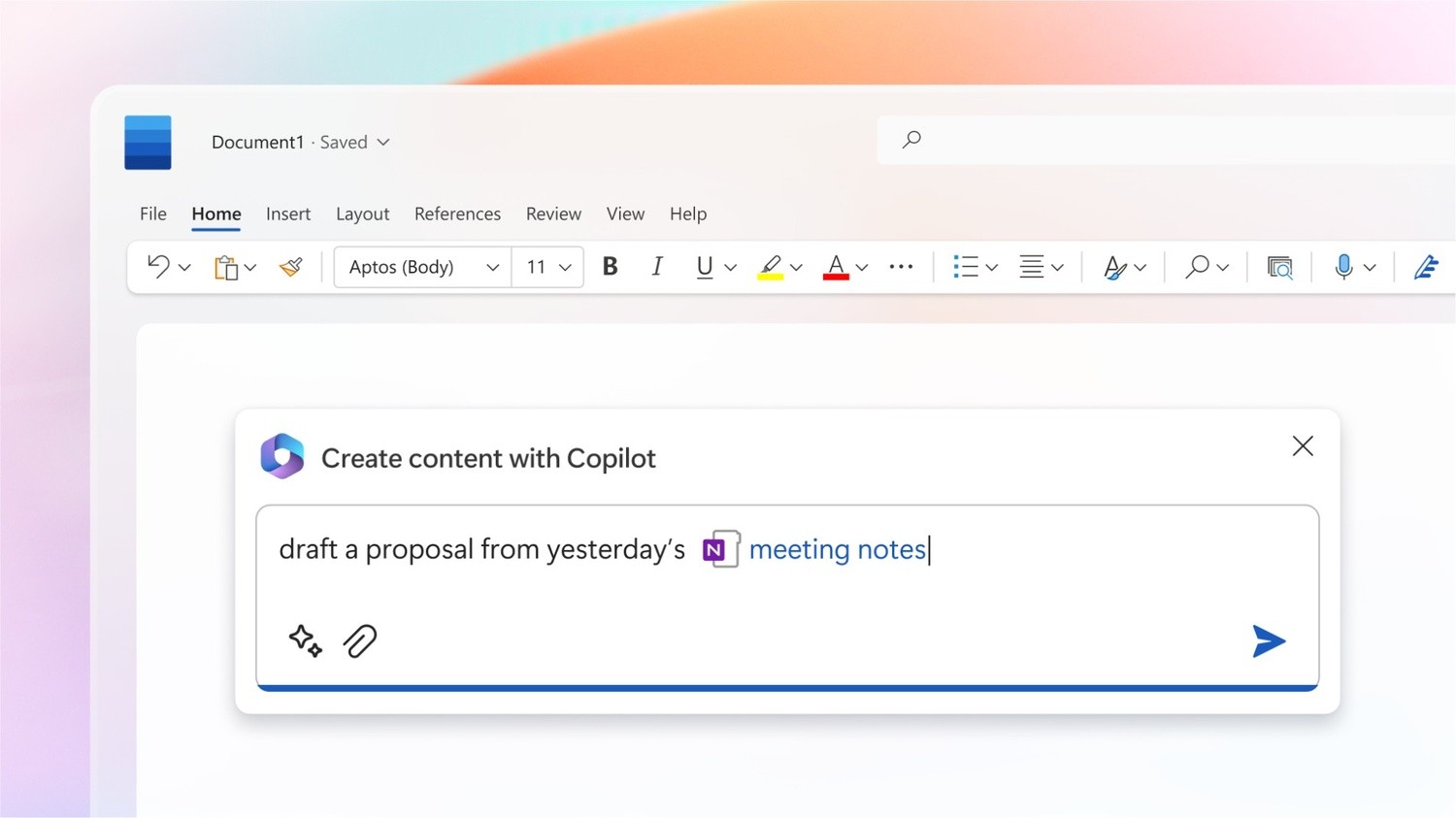
Microsoft Copilot does productivity assistance well inside Microsoft 365. It drafts the email, summarises the meeting, and builds the deck. What it does not do is open SAP, pull the customer record, validate the claim against policy, post the refund in Stripe, and close the ticket in ServiceNow.
That sequence, repeated thousands of times a day across operations teams in banking, insurance, and healthcare, is where the actual cost lives, and it is where Copilot Studio falls short. The right alternative closes the 90% gap by reaching into those systems, enforcing your business rules within regulated processes, and providing compliance teams with an audit trail they can defend.
Three structural gaps tend to show up once a Copilot deployment moves past simple productivity tasks:
Reach: Most operational work in banking, insurance, healthcare, and manufacturing runs on SAP ECC, Guidewire, Oracle EBS, COBOL cores, on-prem databases, and SFTP/EDI pipelines. Copilot Studio's connector model does not cover them, and computer use is still a preview feature unsuited to on-prem applications behind VPNs.
Conversion: Few Copilot pilots make it into broader deployment. The same reasons come up every time: shallow legacy integration, no deterministic execution layer, no air-gapped option, and layered licensing that hides the real total cost.
Governance: Copilot Studio lets the LLM decide which plugins to call and how to chain them, with no hard-coded business logic ensuring a regulated process follows the same rules every time. For auditors who need to see why a decision was made, that is a disqualifier.
The eight platforms below each address parts of these gaps in different ways. Here is how they compare.
Best Microsoft Copilot Alternatives: In-Depth Review & Comparison
1. Noxus
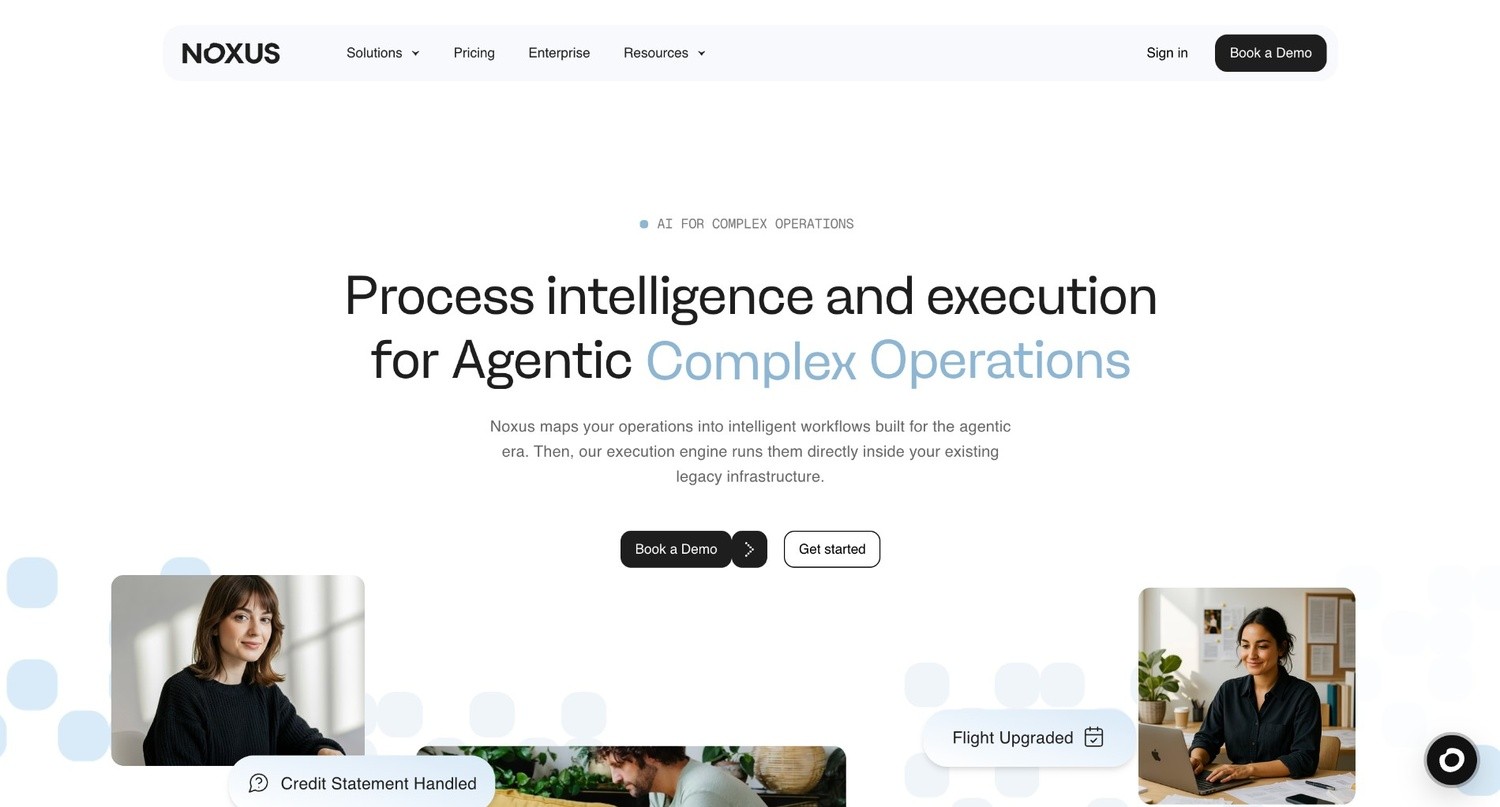
Noxus is an agentic operations platform that deploys end-to-end execution across legacy systems, 400+ native connectors, full audit trail, BYOK routing, air-gapped deployment. And it’s one of the best AI platforms for enterprise in 2026
It was built to solve a specific failure mode in enterprise AI tools that suggest or draft but never actually resolve work, and collapse when they hit real operational systems. Most agentic platforms assume modern APIs and clean data. The reality at most large European enterprises is closer to the opposite.
Where Microsoft Copilot Studio is built primarily for the Microsoft 365 ecosystem and assumes modern API-first architecture, Noxus delivers AI for Enterprise that operates natively inside SAP ECC, Guidewire, Oracle, ServiceNow, and proprietary in-house platforms. It works the way your operations staff already work, on the same screens they already use.
Ideal For
Enterprise operations teams resolving claims, billing disputes, and account changes across multiple legacy systems
Compliance officers in financial services, insurance, and healthcare requiring structural GDPR, EU AI Act, DORA, and SOC 2 adherence
Mid-market COOs (€50M–€500M revenue) who need measurable impact in the first 90 days
Top Features
End-to-end execution runtime: Reads unstructured inputs, applies your business rules, performs multi-step lookups across systems, and writes outcomes back under full governance. Resolves cases rather than summarising them.
Legacy system interaction without APIs: Navigates SAP ECC, Guidewire, Oracle, COBOL-era cores, and proprietary platforms the same way your operations staff do.
400+ native connectors: Pre-built integrations across CRM, ERP, ITSM, communication, identity, and payments, including Salesforce, SAP, ServiceNow, Outlook, Azure AD, and Stripe.
Flexible deployment with BYOK: Fully managed SaaS, self-managed VPC, or air-gapped on-premises. Clients bring their own AI provider keys (Azure AI Foundry, AWS Bedrock, Google Vertex AI) for full data sovereignty.
Why We're the Best Microsoft Copilot Alternative
The architectural choice that gets Noxus into production is the split between AI interpretation and business rule execution. The AI handles unstructured inputs, while hard-coded SOPs govern every consequential decision.
That sounds like a small distinction, but in regulated environments, it is the difference between a platform that ships and one that stalls in a security review. Here are a few highlights:
Santander (Tier 1 European bank): 3x ROI, 45 days to production, 95% AI precision, contract structured for global rollout across up to 15 regions.
CUF / José de Mello (healthcare): 10,000+ patient and administrative communications automated per month at 96% precision, fully GDPR Article 9 compliant.
Jerónimo Martins (retail): 15,000+ daily product listings classified, enriched, and priced with PIM write-back at 5x ROI.
Pros
Executes inside legacy systems without modern APIs or infrastructure modernisation
Air-gapped, on-premises, and VPC deployment for strict data sovereignty
Open-core guarantee. Clients retain all code and binaries at contract end
Cons
Not designed for small businesses or startups with simple, modern SaaS stacks
Requires initial mapping of internal business rules and SOPs before deployment
Specialised use case, not suited to creative content generation or consumer-facing apps
Pricing
Noxus operates on a consumption-based model, with custom prices for each client. No outcome-based pricing, no token-based pricing, no per-seat licensing. Costs are predictable and scale with usage, not headcount.
Final Verdict
Noxus is the strongest Microsoft Copilot competitor for regulated European enterprises automating operations across legacy systems. It enters SAP ECC environments, applies business rules deterministically, and produces a complete audit trail without an API layer or infrastructure project as a prerequisite.
2. UiPath
UiPath is the market-leading robotic process automation vendor, with a substantial installed base across global enterprises.
The platform has evolved from screen-scraping bots toward a broader automation suite that includes AI document processing, process mining, and, more recently, agentic AI capabilities through its Agentic Automation product line.
For Microsoft Copilot Studio buyers, UiPath represents a different architectural approach: cross-system process automation built on a mature RPA foundation, with AI agents layered on top of an existing orchestration platform.
Ideal For
Large enterprises with dedicated automation development teams
Finance and shared services teams processing high volumes of structured documents
Organisations with existing RPA investments adding AI document extraction
Top Features
Process mining: AI-driven analysis of system logs and user behaviour to identify automation opportunities.
AI Centre: Document understanding and computer vision for processing invoices, forms, and contracts.
Combined RPA + agentic orchestration: Single control plane for traditional rule-based bots and newer AI agents.
Why It's a Strong Microsoft Copilot Alternative
For organisations with structured, repetitive processes across a defined set of screens and data formats, UiPath delivers at scale, and the procurement path is often shorter than introducing a new vendor.
The trade-off shows up in maintenance as many target buyers report unfavourable RPA economics over time, where bots that worked beautifully for six months break the moment an ERP UI updates a button.
The cost of keeping them alive starts to outweigh the cost of the work they replaced. That is usually the moment those buyers begin evaluating Microsoft Copilot alternatives.
Pros
Market-leading RPA track record with extensive enterprise deployment history
Strong process discovery to identify where automation adds the most value
Enterprise governance certifications already approved at most large enterprises
Cons
Screen-scraping bots break when ERP interfaces update, driving high maintenance costs
Per-bot, per-process, and per-orchestrator licensing compounds rapidly at scale
Agentic AI is layered onto an RPA-first platform rather than built natively for AI agents
Pricing
UiPath's Unified Pricing has four tiers:
Free plan with 25 licences, no production support.
Pro at £20/user/month (US $25) including Studio, Orchestrator, and unattended robots.
Enterprise is custom-quoted with 100 included licences, AI Centre, and process mining; deployments routinely exceed £85,000/year.
A separate Flex Plan offers per-licence and per-bot pricing for organisations preferring granular control.
Final Verdict
UiPath suits large enterprises extending existing RPA estates rather than starting fresh. For most others, the per-bot pricing and the cost of fixing bots that break when ERP screens change tend to catch up fast, often within the first year or two.
3. Beam AI
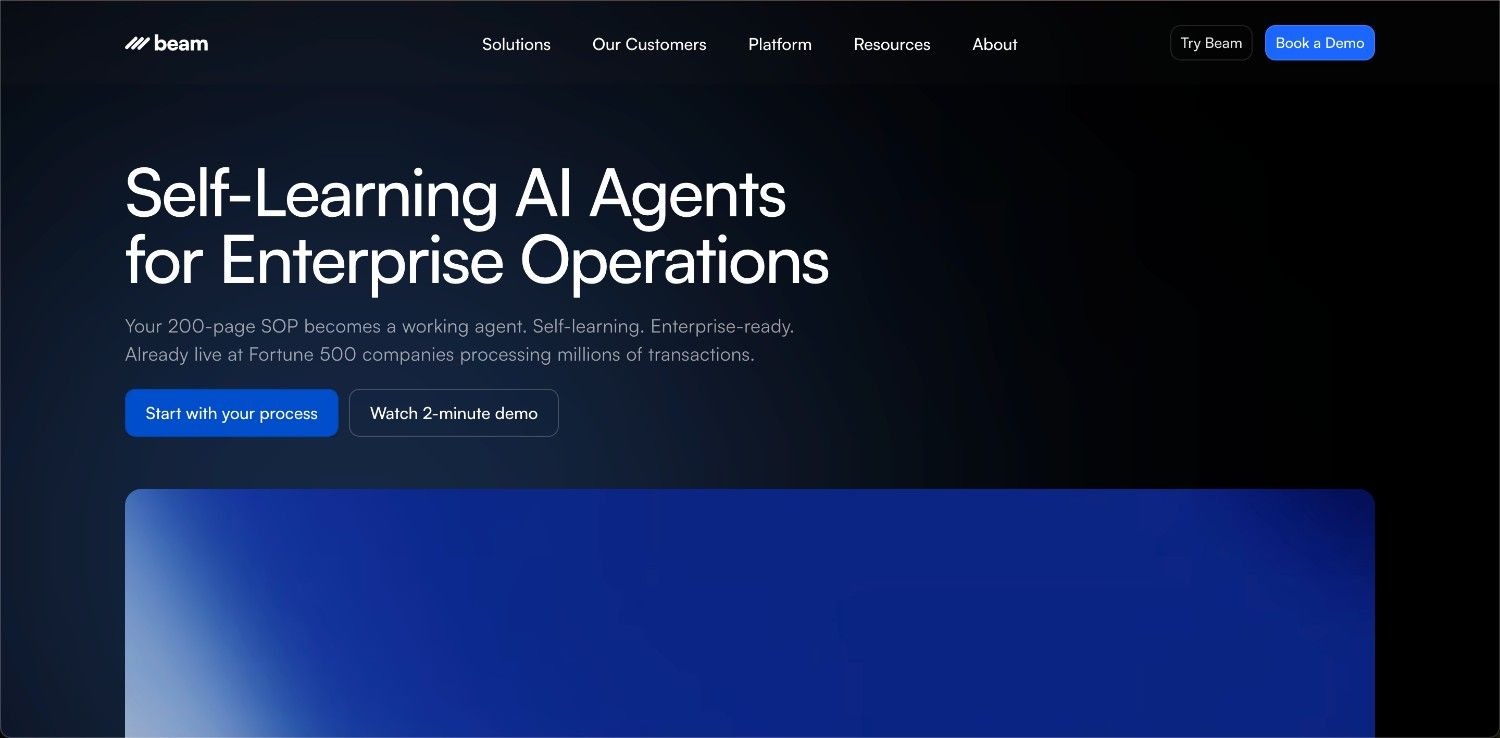
Beam AI is a German-founded agentic AI platform whose core differentiator is SOP-to-agent generation, e.g, you upload a Standard Operating Procedure document, and Beam generates an agent that follows it.
The platform combines self-learning agents with a broad library of prebuilt integrations and pitches itself as the fastest path from a documented process to a working AI worker.
For organisations evaluating Microsoft Copilot Studio against more focused agentic platforms, Beam represents a mid-market alternative with broader cross-system reach than Copilot's Microsoft-centric model.
Ideal For
Mid-market teams with well-documented SOPs looking to prototype agents quickly.
Operations teams comfortable with self-learning AI behaviour in non-regulated contexts
Marketing and sales operations teams automating high-variability workflows
Top Features
SOP-to-agent workflow: Upload procedures, generate working agents that follow them.
Self-learning agents: Adapt from interactions and feedback loops over time.
1,000+ pre-built integrations: Including SAP, Salesforce, DATEV, Oracle, and ServiceNow.
Why It's a Strong Microsoft Copilot Alternative
Beam meets operations teams in their own language. Procedures rather than workflows, SOPs rather than agent graphs.
That lowers the conceptual barrier for non-technical users compared to Copilot Studio's Power Platform-native model, which still expects builders to think in connectors and triggers.
Combined with a broad integration library and SaaS deployment, Beam becomes a credible mid-market choice for organisations moving beyond Microsoft surfaces without committing to enterprise-grade implementation engagements.
Pros
Fast prototyping path from existing SOP documentation to a working agent
Broad connector library covering modern SaaS and major enterprise systems
Deployment flexibility, including an on-premise option
Cons
Self-learning agent behaviour conflicts with regulated industry requirements for deterministic, auditable execution.
Integration breadth doesn't fully translate to depth in custom-configured SAP ECC or Guidewire instances.
Thin published proof points in Tier 1 European banking, insurance, or national health-sector deployments
Pricing
Beam AI does not publish public pricing on beam.ai. All paid plans are custom enterprise quotes, requiring direct sales engagement.
Deployment options span SaaS, on-premises, and hybrid, with pricing varying by integration scope, number of agents, and support tier. A free product tour and demo-based pilot are available before any commercial conversation.
Final Verdict
Beam AI suits mid-market teams with clear SOPs in lightly regulated work. In banking, insurance, or healthcare, the self-learning agents are the part that auditors will ask you to turn off, and at that point, you need a different kind of platform anyway.
4. Stack AI
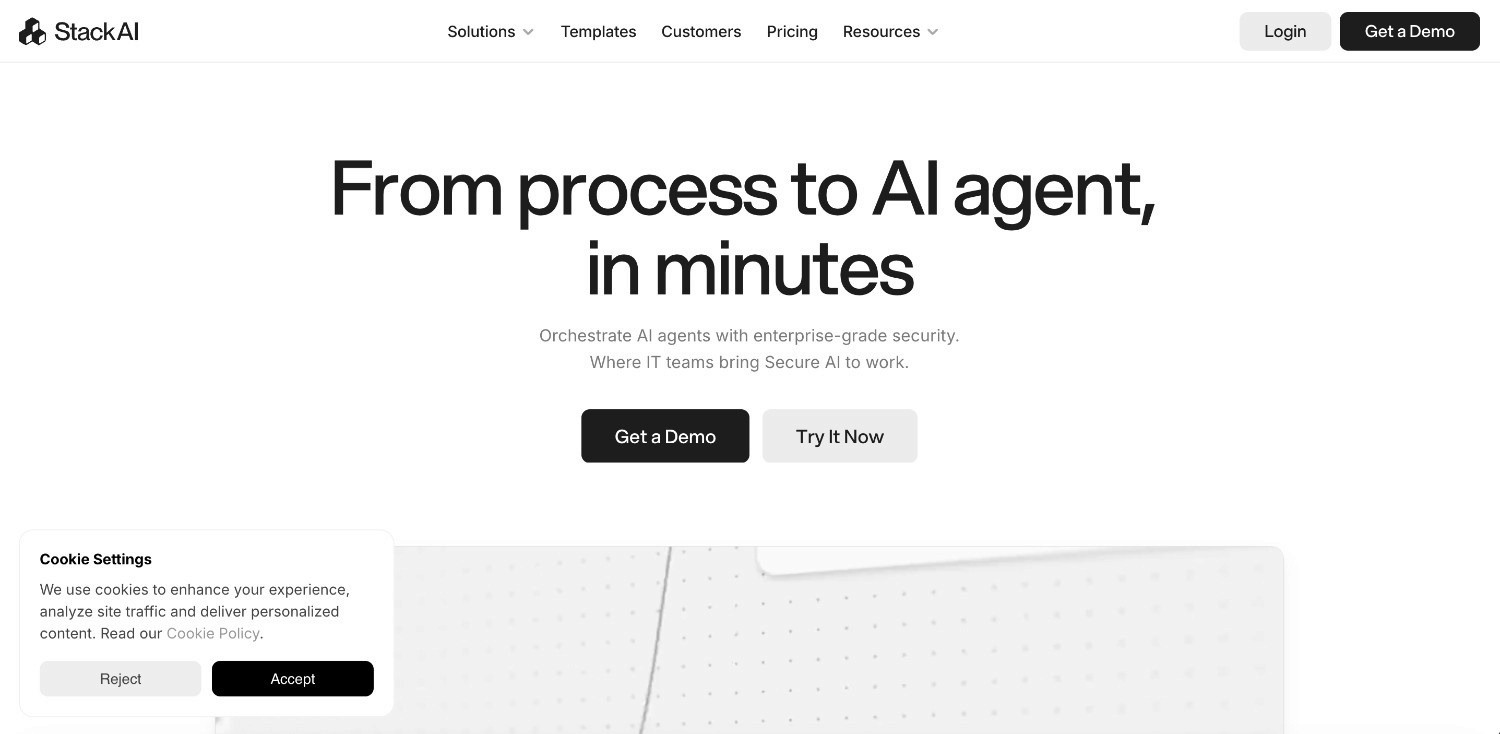
Stack AI is a YC W23-backed enterprise generative AI platform founded by MIT PhDs, with $16M raised across funding rounds and customers including HP, IBM, Nubank, MIT Sloan, and a Top 5 US defense agency.
The platform is consistently praised for its UX, e.g, a polished drag-and-drop canvas for building no-code AI agents, an Auto Agents feature that generates multi-step agents from natural language, and strong RAG capabilities for grounding agents in enterprise knowledge bases.
For Microsoft Copilot Studio buyers focused on knowledge work and document-heavy use cases, Stack AI represents a more focused, UX-led alternative.
Ideal For
Knowledge workers building document Q&A and information retrieval agents
Teams with strong RAG use cases (RFP responses, due diligence research, content QA)
US-based mid-market organisations evaluating AI agent platforms
Top Features
No-code visual builder: Polished drag-and-drop canvas, consistently rated among the cleanest in the category.
Auto Agents: Natural language description generates a complete multi-step agent.
Strong RAG architecture: Knowledge base capabilities across SharePoint, Snowflake, Confluence, and Salesforce.
Why It's a Strong Microsoft Copilot Alternative
Stack AI's UI is better than most enterprise AI platforms. Once you open the canvas, the difference shows up in seconds, particularly for non-Microsoft-native users who find Copilot Studio's Power Platform feel dated.
The free tier removes procurement friction entirely, and Auto Agents delivers a working prototype in minutes.
Where it stops short is operational execution, as the platform was built to retrieve, summarise, and answer, not to write back into SAP, post a refund, or close a ticket inside a regulated stack.
Pros
Polished, modern UI rated among the best in the category
Free tier and self-serve evaluation path with no procurement barrier
Multi-LLM support (30+ providers) with model-agnostic design
Cons
Built for knowledge tasks, not legacy operational execution
No published capability for database-level SAP, Guidewire screen automation, or SFTP/EDI handling
No air-gapped on-premise deployment for sovereignty-restricted clients
Pricing
Stack AI runs a two-tier structure:
Free plan includes 500 runs/month, 2 projects, 1 seat, and community support.
Enterprise is per-seat custom pricing with unlimited runs, dedicated infrastructure, on-premise and VPC deployment, SOC 2 / HIPAA / GDPR compliance, and dedicated solution engineers.
On the Free plan, third-party API calls are billed separately when using Stack AI's keys.
Final Verdict
Stack AI suits teams building agents that retrieve documents and answer questions in non-regulated US contexts. For most enterprise buyers, the issue is not the canvas or the model list. It is that the tool was never built to write back into your real systems, and that becomes clear a few weeks into any serious project.
5. Dify
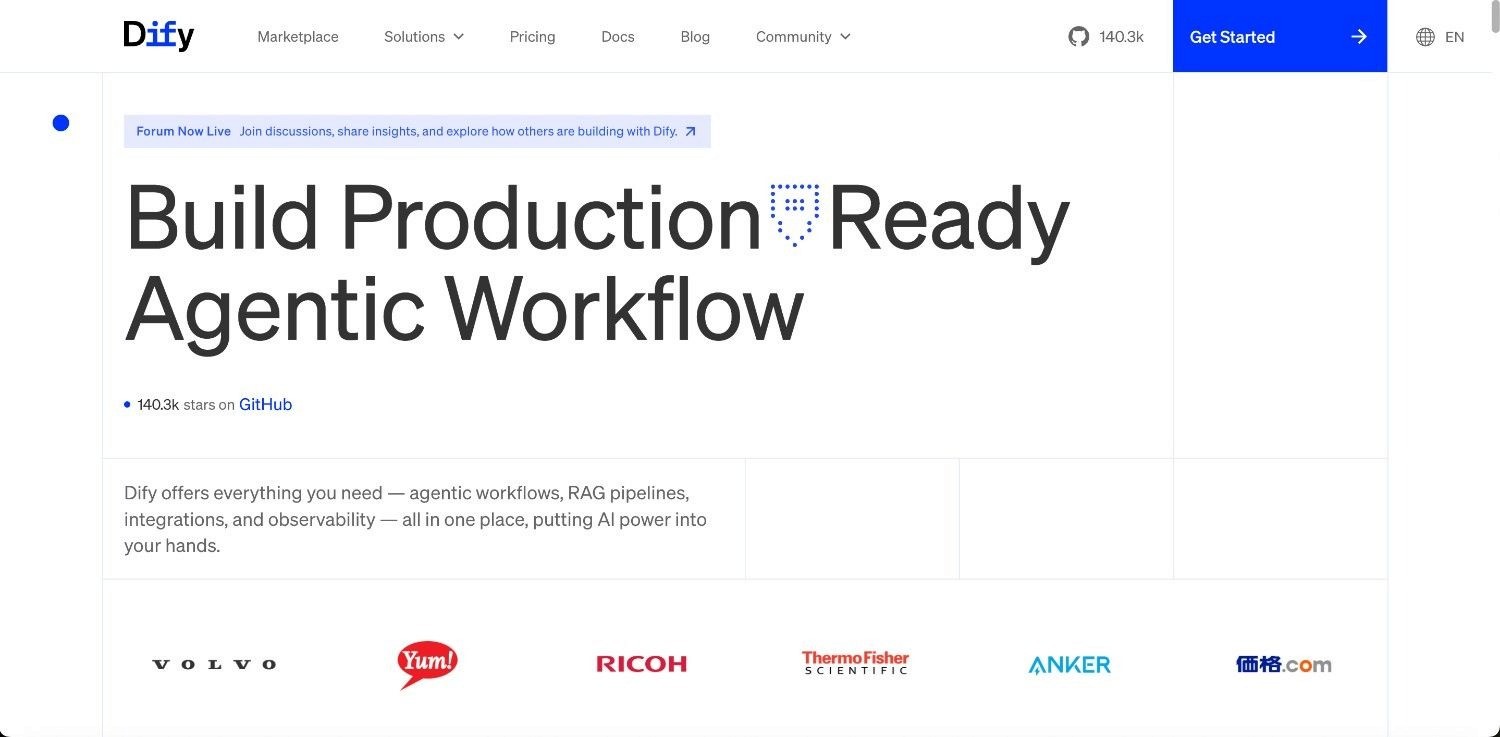
Dify is an open-source LLM application development platform that gives engineering teams the building blocks for AI agents and workflows without the constraints of a closed SaaS product.
Available as both a self-hosted open-source project and a managed cloud service, Dify offers a visual workflow builder, support for multiple LLM providers, and a community-driven plugin ecosystem.
For technical teams that find Copilot Studio's Microsoft-centric, low-code approach too restrictive, Dify offers fundamentally different tradeoffs: full architectural flexibility, no ecosystem lock-in, and the ability to self-host on any infrastructure.
Ideal For
Engineering teams building custom LLM applications with full architectural control
Open-source-first organisations avoiding vendor lock-in
Companies with a strong engineering culture and existing DevOps maturity
Top Features
Open-source core: Self-host on your own infrastructure with full code ownership.
Visual workflow builder: Chains LLM calls, tools, and data sources without writing full code.
Multi-LLM support: OpenAI, Anthropic, and open-source models. Model-agnostic by design.
Why It's a Strong Microsoft Copilot Alternative
Dify is one of the smartest choices for engineering teams that want to avoid vendor lock-in entirely. Open-source means full code ownership, portability across cloud providers, and the ability to modify the platform itself, which matters more than people admit until the day they need to.
The flip side is that production-readiness, error handling, compliance logging, and integration resilience all become the customer's job. That is a fair trade for a strong platform team and a steep one for everyone else.
Pros
Open-source with full code ownership and self-hosting flexibility
No vendor lock-in; portable across cloud providers
Cost-effective compared to commercial enterprise platforms
Cons
Production-readiness burden falls entirely on the engineering team
No native legacy system integration for SAP, Guidewire, or COBOL cores
Limited enterprise support and SLA options compared to commercial vendors
Pricing
Dify offers a free Sandbox (200 message credits, 1 seat) plus a free self-hosted open-source Community edition.
Cloud paid tiers:
Professional at £47/month (US $59) for 5,000 message credits, 3 seats, 50 apps
Team at £125/month (US $159) for 10,000 credits and larger teams.
Enterprise is custom-priced for SSO, on-premise deployment, and dedicated support.
Final Verdict
Dify suits engineering teams that have the people to build and maintain AI workflows themselves. For everyone else, the open-source freedom quickly turns into a second project, where your team has to build the compliance, monitoring, and integration layers that paid platforms include by default.
6. n8n
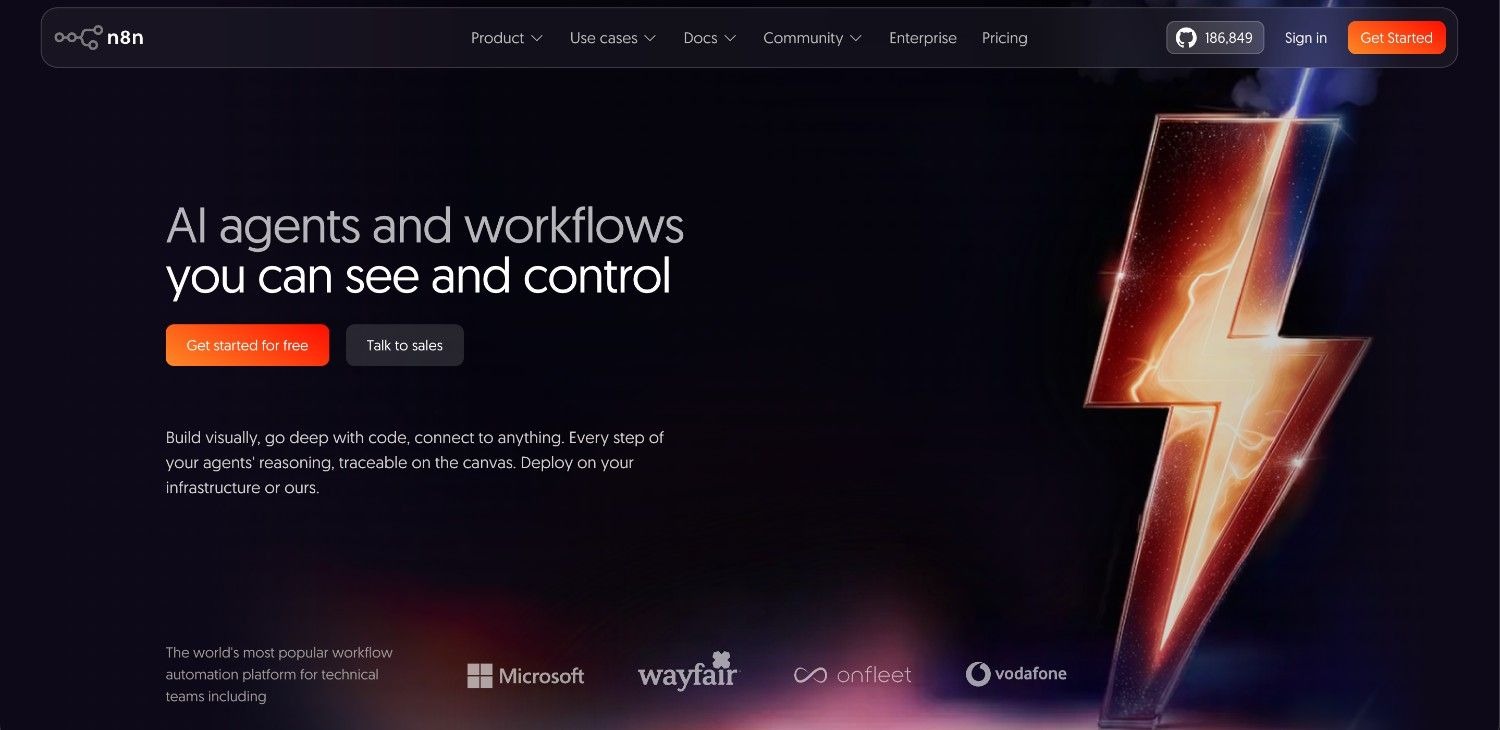
n8n is an open-source workflow automation platform that has expanded from Zapier-style cross-app automation into AI agent orchestration through its AI-Agent nodes.
Self-hostable, developer-friendly, and with predictable pricing, n8n has become a popular choice for technical teams that want flexible workflow automation with LLM capabilities layered in.
For Microsoft Copilot Studio buyers whose primary need is cross-app automation with AI components rather than agent-first conversational experiences, n8n offers a fundamentally different orientation, i.e., workflow-centric with AI nodes added.
Ideal For
Technical teams automating cross-app workflows with AI components layered in
Open-source-friendly organisations wanting Zapier-style flows with self-hosting
Internal IT teams replacing Zapier or Make with a more flexible, self-hosted option
Top Features
400+ integrations: Across SaaS tools and developer platforms.
AI-Agent nodes: Layer LLM tasks into broader automation pipelines.
Self-hostable with custom JavaScript: Run on your own infrastructure with arbitrary code in workflow steps.
Why It's a Strong Microsoft Copilot Alternative
n8n is one of the smartest choices for technical teams that want the flexibility of custom code alongside a growing library of pre-built integrations, all deployed within their own infrastructure.
The open-source model means no proprietary lock-in, so teams can modify the platform or migrate workflow logic without restriction. What it does not replace is the enterprise-grade observability, compliance, and governance that regulated buyers expect by default.
Those still need to be built or bought separately, and that gap is where the cost story changes.
Pros
Full self-hosting keeps data within your own infrastructure
JavaScript nodes provide genuine extensibility for complex logic
Predictable cost structure compared to per-task SaaS automation
Cons
Requires engineering resources to deploy, maintain, and update the platform
No out-of-the-box enterprise support, governance dashboards, or compliance certifications
Light on observability and evaluations for AI-heavy workflows
Pricing
Cloud tiers:
Starter at £19/month for 2,500 executions
Pro at £47/month for 10,000 executions
Business at £635/month for 40,000 executions plus SSO and Git integration.
Enterprise is custom-priced with unlimited executions and dedicated support. Qualifying startups under 20 employees get 50% off Business.
Final Verdict
n8n suits developer teams replacing Zapier or Make with a self-hosted, more flexible option. Outside that profile, it is a workflow tool with AI features added on rather than an enterprise platform, and most buyers underestimate how much extra work it takes to get it production-ready.
7. Salesforce Agentforce
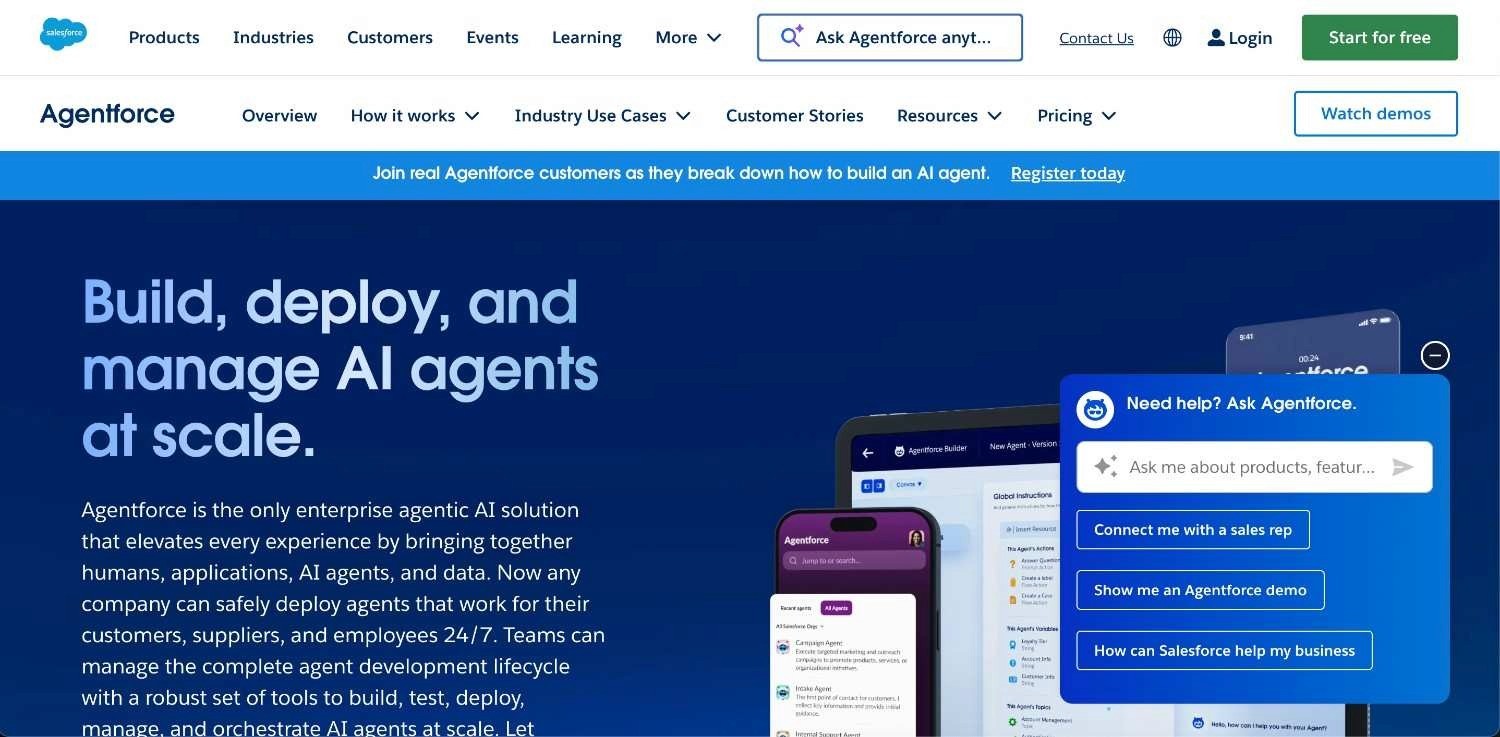
Salesforce Agentforce is Salesforce's autonomous AI agent platform, launched in late 2024, designed to deploy AI agents directly inside the Salesforce data model.
Agentforce handles case routing, customer service workflows, sales lead qualification, and CRM automation natively, with deep integration into Salesforce Data Cloud and the broader Salesforce ecosystem.
For organisations already running Salesforce as their CRM and operations backbone, Agentforce is a more natural Microsoft Copilot alternative than building bridges between Microsoft and Salesforce ecosystems through Copilot Studio.
Ideal For
Enterprises already running Salesforce as their primary CRM and operations platform.
Sales and customer service teams needing AI agents inside Salesforce workflows
Organisations using Salesforce Data Cloud as their customer data foundation
Top Features
Native autonomous agents: Inside the Salesforce data model with structurally tighter integration than external platforms.
Salesforce Data Cloud grounding: Reduces hallucinations by grounding agents in customer data.
Pre-built case routing: Out-of-the-box capabilities for customer service automation.
Why It's a Strong Microsoft Copilot Alternative
For Salesforce-centric organisations, Agentforce removes the awkward bridge between Microsoft and Salesforce ecosystems that a Copilot Studio deployment would otherwise require.
Its access to Salesforce data is structurally tighter than what Copilot can offer through external connectors, and the procurement path is shorter for existing Salesforce Enterprise customers.
Once you step outside the Salesforce ecosystem, though, the value drops sharply. The deeper Agentforce sits inside Salesforce, the harder it works at the boundary.
Pros
Deep, native Salesforce integration that no external platform can match
Strong out-of-the-box capabilities for case routing and CRM automation
Established enterprise procurement path for existing Salesforce customers
Cons
Limited usefulness outside the Salesforce ecosystem
Per-conversation pricing can scale unpredictably at high volume
No native answer for legacy ERP, claims systems, or non-Salesforce operational stacks
Pricing
Agentforce offers four primary pricing routes, not interchangeable in the same org:
Salesforce Foundations: £0 entry tier with 200,000 Flex Credits, 250,000 Data Cloud credits, plus Agent Builder and Prompt Builder included.
Flex Credits: £400 per 100,000 credits (pay-per-action model). Each Agentforce action consumes 20 credits (£0.08 per action); Agentforce Voice actions consume 30 credits.
Conversations: £1.60 per customer-facing conversation (pre-purchase only).
Agentforce User License: £4/user/month for company-wide employee access (requires Flex Credits for usage).
Agentforce add-ons: £100/user/month for unmetered Sales, Service, or Field Service agent usage. Industries add-ons at £120/user/month. Agentforce 1 Editions from £435/user/month with 2.5M Flex Credits/year.
Final Verdict
Agentforce suits organisations whose operations sit mostly inside Salesforce. For mixed-stack enterprises, every other system (SAP, Guidewire, ServiceNow, in-house tools) is a place where the agent stops being useful, and the per-conversation pricing makes that gap expensive over time.
8. Google Gemini Enterprise
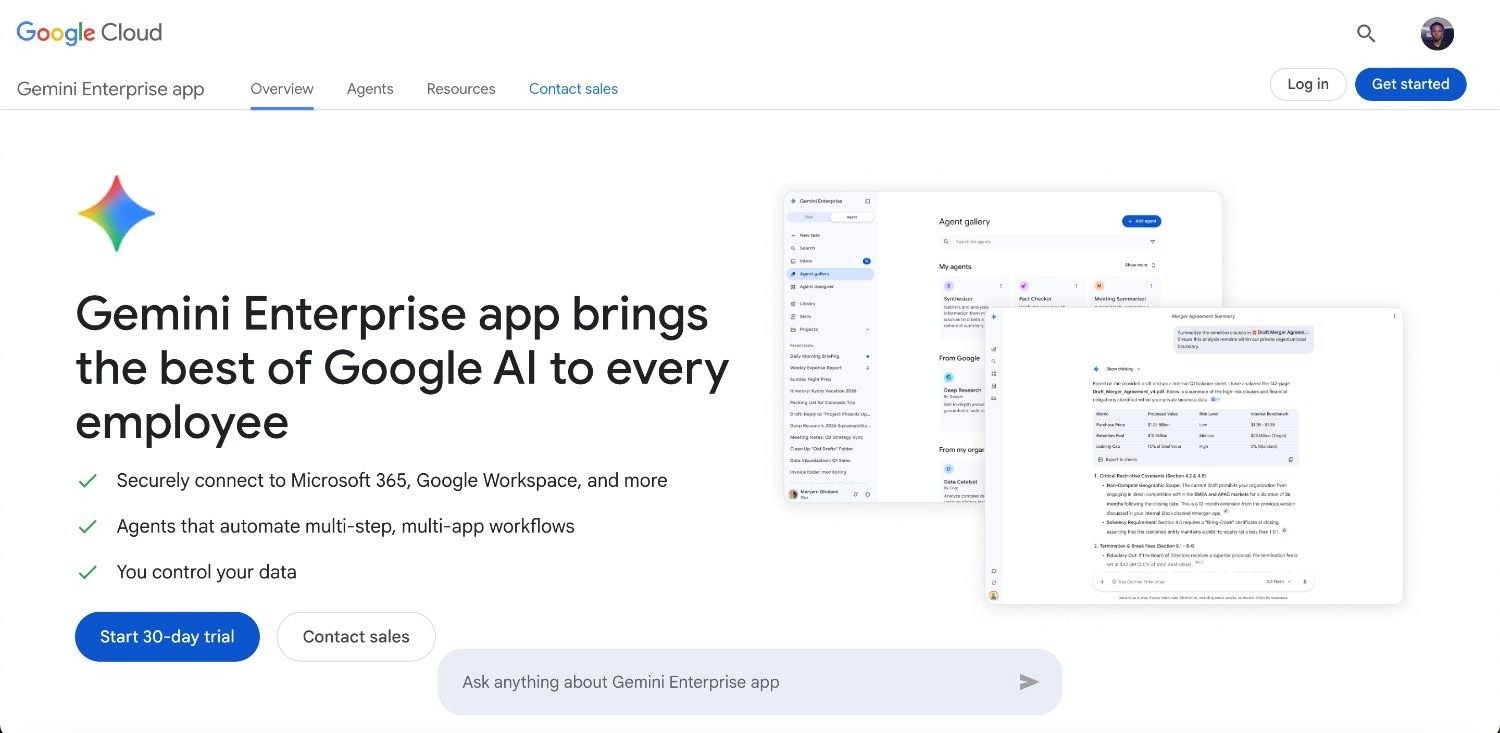
Google Gemini Enterprise is Google's no-code platform for building AI agents, integrated with Google Workspace and a growing roster of third-party apps.
It combines Gemini's large context window and multimodal capabilities with a visual agent designer, making it the natural Copilot equivalent for organisations whose work lives in Gmail, Docs, Sheets, Slides, and Drive rather than Microsoft 365.
Recent updates have added cross-platform knowledge connectors, including SharePoint and Outlook for hybrid environments, narrowing the gap with Copilot for mixed-stack organisations.
Ideal For
Organisations standardised on Google Workspace
Hybrid Google + Microsoft environments needing cross-ecosystem knowledge access
Mid-market companies prioritising simple agent creation over deep operational execution
Top Features
Native Workspace integration: Gmail, Docs, Sheets, Slides, Drive, and Meet.
Large context window with multimodal capabilities: Process long documents and combine text, images, and video.
Cross-platform knowledge connectors: Google Workspace plus SharePoint and Outlook for hybrid environments.
Why It's a Strong Microsoft Copilot Alternative
For Google-first organisations, Gemini Enterprise plays the same role inside Google Workspace that Copilot plays inside Microsoft 365.
It removes Microsoft 365 dependency entirely while providing equivalent productivity assistance and basic agent-building, and the simpler agent designer is easier than Copilot Studio for non-technical builders.
The catch is the same one Copilot has; basically, Gemini stays anchored to its own ecosystem and does not reach deep into the regulated enterprise systems where the operational work actually lives.
Pros
Strong fit for Google Workspace–centric organisations
Strong multimodal capabilities and a long context window
Simpler agent creation experience than Copilot Studio
Cons
Agents are largely siloed within Gemini, with limited ability to act across non-Google tools.
Limited deep integration with regulated enterprise systems (SAP, Guidewire, COBOL cores)
No air-gapped on-premise deployment for sovereignty-restricted clients
Pricing
Google Cloud offers Gemini Enterprise across two main editions for building and deploying AI agents with enterprise search, custom data connectors, and enterprise-grade security:
Business Edition: $20/user/month (about £16) on an annual commitment, or $24/user/month (about £19) on the flexible plan. Suited to teams and small to mid-sized businesses.
Standard and Plus Editions: From $30/user/month (about £24) annual, or $36/user/month (about £28) flexible. Built for larger organisations needing advanced IT controls, higher usage limits, and enterprise-grade compliance.
Google Cloud operates on a pay-as-you-go model for adjacent services, so usage of underlying resources is billed separately based on consumption. A 30-day free trial is available.
Final Verdict
Gemini Enterprise suits organisations already standardised on Google Workspace, looking for what Copilot offers, but inside Google's ecosystem.
Outside Workspace, the same reach and data residency limits that push buyers away from Copilot apply here too, which means it is probably not the alternative you’re looking for.
What Should You Consider When Choosing the Best Microsoft Copilot Alternative?
The right Microsoft Copilot alternative depends on your operational reality, not a feature checklist.
Most buyers come into the evaluation looking for the tool with the longest connector list or the slickest UI, but the ones who end up in production tend to have a different approach:
1. Map Your Process Complexity First
Drafting a Teams meeting summary is a different problem from a multi-step claims resolution workflow that spans five systems and needs a complete audit trail. Treating them as the same problem is how organisations end up with a tool that handles 20% of their automation needs and a six-month integration project for the other 80%.
Before evaluating tools, map the three or four processes that cost the most staff time. Categorise them: structured (same steps every time), semi-structured (mostly predictable with occasional exceptions), or unstructured (highly variable inputs, judgment required). This single exercise eliminates most of the market and reveals whether Copilot Studio is even the right shape of tool for the problem you have.
2. Demand Deterministic Rule Execution
In regulated workflows, AI cannot be the thing that decides whether to approve a claim, post a refund, or update a customer record. You need an architecture that separates AI interpretation of unstructured inputs (emails, scanned PDFs, free-text requests) from hard-coded execution of business rules mapped from your SOPs.
Generative orchestration, where the LLM decides which plugins to call and how to chain them, is fundamentally incompatible with regulated process execution. Ask every vendor on your shortlist where business logic lives: is it in the model, or in code your compliance team can read? If the answer is the model, the platform will not pass an audit.
3. Evaluate Integration Depth, Not Connector Count
A library of 1,400 connectors is only valuable if those connectors reach the systems your process actually touches.
If your operations team works in SAP ECC, Guidewire, a COBOL-era core, or a proprietary in-house platform, a tool with thousands of Microsoft 365 and SaaS connectors does not help you. Ask vendors to demonstrate interaction with your specific systems, not generic cloud apps. If they cannot, the integration gap will surface as a multi-month IT project before you see any automation value.
4. Require a Complete, Replayable Audit Trail
In regulated industries, "it worked" is not sufficient. You need to know what happened, in what order, based on what inputs, according to which rules, and you need to demonstrate it to a regulator.
Look for a step-by-step record of every system interaction, rule evaluation, and output that compliance teams can replay end-to-end. A summary dashboard sitting on top of a black box does not meet this bar.
5. Understand the Deployment Architecture
Where does your data go? Who can access it? What happens if the vendor's infrastructure goes down?
For many regulated industries (banking, insurance, healthcare), the only acceptable deployment model is one where data never leaves your own infrastructure. Look beyond SaaS-only vendors to platforms that offer private VPC, on-premises, or air-gapped deployment as genuine options. Microsoft Copilot Studio does not currently offer air-gapped on-premise, which eliminates it from sovereignty-restricted workloads in European banking and healthcare before evaluation begins.
6. Calculate Total Cost of Ownership, Not Licence Price
The licence fee is rarely the highest cost. Factor in:
Implementation: How much IT time does setup require? Does the vendor provide deployment engineering?
Maintenance: How often do integrations break? How much engineering effort does ongoing maintenance require?
Scaling costs: Does the pricing model (per user, per message, per connector, per conversation) create a cliff edge as adoption grows?
Exit cost: If you need to switch platforms, what is the migration burden? Does the vendor retain your logic and code, or do you?
A tool that is cheap to start can become the most expensive option once maintenance and scaling costs are included, particularly with layered licensing models like Copilot Studio's.
Everything You Need to Know About Microsoft Copilot Alternatives
← scroll to see all columns →
| Company | Pros | Cons | Ease of Use | Integrations | Support | Affordability | Governance |
|---|---|---|---|---|---|---|---|
| Noxus | Legacy execution, zero churn, full audit trail | Needs rule mapping, specialist use case | ⭐⭐⭐⭐⭐ | ⭐⭐⭐⭐⭐ | ⭐⭐⭐⭐⭐ | ⭐⭐⭐⭐⭐ | ⭐⭐⭐⭐⭐ |
| UiPath | RPA track record, process mining, AI docs | Expensive, brittle bots, developer-dependent | ⭐⭐⭐⭐⭐ | ⭐⭐⭐⭐⭐ | ⭐⭐⭐⭐⭐ | ⭐⭐⭐⭐⭐ | ⭐⭐⭐⭐⭐ |
| Beam AI | SOP-to-agent, broad connectors, fast prototype | Self-learning vs. regulation, thin Tier 1 proof | ⭐⭐⭐⭐⭐ | ⭐⭐⭐⭐⭐ | ⭐⭐⭐⭐⭐ | ⭐⭐⭐⭐⭐ | ⭐⭐⭐⭐⭐ |
| Stack AI | Polished UX, strong RAG, free tier | Knowledge work focus, no legacy execution | ⭐⭐⭐⭐⭐ | ⭐⭐⭐⭐⭐ | ⭐⭐⭐⭐⭐ | ⭐⭐⭐⭐⭐ | ⭐⭐⭐⭐⭐ |
| Dify | Open-source, multi-LLM, no lock-in | Engineering-heavy, no enterprise support layer | ⭐⭐⭐⭐⭐ | ⭐⭐⭐⭐⭐ | ⭐⭐⭐⭐⭐ | ⭐⭐⭐⭐⭐ | ⭐⭐⭐⭐⭐ |
| n8n | Self-hosted, extensible, predictable cost | Engineering resource, no compliance layer | ⭐⭐⭐⭐⭐ | ⭐⭐⭐⭐⭐ | ⭐⭐⭐⭐⭐ | ⭐⭐⭐⭐⭐ | ⭐⭐⭐⭐⭐ |
| Salesforce Agentforce | Native CRM depth, Data Cloud grounding | Salesforce-only, per-conversation pricing | ⭐⭐⭐⭐⭐ | ⭐⭐⭐⭐⭐ | ⭐⭐⭐⭐⭐ | ⭐⭐⭐⭐⭐ | ⭐⭐⭐⭐⭐ |
| Google Gemini Enterprise | Workspace-native, multimodal, simple builder | Siloed agents, no air-gapped deployment | ⭐⭐⭐⭐⭐ | ⭐⭐⭐⭐⭐ | ⭐⭐⭐⭐⭐ | ⭐⭐⭐⭐⭐ | ⭐⭐⭐⭐⭐ |
Move Beyond Microsoft Copilot with Noxus
So far, we’ve established that Copilot, Agentforce, and Gemini stay anchored to their ecosystems; Stack AI, Beam, and Dify focus on knowledge work and prototyping; UiPath and n8n offer scale at the cost of brittleness or DIY engineering. None solves the 90% infrastructure problem inside regulated, legacy-heavy enterprises.
That is the gap Noxus closes for organisations running SAP, Guidewire, Oracle, and ServiceNow. Noxus executes operations end-to-end inside those systems, with policy logic and an audit trail that compliance teams can defend.
FAQs About Microsoft Copilot Alternatives
What is a Microsoft Copilot alternative?
A Microsoft Copilot alternative is any AI platform competing with Copilot or Copilot Studio for the same enterprise budget. The category spans productivity assistants (Google Gemini Enterprise), agent builders (Stack AI, Beam AI, Dify), RPA platforms (UiPath, Salesforce Agentforce), and agentic operations platforms (Noxus) that execute multi-system work end-to-end under governance.
What are the best Microsoft Copilot alternatives in 2026?
Noxus is the strongest alternative for regulated enterprises automating operations across legacy systems, with documented 3 to 5x ROI in 45 to 80 days at Tier 1 European banks, insurers, and healthcare groups. UiPath fits organisations extending existing RPA estates, Stack AI excels at knowledge work, Salesforce Agentforce suits Salesforce-centric organisations, and Google Gemini Enterprise mirrors Copilot for Workspace-first teams.
What should I consider when choosing the right Microsoft Copilot alternative?
Map your process complexity first, then evaluate integration depth with your actual systems, governance, and audit capabilities, deployment options against your data residency requirements, and total cost of ownership, including implementation and scaling. Most organisations that move too quickly end up with a tool that handles 20% of their automation needs and creates a new integration problem for the other 80%.
How does Noxus differ from Microsoft Copilot?
Noxus executes operations end-to-end inside legacy systems Copilot Studio cannot reach, including SAP ECC, Guidewire, and COBOL cores. It separates AI interpretation from business rule execution, eliminating LLM-driven decisions on regulated processes. It deploys on-premises and air-gapped, structurally meeting GDPR Article 28, DORA, SOC 2 Type II, ISO 27001, and HIPAA, where Copilot Studio cannot.
Why do most Microsoft Copilot pilots fail to reach production?
Most Copilot pilots fail because Copilot Studio cannot reach the legacy systems where operational work happens. The structural reasons are consistent: shallow legacy integration beyond modern APIs, no deterministic execution layer, no air-gapped deployment for sovereignty-restricted workloads, and layered M365, Power Platform, and Dynamics 365 licensing that hides the total cost of ownership.
How do I deploy Noxus?
Start with a scoping consultation to identify the highest-friction operational workflows in your environment. The Noxus team then maps your business rules and configures the execution runtime to interact with your existing systems. A first production workflow on live data typically goes live within 30 days, with full multi-workflow deployments in 45 to 80 days. No infrastructure modernisation or API layer is required first.
How easy is it to switch from Microsoft Copilot to Noxus?
Switching does not require rebuilding your tech stack or running a parallel migration. Many enterprises run Noxus alongside Copilot rather than replacing it, with Copilot handling Microsoft 365 productivity and Noxus handling operational execution across legacy systems. Implementation focuses on mapping business rules and SOPs, not re-architecting infrastructure. First production workflow typically goes live within 30 days.