Best Customer Sentiment Analysis Tools in 2026 (Reviewed & Compared)

Not all customer sentiment analysis tools are built for the same job. Some focus on social media monitoring, others go deep on open-text feedback from surveys and support tickets, and a handful connect detection all the way through to operational resolution. Which one fits depends entirely on what you plan to do with the signal.
Below are the ten strongest options in 2026, reviewed and compared on AI capabilities, integration depth, deployment models, and operational fit.
Key Takeaways (TL;DR)
Best for End-to-End Customer Sentiment Analysis Tool: Noxus is the strongest choice for regulated enterprises that need sentiment signals to trigger automated case resolution inside SAP, Guidewire, and legacy core banking systems; not just route an alert.
Why You Need It: Over half of large organisations now embed AI-powered sentiment analysis as core infrastructure. Detecting sentiment is the easy part; getting that signal to trigger action before the customer churns is where most programmes fall short.
Who It's For: CX leaders, insights managers, product teams, and operations directors in financial services, insurance, healthcare, and retail who need to convert sentiment signals into measurable retention and revenue impact, not just populate dashboards.
How to Choose: When evaluating the best customer sentiment analysis tools, prioritise AI text analytics depth that surfaces root causes rather than summary scores, integration with the CRM and helpdesk you already run, and whether the tool connects sentiment to operational resolution or stops at the alert.
Expected Price: Consumption-based monthly platform licence. Pricing scales with operational volume and deployment model, not headcount or seats. No per-token or per-bot fees.
Table of Contents
Top Customer Sentiment Analysis Tools in 2026 at a Glance
← scroll to see all columns →
| Company | Best For | Key Features | Pricing |
|---|---|---|---|
| Noxus | End-to-end operational resolution of cases surfaced by sentiment analysis, across legacy enterprise systems |
AI Co-workers
400+ native connectors
Deterministic policy enforcement
Full audit trail
SaaS/VPC/on-prem
|
Custom, consumption-based |
| Chattermill | AI text analytics and root cause analysis for mid-to-large enterprises |
Lyra AI
Unified multi-source feedback
KPI correlation
Theme detection
|
Custom enterprise pricing |
| Qualtrics XM | Enterprise experience management with advanced survey analytics |
Text iQ
Stats iQ
Omnichannel feedback
Driver analysis
|
Custom enterprise pricing |
| Medallia | Real-time signal capture across voice, digital, and contact-centre |
Multi-source AI signals
Frontline coaching
Journey orchestration
|
Custom enterprise pricing |
| Brandwatch | Social listening and brand reputation management at scale |
Consumer intelligence
Demographic breakdowns
Competitive tracking
|
Custom enterprise pricing |
| InMoment | Enterprise XI programmes with bundled professional services |
Active Listening AI
Auto-tagging
Journey mapping
Omnichannel
|
Custom enterprise pricing |
| Sprout Social | Social media management with integrated sentiment tracking |
Sentiment scoring
Manual override
Publishing tools
CRM sync
|
From $199/seat/month |
| Lexalytics (Semantria) | Deep NLP and custom model training for global enterprises |
Sentence-level scoring
Industry-specific training
Multilingual support
|
Custom |
| IBM Watson NLU | Enterprise teams building custom NLP pipelines |
Entity-level sentiment
Emotion detection
Custom model training
|
Usage-based Free tier available |
| Microsoft Azure AI Language | Developer teams in the Microsoft ecosystem |
Pre-trained sentiment
Aspect-based opinion mining
100+ languages
|
Pay-per-use Free tier available |
What Are Customer Sentiment Analysis Tools?
Customer sentiment analysis tools use artificial intelligence and natural language processing (NLP) to identify and interpret the emotional tone in customer communications, whether that's an email complaint, a product review, a support ticket, a post-call transcript, or a social media mention.
Every tool in this category classifies text as positive, neutral, or negative, but the best customer reviews software has moved well past that baseline. Today's leading tools layer AI-driven theme detection, aspect-based analysis (tying sentiment to specific product or service features), emotion classification, and intent detection on top of basic polarity scoring.
There are four core analysis types worth understanding:
Fine-grained sentiment moves beyond positive/neutral/negative to a wider scale (very positive, positive, neutral, negative, very negative), giving CX teams more resolution on where the experience is breaking.
Aspect-based analysis identifies sentiment tied to specific features, touchpoints, or service attributes within a single piece of feedback. A customer who writes "the checkout was easy, but delivery was appalling" gets two sentiment scores, not one blended one.
Emotion detection identifies specific psychological states (anger, frustration, joy, disappointment) beyond polarity, which is useful for prioritising detractor response by urgency rather than just volume.
Intent analysis attempts to determine what the customer was trying to accomplish. A complaint about a billing error combined with intent to cancel is a different operational priority than a complaint about an interface, and the tools that surface intent give CX and operations teams a clearer routing signal.
Why You Need Customer Sentiment Analysis Software
Most sentiment programmes, and much of the best customer satisfaction software on the market, have a measurement problem that looks like a tool problem but is an execution problem.
The signal is captured. The dashboard shows the trend. The weekly report goes to the CX director. And nothing changes, because the customer who flagged the problem is one of thousands, the open-text comment sits unread in a CSV export, and no workflow exists to route the signal to the team that can act on it.
That gap is where churn happens. Now, over half of large organisations embed the best customer sentiment analysis tools as their core infrastructure, but embedding detection isn't the same as closing the loop. Three outcomes matter:
Visibility at the speed of volume: AI text analytics surfaces themes, root causes, and sentiment drivers across tens of thousands of open-text responses in real time, replacing the manual tagging that buries most CX teams and delays insight by weeks.
Routing that reaches the right owner: Detractor signals need to become triggered actions in the CRM, helpdesk, or operations workflow, not a tile in a dashboard that someone checks occasionally. The speed between the signal and reaching the right owner determines whether the account is saved.
Operational execution that resolves the case: Most customer sentiment analysis tools stop at routing an alert. The customer with a billing error needs that error fixed inside the system that owns the record, not a notification to a customer success manager who then does that work manually across three or four separate tools. The distinction between alerting a human and resolving the case operationally is where the ROI of sentiment programmes is won or lost.
Sentiment analysis works only when the signal connects to the systems that own the outcome. That distinction is what this comparison is built around.
Who Needs Customer Sentiment Analysis Tools?
The right tool varies sharply by role, scale, and how far into operational execution your programme needs to reach.
CX and Customer Experience Leaders
CX leaders own loyalty, retention, and the sentiment trend that appears in the board pack. They need multi-channel signal capture, AI-driven root cause analysis, and the ability to show that specific themes correlate with measurable business outcomes, not just that sentiment moved.
What they care about most is whether those shifts translate into early intervention before churn shows up in the renewal numbers, because by the time a CSAT drop is visible on a quarterly chart, the damage is already compounding.
Customer Success and Account Management Teams
Customer success leaders in B2B SaaS and financial services, who typically rely on customer success software reviews to evaluate tool fit, need sentiment data flowing into the CRM so the signal sits alongside contract value, product usage, and support history in the account record.
For this audience, integration depth into Salesforce or HubSpot matters more than survey design flexibility. A tool that captures sentiment but keeps it in its own dashboard creates an internal data silo rather than solving a retention problem.
Operations and Service Delivery Leaders
Service-heavy businesses, including banking, insurance, healthcare, retail, and field services, need sentiment signals to reach frontline staff and drive daily behaviour change, not quarterly reporting cycles.
They also need the feedback loop to reach the back-office systems where resolution actually happens. A customer flagging a direct debit error needs that error corrected inside the core banking system, and a complaints director in insurance needs policy corrections logged in Guidewire. Routing an alert without resolving the underlying case in the source system is half a solution.
Product and Digital Teams
Product teams need in-context feedback tied to specific features and release cycles, with tight integration into product analytics. Aspect-based sentiment analysis is particularly valuable here, as it tells a product manager which capabilities are driving negative signals without requiring them to read individual tickets.
IT and Architecture Leaders in Regulated Sectors
If you're evaluating sentiment tools for European financial services, insurance, or healthcare, your primary concerns are data residency, GDPR compliance, and where customer data is actually processed.
Tools that send customer communications data to shared cloud environments without clear data sovereignty guarantees aren't viable for most regulated European enterprises, regardless of their analytical capabilities.
Best Customer Sentiment Analysis Tools: In-Depth Reviews
1. Noxus
Overview
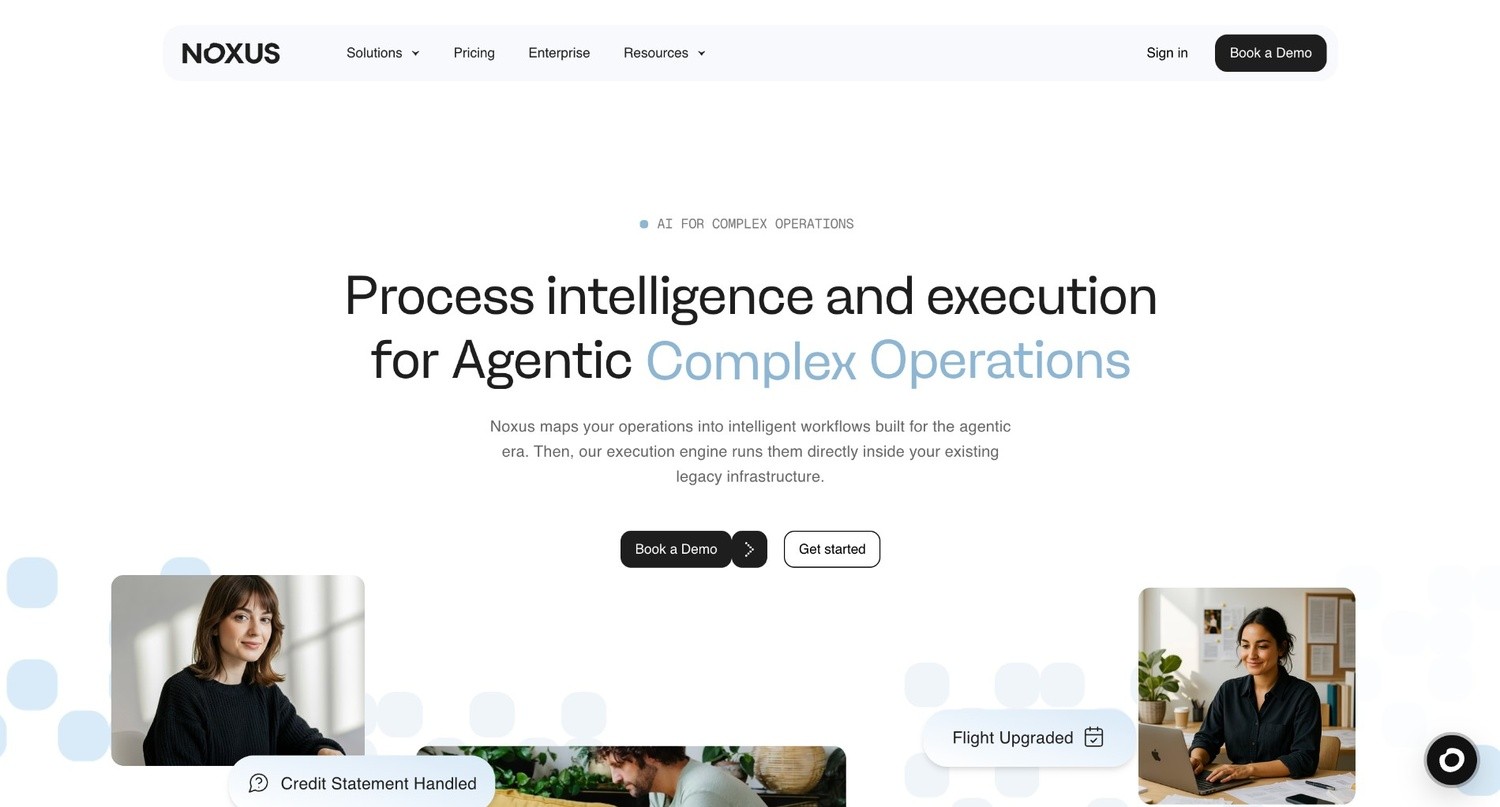
Noxus is an agentic operations platform that deploys AI Co-workers to execute complex, multi-system workflows end-to-end across legacy enterprise environments. Founded in 2023, it is built for regulated European enterprises running SAP, Guidewire, ServiceNow, Oracle, and COBOL-era core systems that other AI vendors will not touch.
Where every other tool in this list detects sentiment and routes an alert, Noxus resolves the underlying case: pulling the account record, applying your business rules, executing the correction, and writing the outcome back to the source system with a complete audit trail. Noxus is the operational execution layer that closes the gap between a detractor signal and a resolved case.
Live in production at Santander, Fidelidade, CUF, and Jerónimo Martins across banking, insurance, healthcare, and retail.
Ideal For
Operations leaders at European enterprises in financial services, insurance, and healthcare who need cases resolved in source systems, not just flagged
IT and architecture leaders in regulated industries requiring deployment sovereignty, GDPR-compliant infrastructure, and full decision auditability
Organisations running legacy back-office systems with no API layer who cannot use middleware-dependent automation tools.
CX programmes that have detection and routing in place but need the operational resolution step automated end-to-end
Enterprise and mid-market buyers replacing BPO contracts or failed RPA deployments with production-grade agentic automation.
Top Features
End-to-end execution runtime: Autonomous execution of multi-step operational workflows, from unstructured intake (emails, scanned documents, portal submissions) through system lookups, rule application, and write-back to source systems. The execution runtime does not draft or suggest; it resolves.
400+ native connectors, including legacy systems: Connects to SAP ECC, Guidewire, Oracle, ServiceNow, Salesforce, and proprietary in-house platforms at database, screen, and file level, without requiring modern APIs or infrastructure modernisation as a prerequisite.
Deterministic policy enforcement: Business rules are hard-coded directly from your SOPs. AI handles unstructured input interpretation; your rules govern every decision. No LLM decides whether to approve a claim or process a refund.
Full audit trail and replayability: Every agent decision, action, and system interaction is logged with complete traceability. Every process run can be replayed, inspected, and presented to compliance teams or regulators.
Deployment sovereignty: Three deployment models: fully managed SaaS, self-managed VPC on client cloud, and air-gapped on-premises. Data stays where you put it. GDPR compliance is structural, not contractual.
Why We Stand Out
Noxus is the only tool in this list that resolves operational cases rather than detecting and alerting on them. Every other tool surfaces the signal. Noxus acts on it, inside the systems that own the record.
The legacy integration depth is the core differentiator. Noxus interacts with legacy systems the way your operations teams do today, navigating interfaces, performing multi-step lookups, and writing back results across systems that were never designed to talk to each other. No API modernisation required. No middleware project. No infrastructure re-architecture as a prerequisite.
At Santander, that translated to 3x ROI in 45 days on live operational data, with the contract structured for global rollout across up to 15 regions.
Pros
Resolves cases end-to-end in source systems, not just routes alerts
Operates natively on legacy systems with no API layer required
Deterministic execution with full audit trail satisfies compliance requirements in banking, insurance, and healthcare
Deployment sovereignty: SaaS, private VPC, or air-gapped on-premises
45 to 80 days from contract to first production deployment on live data; zero churn across all clients to date
Cons
Not a standalone sentiment analysis tool; requires a CX tool upstream to surface the signal.
Enterprise and mid-market positioning; not suited to SMB budgets or single-system environments
Consumption-based custom pricing requires a scoping conversation before cost modelling.
Pricing
Consumption-based monthly platform licence. Custom pricing based on operational volume and deployment model. No per-seat, per-token, or per-bot pricing. Costs are predictable and scale with usage, not headcount. Contact Noxus for a scoping conversation.
Final Verdict
Noxus is the strongest choice for regulated European enterprises that need sentiment signals to trigger operational resolution inside legacy back-office systems, not just notifications to a relationship manager. It isn't a sentiment analysis tool and doesn't replace the detection layer; it completes it. Organisations that already have Chattermill, Medallia, or Qualtrics surfacing the signal and need those signals to close cases in SAP, Guidewire, or core banking without a manual handoff will find no closer fit in this category.
2. Chattermill
Overview
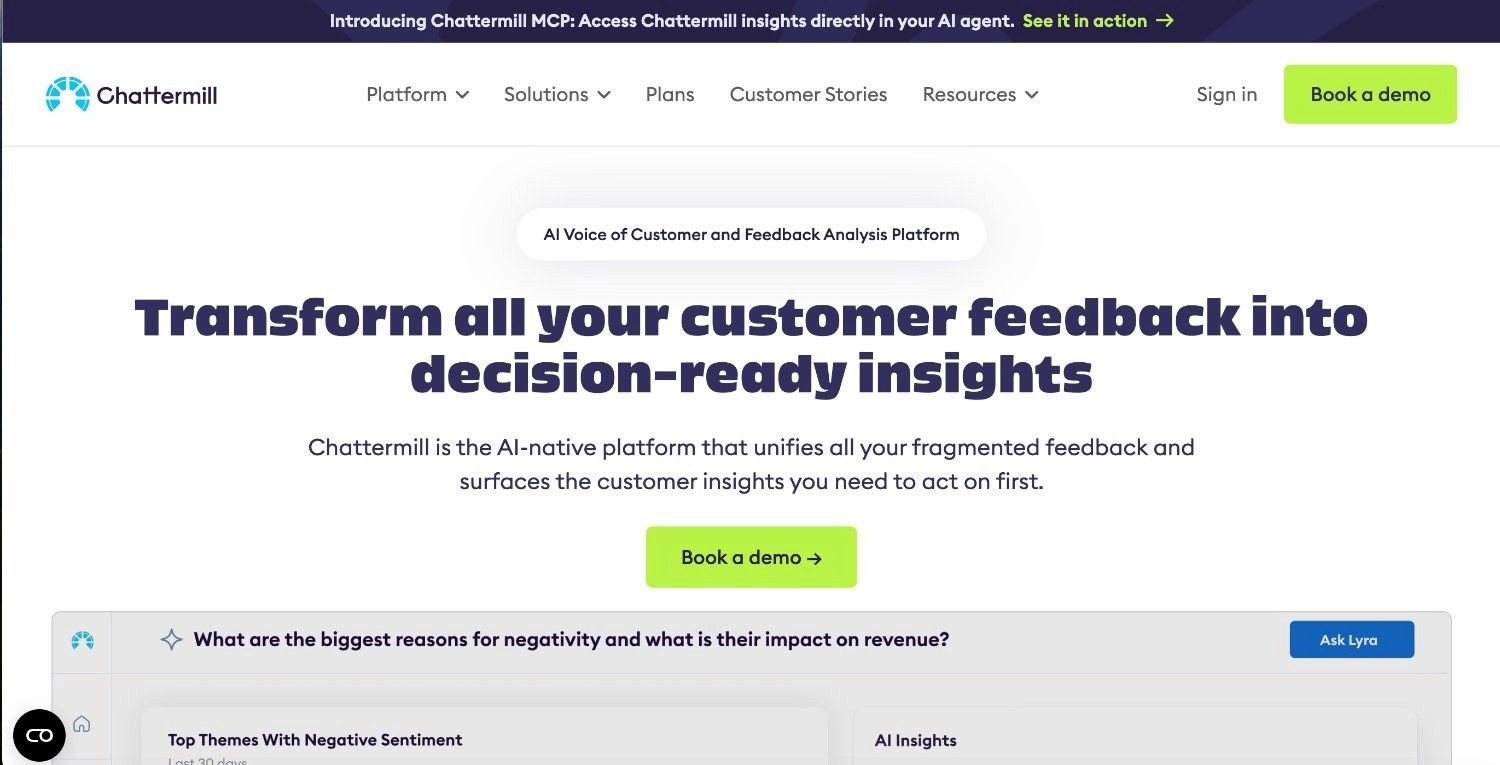
Chattermill is an AI-powered customer experience intelligence tool that pulls feedback from every channel (surveys, support tickets, reviews, social media, chat transcripts) into a single analysis layer, powered by its proprietary Lyra AI engine.
Used by global brands, Chattermill is built for the analytics layer rather than survey collection, making it both a complement to and a deeper replacement for the text analytics modules in Qualtrics and Medallia.
Where most sentiment tools tell you what customers feel, Chattermill surfaces why, identifying the specific themes, features, and service attributes driving sentiment shifts and connecting those findings directly to business metrics like NPS, churn, and revenue.
Ideal For
CX and insights teams at mid-to-large enterprises processing feedback from multiple sources (surveys, support, reviews, social)
Product teams that need theme-level signal tied to specific features and business outcomes
Organisations that collect feedback in multiple tools and need a unified intelligence layer without re-platforming collection
Enterprises that need to demonstrate the revenue and retention impact of CX investment to leadership
Teams that have outgrown the text analytics depth of Qualtrics Text iQ or Medallia's AI layer
Top Features
Lyra AI: Chattermill's AI engine produces concise, board-ready summaries of large feedback datasets and identifies specific themes within individual responses, not just overall sentiment. A single ticket can surface multiple positive and negative signals assigned to distinct product or service attributes.
Unified multi-source feedback: Aggregates feedback from survey tools, helpdesks, review tools, and social channels into a single analytical view without replacing any of the existing collection tools.
KPI correlation: Links sentiment themes directly to NPS, CSAT, churn, and revenue data, so CX leaders can answer not just what customers think but what it's costing the business.
Root cause analysis: Surfaces the specific drivers of satisfaction shifts rather than summarising overall tone. When NPS drops 4 points, Chattermill identifies which theme, touchpoint, or product attribute moved.
Chattermill CX intelligence: Forecasts which themes are likely to impact retention based on historical signal patterns, giving CX teams the lead time to intervene before churn materialises.
Why Chattermill Stands Out
Chattermill's AI text analytics depth is one of the strongest in this category, particularly for organisations that collect feedback from many sources and need a single intelligence layer that doesn't require them to re-platform their collection tools.
The KPI correlation capability is more sophisticated than most competitors. For CX teams who need to prove business impact quantitatively, not just report sentiment trends, this matters more than any other feature on the list. Uber has used Chattermill to scale CX intelligence across five mega-regions, and Tesco uses it to unify feedback across channels at retail scale.
Pros
Strongest AI text analytics in this list across multi-source feedback
Lyra AI surfaces root causes and specific drivers, not just summary scores
Connects sentiment themes directly to business metrics, including churn and revenue
Complements existing survey and helpdesk tools rather than replacing them
Faster to implement than enterprise XM suites; insights are typically available within weeks
Cons
Analytics-only; doesn't include native survey collection
Less useful for teams that haven't yet established multi-source feedback collection
Custom pricing positions it above mid-market analytics budgets
Doesn't execute operational resolution workflows in back-office systems
Pricing
Custom, quote-based. Chattermill doesn't publish pricing. Contact for enterprise quotes.
Final Verdict
Chattermill is the strongest pure analytics choice for mid-to-large enterprises whose programmes already collect feedback from multiple sources and need a unified AI intelligence layer that surfaces root causes and KPI impact. It's not the right fit for teams starting a first NPS programme or for organisations that need primary survey collection rather than analytics depth.
3. Qualtrics XM
Overview
Qualtrics XM is the dominant enterprise experience management suite, covering customer experience, employee experience, product experience, and brand research in a single product. Its sentiment analysis capabilities sit within the Customer Experience product, powered by Text iQ, Qualtrics' AI engine for open-text analysis.
For organisations that want one tool across every experience programme and have the analyst capacity to operate it, Qualtrics is the category default.
Ideal For
Large enterprises running multi-programme XM across CX, employee, and product experience
Research and academic teams requiring advanced statistical methodology alongside sentiment
Organisations with dedicated CX analyst teams to extract its full value
Multi-region, multi-language global deployments with strict governance requirements
Top Features
Text iQ: AI-powered text analytics that surfaces themes, sentiment, and emotion across open-ended responses, with a refined 5-label sentiment system from "Very Negative" to "Very Positive."
Stats iQ: Built-in statistical analysis, including significance testing, regression, and key driver analysis, replacing SPSS or R for most teams.
Omnichannel distribution: Survey deployment across email, SMS, web, mobile, IVR, and chat from a single product.
Advanced survey logic: Branching, quotas, randomisation, and embedded data for research-grade survey design, the most flexible in the category.
Why They Stand Out
Qualtrics XM's breadth across four experience pillars, combined with genuine methodology depth, is among the most comprehensive combinations in the market. It's trusted by research teams as much as CX practitioners, which is rare in this category.
Pros
Most flexible survey design with research-grade methodology
AI-driven text and statistical analysis through Text iQ and Stats iQ
Single product covering customer, employee, product, and brand experience
Wide integration ecosystem and strong governance posture for regulated industries
Cons
Steep learning curve; analyst teams are typically required to extract full value
Text iQ and Stats iQ are priced as add-ons on top of the base licence
Implementation timelines often reach six months or more for enterprise deployments
High cost; base contracts start in five figures and scale into six figures
Pricing
Custom, quote-based. Qualtrics doesn't publish pricing. Annual contracts only; add-ons priced separately.
Final Verdict
Qualtrics XM is recommended for enterprises with dedicated CX teams, multi-programme XM requirements, and budgets to match. Organisations that need sentiment analytics depth without the full XM overhead will find Chattermill a faster, more focused option.
4. Medallia
Overview
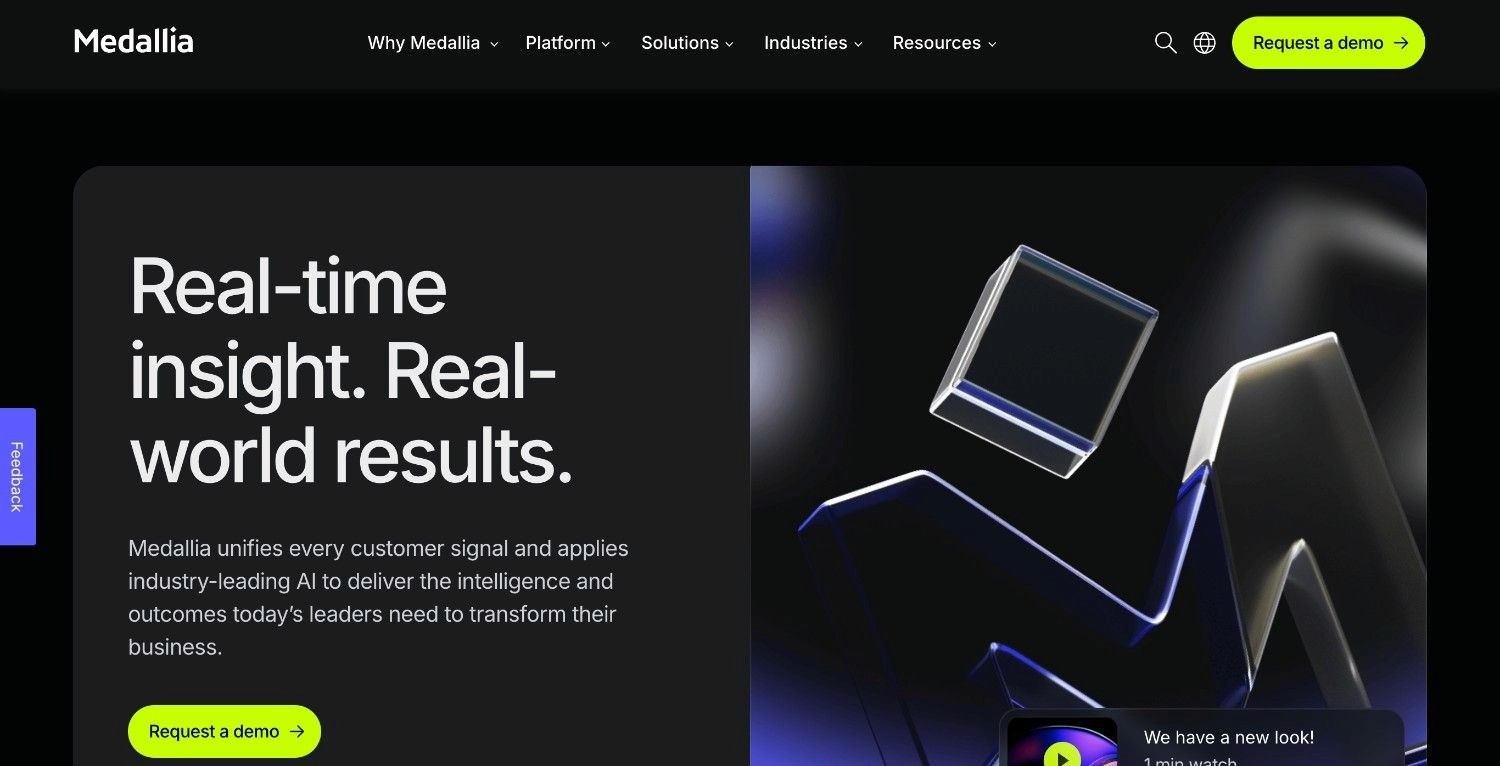
Medallia is an enterprise experience management suite focused on real-time signal capture across surveys, voice, video, social, contact-centre, and behavioural data. Acquired by Thoma Bravo in 2021, Medallia's differentiation is the breadth of its signal sources and the maturity of its frontline action management workflows.
Ideal For
Large enterprises with contact-centre-heavy operations in financial services, telecom, and hospitality
Organisations with mature frontline action workflows where individual employee performance affects CX scores
Companies needing voice and video feedback alongside survey-based sentiment
Top Features
Multi-source signal capture: Surveys, voice, video, social signals, and contact-centre data in a single product, broader than most survey-only competitors.
AI-driven text analytics: Sentiment, intent, and key driver analysis across structured and unstructured feedback at enterprise scale.
Real-time frontline alerting: Routes detractor signals to specific roles and locations based on signal type and severity, enabling same-day service recovery.
Why They Stand Out
Medallia's signal breadth is a genuine differentiator. Voice, video, and contact-centre data flow into the same product as NPS and CSAT, a rarity among competitors, where surveys are still the primary input. Real-time alerting and frontline action management are among the most mature in the market.
Pros
Broadest signal capture in the category: surveys plus voice, video, social, and behavioural data
Real-time alerting and frontline action workflows
Deep contact-centre integration
Mature governance, compliance, and enterprise controls
Cons
High pricing; typically not viable for mid-market buyers
Long implementation timelines, often six months or more
Dependency on paid managed services, even for routine configuration changes
Pricing
Custom, quote-based. Licensing scales with experience data record (EDR) volume. Enterprise contracts commonly reach six figures annually, with implementation services adding meaningfully to the total.
Final Verdict
Medallia is recommended for enterprises whose CX strategy depends on real-time multi-channel signal capture and frontline action management. It's not the right fit for mid-market organisations or teams that need to move quickly.
5. Brandwatch
Overview
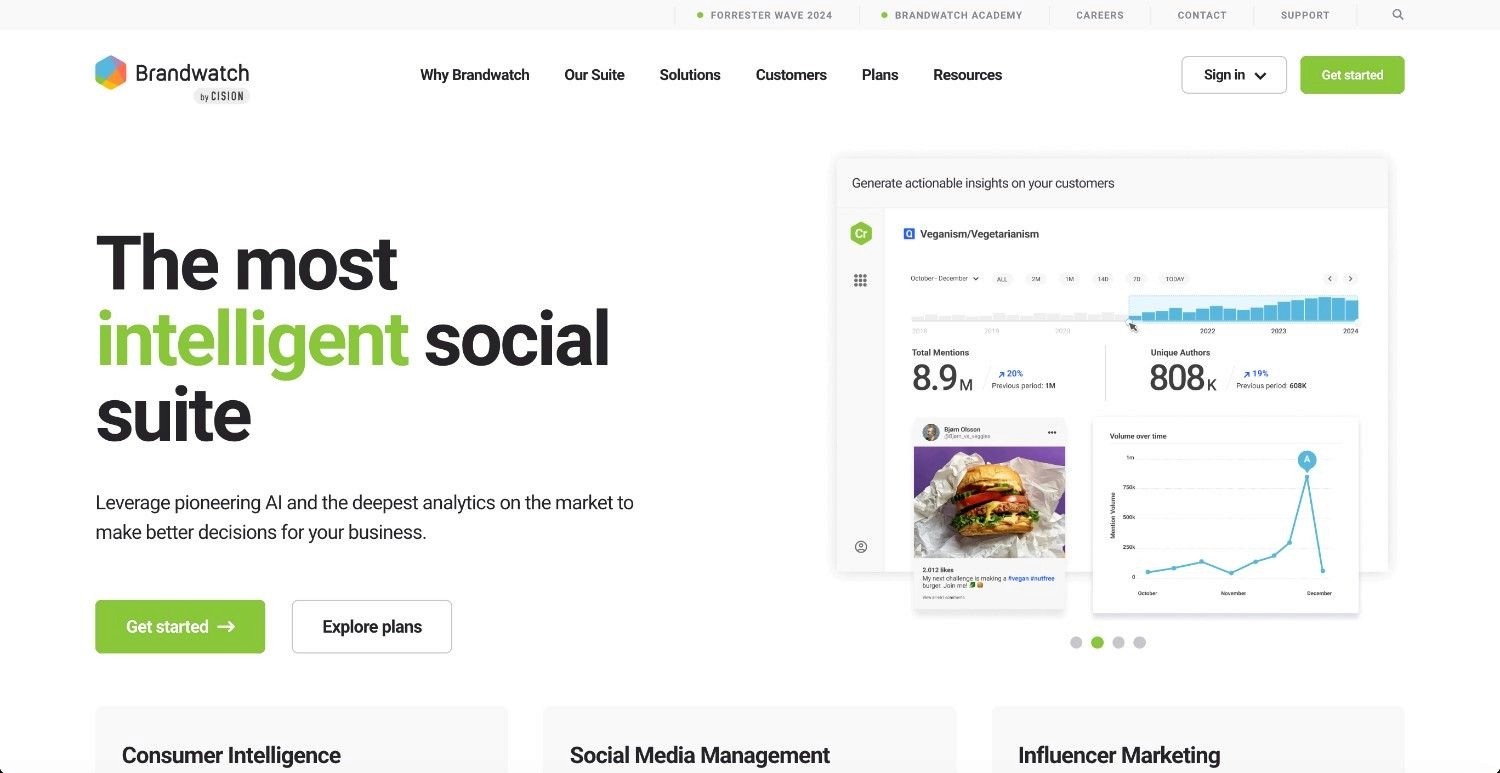
Brandwatch is an enterprise social intelligence tool that monitors brand sentiment across social media, news, blogs, forums, and review sites at scale. It's designed for brand teams, PR departments, and marketing organisations that need to understand how their brand is perceived in public channels.
Ideal For
Enterprise brand and marketing teams managing global reputation across social channels.
PR and communications departments needing real-time brand perception monitoring
Market research teams tracking competitive sentiment and industry narrative trends
Top Features
Consumer intelligence at scale: Monitors hundreds of millions of public data sources with demographic and geographic sentiment breakdowns.
Real-time alerts: Flags negative sentiment spikes as they emerge, enabling brand teams to respond before issues escalate.
Competitive intelligence: Tracks competitor brand sentiment alongside your own for benchmarking and trend comparison.
Why They Stand Out
Brandwatch's data breadth across social media, news, and review tools is unmatched in the public-channel monitoring category. The demographic and geographic breakdown capabilities are particularly valuable for brands managing regional reputation across multiple markets.
Pros
Extensive data coverage across social media, news, and review tools
Strong demographic and geographic sentiment breakdowns
Real-time monitoring and competitive intelligence built in
Proven at enterprise scale for global brand management
Cons
Focused entirely on public brand sentiment, not suited to internal customer operations or back-office complaint resolution
Doesn't connect to operational resolution workflows or legacy back-office systems
Premium pricing makes it inaccessible for mid-market budgets
Pricing
Custom, quote-based. Enterprise-positioned pricing. Contact for quotes.
Final Verdict
Brandwatch is a strong choice for enterprise brand and marketing teams that need comprehensive social listening and reputation management. It isn't designed for operational customer sentiment analysis tied to complaint resolution or back-office execution.
6. InMoment
Overview
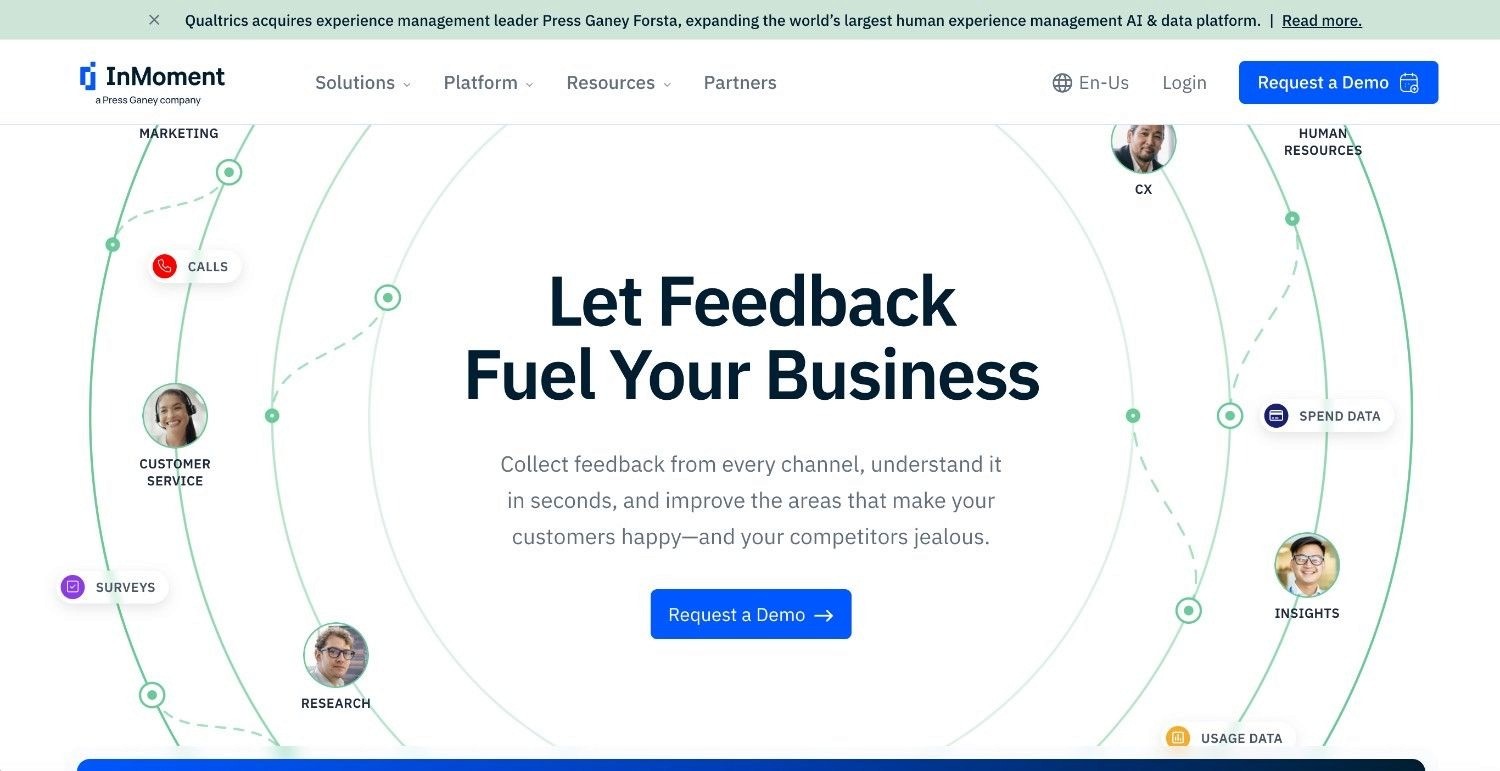
InMoment offers an Experience Improvement (XI) programme for enterprises that want to listen, analyse, and act on feedback across the full customer journey. Acquired by Press Ganey Forsta in May 2025, InMoment continues to operate with its own product identity and is particularly strong in retail, hospitality, and contact-centre-heavy verticals.
Ideal For
Large enterprises in retail, travel, and hospitality wanting product plus strategic consulting in one relationship
CX programmes organised around the customer lifecycle and journey mapping
Organisations with high open-text volume that need AI to improve response quality
Top Features
Active Listening AI: Prompts more detailed customer responses in real time during survey completion and uses generative AI to enrich open-text feedback with additional context.
Journey mapping: Overlays feedback data onto the customer lifecycle, surfacing the specific points where experience breaks down at scale.
Auto-tagging: Real-time thematic tagging of qualitative feedback for routing, analysis, and case escalation.
Why They Stand Out
InMoment's combination of product plus bundled professional services is a genuine differentiator for organisations that want strategic implementation support rather than a self-serve tool. The Active Listening AI capability improves the quality of open-text data before it reaches the analysis layer, an upstream enrichment step that most tools don't offer.
Pros
Journey mapping and lifecycle-centric analytics more mature than most competitors
Bundled professional services reduce internal implementation burden
Active Listening AI improves the quality of open-text feedback at collection
Particularly strong in retail, travel, and hospitality
Cons
Software-plus-services model limits self-service flexibility
Customisation often requires InMoment's professional services team rather than in-house configuration
Less suited to B2B feedback programmes than to consumer and service verticals
Pricing
Custom, quote-based. Mid-to-upper enterprise pricing. Annual contracts typically bundle professional services into the fee.
Final Verdict
InMoment is recommended for enterprises in retail, hospitality, and contact-centre-heavy industries that want product plus strategic consulting in one relationship. It's not the right fit for B2B SaaS teams, self-serve mid-market deployments, or buyers who want full configuration control without involving professional services.
7. Sprout Social
Overview
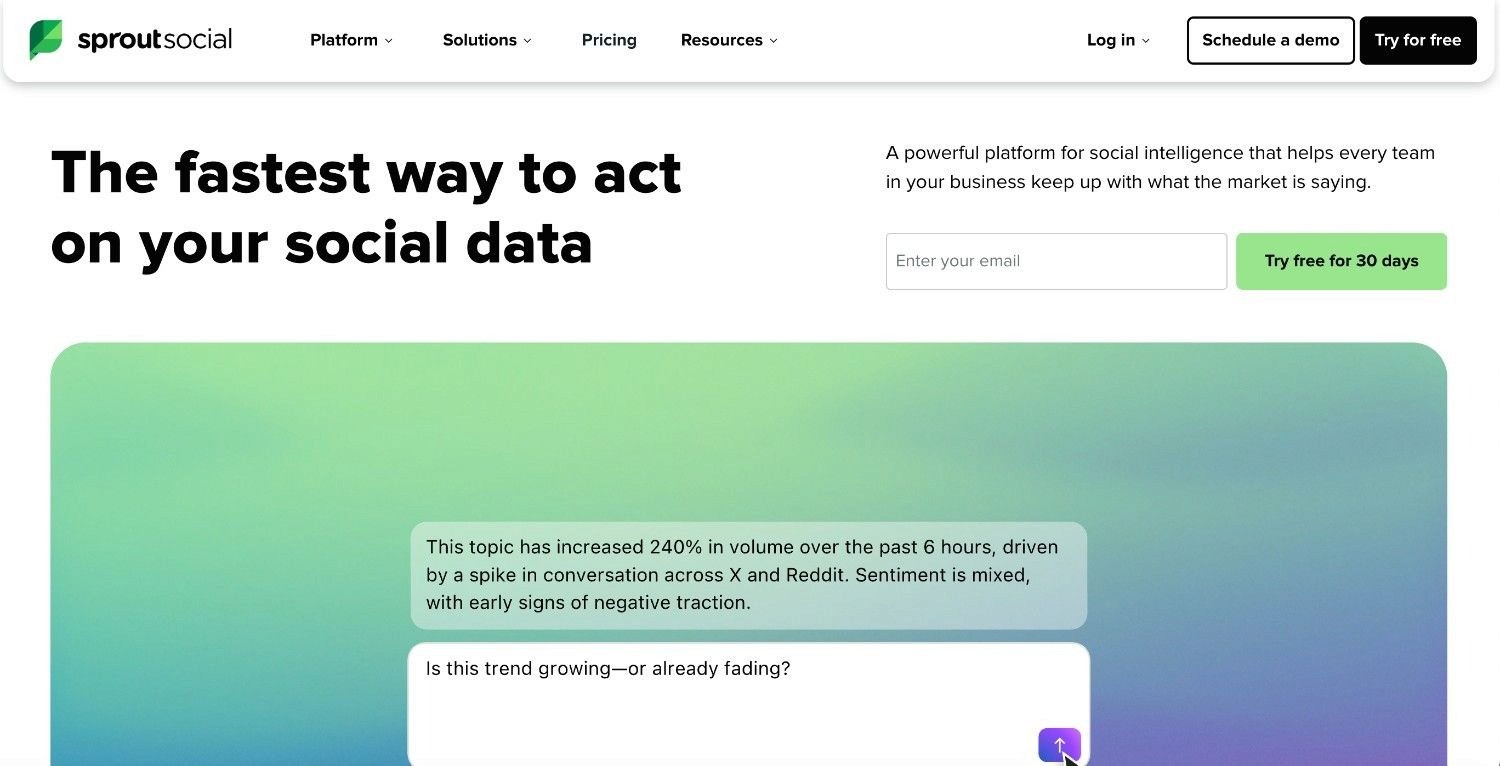
Sprout Social is an all-in-one social media management tool that includes sentiment analysis as part of its analytics suite. It's primarily designed for marketing and social media teams that need to manage publishing, engagement, and performance measurement alongside basic sentiment tracking across social channels.
Ideal For
Marketing and social media teams at mid-market to enterprise brands
Customer service teams handling social media enquiries alongside publishing and scheduling
Organisations that need social media management and sentiment tracking in one product without a separate analytics tool
Top Features
Integrated sentiment tracking: Analyses sentiment across social mentions and messages with the ability to manually override AI classifications to improve accuracy over time.
Social listening: Monitors brand mentions and keywords across social channels with trend analysis and topic modelling.
CRM sync: Connects social interactions to CRM records for a unified view of customer engagement history.
Why They Stand Out
Sprout Social is one of the most accessible entry points for teams that need social sentiment analysis alongside social media management. The combined product reduces tool sprawl for marketing teams managing both content and community, and the manual override capability gives teams control over AI accuracy without requiring data science resources.
Pros
Combines social media management and sentiment analysis in one product
Accessible pricing compared to specialist enterprise sentiment tools
Manual override improves AI classification accuracy over time
Strong CRM integration for connecting social sentiment to customer records
Cons
Sentiment analysis limited to social channels only, not email, documents, or back-office communications
Doesn't connect to operational resolution workflows or legacy systems
Advanced analytics depth is limited compared to specialist sentiment intelligence tools
Pricing
From $199/seat/month (billed annually). Enterprise plans available on custom terms.
Final Verdict
Sprout Social is a sensible choice for marketing and social media teams that need sentiment tracking alongside publishing and engagement management. It isn't suited to operations leaders or CX teams that need sentiment signals to route into operational workflows beyond social channels.
8. Lexalytics (Semantria)
Overview
Lexalytics, operating as Semantria, is an advanced enterprise text analytics tool with detailed, sentence-level sentiment scoring, topic modelling, and entity extraction. It's designed for large enterprises and global organisations that need deep NLP analysis on high volumes of text, with customisation for industry-specific terminology.
Ideal For
Large enterprises with global operations requiring multilingual sentiment analysis with cultural context
Research and analytics teams that need detailed scoring beyond basic positive/negative classification
Organisations with domain-specific vocabulary, including financial services, healthcare, and legal, requiring custom model training
Top Features
Sentence and entity-level scoring: Sentiment scores at sentence, aspect, and entity level, going significantly further than binary classification.
Industry-specific model training: Customises NLP models for domain-specific language, particularly valuable in financial services, healthcare, and legal sectors.
Multilingual analysis: Sentiment analysis in dozens of languages with cultural context awareness, relevant for European enterprises with multi-country operations.
Why They Stand Out
Lexalytics is one of the most analytically deep NLP tools available. For organisations that need to explain what's driving sentiment at the sentence, feature, or agent level, it has the scoring precision to do so.
Pros
Deeper analytical scoring than mainstream sentiment tools, with sentence and entity-level precision
Strong multilingual capabilities for European multi-country operations
Highly customisable for industry-specific terminology
Proven in enterprise deployments across financial services and retail
Cons
Complex to deploy and configure; typically requires specialist implementation.
No built-in operational integration with the best workflow automation software or legacy systems
Custom pricing with no published entry point
Pricing
Custom. Enterprise-positioned. Contact Lexalytics for quotes.
Final Verdict
Lexalytics is a strong choice for analytics teams at large enterprises needing deep, precise NLP with high customisation. It isn't suited to teams that need rapid deployment, pre-built dashboards, or sentiment connected to operational workflows.
9. IBM Watson Natural Language Understanding
Overview
IBM Watson Natural Language Understanding (NLU) is an enterprise AI service providing deep NLP analysis, including sentiment detection, emotion classification, entity extraction, and concept analysis, delivered via API. It's designed for development teams building custom AI applications that require advanced text analysis without building models from scratch.
Ideal For
Enterprise engineering and data science teams building custom NLP pipelines
Organisations already invested in IBM cloud infrastructure
Development teams needing entity-level sentiment tied to specific products, people, or topics within a text
Top Features
Entity-level sentiment: Detects how customers feel about specific products, services, or people mentioned in a text, not just the overall document sentiment.
Emotion detection: Identifies specific emotions (anger, fear, joy, sadness, disgust), going beyond polarity scoring to the psychological state behind the communication.
Custom model training: Industry-specific models trained on proprietary terminology to improve accuracy for specialist domains.
Why They Stand Out
Watson NLU's entity-level analysis and emotion detection go further than most tools in identifying the psychological state and specific targets of customer sentiment. For organisations building custom applications, that analytical precision is a genuine asset.
Pros
Entity-level and emotion detection beyond basic positive/negative scoring
Highly customisable with industry-specific model training
Pay-as-you-go with a free tier for evaluation
API-first architecture integrates with any existing application stack
Cons
Developer-only; requires engineering resources to implement and maintain
No pre-built dashboards, operational workflows, or legacy system connectors
Doesn't include front-end analytics or business metric connections out of the box
Pricing
Usage-based per NLU enrichment. Free tier available. Enterprise plans with volume discounts on custom terms.
Final Verdict
IBM Watson NLU is a strong option for enterprise engineering teams that need customisable, deep NLP as a building block. It isn't a standalone solution for CX or operations leaders who need out-of-the-box sentiment analysis connected to business workflows.
10. Microsoft Azure AI Language
Overview
Microsoft Azure AI Language (formerly Azure Text Analytics) is a cloud-based NLP service providing pre-trained sentiment analysis, opinion mining, key phrase extraction, and entity recognition via API. It's designed for development teams in the Microsoft ecosystem, adding NLP capabilities to custom applications.
Ideal For
Engineering teams building custom applications within Microsoft Azure
Organisations with existing Azure infrastructure that want to add sentiment without a separate vendor
Developers building sentiment analysis into business intelligence pipelines or data processing tools
Top Features
Pre-trained sentiment analysis: Out-of-the-box positive/neutral/negative classification at document and sentence level, available immediately without model training.
Aspect-based opinion mining: Identifies the specific aspects of a product or service that customers comment on and the sentiment associated with each.
Multi-language support: Sentiment analysis in over 100 languages, relevant for European enterprises with multilingual customer bases.
Why They Stand Out
Azure AI Language is the most practical entry point for teams already in the Microsoft ecosystem. Pre-trained models work immediately, pricing scales with usage, and the integration with the broader Azure stack is native. For development teams building custom pipelines, the combination of low entry cost and solid NLP depth is hard to match.
Pros
Accessible via API with no model training required for standard use cases
Pay-per-use pricing with a free tier for evaluation
Native Microsoft ecosystem integration
Aspect-based opinion mining delivers more precision than basic sentiment scoring.
Cons
Developer-only; requires engineering resources to implement and maintain
No pre-built operational workflows, dashboards, or reporting interfaces
Aspect-based analysis is less mature in non-English languages
Pricing
Pay-per-use based on text records processed. Free tier: 5,000 transactions/month. Enterprise pricing on custom terms.
Final Verdict
Azure AI Language is a practical choice for engineering teams in the Microsoft ecosystem that need to add sentiment to custom applications at a low entry cost. It isn't a standalone solution for CX or operations leaders who need pre-built analytics or automated workflow integration.
How to Choose the Best Customer Sentiment Analysis Tool
Choosing the right customer sentiment analysis software comes down to operational reality, not feature comparison. Here are the five decisions that matter most.
1. Define What You Need to Do With the Sentiment Signal
When comparing the best customer sentiment analysis tools, the most important question is what happens after the sentiment is detected, not which tool scores highest on accuracy benchmarks.
If you need to understand root causes and present KPI-linked insights to leadership, a specialist analytics tool like Chattermill is the right fit. If you're focused on social brand monitoring, Brandwatch or Sprout Social gets you there. If you need custom NLP pipelines for your engineering team, Watson NLU or Azure AI Language are the right starting points.
If the goal is automatically routing the detractor signal into the operational system that resolves the underlying case, i.e the refund in SAP, the policy correction in Guidewire, the account update in core banking, Noxus is built for that. See the full review at number one above and the deeper explanation in the bridge section below.
2. Test AI Text Analytics on Your Own Data
Accuracy varies sharply by domain, and the best customer sentiment analysis tools will have been tested on text from comparable industries; the best platform for one industry may perform poorly on another's terminology. Banking jargon, healthcare terminology, and retail product language all require models that have seen similar text before, and vendor demos are tuned to perform well on their demo data.
Always test any shortlisted tool on a sample of your own customer feedback before committing. The gap between demo performance and production accuracy on industry-specific text can be significant.
3. Verify Channel Coverage Against Your Customer Reality
Channel requirements vary more than most buyers expect. If your customers primarily communicate on WhatsApp, a tool without WhatsApp coverage misses a significant portion of the signal. If you process high volumes of email complaints, you need strong unstructured text processing on long-form communications, and if you run contact centres, voice-to-text analytics is non-negotiable. Map where sentiment actually surfaces in your environment before shortlisting, because channel mismatch reduces coverage and undermines the entire programme.
4. Check Deployment Options Against Your Data Residency Requirements
For European enterprises in financial services, insurance, or healthcare, sending customer communication data to shared cloud environments without explicit data residency guarantees creates regulatory exposure. Confirm what deployment models each shortlisted tool offers before engaging procurement. The same question applies to the operational execution layer downstream; if the system that resolves cases must also run inside your infrastructure, that rules out most generic automation middleware immediately.
5. Calculate Total Cost Including Integration and Operational Overhead
The licence fee is rarely the highest cost. Factor in implementation time, analyst resources required to operate it, add-ons priced separately (Text iQ, Stats iQ in Qualtrics), and the integration effort to connect it to your CRM, helpdesk, and operational systems.
A tool that's cheap to start can become the most expensive option once you factor in scaling, switching costs, and manual resolution overhead.
Why Should Your Sentiment Analysis Tool Connect to Your Operational Systems?
Sentiment analysis is diagnostic: it tells you where customer pain lives, but a diagnosis without execution does not save accounts.
The customer who flagged a billing error needs that error corrected inside SAP. The insurance policyholder who complained about a claims delay needs their case updated inside Guidewire. Routing an alert to a relationship manager who then does that work manually across four separate tools does not close the loop; it moves the problem.
Most sentiment tools stop at the alert layer, and middleware like Zapier creates fragile connections that break when source systems update. The gap between routing a signal and resolving the underlying case is where the ROI of sentiment programmes is won or lost.
As covered in the Noxus review above, Noxus closes that gap by operating natively inside legacy systems, including SAP ECC, Guidewire, and COBOL-era cores, without requiring API layers or infrastructure modernisation. The execution runtime reads the complaint, pulls the account record, applies your business rules, executes the correction, and writes the outcome back with a complete audit trail. At Santander, that translated to 3x ROI in 45 days on live operational data.
The sentiment tool identifies the problem. Noxus resolves it.
Everything You Need to Know About Customer Sentiment Analysis Tools
← scroll to see all columns →
| Company | Pros | Cons | Ease of Use | Integrations | Support | Affordability | AI Depth |
|---|---|---|---|---|---|---|---|
| Noxus | End-to-end case resolution, legacy system depth, full audit trail | Not a standalone sentiment tool, enterprise-focused, custom pricing | ⭐⭐⭐⭐⭐ | ⭐⭐⭐⭐⭐ | ⭐⭐⭐⭐⭐ | ⭐⭐⭐⭐⭐ | ⭐⭐⭐⭐⭐ |
| Chattermill | Root cause depth, KPI correlation, multi-source | Analytics-only, no survey collection, enterprise-priced | ⭐⭐⭐⭐⭐ | ⭐⭐⭐⭐⭐ | ⭐⭐⭐⭐⭐ | ⭐⭐⭐⭐⭐ | ⭐⭐⭐⭐⭐ |
| Qualtrics XM | Full XM scope, research-grade methodology, analytics depth | Steep learning curve, high cost, add-on pricing | ⭐⭐⭐⭐⭐ | ⭐⭐⭐⭐⭐ | ⭐⭐⭐⭐⭐ | ⭐⭐⭐⭐⭐ | ⭐⭐⭐⭐⭐ |
| Medallia | Broadest signal capture, frontline workflows, contact-centre fit | High cost, long implementation, managed-services dependency | ⭐⭐⭐⭐⭐ | ⭐⭐⭐⭐⭐ | ⭐⭐⭐⭐⭐ | ⭐⭐⭐⭐⭐ | ⭐⭐⭐⭐⭐ |
| Brandwatch | Social data breadth, competitive intelligence, real-time alerts | Social channels only, no operational integration | ⭐⭐⭐⭐⭐ | ⭐⭐⭐⭐⭐ | ⭐⭐⭐⭐⭐ | ⭐⭐⭐⭐⭐ | ⭐⭐⭐⭐⭐ |
| InMoment | Journey mapping, Active Listening AI, bundled services | Services-heavy, limited self-serve, B2B fit lower | ⭐⭐⭐⭐⭐ | ⭐⭐⭐⭐⭐ | ⭐⭐⭐⭐⭐ | ⭐⭐⭐⭐⭐ | ⭐⭐⭐⭐⭐ |
| Sprout Social | Social + sentiment in one, accessible pricing, CRM sync | Social channels only, limited analytics depth | ⭐⭐⭐⭐⭐ | ⭐⭐⭐⭐⭐ | ⭐⭐⭐⭐⭐ | ⭐⭐⭐⭐⭐ | ⭐⭐⭐⭐⭐ |
| Lexalytics (Semantria) | Sentence-level NLP scoring, multilingual, industry-specific | Complex, no pre-built workflows, opaque pricing | ⭐⭐⭐⭐⭐ | ⭐⭐⭐⭐⭐ | ⭐⭐⭐⭐⭐ | ⭐⭐⭐⭐⭐ | ⭐⭐⭐⭐⭐ |
| IBM Watson NLU | Entity-level and emotion detection, highly customisable | Developer-only, no dashboards or pre-built workflows | ⭐⭐⭐⭐⭐ | ⭐⭐⭐⭐⭐ | ⭐⭐⭐⭐⭐ | ⭐⭐⭐⭐⭐ | ⭐⭐⭐⭐⭐ |
| Microsoft Azure AI Language | Pay-per-use, fast API access, Microsoft ecosystem native | Developer-only, no dashboards or operational workflows | ⭐⭐⭐⭐⭐ | ⭐⭐⭐⭐⭐ | ⭐⭐⭐⭐⭐ | ⭐⭐⭐⭐⭐ | ⭐⭐⭐⭐⭐ |
Turn Sentiment Signals Into Resolved Cases with Noxus
Every detection tool in this list tells you which customers are frustrated and why. Noxus is the only one that resolves the underlying case inside the systems that own the record. For regulated enterprises running SAP, Guidewire, or legacy core banking, that distinction is where the ROI of a sentiment programme is won or lost.
Noxus takes the detractor signal from your CX tool, pulls the account record across your back-office systems, applies your business rules, executes the correction, and writes the outcome back with a complete audit trail. No middleware, no manual handoff, no modernisation required.
Operations teams at Santander, CUF, and Jerónimo Martins run exactly this pattern. At Santander, that translated to 3x ROI in 45 days on live operational data, with zero churn across all deployments to date.
Book a demo and see your own detractor workflow resolved on your actual systems in 30 minutes.
FAQs About Customer Sentiment Analysis Tools
What is the best customer sentiment analysis tool in 2026?
Noxus leads for regulated enterprises that need sentiment signals to trigger automated case resolution inside SAP, Guidewire, or legacy core banking systems end-to-end. Unlike every other tool in this list, Noxus doesn't stop at the alert - it executes the resolution inside the source system, under audit, with no manual handoff required.
What should I consider when choosing the best customer feedback software?
The most important starting point is defining what happens after sentiment is detected, because that determines which category of tool you actually need. From there, test AI text analytics on your own industry-specific data rather than vendor demos, and verify that closed-loop routing connects to your CRM and operational systems, not just to an alert inbox. Round out the evaluation by checking channel coverage against where your customers communicate, calculating total cost including AI add-ons and implementation, and confirming deployment options against your data residency requirements.
How does Noxus differ from customer sentiment analysis tools?
Noxus sits downstream of sentiment analysis. Where tools like Chattermill, Qualtrics, and Medallia surface the signal, Noxus executes the resolution end-to-end, inside SAP, Guidewire, core banking systems, and Salesforce, with documented 3x to 5x ROI in 45 to 80 days.
How do I get started with Noxus?
Start with a scoping call to map your highest-friction workflows and compliance requirements. The deployment team configures AI Co-workers to work with your existing systems and business logic. A first production workflow on your actual systems with live data typically goes live within 30 days. Full multi-workflow deployments follow in 45 to 80 days. Implementation focuses on mapping your business rules, not rebuilding your technology stack.
Can customer sentiment analysis tools integrate with legacy enterprise systems like SAP?
Most cannot. Standard tools integrate well with cloud applications like Salesforce and HubSpot, but do not reach legacy systems like SAP ECC, Guidewire, or COBOL-era core systems. Organisations that need case resolution inside legacy back-office systems pair CX tools with agentic AI execution layers like Noxus, which operate on legacy interfaces without requiring modern APIs.
What types of customer sentiment analysis exist?
There are four core types worth distinguishing. Fine-grained analysis rates text on a wider scale than positive/neutral/negative, while aspect-based analysis ties sentiment to specific product or service features within the same piece of feedback. Emotion detection goes further still, identifying specific psychological states such as anger, frustration, or joy beyond basic polarity scoring. Intent analysis is the most operationally useful of the four, as it attempts to identify what the customer was trying to accomplish, which directly informs routing and prioritisation decisions.
What is the difference between customer sentiment analysis and NPS software?
NPS software measures customer loyalty through a single question and tracks the trend over time. Customer sentiment analysis software interprets the why behind those feelings, tracing the specific themes, emotions, and drivers across unstructured text at scale. The most effective CX programmes use both NPS to measure the signal and sentiment analysis to explain it.