Best AI Software for Manufacturing in 2026 (Top-Rated Tools Reviewed)
Best AI software for manufacturing in 2026, compared: 10 AI workflow tools rated on legacy SAP depth, governance and speed to production. See the list.

Most roundups of the best AI software for manufacturing rank tools by how quickly you can build a demo. That is the wrong test for a plant.
The test that matters is whether the software can read an incoming supplier certificate, find the matching inspection lot in a customised SAP ECC instance, validate every value against your acceptance criteria, write the result back, and leave a trace a VDA 6.3 auditor will accept.
This comparison rates ten AI workflow tools against that standard, using the six quality and supplier processes that carry most of the manual hours in a manufacturing operation.
Key Takeaways (TL;DR)
The best overall AI software for manufacturing: Noxus. We run quality and supplier operations end to end inside SAP QM, MM and PP, with AI reading the unstructured input and your own rules executing every governed decision. Documented deployments reach production on live client systems in 45 to 80 days at 3x to 5x returns.
Why you need it: a single supplier claim crosses three to seven systems before it closes, and manual data entry into SAP runs at a 3% to 8% error rate at scale. Adding headcount to a document backlog does not fix either.
Who it is for: quality and supplier operations teams at manufacturers running SAP across multiple plants, where documentation is contractually mandated and audit evidence has to exist on demand. Mid-market manufacturers with one decision-maker buy fastest.
How to choose: three factors decide it. Whether the tool executes or only drafts, whether it operates legacy systems with no API layer, and whether every action produces exportable lineage.
Why it matters most in some industries: the payback is largest where documentation volume, regulatory obligation and externally imposed deadlines all stack up. Pharmaceutical, automotive and motor vehicle, food and beverage, industrial machinery, chemical, appliances and electronics, medical equipment, machinery, defence and space, and personal care manufacturing carry that combination, which is why the same six processes recur across all ten.
Table of Contents
Top AI Software for Manufacturing in 2026 at a Glance
← scroll to see all columns →
| Company | Best For | Key Features | Pricing |
|---|---|---|---|
| Noxus | Running quality and supplier operations end to end inside legacy SAP, under audit | Six production use cases across SAP QM/MM/PPDeterministic policy with human escalation400+ connectorsFull lineage on every actionSelf-hosted, hybrid or air-gapped | Monthly licence; quoted by workflow count and deployment complexity |
| Microsoft Copilot Studio | Internal agents for organisations already standardised on Microsoft 365 | Agent builder inside Microsoft estatePower Platform connectorsDataverse groundingCredit-metered execution | $200/month standalone M365 Copilot $30/user/month (includes Studio) |
| UiPath | Manufacturers with an established automation centre of excellence extending into agents | Agentic orchestration over existing robotsDocument understandingOn-premises and cloud runtimesProcess mining | Basic from $25/month Standard and Enterprise: contact sales |
| Automation Anywhere | Cloud-first enterprises consolidating RPA and agentic work in one contract | Agentic Process AutomationProcess Composer orchestrationNatural-language bot creationAI evaluations | Quote-based enterprise licensing |
| SS&C Blue Prism | Regulated manufacturers with strict on-premises and control requirements | Central orchestrationOn-premises deployment heritageStrong change controlRole separation | Quote-based enterprise licensing |
| n8n | Engineering teams that want to self-host and control every node | Open-source Community EditionExecution-based billingAI agent nodesSelf-hosted or cloud | Starter €20 • Pro €50 • Business €667/month Free self-hosted Community Edition |
| StackAI | Regulated teams building internal AI workflows with governance built in | No-code builderRBAC, SSO, audit logs and PII maskingSOC 2/HIPAA/GDPRVPC and on-premises deployment | Free plan (500 runs/month) Enterprise: custom |
| Dify | Technical teams prototyping AI applications and retrieval pipelines | Open-sourceVisual workflow builderKnowledge base managementMulti-provider model support | Community edition free Professional $590 • Team $1,590/workspace/year |
| Gumloop | Operations teams automating SaaS-based work without engineering support | Visual node editor200+ integrationsAI extraction and document stepsCredit-based execution | Pro from $37/month (20k credits) Enterprise: custom; 14-day free trial |
| Langdock | European organisations rolling out governed internal AI access | EU data residencyAssistants and workflowsSSO, SCIM and SAMLPer-seat governance | Business from €23.20/user/month Workflows add-on from €449/workspace/month |
Pricing above was checked against each vendor's public pricing page in July 2026. Confirm current figures before you build a business case, since several of these products changed their metering during the last twelve months.
What Is AI Software for Manufacturing?
AI manufacturing software covers three categories that are frequently discussed as one. Production-side tools apply computer vision and predictive models to the line and the asset. Analytical tools forecast demand, yield and maintenance windows.
The third category, and the one this comparison is about, is the enterprise side. These are AI tools for manufacturing operations that read documents, interpret free-text inputs, coordinate work across systems and update records of truth.
That third category holds most of the manual headcount in a manufacturer and receives the least attention. A quality engineer receives a certificate by email, opens SAP QM to find the inspection lot, checks values against the specification, opens SAP MM to confirm part and vendor, then types the results in.
The distinction that matters commercially is between software that drafts and software that executes. A copilot summarising an 8D still leaves a person opening the OEM portal and pasting. Software that executes closes the case in SAP QM and files the evidence.
The Six Processes This Comparison Is Judged Against
Every vendor below is rated against the same six quality and supplier processes, because these are where the documented hours and the contractual deadlines sit in a manufacturing operation.
Supplier quality document processing: Certificates, test reports and control plans classified, extracted, validated against SAP acceptance criteria and written back to the inspection lot.
Supplier quality claims: Claim opened in SAP QM, evidence assembled, cross-plant containment checked in SAP MM, the 8D tracked against contractual deadlines to verified closure.
Customer quality claims: OEM complaint captured, batch data pulled from SAP QM, PP and MM, affected batch scope resolved, 8D pre-populated in the customer's own format.
Supplier PPAP review: Every element checked against the submission level, dimensional results against drawing tolerances, MSA and Cp/Cpk against customer-specific thresholds.
Supplier performance monitoring: Continuous scorecards built from claims, PPAP outcomes and inspection data already held in SAP, consolidated across every receiving plant.
Supplier audit preparation and follow-up: Risk-based audit calendar, briefing pack assembled from the supplier record, findings structured into VDA 6.3, corrective actions tracked to verified closure.
For the full walkthrough of all six, including workflows and results, see our guide to AI in manufacturing. Industry-specific versions are covered in the guides to AI in the pharmaceutical industry, AI in automotive manufacturing and AI in the food and beverage industry.
Why Do You Need AI Software for Manufacturing?
Operations headcount grows in a straight line while transaction volume grows faster than that. Adding people to a documentation backlog is not a long-term strategy, and BPO contracts carry annual escalation clauses that erode the savings they promised.
Underneath that sits a system problem. Staff work across three to seven systems per case, with manual handoffs at every boundary, and manual data entry into those systems runs at a 3% to 8% error rate at scale. Every one of those errors becomes rework, a customer credit, or a finding at the next audit.
The failure mode is documented, and it is more acute in industrial settings than in the enterprise generally. A 2026 review of foundation-model agents in industrial automation found roughly 75% of reported systems sitting at technology readiness levels 4 to 6, meaning pilot or proof of concept, with only 9.1% showing deployment-oriented evidence.
The money is arriving regardless. Deloitte's 2026 manufacturing outlook, based on a survey of 600 manufacturing executives, found 80% plan to put at least 20% of their improvement budgets into smart manufacturing initiatives. What decides the outcome is whether the tool chosen can operate the systems the plant already runs.
That is the gap this category exists to close. Before it existed, manufacturers automating complex operations had to build the whole integration layer themselves, a €500k to €1M+ engineering investment before a single process ran.
Who Needs AI Software for Manufacturing?
AI tools for manufacturing companies pay back fastest where documents are heavy, regulation is strict and someone else sets the deadline. The six processes are the same everywhere; only the paperwork and the clock change. These four industries feel it most.
Pharmaceutical and CDMO Manufacturing
QA and quality control teams handle certificates of analysis, GMP certificates, analytical test reports and TSE or BSE statements against registered specifications, with deviations, product quality complaints and supplier qualification dossiers layered on top. Every page is subject to GMP scrutiny, which changes the cost of a small error: a mistyped result is a data integrity finding waiting for the next inspection rather than a correction someone makes later.
In this industry the six processes become incoming GMP document and CoA processing, supplier deviation and CAPA handling, product quality complaint investigation, supplier qualification and change control review, continuous supplier and CMO scoring, and GMP audit preparation. Validation remains your obligation and no vendor removes it, but the lineage that validation and periodic review draw on arrives as a by-product of running the process.
Our guide to AI in the pharmaceutical industry covers all six with workflows and results.
Automotive and Motor Vehicle Manufacturing
Automotive quality runs on formats the customer dictates: PPAP submission levels, 8D response windows set by the OEM, VDA 6.3 audit scoring and IATF 16949 obligations. The deadline is the defining feature. A customer quality engineer receiving an OEM complaint at 16:00 with a 24-hour acknowledgement clock spends the first day pulling batch records out of three SAP modules before any engineering work starts.
Here the six processes appear in their native form: supplier quality document processing into SAP QM, supplier claims with 8D tracking and cross-plant containment, OEM customer claim handling with the 8D pre-populated in the customer's own template, PPAP element review against the submission level, tier supplier scorecards, and VDA 6.3 audit preparation. Missing an acknowledgement window shows up in a customer scorecard long before the technical root cause is settled.
Full detail in our guide to AI in automotive manufacturing.
Food and Beverage Manufacturing
Technical and quality teams here handle allergen declarations, microbiological certificates, HACCP records and retailer specification packs, all against BRCGS, IFS or FSSC 22000 requirements and audits that arrive unannounced. Retailer requirements expand every year and each new customer brings its own specification format and portal, so SKU count rises faster than technical headcount ever will.
The six processes become incoming CoA and allergen document processing, supplier non-conformance handling, retailer and consumer complaint investigation, supplier specification and approval pack review, continuous supplier scoring, and GFSI audit preparation. Traceability is the one that changes the commercial outcome most, because resolving affected lot scope across SAP in minutes rather than hours is the difference between a precise withdrawal and a precautionary one.
Our guide to AI in the food and beverage industry walks through each.
Every Other Manufacturer Running Quality on SAP
The same pattern repeats across industrial machinery, chemical, appliances and electronics, medical equipment, machinery, defence and space, and personal care manufacturing. What varies is the document mix and the regulation attached to it, not the shape of the work.
Chemical operations lean hardest on certificate validity and accreditation checking, since that is the highest-frequency control in the function. Medical equipment turns every complaint into a potential vigilance case with a regulatory clock, which makes automatic affected-batch scoping the fastest way to reduce exposure. Defence and space settles the deployment question first, because air-gapped on-premises with no data leaving the perimeter is the entry requirement before any use case is discussed.
Our guide to AI in manufacturing covers all ten industries and the six processes in full.
Best AI Software for Manufacturing: In-Depth Review and Comparison
A note on scope before the reviews. Every product here is an AI workflow or agentic automation tool, judged on whether it can execute the six quality and supplier processes above.
Conversational AI products aimed at customer support, such as Sierra, Decagon, Eesel and Lorikeet, are excluded. They resolve customer conversations rather than operational work inside SAP, which puts them in a different buying decision for a manufacturer.
1. Noxus
Overview
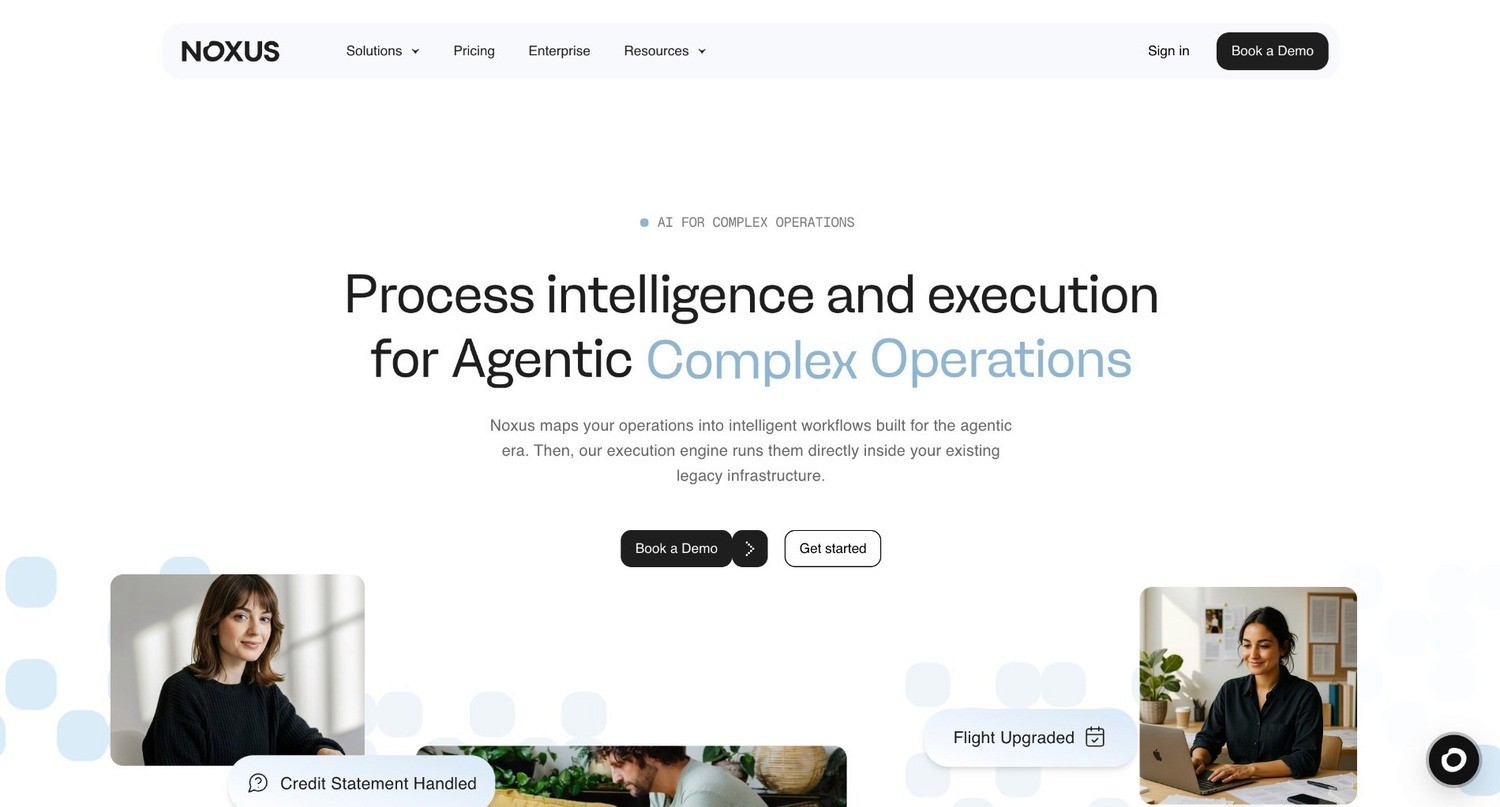
Noxus is the process intelligence layer for enterprise operations. Founded in 2023, we run complex, multi-system processes end to end inside SAP and the other systems a manufacturer already operates, writing every outcome back into the system of record with a full audit trail.
We built the company around a specific observation: getting AI into production in an enterprise is 90% infrastructure and integration, 10% AI. Rather than offering another builder and leaving the integration to you, we supply the execution layer already built and proven in production across banking, insurance, healthcare, retail and manufacturing, with zero client churn to date.
Ideal For
Supplier quality and customer quality teams at tier one and tier two manufacturers running SAP across multiple plants
Manufacturers with contractually mandated formats and externally imposed deadlines, such as PPAP levels, 8D windows and VDA 6.3 scoring
Regulated operations in pharmaceutical, food and beverage, chemical and medical device manufacturing where audit evidence is assumed to exist
Organisations with SAP ECC or S/4HANA estates that expose no usable modern API layer
Defence, space and other environments requiring air-gapped deployment with no data leaving the perimeter
Top Features
Six production quality use cases covering supplier document processing, supplier claims, customer claims, PPAP review, supplier performance monitoring and audit preparation, each ending in a validated SAP write-back
Deterministic policy execution where AI interprets the input and hard-coded rules mapped from your SOPs make every governed decision, with confidence-based escalation to a named person
400+ connectors across SAP ECC and S/4HANA, Oracle, ServiceNow, Salesforce, Outlook, SharePoint and industry-specific systems, with no API layer required
Full lineage on every action, user, policy, model and input, replayable and exportable for regulators
Deployment on your architecture, self-hosted, hybrid, or on-premises and air-gapped, with bring-your-own-key model routing across fourteen providers and no training on client data
Why We Stand Out
Three things separate us from everything else on this list. Your rules execute and AI only interprets, so no model approves a PPAP or closes a claim, and the outcome holds up under audit questioning. We operate the systems you already run the way your teams do, including SAP estates that will not be modernised for another three to five years. And every action produces a complete trace rather than a dashboard sitting on top of a black box.
Our production record is the fourth. KIRCHHOFF Automotive connects production operations directly to SAP through OData, from intake to write-back. Santander runs branch operations as a governed process across five countries on the bank's own infrastructure, live in under 90 days. Carlsberg Group reconciles supplier invoices against purchase orders and delivery records, with only the exceptions reaching finance.
Pros
We execute complete operations rather than drafting them, ending in a write-back to SAP QM, MM or PP
We work on legacy SAP with no API layer, no middleware project and no modernisation prerequisite
Our deployments reach production on live systems and live data in 45 to 80 days, with the first workflow typically live in around 30 days
Our governance is architectural: ISO 27001, SOC 2 Type II, GDPR and HIPAA, with ISO 27701 in progress and NIS2 controls in place
Our open-core guarantee leaves you holding all code and binaries if the relationship ends
Cons
We are not built for teams wanting a free self-serve tier to experiment with over a weekend, since deployment starts with a mapped business case
We are overkill for simple SaaS-to-SaaS automation where both systems expose modern APIs and no governance requirement exists
We are not a customer-facing conversational product, so organisations shopping for a website chat agent should look elsewhere
Pricing
We run on a monthly licence with included AI operations volume, with no outcome-based, token-based or per-seat pricing. Costs scale with operational volume and deployment complexity rather than headcount, and first engagements typically include deployment engineering alongside the licence to get the initial use case into production. Subsequent use cases are predominantly licence spend, because the integration is already running.
Final Verdict
For a manufacturer whose problem is documentation volume, contractual deadlines and audit exposure across a legacy SAP estate, we are the strongest option on this list. We are the only product here designed from the outset to complete the operation inside those systems rather than to help a person complete it faster.
2. Microsoft Copilot Studio
Overview
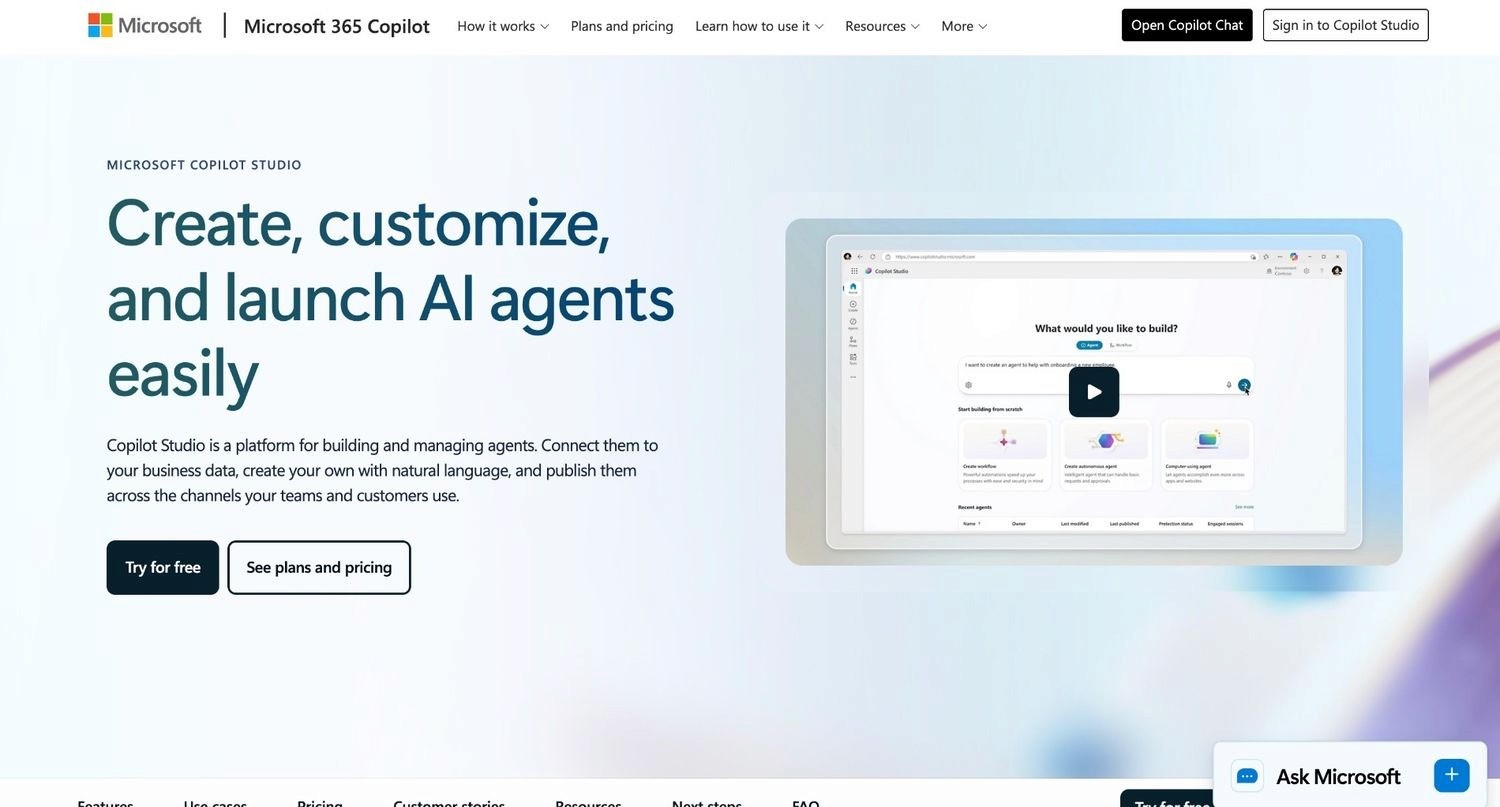
Copilot Studio is Microsoft's agent builder, sitting inside the Microsoft 365 and Power Platform estate. It lets organisations create internal agents grounded in SharePoint, Dataverse and Microsoft 365 content, and publish them into Teams and Copilot Chat.
For manufacturers already standardised on Microsoft, it arrives through a familiar procurement path and a licence many have already bought. That familiarity is its single biggest commercial advantage in this category.
Ideal For
Manufacturers with a mature Microsoft 365 estate and existing Copilot licences
Internal knowledge agents grounded in SharePoint and Teams content
Simple conversational interfaces and basic approval automations
Teams whose target systems already expose modern APIs through Power Platform connectors
Top Features
Agent builder integrated with Microsoft 365, Teams and Copilot Chat
Power Platform connector library and Power Automate flow integration
Dataverse grounding with organisational knowledge sources
Credit-metered execution with pay-as-you-go or prepaid capacity
Why They Stand Out
Copilot Studio is one of the strongest choices for organisations whose work already lives inside Microsoft. Internal agents built by licensed Microsoft 365 Copilot users do not consume separate credits, which makes the entry cost close to zero for teams that have already bought Copilot seats.
The bundled procurement path matters more than it sounds. In many manufacturers the Microsoft agreement is already signed, which removes the vendor risk review that slows every other product on this list.
Pros
Familiar procurement and an existing commercial relationship in most enterprises
Strong grounding in Microsoft 365 content and Teams distribution
Large connector library through Power Platform
No incremental licence cost for internal agents where Microsoft 365 Copilot seats already exist
Cons
Drafts and summarises rather than resolving multi-system operations end to end
Assumes modern API architecture, which limits depth on SAP ECC and other legacy systems
Credit metering is difficult to forecast, since credits are consumed whenever an agent performs a task or generates a response, and a single question can trigger several metered actions
Pricing
Copilot Studio is listed at $200 for the standalone licence, sold either as a pre-purchase plan using prepaid Copilot Credit Commit Units, with up to 20% saved on up-front purchase, or as pay-as-you-go usage-based billing. Both routes require an Azure subscription. Microsoft 365 Copilot is $30 per user per month paid yearly and includes Copilot Studio access for all licences, so organisations already holding Copilot seats can build internal agents without buying a standalone plan.
Final Verdict
Copilot Studio is a sensible choice for internal knowledge agents and light automation inside a Microsoft-standardised manufacturer. It is well suited to the 70% of questions that can be answered from documents rather than resolved across systems.
It is a weaker fit where the process spans SAP QM, SAP MM and a supplier portal with no API layer between them. Teams evaluating it for quality operations should model credit consumption on a metered pilot before committing to a pre-purchase plan.
3. UiPath
Overview
UiPath is the best-known name in enterprise automation and repositioned itself around agentic automation in September 2025, coordinating AI agents, software robots and people in the same orchestrated process. In May 2026 it extended that with capabilities for integrating coding agents into governed workflows across cloud and on-premises environments.
For manufacturers, UiPath is often already present. Many plants have an automation centre of excellence and a library of existing robots, which makes the agentic extension an incremental decision rather than a new vendor.
Ideal For
Manufacturers with an established RPA programme and a centre of excellence
Well-defined, high-volume, rule-based processes with stable interfaces
Organisations wanting document understanding and process mining in the same contract
Environments requiring on-premises runtimes alongside cloud orchestration
Top Features
Agentic orchestration layered over an existing robot estate
Document understanding and intelligent extraction
Process mining and task mining to identify candidates
On-premises, cloud and hybrid runtime options
Why They Stand Out
UiPath is one of the strongest choices for manufacturers that have already invested in automation and want to extend rather than replace. The installed base, the partner network and the maturity of the governance tooling are genuine advantages in a procurement review.
Its orchestration-first direction also positions it as a control layer above other agents, which appeals to IT teams worried about a proliferation of ungoverned tools.
Pros
Deep enterprise track record and a large implementation partner ecosystem
Extensive governance, versioning and lifecycle tooling
Handles structured, high-volume automation reliably at scale
Standard and Enterprise tiers can be hosted in a chosen region or on your own premises
Cons
Screen-based automation remains brittle when ERP interfaces update, which is the failure many manufacturing quality teams already experienced
Licensing has several layers, since users and robots are bought separately from the plan tier and some capabilities carry additional usage charges, so two buyers on the same tier can face very different bills
Serious deployments carry meaningful annual budgets, and independent analyses put realistic enterprise programmes well into six figures
Pricing
Automation Cloud Basic starts at $25 per month for individuals and small teams, with limited scale on users and robots, European hosting and Bronze support. Standard and Enterprise are contact-sales with no published price. Users and robots are purchased separately across all three tiers, and UiPath notes that some capabilities are included but that usage may require additional purchase, so the headline figure is not the whole cost.
Final Verdict
UiPath is recommended for manufacturers with an existing automation programme, dedicated internal capability and processes that are already well documented. In that context it is a safe and capable choice.
It is a weaker fit for a quality team with no centre of excellence that needs one process resolved end to end across unstructured inputs. The licensing model also makes early cost modelling harder than a fixed monthly commitment.
4. Automation Anywhere
Overview
Automation Anywhere sells Agentic Process Automation, combining RPA, AI and generative models to coordinate agents, automations, systems and people. Its May 2026 release added AI evaluations for measuring whether agents reach the correct outcome, and process simulation for testing whole workflows including failures and edge cases before deployment.
The company has been consolidating aggressively, acquiring Aisera in November 2025 for pre-built agentic capability in ITSM, HR and customer service. It has also been reported in merger discussions with C3.ai since January 2026.
Ideal For
Cloud-first manufacturers consolidating RPA and agentic work under one vendor
Back-office and shared services operations at scale
Teams wanting pre-built agentic capability for IT service management and HR alongside operations
Organisations that value pre-deployment simulation and agent evaluation tooling
Top Features
Agentic Process Automation with multi-agent orchestration through Process Composer
Natural-language bot creation
AI evaluations at design time and runtime
Process simulation and testing across failure and exception scenarios
Why They Stand Out
Automation Anywhere is one of the smarter choices for organisations that want testing and evaluation built into the product rather than bolted on. Simulating exceptions before deployment addresses a real weakness in first-generation automation programmes.
Its cloud-native architecture also tends to suit manufacturers that have already moved substantial back-office workload off premises.
Pros
Mature enterprise automation capability with a strong shared services track record
Evaluation and simulation tooling that supports a governed rollout
Pre-built agentic capability across several corporate functions
Reported customer results in complex administrative environments, including large public healthcare operations
Cons
Reported merger discussions with C3.ai introduce roadmap and integration uncertainty that procurement teams should factor into a multi-year commitment
Inherits the RPA lineage, so unstructured inputs and interface changes remain the harder cases
Pricing is quote-only with no public entry point, which lengthens early evaluation
Pricing
Automation Anywhere is licensed through enterprise agreements with quote-based pricing and no published list price for production deployments. Cost drivers are typically bot or agent volume, orchestration capacity and the AI consumption attached to agentic workloads.
Final Verdict
Automation Anywhere is recommended for cloud-first manufacturers with substantial back-office volume that want RPA and agentic capability from a single vendor. The evaluation and simulation features are a genuine differentiator for teams that need to prove behaviour before go-live.
Buyers should ask direct questions about the reported C3.ai transaction and its effect on the roadmap before signing a multi-year agreement. It is also a weaker fit where the priority is depth inside a single legacy SAP estate rather than breadth across functions.
5. SS&C Blue Prism

Overview
Blue Prism, now part of SS&C, is one of the original enterprise automation vendors and retains a strong following in regulated industries. Its heritage is centralised control, separation of duties and on-premises deployment rather than desktop-level automation.
For manufacturers with a conservative IT function, that heritage is the appeal. The governance model was designed for organisations where an unaudited change is a bigger risk than a slow one.
Ideal For
Regulated manufacturers with strict on-premises and data residency requirements
Organisations with formal change control and separation of duties expectations
Established automation programmes with dedicated internal capability
Back-office processes with stable, well-documented rules
Top Features
Centralised orchestration and control room
On-premises deployment heritage with strong governance defaults
Role separation and change control aligned to regulated environments
Integration with the wider SS&C operations portfolio
Why They Stand Out
Blue Prism is one of the stronger choices where the security review is the hardest part of the purchase. Its control model and on-premises track record clear conversations that stall other vendors.
The SS&C relationship also gives it reach into organisations that already buy operations software from the group.
Pros
Strong governance and control model suited to regulated manufacturing
Proven on-premises deployment at enterprise scale
Predictable behaviour on well-defined, structured processes
Established partner and implementation network
Cons
Rooted in structured automation, so unstructured documents and free-text inputs remain a weak point
Development experience is generally considered less modern than newer entrants
Quote-only pricing with no published entry tier
Pricing
SS&C Blue Prism is sold through enterprise agreements with quote-based pricing. Cost is typically driven by digital worker count and the deployment architecture required.
Final Verdict
Blue Prism is recommended for regulated manufacturers whose primary constraint is control and on-premises deployment, and whose target processes are structured and stable. In those conditions it remains a credible choice.
It is a weaker fit for quality operations dominated by scanned certificates, free-text complaints and supplier documents in dozens of formats, which is where a reasoning layer matters more than a control room.
6. n8n
Overview
n8n is an open-source workflow automation tool that has become one of the fastest-growing options for technical teams. It bills per workflow execution rather than per step, and its AI agent nodes connect to major model providers as well as locally hosted models.
Its defining characteristic is control. The Community Edition can be self-hosted with no licence fee and no execution limit, which appeals to manufacturers with capable internal engineering and strict data handling requirements.
Ideal For
Engineering teams with the capacity to self-host and maintain their own instance
Data-sensitive environments where self-hosting on owned infrastructure is a requirement
Connecting modern applications and APIs with AI steps in between
Teams comfortable owning the design and support of their own automations
Top Features
Open-source Community Edition, self-hosted with no execution limits
Execution-based billing on cloud plans rather than per-step counting
AI agent nodes across OpenAI, Anthropic, Google and local models
Large library of integrations and a strong community
Why They Stand Out
n8n is one of the strongest options on cost control for technically capable teams. Self-hosting removes execution metering entirely, leaving only server cost and the model API spend.
The execution-based counting model is also more forgiving than step-based competitors for multi-step workflows, which matters once a process has twenty nodes rather than three.
Pros
Free self-hosted Community Edition with no licence fee
Transparent published cloud pricing at every tier, which is rare in this category
Model-agnostic AI nodes including locally hosted models
Active community and rapid feature development
Cons
The client owns discovery, design, deployment and support, with no deployment engineering included
Enterprise controls are tiered, with SSO, SAML and Git version control arriving at Business and log streaming and external secret stores only at Enterprise
No native depth in legacy SAP navigation, so multi-step lookups inside SAP QM and MM become a build project
Pricing
Cloud plans are Starter at €20 a month for 2,500 workflow executions, Pro at €50 for 10,000, and Business at €667 for 40,000, all billed annually with a 17% saving over monthly. Enterprise carries a custom execution volume and adds unlimited projects, 200+ concurrent executions, log streaming, external secret store integration and a dedicated SLA. The self-hosted Community Edition remains free, a start-up plan offers up to 90% off Business for companies under 20 employees, and n8n charges per full workflow execution rather than per step.
Final Verdict
n8n is recommended for manufacturers with real internal engineering capacity that want maximum control at minimum licence cost. For connecting modern systems with AI steps between them, it is hard to beat on price.
It is not recommended where the requirement is production execution inside a legacy SAP estate with governance evidence attached. That work becomes an internal build, which is the €500k to €1M+ path most organisations fail to finish.
7. StackAI

Overview
StackAI is a no-code builder for enterprise AI agents, aimed at IT and architecture teams in regulated or complex organisations. It supports deployment across multi-tenant cloud, VPC and on-premises environments, with an LLM-agnostic architecture.
Governance is its selling point. Access control, SSO, audit logs, PII masking and data residency controls are built in rather than added later, backed by SOC 2, HIPAA and GDPR compliance on the Enterprise plan.
Ideal For
Regulated organisations building internal AI workflows with compliance requirements
IT and enterprise architecture teams standardising how agents are built and governed
Document processing and knowledge retrieval across SharePoint, Confluence and internal databases
Teams needing VPC or on-premises deployment without a bespoke engineering project
Top Features
No-code drag-and-drop workflow builder with multi-agent orchestration
Governance controls including access control, SSO, audit logs and PII masking
Model routing across major providers plus local models, with guardrails and evaluations
Deployment across multi-tenant, dedicated, private cloud and on-premises
Why They Stand Out
StackAI is one of the stronger choices for regulated teams that want governance without building it. The compliance posture removes a large part of the security configuration burden that other builders leave to the client.
Human-in-the-loop checkpoints are also a first-class concept rather than an afterthought, which matters for any process where a person must approve before a record changes.
Pros
Strong compliance posture out of the box, covering SOC 2, HIPAA and GDPR
On-premises and VPC deployment for data residency requirements
Accessible to non-developers while retaining enterprise controls
Model-agnostic with routing and evaluation tooling
Cons
Targets internal tooling and document workflows rather than deep legacy ERP execution
The client still owns use case discovery and process design
Enterprise pricing is custom and per seat, which scales with people rather than with work completed
Pricing
The free plan is $0 a month and covers 500 runs, 2 projects, 1 seat and community support, which is enough to evaluate but not to run anything. Enterprise is custom-priced with a custom number of runs and seats, unlimited projects, dedicated infrastructure and solution engineers, on-premises and virtual private cloud deployment, access control, SSO, and SOC 2, HIPAA and GDPR compliance.
Final Verdict
StackAI is recommended for manufacturers whose first AI project is internal: document search, knowledge retrieval, structured internal workflows with approval steps. The governance foundation makes it easier to clear a vendor risk review than most builders in its price band.
It is a weaker fit for the six quality processes in this comparison, which depend on multi-step navigation inside SAP QM, MM and PP rather than on retrieval from a document store.
8. Dify
Overview
Dify is an open-source tool for building AI applications, retrieval pipelines and agentic workflows, from prototype through to production. It provides a visual workflow builder, built-in knowledge base management and support for multiple model providers.
It sits closer to the developer end of this list. Teams choose it when they want to own the stack and are comfortable with the configuration that comes with that.
Ideal For
Technical teams prototyping AI applications and retrieval pipelines
Organisations that want to self-host an open-source stack
Internal tools where the builder is an engineer rather than an operations lead
Teams experimenting across several model providers
Top Features
Open-source Community edition with self-hosting available
Visual workflow builder for chains and agents
Knowledge base management with document processing and annotation quotas
Multi-provider model support with message-credit metering on cloud plans
Why They Stand Out
Dify is one of the smarter choices for engineering teams that want to move from prototype to internal production without licence commitments. The open-source foundation and active community keep the entry barrier low.
Its retrieval tooling is also more developed than several no-code alternatives, which matters when the use case is grounded question answering rather than transaction execution.
Pros
Open-source with no licence fee for self-hosting
Strong retrieval and knowledge base capability
Model-agnostic across providers
Rapid iteration for technical teams
Cons
Requires technical configuration, so business users cannot deploy it unaided
Aimed at application development rather than governed operational execution
No deployment engineering, so integration into a legacy SAP estate is entirely the client's project
Pricing
The Community edition is free to self-host under the Dify open source licence, and a free Sandbox tier on Dify Cloud provides 200 message credits for evaluation. Paid cloud plans are Professional at $590 per workspace per year with 5,000 monthly message credits, and Team at $1,590 per workspace per year with 10,000. Enterprise is custom and adds SSO, negotiated SLAs, multiple workspaces and commercial licence authorisation.
Final Verdict
Dify is recommended for engineering teams building AI applications and retrieval tools inside a manufacturer, particularly where self-hosting is a requirement. As a development environment it is capable and inexpensive.
It is not intended to resolve supplier claims inside SAP QM under audit, and should not be evaluated against that requirement. Teams comparing it with alternatives may also find our Dify alternatives roundup useful.
9. Gumloop
Overview
Gumloop is a no-code AI automation builder aimed at business and operations teams that know what should be automated but have no developers to build it. It provides a visual node editor, a large integration library and AI-powered steps including document processing and data extraction.
Its model is credit-based rather than per-seat, with consumption driven by AI reasoning, integrations and other resource-intensive nodes. Seats are unlimited on the paid tier, so cost tracks what the workflows do rather than how many people use them.
Ideal For
Operations teams automating work across modern SaaS applications
Non-technical builders who need results in hours rather than sprints
Document processing and unstructured data extraction on cloud-based sources
Smaller manufacturers without engineering capacity
Top Features
Visual node editor accessible to non-developers
200+ pre-built integrations
AI steps covering model calls, document processing, web research and data transformation
Enterprise controls including RBAC, audit logging and private cloud deployment
Why They Stand Out
Gumloop is one of the more practical choices for teams on modern SaaS stacks that need AI automation without a development cycle. Where other builders demand configuration, business users can typically deploy something useful the same day.
Its AI-native design also handles unstructured inputs better than classic trigger-and-action automation tools.
Pros
Genuinely accessible to non-technical operations staff
Fast time to a working automation with pre-built templates
Broad integration coverage across cloud applications
Unlimited seats included on the paid tier, with a 14-day free trial for evaluation
Cons
Less suited to high-volume, high-complexity enterprise operations requiring end-to-end execution under governance
Credit consumption is difficult to forecast before live traffic, since cost depends on what each node does
No native depth in legacy SAP or on-premises systems
Pricing
Pro starts at $37 a month including more than 20,000 credits, unlimited seats, 5 concurrent runs and 25 concurrent agent chats, with a 14-day free trial. Credit volume scales through published tiers up to 1.5 million a month, and annual billing carries a 20% discount. Enterprise is custom-priced and adds role-based access control, SCIM and SAML, audit logs, custom data retention rules, AI model access control and virtual private cloud.
Final Verdict
Gumloop is recommended for smaller manufacturers and individual operations teams automating SaaS-based work without engineering support. For that job it is fast, affordable and easy to adopt.
It is not the right tool for supplier claims spanning SAP QM, SAP MM and a supplier portal with contractual deadlines attached. The governance and legacy depth required there are outside its design.
10. Langdock
Overview
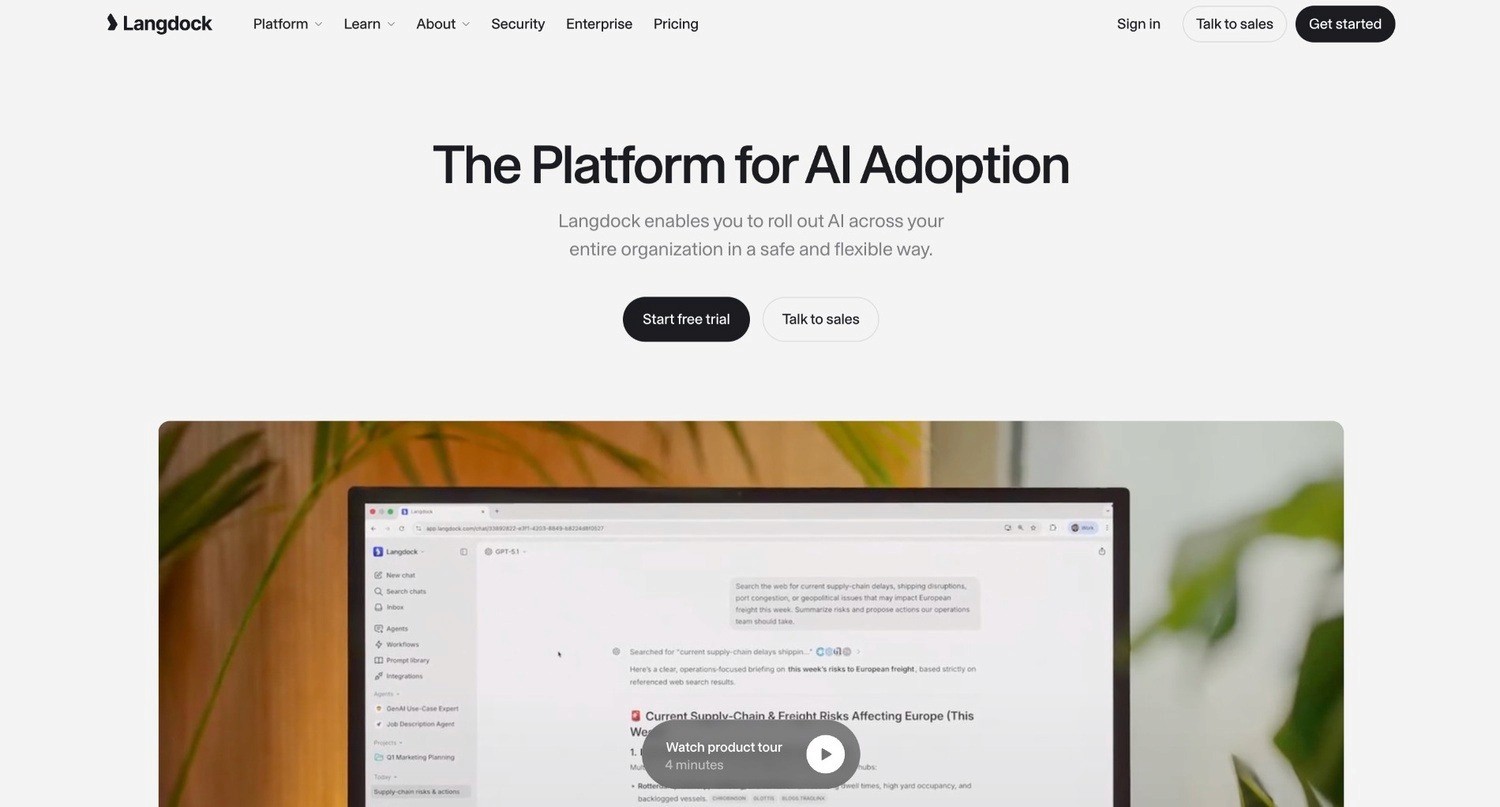
Langdock is a European enterprise AI workspace built around secure internal AI access, assistants and workflows, with a strong emphasis on EU data residency and governance. Berlin-based and certified against ISO 27001 and SOC 2 Type II, it is frequently shortlisted by organisations that want controlled AI adoption across a defined user base.
For a European manufacturer worried about ungoverned AI use, that framing is the appeal. It gives IT a sanctioned alternative to staff pasting operational data into consumer tools.
Ideal For
European organisations rolling out governed internal AI access across teams
Knowledge access and internal productivity use cases with compliance requirements
Replacing shadow AI usage with a sanctioned, auditable alternative
Teams that value EU hosting and data residency above all else
Top Features
EU data residency with managed cloud or on-premises deployment, under ISO 27001 and SOC 2 Type II
Assistants and workflows with shared organisational knowledge
SSO, SCIM and SAML for enterprise identity integration
A governance add-on with custom compliance rules, including templates for the EU AI Act and GDPR
Why They Stand Out
Langdock is one of the stronger options for European enterprises whose first concern is where the data sits and who can access it. The residency and governance posture answers the objection that stalls most AI rollouts on the continent.
It is also straightforward to adopt across a broad user base, which suits organisations aiming for controlled breadth rather than deep automation of one process. Its published customer list carries weight with an industrial buyer, including Merck, BASF, Würth IT, Eppendorf and TRUMPF.
Pros
Clear EU data residency and compliance positioning
Strong internal governance and access controls
Transparent published entry price, unlike much of this category
Quick to roll out across knowledge workers
Cons
Focused on assisted work rather than executing operations end to end, so people still complete most operational tasks
Per-seat pricing scales with headcount rather than with work completed, which weakens the ROI story as adoption grows
Costs arrive in four layers across seats, workflow runs, governance and per-token API usage, making forecasting harder than the seat price suggests
Pricing
The Chat and Agents base subscription is €23.20 per standard seat per month excluding VAT on annual billing, or €99 for a Business Max seat carrying five times the usage, covering up to 1,000 users with AI models included and SSO, SCIM and SAML. Workflows are a separate add-on, with 2,500 runs a month included and a Business package at €449 per workspace per month for 40,000 runs. Governance is a further add-on, free until 1 January 2027 and €2.80 per user per month afterwards, and API model usage is billed per token.
Final Verdict
Langdock is recommended for European manufacturers whose priority is governed, auditable AI access for employees. As a controlled replacement for shadow AI usage it does its job well.
It is a weaker fit as an answer to the six quality processes here, because those require execution inside SAP rather than assistance alongside it. Organisations often end up needing both: one product for broad access, another for operational execution.
How to Choose the Best AI Software for Manufacturing (What to Consider)?
The comparison above will narrow the list, but the decision usually comes down to five questions.
Work through them in order, because the first one eliminates more candidates than the other four combined.
1. Does It Execute, or Only Draft?
The most expensive mistake in this category is buying assistance and expecting resolution. Summarising an 8D is not completing an 8D, and drafting a reply to a supplier is not closing a claim in SAP QM.
Test it directly. Ask the vendor to show the final state of the record in your system of record at the end of the demo, not the output in their interface. If a person still has to open SAP and type, the manual hours have moved rather than disappeared.
2. Can It Operate Your Legacy Systems Without an API Project?
SAP ECC and the plant systems around it will not be replaced in the next three to five years. Any tool requiring an API layer, middleware project or modernisation programme before value appears will not survive a budget cycle.
Ask specifically how the software performs a multi-step lookup inside SAP QM, how it handles an interface change, and whether an on-premises component can sit next to SAP and talk to the database directly. Vendors whose architecture assumes modern APIs will answer this question vaguely.
3. What Makes the Decisions?
In a governed process, a model should never decide whether a PPAP is approved or a lot is released. The defensible pattern is that AI interprets the unstructured input while deterministic rules mapped from your own procedures execute every governed outcome.
Ask where the business logic lives, whether it is visible and editable by your quality team, and what happens when model confidence falls below a threshold. A configurable confidence floor with escalation to a named person is the answer you want.
4. What Evidence Does It Produce?
Audit evidence should be a by-product of running the process, not a reporting exercise afterwards. The standard to hold vendors to is full lineage on every action, user, policy, model and input, replayable and exportable for regulators.
A dashboard showing throughput is not the same thing. Ask to see what an auditor would receive, and check whether it reconstructs what happened or merely reports that something did.
5. How Predictable Is the Cost?
Several products in this comparison meter by credits, platform units or consumables, where a single user request can trigger multiple metered actions. That makes total cost of ownership hard to model before the first month of live traffic.
If you are comparing a consumption model with a fixed monthly commitment, run a metered pilot and size the commitment on measured median usage rather than on the vendor's tier suggestion. Over-commitment is the most common procurement error in this category.
Everything You Need to Know About AI Software for Manufacturing
← scroll to see all columns →
| Company | Pros | Cons | Ease of Use | Integrations | Support | Affordability | Legacy SAP Depth | Governance & Audit |
|---|---|---|---|---|---|---|---|---|
| Noxus | Executes end to end into SAP; works on legacy with no API layer; full exportable lineage | Enterprise engagement rather than self-serve; overkill for simple SaaS automation; not customer-facing chat | ⭐⭐⭐⭐⭐ | ⭐⭐⭐⭐⭐ | ⭐⭐⭐⭐⭐ | ⭐⭐⭐⭐⭐ | ⭐⭐⭐⭐⭐ | ⭐⭐⭐⭐⭐ |
| Microsoft Copilot Studio | Familiar procurement; strong M365 grounding; low incremental cost with existing licences | Drafts rather than resolves; assumes modern APIs; credit forecasting is hard | ⭐⭐⭐⭐⭐ | ⭐⭐⭐⭐⭐ | ⭐⭐⭐⭐⭐ | ⭐⭐⭐⭐⭐ | ⭐⭐⭐⭐⭐ | ⭐⭐⭐⭐⭐ |
| UiPath | Deep enterprise track record; strong lifecycle tooling; on-premises available | Brittle to interface changes; complex licensing; high programme cost | ⭐⭐⭐⭐⭐ | ⭐⭐⭐⭐⭐ | ⭐⭐⭐⭐⭐ | ⭐⭐⭐⭐⭐ | ⭐⭐⭐⭐⭐ | ⭐⭐⭐⭐⭐ |
| Automation Anywhere | Mature automation capability; evaluation and simulation tooling; broad function coverage | Reported merger uncertainty; RPA lineage on unstructured inputs; quote-only pricing | ⭐⭐⭐⭐⭐ | ⭐⭐⭐⭐⭐ | ⭐⭐⭐⭐⭐ | ⭐⭐⭐⭐⭐ | ⭐⭐⭐⭐⭐ | ⭐⭐⭐⭐⭐ |
| SS&C Blue Prism | Strong control model; proven on-premises; predictable on structured work | Weak on unstructured documents; dated developer experience; quote-only pricing | ⭐⭐⭐⭐⭐ | ⭐⭐⭐⭐⭐ | ⭐⭐⭐⭐⭐ | ⭐⭐⭐⭐⭐ | ⭐⭐⭐⭐⭐ | ⭐⭐⭐⭐⭐ |
| n8n | Free self-hosted edition; low cloud cost; model-agnostic AI nodes | Client owns design and support; enterprise controls gated; no native SAP depth | ⭐⭐⭐⭐⭐ | ⭐⭐⭐⭐⭐ | ⭐⭐⭐⭐⭐ | ⭐⭐⭐⭐⭐ | ⭐⭐⭐⭐⭐ | ⭐⭐⭐⭐⭐ |
| StackAI | Compliance built in; on-premises and VPC; accessible to non-developers | Internal tooling focus; client owns discovery; per-seat enterprise pricing | ⭐⭐⭐⭐⭐ | ⭐⭐⭐⭐⭐ | ⭐⭐⭐⭐⭐ | ⭐⭐⭐⭐⭐ | ⭐⭐⭐⭐⭐ | ⭐⭐⭐⭐⭐ |
| Dify | Open-source; strong retrieval; model-agnostic | Requires technical configuration; application development focus; no deployment engineering | ⭐⭐⭐⭐⭐ | ⭐⭐⭐⭐⭐ | ⭐⭐⭐⭐⭐ | ⭐⭐⭐⭐⭐ | ⭐⭐⭐⭐⭐ | ⭐⭐⭐⭐⭐ |
| Gumloop | Accessible to non-technical staff; fast to a working automation; free tier | Not built for governed enterprise operations; credit forecasting is hard; no legacy depth | ⭐⭐⭐⭐⭐ | ⭐⭐⭐⭐⭐ | ⭐⭐⭐⭐⭐ | ⭐⭐⭐⭐⭐ | ⭐⭐⭐⭐⭐ | ⭐⭐⭐⭐⭐ |
| Langdock | Clear EU residency; strong access governance; published entry price | Assists rather than executes; per-seat scaling; layered cost structure | ⭐⭐⭐⭐⭐ | ⭐⭐⭐⭐⭐ | ⭐⭐⭐⭐⭐ | ⭐⭐⭐⭐⭐ | ⭐⭐⭐⭐⭐ | ⭐⭐⭐⭐⭐ |
Ratings reflect suitability for the six manufacturing quality and supplier processes this comparison is built around, not general product quality. A tool rated one star on legacy SAP depth may be excellent at what it was designed for.
Run Your Manufacturing Operations With Noxus
Three things separate us from every other option on this list.
Your rules execute, AI interprets: No model approves a PPAP, closes a claim or changes a supplier tier. Hard-coded logic mapped from your own procedures makes every governed decision, which is why the outcome holds up under audit questioning and why nothing is invented along the way.
We run on the systems you already have: SAP ECC, S/4HANA, QM, MM and PP, supplier portals, OEM portals and EDI, through 400+ connectors, with no API layer and no middleware project first. For SAP that lives on your own servers, an on-premises agent sits next to it and talks straight to the database.
Every action is visible and every outcome explainable: Full lineage on every action, user, policy, model and input, replayable and exportable for regulators, with self-hosted, hybrid or air-gapped deployment, bring-your-own-key encryption and no training on client data.
We built this for quality and supplier operations teams at manufacturers running high document and claim volumes across SAP and multiple plants, where deadlines are contractual and audit evidence has to exist whether or not anyone asked for it yet. If your engineers spend more time assembling data than analysing it, that is the situation this was built for.
Bring one process. We will map it, prove it on your live systems within weeks against criteria you set, and take it to production.
FAQs About the Best AI Software for Manufacturing
What is the best AI software for manufacturing in 2026?
The best AI software for manufacturing in 2026 is Noxus for quality and supplier operations that run across legacy SAP, because we complete the process inside SAP QM, MM and PP rather than drafting an output for someone to key in. UiPath and Automation Anywhere are the strongest choices for manufacturers with an existing automation centre of excellence, and Microsoft Copilot Studio is the practical pick for internal agents inside a Microsoft-standardised estate. For technical teams wanting control at minimum licence cost, n8n and Dify are the leading open-source options.
What should I consider when choosing the right AI software for manufacturing for me?
When choosing AI software for manufacturing, five factors decide it: whether the tool executes or only drafts, whether it operates legacy systems without an API project, what makes the governed decisions, what audit evidence it produces, and how predictable the cost is. The first factor eliminates the most candidates, because assistance leaves the manual hours in place. Ask every vendor to show the final state of the record in your own system at the end of the demo.
What are the best AI tools for manufacturing quality teams specifically?
The best AI tools for manufacturing quality teams are the ones that can complete all six core processes: supplier document processing, supplier claims, customer claims, PPAP review, supplier performance monitoring and audit preparation. Most products in this category handle document reading well and stop at the point where a record has to change inside SAP. We are built around those six processes end to end, with validated write-back to the inspection lot, goods receipt or quality notification.
How does Noxus differ from similar alternatives?
Noxus differs from similar alternatives in three ways: we execute operations end to end rather than drafting them, we operate legacy SAP without requiring an API layer or middleware project, and we produce full lineage on every action, user, policy, model and input. Most alternatives assume modern API architecture, which is where they lose depth on SAP ECC estates. We also include deployment engineering rather than leaving process design and integration to you.
How do I start a deployment with Noxus?
You start a deployment with us by bringing one process with high volume, clear rules and a measurable cost, usually supplier quality document processing. We then run three steps: a prioritised business case that maps and redesigns the process, proof on your live systems within weeks against criteria set upfront, then production. Our documented deployments have reached production in 45 to 80 days, with the first workflow typically live in around 30 days.
How easy is it to switch to Noxus?
Switching to Noxus is straightforward because we operate alongside your existing systems rather than replacing them, connecting through 400+ connectors with no modernisation prerequisite. Existing RPA bots and quality management systems can stay in place, since we take the processes those tools cannot complete rather than the ones already working. Our open-core guarantee also means you retain all code and binaries if the relationship ends, which removes the exit risk that IT teams usually raise.
Are AI tools for manufacturing companies compliant with the EU AI Act and GDPR?
AI tools for manufacturing companies can be compliant with the EU AI Act and GDPR, but compliance depends on the architecture rather than on contractual assurances. We are certified against ISO 27001 and SOC 2 Type II, operate under GDPR including Article 28 and HIPAA, and have ISO 27701 in progress with NIS2 controls in place. We deploy on-premises or air-gapped with bring-your-own-key encryption and no training on client data, and every action carries lineage that is exportable for regulators.
We already tried RPA and it failed. Why would this be different?
RPA failed in most manufacturing quality functions for a specific reason: screen scripting breaks when an ERP interface updates, and it cannot read a scanned certificate or a free-text complaint at all. Agentic execution handles the unstructured input that RPA never reached, while deterministic rules still govern every decision, so the reasoning problem and the governance problem are solved separately. Ask any vendor to prove it on your live systems with your real exception rate rather than on synthetic data in a sandbox.
How long does it take to see results from AI software in a manufacturing plant?
Results from AI software in a manufacturing plant should be visible within weeks, not quarters, if the deployment is scoped to one process with a recorded baseline. Our documented deployments reach production on live systems and live data in 45 to 80 days, with the first workflow typically live in around 30 days and returns documented between 3x and 5x. Second and third use cases deploy considerably faster, because the integration is already running in your environment.