Best Healthcare AI Companies in 2026 (Top-Rated Solutions Reviewed & Compared)
This is a subtitle for the blogpost

Key Takeaways (TL;DR)
The Best Overall Healthcare AI Company: Noxus is our top pick for healthcare groups managing high-volume operational and administrative workflows across legacy clinical and administrative systems. Where most tools address a single point in the patient journey, we execute end-to-end workflows from communication intake through system write-back under full GDPR Article 9 compliance.
Why Do You Need It: Healthcare organisations are running administrative operations on legacy systems with growing communication volumes and shrinking administrative headcount. Automating the back-office workflows that sit between patient communications and clinical systems directly reduces cost, error rates, and compliance exposure.
Who It's For: COOs, Operations Directors, and Digital Transformation Leaders at hospital groups, healthcare networks, and large clinical practices who need AI that executes administrative work, not just drafts responses.
How to Choose the Right One?: Match the tool to your specific use case, whether that is clinical documentation, patient engagement, or operational workflow automation; verify it can operate under GDPR Article 9 and your local data residency requirements; and confirm it produces an audit trail that satisfies your compliance obligations.
Expected Price: Noxus operates on a usage-based model; you pay for completed operations, not a fixed per-seat subscription. A structured pilot on your actual workflows is available before full commitment. Across the market, most healthcare AI companies have products with prices ranging from Commure's free plan up through Suki AI's approximately $300-$500 per clinician per month, with enterprise-grade tools typically requiring custom quotes.
Table of Contents
Top Healthcare AI Companies in 2026 at a Glance
← scroll to see all columns →
| Company | Best For | Key Features | Pricing |
|---|---|---|---|
| Noxus | Healthcare groups managing high-volume administrative communications and multi-system operational workflows | End-to-end communication triageLegacy clinical system integrationGDPR Article 9 complianceFull audit trail | Usage-based; custom per deployment |
| Voiceoc | Hospitals and clinics wanting WhatsApp-based patient communication and appointment automation | WhatsApp AI assistantAppointment schedulingPatient queriesMultilingual support | Custom pricing based on call volume |
| TeleVox | Health systems needing omnichannel patient engagement across the full care journey | AI-driven patient outreachAppointment managementPre- and post-visit automationEHR integration | Custom pricing |
| Commure | Healthcare organisations wanting AI-assisted clinical documentation and workflow tools | AI scribeClinical documentationWorkflow automationEHR integration | Free plan Pro $89/month; Enterprise: custom |
| Abridge | Clinicians wanting AI-generated structured clinical notes from patient conversations | Real-time AI medical scribeStructured note generationEHR integrationMultilingual support | Enterprise pricing via direct sales |
| Murphi AI | Hospitals and health systems needing multi-agent AI for complex healthcare workflows | Multi-agent AIClinical and operational automationWorkflow orchestration | Subscription-based; custom pricing |
| Qventus | Health systems wanting AI-driven surgical and inpatient operations scheduling | AI-powered surgical schedulingCapacity managementCare coordinationEHR integration | Enterprise pricing via direct sales |
| Luma Health | Healthcare providers wanting automated patient intake, reminders, and care gap outreach | Patient engagementAutomated remindersDigital intakeReferral management | From $250/month Custom for large health systems |
| Athelas | Primary care and outpatient practices wanting AI-assisted remote patient monitoring | Remote patient monitoringAI documentationCare managementBilling automation | Custom pricing |
| Suki AI | Clinicians wanting a voice-driven AI assistant for clinical documentation | Voice AI assistantClinical documentationEHR integrationCustom vocabulary | ~$300–$500/clinician/month Enterprise pricing available |
What Are Healthcare AI Companies?
Healthcare AI companies are organisations that build and deploy artificial intelligence products specifically designed for the healthcare sector. They address a wide range of problems, from clinical decision support and medical imaging analysis to patient communication automation and administrative back-office processing.
The category is broad. At one end sit companies building diagnostic AI for radiology, pathology, and genomics: tools that assist clinicians in identifying patterns within medical data. At the other end sit companies building operational AI: systems that automate the administrative work of healthcare organisations, including scheduling, triage, documentation, billing, and patient communication.
The AI in healthcare companies most relevant to hospital operations and administrative leaders tend to fall into three categories:
First, patient engagement tools that automate appointment reminders, pre-visit intake, post-discharge follow-up, and care gap outreach.
Second, clinical documentation tools that listen to patient-clinician conversations and generate structured clinical notes for EHR entry.
Third, operational workflow tools that process high volumes of administrative communications, connect to clinical and administrative systems, and execute end-to-end workflows from intake through system write-back.
This guide focuses primarily on the operational and administrative layer, where the decisions are made by COOs, Operations Directors, and Digital Transformation Leaders rather than clinical informaticists.
For European healthcare organisations specifically, the regulatory environment, including GDPR Article 9 (health data), the EU AI Act's provisions on high-risk AI systems, and NHS or equivalent data governance requirements, significantly narrows which organisations are deployable without creating compliance exposure.
The global healthcare AI market was valued at approximately $20 billion in 2024 and is projected to reach over $100 billion by 2030, according to MarketsandMarkets research.
That growth is driven primarily by the administrative burden problem: the cost of processing patient communications, managing appointments, handling documentation, and executing back-office workflows is growing faster than healthcare organisations can add headcount.
Why Do Healthcare Organisations Need AI?
Healthcare organisations face a specific version of the operational scaling problem that affects every large enterprise: communication and transaction volume grows faster than headcount, and the manual processes that bridged the gap are no longer sustainable.
In a typical large hospital group, the administrative operations team processes thousands of patient communications per month: appointment requests, billing enquiries, document requests, referral management, and discharge coordination. Each of those communications requires a human to read it, look up the relevant patient record in a clinical system, check availability or status, generate a response, and update the record. That process might involve two or three separate systems for a simple query, and five or six for a complex one.
According to research published in the BMJ, administrative tasks consume approximately 34% of a physician's working time and up to 70% of the time of administrative support staff in large healthcare systems. Those hours are not delivering clinical outcomes. They are the operational overhead of running a healthcare organisation on manual processes that were designed for a fraction of current patient volumes.
The compliance dimension makes it worse. Healthcare data is subject to the strictest data governance requirements in most jurisdictions: GDPR Article 9 in Europe, HIPAA in the US, and equivalent frameworks everywhere else. Any AI system processing patient communications must operate under those frameworks, which rules out the majority of general-purpose AI tools that do not offer healthcare-compliant deployment architectures.
Burnout among administrative and clinical staff is another direct consequence. NHS England data from 2025 shows that administrative staff vacancy rates in NHS trusts ran at approximately 6.9% on average, with significantly higher rates in patient-facing administrative roles. The organisations most affected are those that have not automated the routine, high-volume parts of the administrative workflow, leaving staff to manage growing queues manually.
The opportunity for AI in healthcare companies to address this problem is real and measurable.
For CUF/José de Mello, one of Portugal's largest healthcare groups, deploying Noxus AI co-workers to handle patient and administrative communications delivered 3x ROI and 96% precision on 10,000+ communications per month within 50 days of production deployment. That is the type of outcome that moves from pilot to board conversation.
Who Needs Healthcare AI Companies?
1. Chief Operating Officers and Operations Directors at Hospital Groups
COOs and Operations Directors at hospital groups and large healthcare networks managing 50,000 or more patient interactions per month.
Their primary problem is that administrative headcount is growing faster than patient volume justifies, while error rates in manual processing create downstream clinical and compliance risk.
They need AI in healthcare companies that can demonstrate measurable throughput improvement and cost reduction on actual clinical and administrative workflows, not in a controlled demo environment.
To know more about how our healthcare AI deployments work, check out our website or explore enterprise AI use cases most relevant to hospital operations and healthcare networks.
2. Digital Transformation and AI Leaders at Healthcare Organisations
Chief Digital Officers, Heads of AI, and Digital Transformation Directors at NHS trusts, private hospital groups, and integrated care systems evaluating AI options as part of a broader digital programme.
Their specific concern is production deployment: they have seen multiple AI pilots fail to reach production because the underlying infrastructure integration was either too complex or too slow.
They need a healthcare AI partner that can demonstrate live production credentials in comparable healthcare environments.
3. Clinical Informatics and IT Leaders
CISO, CIO, and IT Directors at healthcare organisations whose approval is required before any AI system processes patient data.
Their concerns are data governance: GDPR Article 9 compliance, NHS Data Security and Protection Toolkit alignment, and the EU AI Act's provisions on high-risk AI in healthcare.
They need vendors that offer deployment sovereignty options, meaning the ability to run on the organisation's own infrastructure rather than sending patient data to a third-party cloud.
4. Heads of Patient Experience and Patient Services
Directors of Patient Experience and Heads of Patient Services at large healthcare providers where the volume of inbound patient communications has outgrown the team's capacity to respond within SLA.
They need AI-assisted triage and response that maintains clinical tone, applies the organisation's communication policies, and produces a complete record of every interaction for audit and quality review.
5. Operations Leaders at Integrated Care Systems
Programme Directors and Operations Leads at NHS Integrated Care Systems (ICSs) and similar health network organisations coordinating care across multiple providers and services.
Their challenge is the fragmentation of clinical and administrative systems across the network, combined with increasing patient volumes and NHS efficiency targets.
The options most relevant to this audience are those that can operate across heterogeneous system landscapes without requiring standardisation as a prerequisite.
Best Healthcare AI Companies in 2026: In-Depth Review & Comparison
1. Noxus

Overview
Noxus addresses the specific operational problem that healthcare groups face when AI pilots fail to reach production: the infrastructure integration challenge. Most tools in this space cover a specific clinical or patient-facing use case in isolation. We address the back-office operational layer that sits between patient communications and the clinical and administrative systems those communications need to update.
Our healthcare deployment at CUF/José de Mello is the most direct proof point. CUF, part of the José de Mello Group and one of Portugal's largest private healthcare groups, was processing 10,000+ patient and administrative communications per month: appointment requests, document requests, billing enquiries, referral management.
Each communication required manual lookup across legacy clinical and administrative systems, manual response generation, and manual record updates. That process was consuming headcount, introducing inconsistency, and creating compliance exposure on a dataset governed by GDPR Article 9.
We deployed the platform to automate the full communication triage and handling workflow. The AI classifies inbound communications, retrieves context from clinical and administrative systems, applies the organisation's communication policies through deterministic rule execution, generates responses, and writes outcomes back with complete action logging. No AI model makes clinical or compliance decisions: those are governed by hard-coded policy rules.
The result was 3x ROI, 96% AI precision, and full GDPR Article 9 compliance maintained throughout, reaching production in 50 days.
Among top healthcare AI companies focused on operational workflow automation rather than clinical tools, Noxus acts as the infrastructure layer that makes AI executable at scale inside the complex system environments healthcare organisations actually run.
Ideal For
COOs and Operations Directors at hospital groups and large healthcare networks processing 5,000+ patient communications per month who need end-to-end workflow automation rather than a point tool for one communication type
Digital Transformation Leaders at NHS trusts and private healthcare groups whose AI programmes have stalled at the system integration layer, and who need a partner with production credentials in comparable healthcare environments to build the internal case for moving from pilot to production
CIOs and CISOs at healthcare organisations where patient data governance under GDPR Article 9, NHS Data Security and Protection Toolkit, or HIPAA is a hard procurement requirement
Operations teams at large integrated care systems managing communications across multiple clinical and administrative systems with no unified API layer
Healthcare CFOs evaluating AI investment on the basis of measurable cost reduction from administrative headcount displacement, with 3x ROI as the documented benchmark from comparable deployments
Top Features
End-to-End Healthcare Communication Automation: The platform handles the complete workflow for patient and administrative communications, from classification and clinical system lookup through response generation and record write-back, under deterministic policy enforcement. No AI model makes clinical or compliance decisions; your policies govern what happens at each step.
GDPR Article 9 Compliant Deployment: Three deployment architectures including fully air-gapped on-premises ensure patient health data never leaves the organisation's infrastructure unless explicitly permitted. Every action produces a tamper-evident audit trail. Certified against SOC 2 Type II, ISO 27001, GDPR Article 28, and HIPAA.
Legacy Clinical System Integration Without APIs: The platform connects to legacy clinical and administrative systems the way your operations teams do today: navigating interfaces, performing lookups, writing back results. This includes proprietary hospital management systems, COBOL-era administrative platforms, and legacy EHR environments that other AI vendors will not touch.
Deterministic Policy Execution: Communication policies, escalation thresholds, and clinical governance rules are hard-coded into the workflow execution layer. The AI interprets unstructured communications; your policies make every decision that carries clinical or compliance weight.
Proof of Results on Your Own Data: We run a Proof of Results test on your actual communication data and systems before any production commitment, showing before-and-after performance metrics on your real workflows within 30 days.
Why We Stand Out?
Every other healthcare AI company on this list addresses a specific point in the patient journey or clinical workflow.
We address the operational infrastructure that sits underneath all of them: the system integration layer that makes it possible to automate complex, multi-step healthcare workflows on the legacy systems that hospital groups and healthcare networks actually run.
The CUF/José de Mello deployment demonstrates this in production: 10,000+ patient communications per month, 50 days from contract to production, full GDPR Article 9 compliance throughout.
We are also deployed at SNS (Serviço Nacional de Saúde), the Portuguese National Health Service, for administrative automation across public healthcare operations – a deployment directly comparable to NHS trust environments for UK healthcare groups evaluating this list.
Pros
Proven production deployment in healthcare at CUF/José de Mello: 3x ROI, 96% precision, 10,000+ communications/month
GDPR Article 9 compliant with on-premises deployment option; patient health data never leaves organisation infrastructure
Operates inside legacy clinical and administrative systems without API prerequisites
Full audit trail and deterministic policy execution satisfies healthcare governance requirements
Usage-based pricing with no setup fees; free test tier before any commitment
Cons
Purpose-built for hospital groups and large healthcare networks managing high volumes of patient and administrative communications; not suited to small practices, individual clinicians, or organisations with straightforward communication workflows
Operates as an operational and administrative automation layer, not a clinical documentation, diagnostics, or patient-facing engagement tool; healthcare organisations seeking clinical AI should evaluate the specialist tools on this list for those use cases
Pricing
Noxus operates on a monthly platform licence with consumption-based pricing. You pay for the operations your AI co-workers complete, not for seats or tokens. Pricing scales with operational volume and deployment complexity.
The economics improve structurally with each additional workflow deployed on the same infrastructure, as the integration layer is already operational for subsequent use cases. A structured pilot on your actual workflows is available before full commitment.
Contact the team directly for pricing aligned to your use case and scale.
Final Verdict
Noxus is one of the best healthcare AI companies, especially for hospital groups, healthcare networks and even large clinical operations where the primary challenge concerns operational backlog of patient and administrative communications requiring multi-system processing.
If your operations team is manually triaging thousands of communications per month across disconnected clinical and administrative systems, we can automate that entire chain on the systems you already run, under full compliance governance.
For healthcare organisations needing clinical documentation AI, patient engagement tools, or point solutions for a single communication type, the other tools on this list are better starting points.
The distinction from patient engagement tools like TeleVox and Voiceoc is the integration depth: those tools automate the patient-facing communication layer; Noxus automates the full workflow that follows – including multi-system lookups, record updates, compliance logging, and the write-back to clinical and administrative systems, on the legacy infrastructure those systems actually run on.
2. Voiceoc
Overview
Voiceoc is targeting hospital and clinic patient engagement through the WhatsApp channel.
Their AI-powered assistant enables patients to book, reschedule, and cancel appointments; receive test results and reports; and get answers to common clinical queries, all through a WhatsApp interface with no app download required.
Voiceoc's model is specifically designed for healthcare markets where WhatsApp has high patient penetration – including India, the Middle East, and parts of Africa, and where hospitals have historically struggled with appointment no-shows and call centre overload.
Ideal For
Hospital operations leaders and patient services directors at hospitals with high patient volumes and appointment management bottlenecks
Healthcare organisations in markets where WhatsApp is the primary patient communication channel, including India, UAE, and the Middle East
Digital transformation leaders at hospital networks wanting to reduce call centre volume through patient self-service
Operations teams at multi-site hospital groups needing a single patient communication layer across all sites
Top Features
WhatsApp-Based Patient Self-Service: Patients book, reschedule, and cancel appointments, access reports, and receive pre-visit instructions through WhatsApp without requiring a separate app or patient portal login.
Appointment Reminder and No-Show Reduction: Automated appointment reminders and confirmation workflows reduce the no-show rates that cost hospitals significant revenue and capacity in outpatient services.
Multilingual Patient Support: The system supports multiple languages, which matters for hospitals serving diverse patient populations across different linguistic communities.
Why They Stand Out?
Voiceoc is one of the best healthcare in AI companies targeting the appointment management and patient communication channel specifically through WhatsApp.
For hospital groups in markets with high WhatsApp penetration, the zero-download patient experience is a genuine differentiator over patient portal approaches that require app installation.
Pros
WhatsApp-native interface requires no patient app download; reduces friction to adoption
Appointment automation reduces no-shows and call centre volume simultaneously
Multilingual support relevant for diverse patient populations
Custom pricing aligned to call volume makes cost predictable
Cons
Primarily useful in markets with high WhatsApp patient communication penetration; less relevant for NHS or UK hospital contexts where other channels dominate
Does not cover operational back-office workflows; focused on patient-facing appointment and query management
Custom pricing requires sales engagement; no published tiers for early budget assessment
Pricing
Voiceoc uses custom pricing based on the organisation's monthly appointment call volume. Contact their sales team for a quote tailored to your patient volume and use case.
Final Verdict
Voiceoc is one of the best healthcare AI companies, especially for hospital and clinic operations in markets where WhatsApp is a dominant communication channel - and where appointment no-shows and call centre overload are primary problems to solve.
For UK NHS organisations or healthcare groups where the operational challenge is more complex multi-system administrative workflows, the WhatsApp channel focus limits applicability.
3. TeleVox
Overview
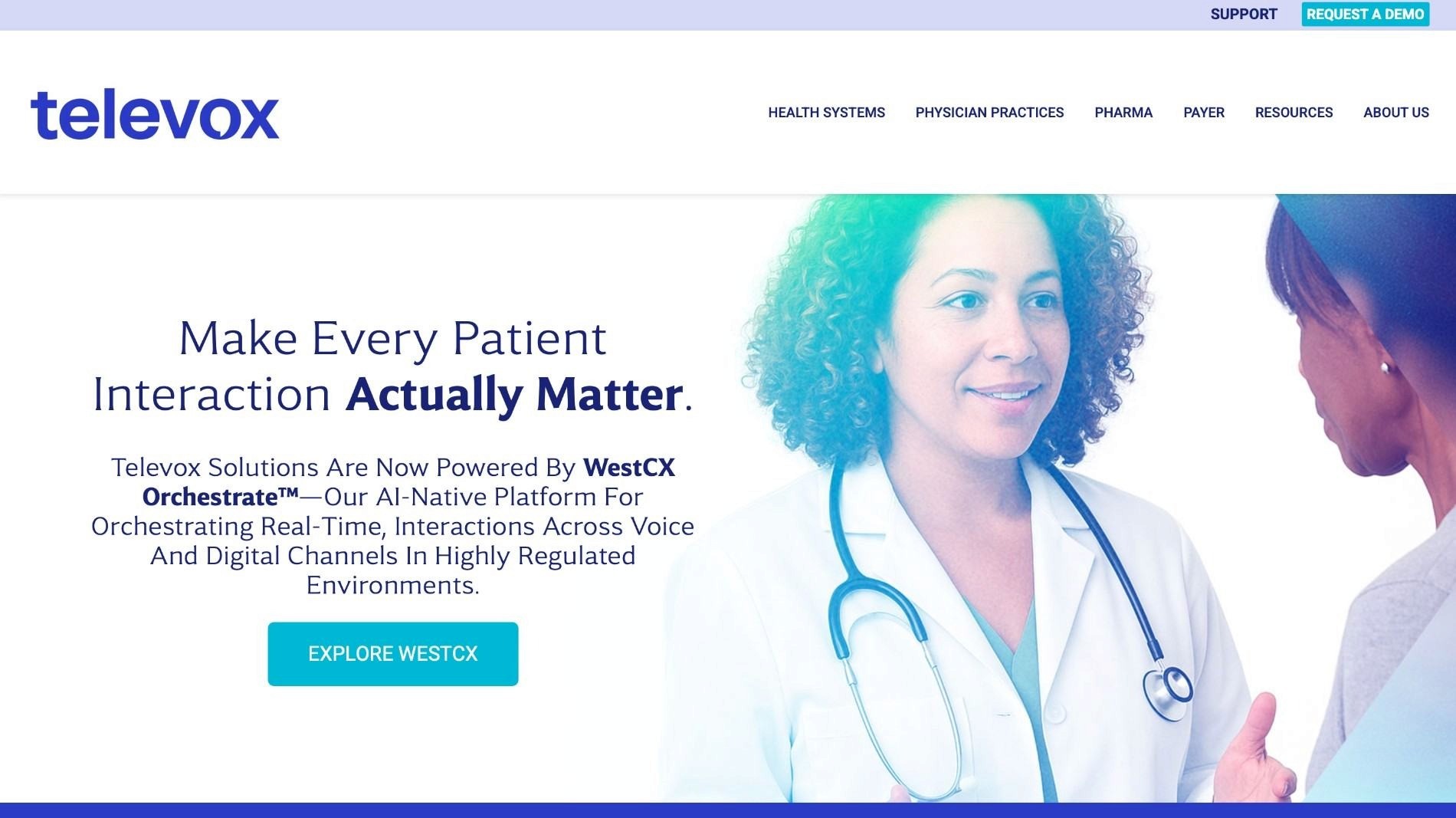
TeleVox is an established patient engagement platform targeting US and international health systems with omnichannel outreach covering the full patient care journey.
Their product covers pre-visit appointment reminders and confirmations, digital intake, care gap identification and outreach, post-discharge follow-up, and prescription refill reminders.
TeleVox has a long track record in the patient engagement category, now operating under the WestCX group, and has expanded its AI capabilities to include conversational AI-driven outreach that adapts to patient responses rather than following a fixed script.
TeleVox's breadth of care journey coverage across multiple communication channels distinguishes it from point solutions that address only appointment reminders or only discharge follow-up.
Ideal For
Large health systems wanting comprehensive patient engagement automation across the full care journey from appointment to post-discharge
Health system operations and patient experience leaders wanting to reduce no-shows, improve care gap closure, and increase medication adherence through automated outreach
Healthcare organisations on established EHR platforms needing a patient engagement layer with pre-built EHR integrations
Health systems wanting conversation AI that adapts to patient responses rather than following a fixed notification script
Top Features
Full Care Journey Outreach: TeleVox covers the patient communication workflow from pre-visit to post-discharge, allowing health systems to deploy a single vendor for patient engagement across all contact points rather than managing separate tools for each stage.
Conversational AI Interaction: Rather than one-way notification sending, TeleVox's AI engages patients in two-way conversations, handling common questions and routing complex queries to staff, reducing the staff time consumed by inbound patient communication.
EHR Integration Across Major Platforms: Pre-built integrations with major EHR systems allow TeleVox to pull patient appointment data and update records without requiring custom integration work for each deployment.
Why They Stand Out?
TeleVox is one of the more established names in patient engagement AI.
The full care journey coverage from a single vendor is a practical differentiator for health systems that currently manage multiple point solutions for different stages of patient outreach.
Pros
Full care journey coverage from pre-visit to post-discharge in a single product
Conversational AI enables two-way patient interaction rather than one-way notifications
Established track record across large US health systems
Pre-built EHR integrations reduce deployment time
Cons
Primarily a US-focused product; UK and European healthcare system integrations are less mature
Patient engagement focus means it does not cover operational back-office workflows or clinical documentation
Custom pricing requires full sales engagement before budget assessment
Pricing
TeleVox uses custom pricing. Contact their sales team for a quote based on your patient volume, site count, and specific care journey coverage requirements.
Final Verdict
TeleVox is one of the best healthcare AI companies for large US health systems seeking omnichannel patient engagement across the full care journey from a single vendor.
For UK NHS organisations or European healthcare groups, the US-centric integration maturity is a practical limitation.
Alternatively, for healthcare operations teams whose primary challenge is not patient engagement but operational back-office workflow automation, TeleVox does not address that layer.
4. Commure
Overview
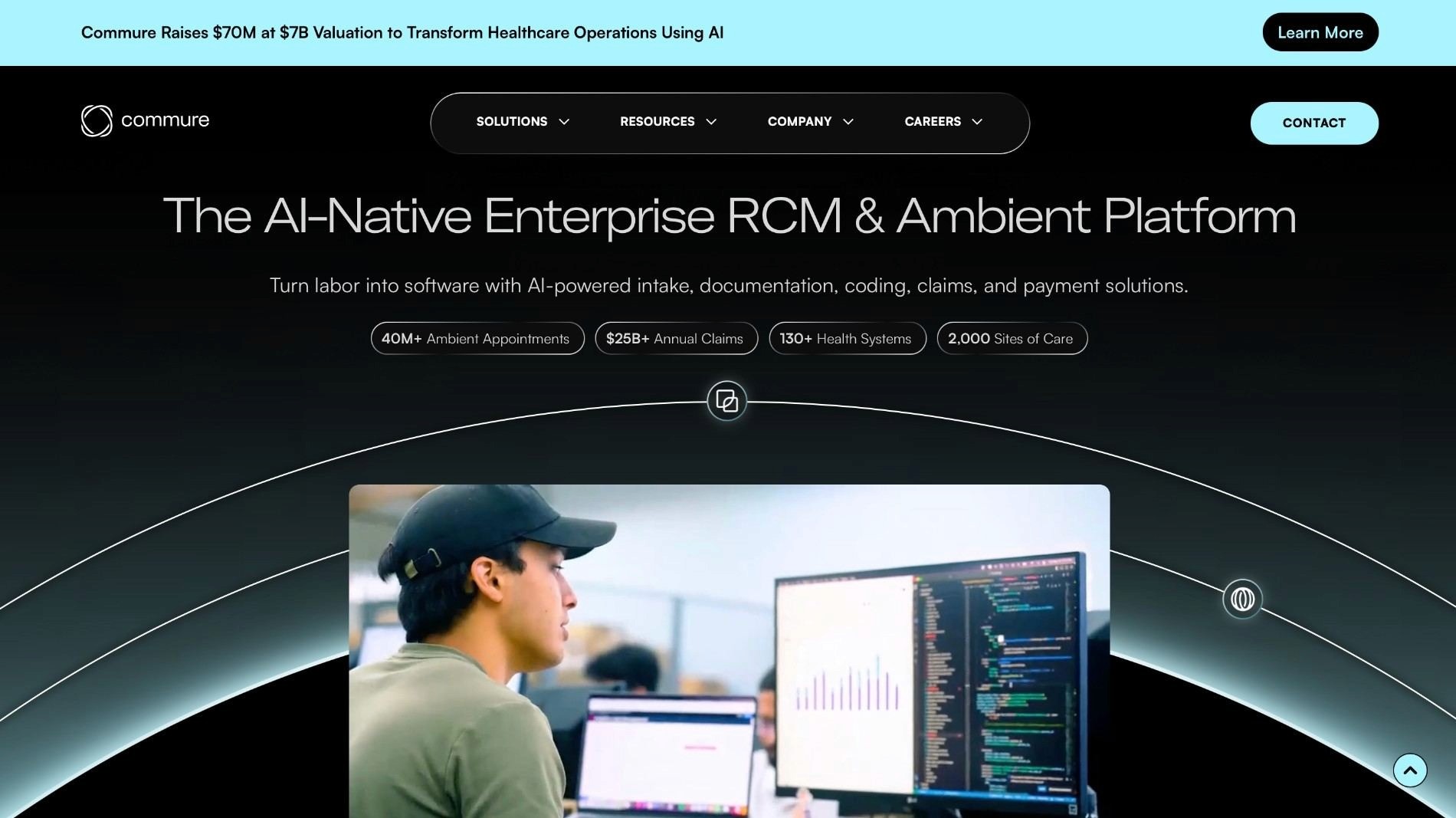
Commure is one of the best healthcare AI companies globally, with a robust clinical documentation and workflow product for healthcare providers.
Their AI scribe listens to patient-clinician conversations and generates structured clinical notes for review and EHR entry, reducing the documentation burden that contributes significantly to clinician burnout.
Commure has expanded from its documentation origin into broader workflow automation tools covering clinical communication, scheduling, and administrative tasks.
Among healthcare AI documentation tools, Commure's accessible pricing model, including a free plan, makes it one of the lower-barrier entry points for healthcare practices exploring AI-assisted documentation.
Ideal For
Clinicians and small-to-mid-size practices wanting AI-assisted clinical documentation to reduce after-hours charting time
Healthcare practices and ambulatory care groups wanting a free or low-cost entry point into AI clinical documentation
Medical groups evaluating AI scribing before committing to enterprise-level clinical documentation tools
Practice managers wanting workflow automation alongside clinical documentation in a single product
Top Features
AI Clinical Scribe: Commure listens to patient-clinician conversations and generates structured clinical notes, reducing post-visit charting time by eliminating manual note-taking during the consultation.
EHR Integration for Documentation Write-Back: Clinical notes generated by the AI scribe are reviewed and posted to the EHR rather than requiring a separate copy-paste step, reducing friction in the documentation workflow.
Workflow Automation Tools: Beyond documentation, Commure covers scheduling, clinical communication, and basic administrative workflow automation, providing additional operational coverage for practices that want to consolidate tools.
Why They Stand Out?
Commure's free plan entry point and accessible Pro tier at $89/month make it one of the most accessible options for smaller practices and medical groups exploring clinical AI documentation without an enterprise-level budget commitment.
Pros
Free plan available; Pro at $89/month is accessible for small and mid-size practices
AI scribe reduces post-visit charting time meaningfully
EHR integration reduces manual documentation transfer
Broad coverage of documentation, scheduling, and workflows in one product
Cons
Enterprise features and support require a custom sales engagement
Less suited to large hospital groups with complex multi-system administrative workflows
Clinical documentation quality may require review and correction on complex or specialist consultations
Pricing
Commure offers a free plan with core documentation features. The Pro plan is $89/month.
Enterprise users with larger requirements and customisation needs can contact their sales team for a custom quote or explore annual pricing options.
Final Verdict
Commure is a solid pick for smaller practices looking for affordable clinical notes.
However, it isn't the best fit among AI in healthcare companies for large hospital groups that need to automate complex operational workflows across legacy systems.
5. Abridge

Overview
Abridge is a clinical AI company specifically focused on generating structured clinical notes from patient-clinician conversations in real time.
Founded in 2018 and backed by significant investment from healthcare systems including UPMC, Abridge has built a product that listens to consultations, transcribes and summarises the clinical conversation, and generates a structured note for review by the clinician before EHR entry.
Abridge distinguishes itself with strong clinical accuracy data from academic medical centre deployments and robust support for specialty-specific clinical language.
Ideal For
Hospital-employed physicians and clinicians at academic medical centres wanting AI documentation assistance validated in high-acuity clinical environments
Health systems deploying AI documentation at scale across multiple specialty departments
Clinicians in specialist settings who need documentation AI that handles specialty-specific clinical terminology accurately
Healthcare organisations wanting AI documentation with strong clinical validation research backing the accuracy claims
Top Features
Real-Time Clinical Note Generation: Abridge listens to the patient-clinician conversation and generates a structured note in real time, allowing clinicians to review and finalise documentation during or immediately after the consultation rather than completing charting after hours.
Specialty-Specific Clinical Language Support: The system is trained on a broad range of clinical specialty language, reducing the note editing burden for specialists whose terminology and documentation patterns differ significantly from primary care.
Academic Medical Centre Validation: Abridge's accuracy has been validated in deployment studies at major academic medical centres, providing clinical leaders with evidence-based grounds for procurement rather than relying solely on vendor claims.
Why They Stand Out?
Abridge is one of the best healthcare AI companies for clinical documentation in hospital and academic medical centre environments, where documentation accuracy across clinical specialties and robust validation evidence are procurement requirements.
Pros
Real-time note generation reduces post-visit charting burden significantly
Strong specialty language support reduces editing time for specialist clinicians
Validated accuracy in academic medical centre deployments provides credible evidence base
Backed by healthcare system investors including UPMC, indicating clinical confidence in the product
Cons
Enterprise-only pricing via direct sales; no self-serve or published pricing tiers
Specifically a clinical documentation tool; does not cover patient engagement, scheduling, or operational back-office workflows
UK and European EHR integration depth is less developed than US EHR coverage
Pricing
Abridge uses enterprise pricing via direct sales engagement. Specific rates are not publicly disclosed. Contact their sales team for a quote based on your clinician count, specialty mix, and EHR environment.
Final Verdict
Abridge is one of the best AI in healthcare companies for hospital groups and academic medical centres who prioritise clinical documentation accuracy with validation evidence from comparable environments – and are seeking healthcare AI companies to do the same.
For healthcare organisations whose primary challenge is operational workflow automation, patient communication triage, or multi-system administrative processing – Abridge's clinical documentation focus does not address those workflows.
6. Murphi
Overview
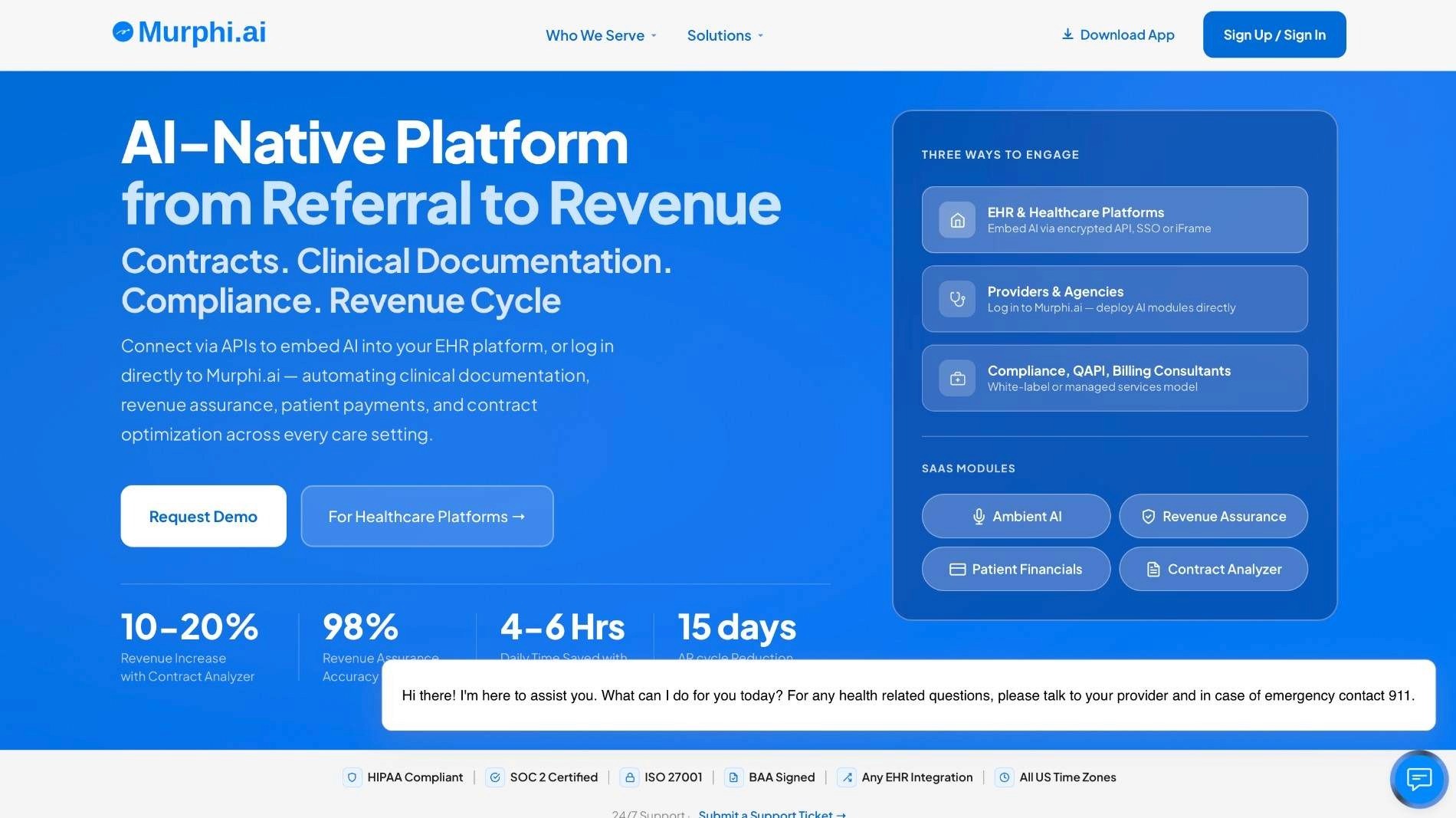
Murphi AI is among the best healthcare AI companies building a multi-agent AI platform for automating healthcare workflows.
Their product deploys multiple AI agents that can handle clinical and operational tasks concurrently, covering areas including patient communication, clinical documentation assistance, care coordination, and administrative process automation.
Murphi AI positions itself as a healthcare-specific orchestration layer for multi-agent AI, designed for hospital groups and health systems that need AI to span multiple departments and workflow types simultaneously rather than deploying point solutions for each.
Ideal For
Hospital Chief Digital Officers and AI transformation leaders evaluating multi-agent healthcare AI for complex, multi-department deployments
Health systems that want a single AI vendor covering both clinical and operational automation rather than managing separate products for each department
Healthcare organisations in the evaluation stage of larger AI programmes who want to test multi-agent approaches before committing to a single-use-case tool
Innovation and digital health leads at hospital groups wanting a configurable healthcare AI platform
Top Features
Multi-Agent AI for Healthcare: Multiple AI agents handle different task types concurrently, allowing a single deployment to cover patient communication, documentation assistance, and administrative workflows simultaneously across different departments.
Clinical and Operational Coverage: Murphi spans both clinical workflow assistance and operational administrative automation, reducing the vendor fragmentation that occurs when separate tools are deployed for clinical and non-clinical use cases.
Healthcare-Specific Workflow Orchestration: The orchestration layer manages agent interactions and task routing within a healthcare governance context, applying healthcare-specific rules and compliance requirements to agent behaviour.
Why They Stand Out?
Murphi is one of the best AI healthcare companies with multi-agent AI as the core architecture for complex healthcare deployments.
For health systems that want to explore multi-agent approaches to cover multiple departments and workflow types from a single vendor, Murphi occupies a distinct position relative to single-use-case tools.
Pros
Multi-agent architecture covers multiple healthcare use cases from a single deployment
Spans clinical and operational automation, reducing vendor count
Healthcare-specific governance framework applied to agent behaviour
Configurable for different department requirements within the same deployment
Cons
Newer market entrant with less production deployment evidence compared to established vendors
Custom pricing based on multiple factors requires full sales engagement before budget assessment
Production scalability evidence at enterprise health system scale is limited compared to more established vendors
Pricing
Murphi AI uses subscription-based, custom pricing based on use case, volume, business size, and other key factors. Contact their team for a quote.
Final Verdict
Murphi AI is one of the best AI in healthcare companies for health systems interested in multi-agent AI architectures that span both clinical and operational use cases from a single vendor.
For healthcare organisations that need established production evidence in comparable environments before committing, the relatively newer market position is a consideration.
7. Qventus
Overview
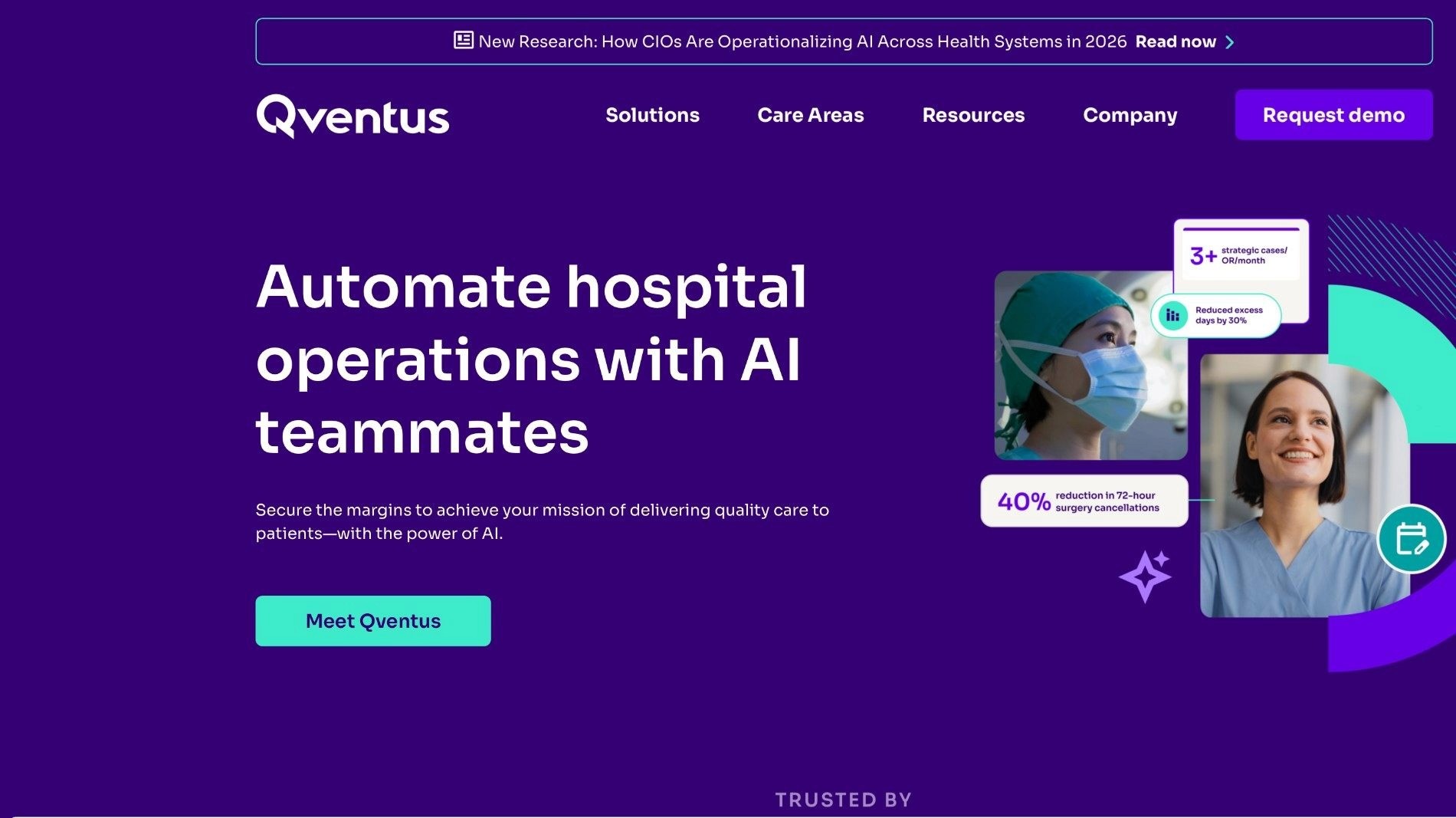
Qventus is a healthcare AI company focused specifically on operational scheduling and care coordination within health systems, with a particular strength in surgical and inpatient operations.
Their AI product covers surgical scheduling optimisation, perioperative capacity management, discharge planning coordination, and inpatient flow, helping health systems reduce length of stay, increase surgical volume, and improve bed utilisation. Qventus combines machine learning forecasting with workflow automation to predict bottlenecks and trigger pre-emptive actions rather than reacting to problems after they occur.
Among healthcare AI companies focused on operational throughput and capacity management rather than patient communication or clinical documentation, Qventus addresses a distinct set of problems faced by hospital operations and surgical services leaders.
Ideal For
Chief Operating Officers and surgical services leaders at large hospitals and health systems wanting to increase surgical volume and reduce cancellations through better scheduling
Inpatient operations and capacity management teams needing AI-driven discharge planning to reduce length of stay and bed bottlenecks
Health system operations leaders whose primary challenge is operational throughput rather than patient communication or clinical documentation
Healthcare CFOs evaluating AI investments on the basis of surgical revenue increase and bed utilisation improvement
Top Features
AI-Powered Surgical Scheduling Optimisation: Qventus analyses historical scheduling data, cancellation patterns, and capacity constraints to optimise the surgical schedule and reduce last-minute cancellations that create revenue loss and resource waste.
Inpatient Flow and Discharge Planning: Predictive tools identify patients approaching discharge criteria early, triggering care coordination actions that accelerate discharge preparation and reduce the length of stay backlog that creates bed capacity constraints.
Machine Learning Forecasting for Capacity Management: Demand forecasting models predict patient volume, staffing requirements, and bed utilisation patterns to allow proactive capacity management rather than reactive bed management.
Why They Stand Out?
Qventus is one of the best healthcare AI companies targeting surgical operations and inpatient flow.
The combination of scheduling optimisation and predictive discharge planning addresses two of the highest-value operational problems for hospital COOs.
Pros
Directly addresses surgical scheduling and inpatient capacity, which are high-value operational problems for hospital revenue and throughput
Predictive discharge planning reduces length of stay bottlenecks
Machine learning forecasting supports proactive rather than reactive capacity management
Strong track record in US health system deployments
Cons
Enterprise pricing via direct sales only; no published tiers
Primarily a US-market product with limited UK and European health system deployment evidence
Does not cover patient communication triage, clinical documentation, or general administrative workflow automation
Pricing
Qventus uses enterprise-grade pricing via direct sales engagement. Contact their sales team for a custom quote based on your facility type, bed count, and target use cases.
Final Verdict
Qventus is one of the best AI in healthcare companies, especially for large hospitals and surgical service leaders whose main priority is to increase surgical throughput and reduce in-patient length of stay.
For healthcare organisations whose primary challenge is patient communication automation, clinical documentation, or multi-system administrative workflow processing, the surgical operations focus does not address those use cases.
8. Luma Health

Overview
Luma Health is a patient engagement and care coordination platform covering automated appointment reminders, digital intake, referral management, and care gap outreach for healthcare providers across the patient journey.
Their product integrates with a broad range of EHR and practice management systems, making it deployable without significant custom integration work.
If you’re exploring the best healthcare AI companies for improving patient engagement (including reducing no-shows, automate intake and referral management) - Luma Health is a great option.
Ideal For
Primary care and specialty practice administrators wanting to reduce appointment no-shows through automated patient reminders and confirmations
Health systems and large practices wanting to digitise patient intake and reduce front-desk paper-based processes
Referral management teams at health systems wanting to track referral completion rates and automate follow-up with patients who have not scheduled referred appointments
Ambulatory care operations leaders wanting a single platform for patient communication, intake, and care gap outreach
Top Features
Automated Appointment Reminders and Confirmations: Luma Health sends automated appointment reminders via text, email, and phone, and captures patient confirmations and cancellations, feeding responses back to the scheduling system without staff involvement.
Digital Patient Intake: Patients complete intake forms digitally before the appointment, reducing front-desk processing time and the paper-based intake processes that slow patient flow during busy clinic sessions.
Referral Management and Follow-Up Automation: Luma tracks whether referred patients schedule and attend referred appointments, automating follow-up reminders to patients who have not booked and alerting care teams when referral completion rates fall below target.
Why They Stand Out?
Luma Health is one of the best healthcare AI companies for ambulatory care and outpatient practices wanting a single patient engagement product covering reminders, intake, and referral management.
Pros
Published starting pricing from $250/month makes budget assessment possible without a full sales engagement
Covers appointment reminders, digital intake, and referral management in a single product
Broad EHR integration coverage for ambulatory care and outpatient environments
Accessible entry point for smaller practices alongside enterprise pricing for large health systems
Cons
Primarily designed for ambulatory and outpatient care; less relevant for inpatient or complex hospital operations
Does not cover operational back-office automation, clinical documentation, or multi-system legacy integration
Enterprise pricing for large health systems requires custom engagement beyond the published starting rate
Pricing
Luma Health's pricing starts at approximately $250/month, scaling with the number of providers and patient volume. Custom pricing is available for larger health systems. Contact their sales team for enterprise-scale quotes.
Final Verdict
Luma Health is one of the more renowned AI in healthcare companies - with its product being a key solution for primary care and specialty care practices, alongside ambulatory care organisations who want to automate patient reminders, digital intake and referral management at an accessible price.
For hospital groups or healthcare networks needing operational back-office workflow automation or clinical documentation AI, the patient engagement focus does not address those requirements.
9. Athelas
Overview
Athelas occupies the ninth spot on our list of the top AI in healthcare companies. They started off with remote patient monitoring and have since expanded into AI-assisted clinical documentation and care management automation.
Their product covers features like remote monitoring devices and data collection, AI-assisted documentation, care management workflows, and billing automation for primary care and chronic disease management practices.
Among tools combining remote patient monitoring with AI documentation, Athelas has carved a distinct position by addressing the administrative burden of monitoring programmes specifically, rather than either standalone monitoring or standalone documentation.
Ideal For
Primary care and chronic disease management practices with significant remote patient monitoring programmes needing to reduce monitoring programme administrative overhead
Practice managers at outpatient practices where care management documentation and billing consume disproportionate staff time relative to the clinical work delivered
Healthcare organisations running CMS chronic care management programmes that need to document programme touchpoints accurately for billing compliance
Primary care groups evaluating combined remote monitoring and documentation AI rather than separate tools for each function
Top Features
Remote Patient Monitoring with AI Analysis: Athelas combines physical monitoring devices with AI analysis of monitoring data, identifying clinical anomalies and generating alerts for care team review, automating the monitoring programme workflow from data collection through clinical notification.
AI-Assisted Documentation for Monitoring Touchpoints: The system generates documentation for care management interactions, reducing the manual charting burden associated with regular monitoring check-ins and care plan updates.
Billing Automation for Care Management Programmes: Automated billing workflows identify billable monitoring and care management events, reducing the revenue leakage that occurs when manual billing processes miss eligible encounters.
Why They Stand Out?
Athelas is a great all-in-one choice for teams running big remote monitoring programs. It brings devices, documentation, and billing onto a single platform, so you don't have to juggle a dozen different tools.
Pros
Combines remote monitoring devices, AI documentation, and billing automation in an integrated product
Specifically designed for the administrative burden of monitoring and care management programmes
Reduces revenue leakage from unbilled monitoring encounters
Relevant for primary care practices with CMS programme participation
Cons
Custom pricing requires engagement; no published rates for early budget comparison
Primarily suited to primary care and chronic disease management contexts; limited applicability for hospital groups or large health systems
The combined device-plus-software model means adoption requires hardware deployment alongside software
Pricing
Athelas uses custom pricing plans based on use cases, practice size, and monthly programme volume. Contact their team for a quote.
Final Verdict
Athelas is one of the best healthcare AI companies for primary care and chronic disease management practices that run remote monitoring programmes and want to reduce administrative overhead through combined monitoring, documentation and billing automation.
For hospital groups or healthcare networks with large-scale operational workflow challenges across multiple clinical departments, the primary care and monitoring programme focus limits applicability.
10. Suki AI
Overview
Suki AI is one of the best healthcare AI companies globally, with a voice-driven AI assistant for clinical documentation allowing clinicians to dictate notes, query patient data and complete clinical tasks by voice during or after patient consultations.
Their core product generates clinical notes from voice dictation, integrates with major EHR systems for direct note entry, and supports custom medical vocabulary for specialist clinicians.
Among clinical documentation AI tools, Suki is positioned for clinicians who prefer voice-first interaction over conversation capture, and who want a dedicated documentation assistant rather than a passive ambient listener.
Ideal For
Clinicians who prefer voice-first interaction for clinical documentation rather than ambient AI listening during consultations
Healthcare practices and health systems where clinicians want to maintain control over documentation by actively dictating rather than having AI generate notes from ambient conversation capture
Specialist clinicians needing custom vocabulary training for specialist-specific documentation patterns
Health system medical informatics leaders evaluating voice AI documentation as an alternative or complement to ambient AI scribing
Top Features
Voice-Driven Clinical Note Dictation: Clinicians dictate clinical notes by voice, with Suki's AI converting dictation into structured clinical documentation that can be reviewed and posted to the EHR without manual transcription.
EHR Integration and Direct Note Entry: Suki integrates with major EHR systems, allowing dictated notes to be reviewed and posted directly into the patient record without a separate copy-paste step.
Custom Medical Vocabulary: Suki supports custom vocabulary training for specialist clinical language, reducing the error rate on specialist terminology that general voice recognition systems often mishandle.
Why They Stand Out?
Suki is one of the more focused AI in healthcare companies for voice-first clinical documentation.
The custom vocabulary capability is a practical differentiator for specialist clinicians whose documentation requires terminology accuracy that generic voice AI cannot achieve consistently.
Pros
Voice-first documentation gives clinicians active control over note content rather than relying on ambient AI interpretation
Custom medical vocabulary reduces specialist terminology error rates
EHR integration supports direct note posting rather than manual transfer
Strong clinician adoption evidence in practices with high specialist vocabulary requirements
Cons
Pricing at approximately $300–$500 per clinician per month is at the higher end of the AI documentation category
Focused specifically on clinical documentation; does not cover patient engagement, scheduling, or operational workflow automation
Voice dictation requires adaptation to a different documentation workflow for clinicians accustomed to typing or templated documentation
Pricing
Suki AI is priced at approximately $300–$500 per clinician per month, depending on features and volume.
Enterprise pricing is available for larger healthcare organisations. Contact their sales team for a custom quote.
Final Verdict
Suki AI is one of the top healthcare AI companies for clinicians and practices where voice-first documentation is preferred over ambient AI scribing - and where specialist vocabulary accuracy is a requirement.
The per-clinician pricing at the higher end of the category makes it a significant investment for large organisations, and the documentation-only scope means it does not address operational or patient engagement challenges.
How to Choose the Best Healthcare AI Companies (What to Consider) For Your Use Case?
1. Define Whether You Need Clinical, Patient Engagement, or Operational AI
The most important clarification before evaluating any healthcare AI companies is: which category of problem you are solving?
Clinical AI covers diagnostics, clinical documentation, and decision support, while patient engagement AI covers appointment management, reminders, and patient communication.
Outside of the above two, operational AI covers administrative workflow automation, communication triage and multi-system back-office processing. These are distinct problems served by different sets of tools.
Most organisations have challenges in all three areas, but the highest-value starting point is typically the one generating the most measurable operational cost.
2. Verify GDPR Article 9 and Data Governance Compliance
For European healthcare organisations, any AI system processing patient health data is processing special category data under GDPR Article 9, which carries the strictest processing obligations in European data law.
Verify specifically, not in principle: does the vendor have a deployment architecture where patient health data never leaves the organisation's infrastructure? Do they hold ISO 27001 certification and a GDPR Article 28 data processing agreement?
For NHS organisations, does the product align with the NHS Data Security and Protection Toolkit? Discovering a compliance gap post-procurement creates significant organisational risk.
3. Assess Legacy System Integration Depth for Operational AI
For operational AI tools in healthcare, the quality of integration with existing clinical and administrative systems determines whether the AI reduces manual work or simply adds another tool to manage.
Ask specifically: does the product connect to your hospital management system, your legacy EHR, and your administrative systems natively, or does integration require a modernisation project?
For hospital groups running on older systems, the vendors that require API-first infrastructure exclude themselves before the evaluation begins.
4. Require Production Evidence in Comparable Healthcare Environments
Healthcare procurement is not the right context for being the first production reference.
Before committing to any of the options on this list, require evidence of live production deployments in comparable healthcare environments: similar organisation size, similar legacy system landscape, similar data governance requirements.
Sandbox demonstrations on generic data are not sufficient.
The CUF/José de Mello case study with Noxus, 10,000+ communications per month in production at 96% precision under GDPR Article 9, is an example of the type of evidence worth requiring.
5. Model Total Cost Against Administrative Headcount Displaced
For operational AI, the financial justification is direct: the cost of the AI deployment against the administrative headcount and error-rate cost it replaces.
Before selecting from the various AI in healthcare companies on this list, calculate your current cost per communication processed, your monthly communication volume, and your current error rate and downstream rework cost.
Compare that against the deployment cost at your projected communication volume at 12 and 24 months.
The vendors whose cost structure aligns with your volume growth rather than charging against a fixed seat count or transaction model will produce better long-term economics.
Everything You Need to Know About Healthcare AI Companies
← scroll to see all columns →
| Company | Pros | Cons | Ease of Use | Integrations | Support | Affordability |
|---|---|---|---|---|---|---|
| Noxus | End-to-end operational workflow automation; GDPR Article 9 compliance; legacy system depth | Not suited to small practices; operational layer only | ⭐⭐⭐⭐⭐ | ⭐⭐⭐⭐⭐ | ⭐⭐⭐⭐⭐ | ⭐⭐⭐⭐⭐ |
| Voiceoc | WhatsApp patient engagement; no app required; multilingual | Market-specific; limited to appointment management | ⭐⭐⭐⭐⭐ | ⭐⭐⭐⭐⭐ | ⭐⭐⭐⭐⭐ | ⭐⭐⭐⭐⭐ |
| TeleVox | Full care journey coverage; conversational AI; established track record | US-centric integration; patient engagement only | ⭐⭐⭐⭐⭐ | ⭐⭐⭐⭐⭐ | ⭐⭐⭐⭐⭐ | ⭐⭐⭐⭐⭐ |
| Commure | Free plan; affordable Pro tier; documentation plus workflows | Enterprise gaps; limited large health system depth | ⭐⭐⭐⭐⭐ | ⭐⭐⭐⭐⭐ | ⭐⭐⭐⭐⭐ | ⭐⭐⭐⭐⭐ |
| Abridge | Academic validation; specialty language support; real-time notes | Enterprise pricing only; documentation-only scope | ⭐⭐⭐⭐⭐ | ⭐⭐⭐⭐⭐ | ⭐⭐⭐⭐⭐ | ⭐⭐⭐⭐⭐ |
| Murphi.ai | Multi-agent architecture; clinical and operational coverage | Newer entrant; limited production evidence at scale | ⭐⭐⭐⭐⭐ | ⭐⭐⭐⭐⭐ | ⭐⭐⭐⭐⭐ | ⭐⭐⭐⭐⭐ |
| Qventus | Surgical scheduling optimisation; predictive discharge planning | US-focused; surgical operations only; custom pricing | ⭐⭐⭐⭐⭐ | ⭐⭐⭐⭐⭐ | ⭐⭐⭐⭐⭐ | ⭐⭐⭐⭐⭐ |
| Luma Health | Published starting price; reminders plus intake plus referrals | Ambulatory focus; no back-office automation | ⭐⭐⭐⭐⭐ | ⭐⭐⭐⭐⭐ | ⭐⭐⭐⭐⭐ | ⭐⭐⭐⭐⭐ |
| Athelas | Remote monitoring plus documentation in one product; billing automation | Primary care focus; hardware deployment required | ⭐⭐⭐⭐⭐ | ⭐⭐⭐⭐⭐ | ⭐⭐⭐⭐⭐ | ⭐⭐⭐⭐⭐ |
| Suki AI | Voice-first documentation; custom vocabulary; EHR integration | High per-clinician cost; documentation-only scope | ⭐⭐⭐⭐⭐ | ⭐⭐⭐⭐⭐ | ⭐⭐⭐⭐⭐ | ⭐⭐⭐⭐⭐ |
Automate Your Healthcare Operations with Noxus
A significant number of healthcare AI companies on this list address specific pain points in the patient journey or clinical workflow. We address the back-office operational layer that those tools sit on top of: the system integration and workflow automation infrastructure that makes AI executable at scale inside the complex legacy environments healthcare groups actually run.
Our healthcare deployment at CUF/José de Mello is in production, with 10,000+ patient and administrative communications per month, 3x ROI, 96% AI precision, full GDPR Article 9 compliance, 50 days from contract to production – with every action being logged and governed by the organisation's own policies. Patient health data never leaves the organisation's infrastructure.
If your operations team is processing thousands of healthcare communications per month manually, bridging the gap between patient-facing channels and clinical or administrative systems by hand, we automate that entire chain on the systems you already run.
Most healthcare AI programmes we encounter have already run pilots. The pilots demonstrated capability in a controlled environment and stalled when they met legacy hospital management systems, GDPR Article 9 requirements, and the multi-system lookups that follow every classified communication.
That is the specific problem we are built to solve – not another sandbox test, but a live deployment on your actual systems in 45-80 days.
Book a free consultation with us now, to scope your requirements and to run a live workflow on your actual healthcare workflows and systems. No credit card or active IT project required.
FAQs About Healthcare AI Companies
What are the best healthcare AI companies in 2026?
Noxus tops the list for the best healthcare AI companies globally. We’re an ideal choice for operational back-office automation and communication triage at hospital groups - delivering 3x ROI and 96% precision in production under GDPR Article 9 compliance. For use cases like clinical documentation and patient engagement, tools like Abridge, Suki AI and Luma Health are ideal options.
What should I consider when choosing the right healthcare AI company for me?
When choosing a healthcare AI company, the 3 most important factors are: which category of problem you are solving, clinical documentation, patient engagement, or operational workflow automation; whether the vendor's deployment architecture satisfies your GDPR Article 9 or equivalent data governance requirements; and whether the vendor has production evidence in comparable healthcare environments rather than only sandbox or pilot deployments. Require production reference data, not demo performance.
How does Noxus differ from other AI in healthcare companies?
Unlike other healthcare AI companies, Noxus tackles the operational back-office layer instead of a single clinical or patient-facing task. Most tools only automate one workflow step, but the platform executes the full end-to-end process: from communication intake, through multi-system lookups, to writing back updates under deterministic policy governance. Our deployment at CUF/José de Mello proves this, handling over 10,000 communications monthly with 96% precision, full GDPR Article 9 compliance, and reaching production in just 50 days.
How do I get started with Noxus?
Starting with Noxus is simple: we run a structured pilot on your actual communication workflows first. You don't commit until you see production-quality results on your own data. The process begins with a discovery conversation and a Proof of Results test, showing performance on your real historical data. We usually get your first deployment running in just 45 to 80 days. You can connect with our team by booking a consultation to scope your use case.
How easy is it to switch to Noxus?
Switching to Noxus does not require replacing your existing clinical or administrative systems. We operate as an automation layer on top of the systems you already run, connecting to your EHR, hospital management system, and clinical platforms without requiring API modernisation. The integration work is handled by our deployment team. Your operations and clinical administration teams are involved in workflow design and policy mapping rather than infrastructure setup. Most first healthcare deployments are live within 50 days, as demonstrated at CUF/José de Mello.
Is Noxus compliant with GDPR Article 9 for processing patient health data?
Yes; GDPR Article 9 compliance is architecturally core to our healthcare deployments, not a contractual add-on. Noxus can be deployed entirely on the healthcare organisation's own infrastructure, air-gapped if required, ensuring patient health data never leaves the organisation's control. Every action produces a complete, tamper-evident audit trail. We are certified against SOC 2 Type II, ISO 27001, GDPR Article 28, and HIPAA. The CUF/José de Mello deployment maintains full GDPR Article 9 compliance throughout, processing 10,000+ patient communications per month on the organisation's own infrastructure.
What is the difference between clinical AI and operational AI in healthcare?
The core difference between clinical AI and operational AI lies in the type of work automated. Clinical AI supports doctors with things like medical imaging analysis, diagnostic support, and clinical documentation. Operational AI focuses on healthcare administration: processing patient communications, automating appointments, handling billing, and executing multi-system administrative workflows. This means the procurement audience differs: Clinical AI is typically evaluated by medical leadership, while Operational AI is for COOs, Operations Directors, and Digital Transformation Leaders.
What does the EU AI Act mean for healthcare AI procurement in 2026?
The EU AI Act classifies AI systems making clinical decisions as high-risk, requiring conformity assessments and human oversight. Noxus avoids this by design: our AI co-workers handle administrative tasks and communications, while all clinical/compliance decisions follow your organization's hard-coded policy rules, not AI inference. This means Noxus deployments aren't subject to high-risk obligations. Healthcare organizations should verify whether an AI system falls within high-risk categories and whether the architecture supports human oversight. For Noxus, deterministic policy execution satisfies oversight requirements.
How does Noxus differ from patient engagement tools like TeleVox or Luma Health?
Patient engagement tools like TeleVox and Luma Health automate reminders, intake, and follow-ups well. Noxus works differently: the platform processes patient requests, retrieves records from clinical systems, applies policies, generates responses, and writes outcomes back to administrative and clinical systems. The difference isn't the channel but the multi-system workflow running on legacy systems. For healthcare orgs where back-office processing after patient interactions is the bottleneck, Noxus addresses what patient engagement tools leave to manual work.