Decagon vs Sierra: Which Automation Platform Is Better in 2026? (Plus a Third Contender)

Key Takeaways (TL;DR)
Primary difference: Decagon vs Sierra is a close contest between two strong conversational AI platforms, separated by emphasis rather than category. Both are organised around the conversation, which is the shared limit when what arrives is a dispute, a claim or an account change that has to be resolved in core systems. That is where the third contender in this comparison sits.
Best overall choice: Noxus, for any organisation where the inbound queue is full of cases rather than questions, and resolving one means retrieving records, applying policy and writing an outcome back.
Resolving the case winner: Noxus. A Case carries its data, documents, state, decisions, tasks and execution history from intake to outcome, pausing for a person without losing context and resuming from the same state.
Multi-system execution winner: Noxus. Retrieving the account record from core banking or SAP, checking the policy, calculating redress, posting the adjustment, updating the CRM and closing the case under a full audit trail.
Governed decisions winner: Noxus. Deterministic logic mapped from your own SOPs handles every decision that must follow an exact rule, so no model determines cover, redress or payment.
Audit and explainability winner: Noxus. Lineage on every action, user, policy, model and input, replayable and exportable for regulators, with tamper-proof logging exportable to your own SIEM.
Deployment sovereignty winner: Noxus. Shared cloud, self-hosted, dedicated cloud or air-gapped on-premises, with bring-your-own-key model access and no training on client data in any deployment model.
Breadth of scope winner: Noxus. One process layer across customer operations, finance, claims, procurement and service management, rather than a separate tool per function.
Where the named pair wins: Sierra takes conversational quality and channel coverage on the strength of its context handling, and Decagon takes time to launch and ease of use on the strength of its setup and implementation support.
Table of Contents
Decagon vs Sierra vs Noxus in 2026: At a Glance
Criteria | Noxus | Decagon | Sierra |
Best for | Enterprises resolving cases across core systems under audit | Support teams wanting fast deployment with hands-on help | Support organisations wanting depth in agent design and channels |
Primary object | A Case, moving from intake to outcome | A conversation | A conversation |
Where the work ends | An outcome written into the system of record | A resolved or routed conversation | A resolved or routed conversation |
Multi-system execution | 400+ systems including SAP, Guidewire, Oracle, core banking | Integrations into the support stack | Tool and integration generation |
Governed decisions | Deterministic logic mapped from your own SOPs | Guardrails and guidelines | Guardrails and guidelines |
Work that spans days | Case persists with state, deadlines and pending work | Within the conversation lifecycle | Within the conversation lifecycle |
Audit record | Lineage on every action, user, policy, model and input | Analytics and QA scorecards | Simulations, experiments, versioning |
Deployment | Shared cloud, self-hosted, dedicated cloud, air-gapped | Managed cloud | Managed cloud |
Scope | Customer operations, finance, claims, procurement, ITSM | Customer support | Customer support |
Channels | Email, documents, APIs, portals, tickets, system events | Chat, voice, email, SMS | Chat, SMS, WhatsApp, email, voice, ChatGPT |
Regulated deployment | ⭐⭐⭐⭐⭐ | ⭐⭐⭐ | ⭐⭐⭐ |
Back-office execution | ⭐⭐⭐⭐⭐ | ⭐⭐ | ⭐⭐⭐ |
Conversational depth | ⭐⭐⭐ | ⭐⭐⭐⭐ | ⭐⭐⭐⭐⭐ |
The Basics If You Are New Around Here
What are AI customer experience platforms?
AI customer experience platforms handle inbound customer conversations with language models, answering questions, taking simple actions and routing what they cannot handle to a person. The category has moved quickly from scripted chatbots to systems that understand intent, hold context across a conversation and call tools on the customer's behalf.
The measure the category reports on is deflection or resolution rate: the share of conversations closed without a human agent. That is a real operational number and it maps to a real cost line in a contact centre.
Where the category meets its boundary is work that is not a conversation. A billing dispute may begin as a chat and end as a credit posted in a core banking system, a note in the CRM and an entry in an audit log. The conversation is the front door rather than the whole house.
What is Noxus?
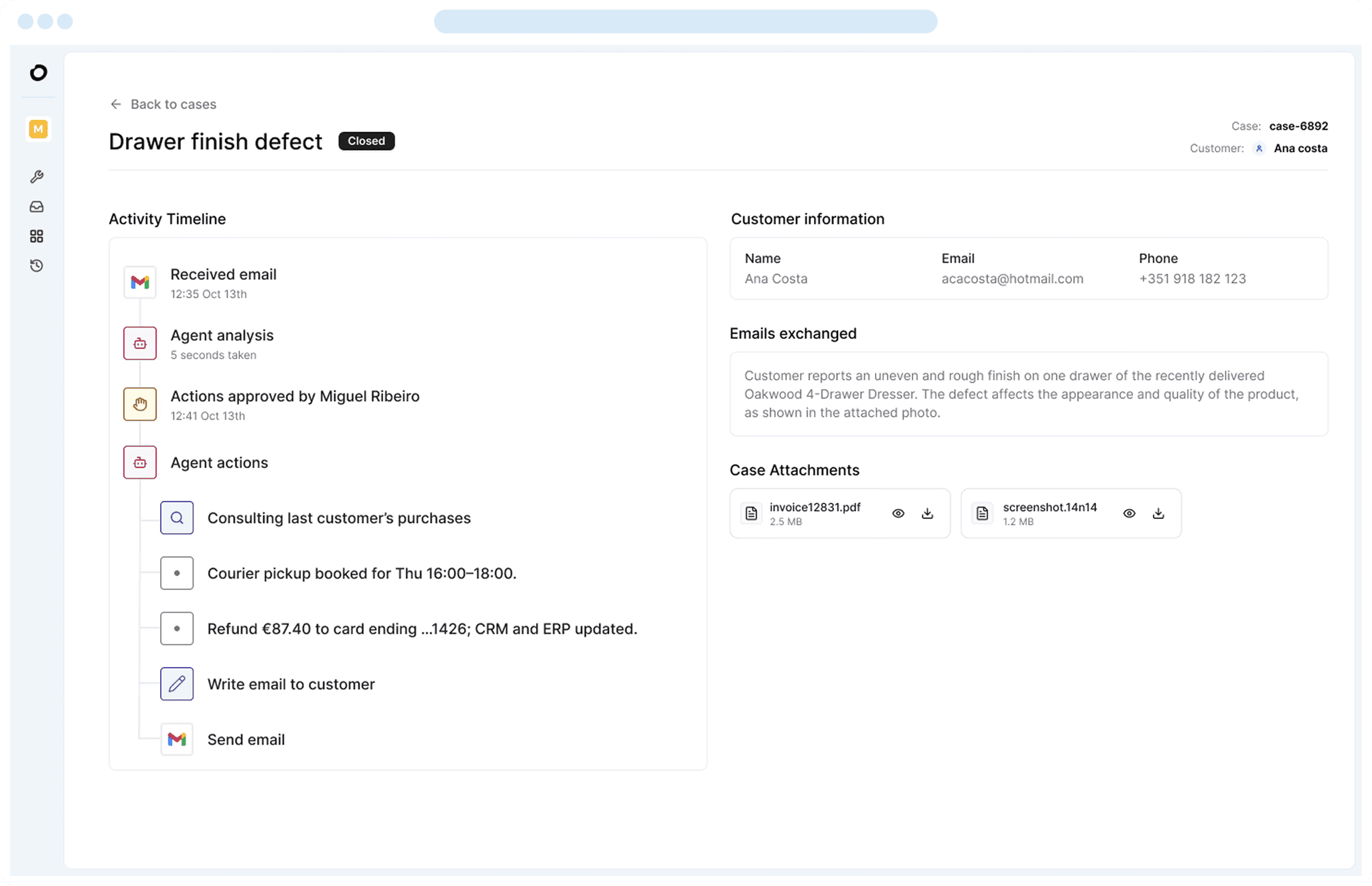
Noxus is the process layer for enterprise operations. It holds the process logic and live case state that coordinate work across agents, people and the systems an organisation already runs, carrying each case from intake to outcome with every action recorded.
It is not a chatbot, a copilot or a conversational AI tool, and it does not compete for support deflection. It appears in this comparison because a large share of what arrives in a support queue is not really a support question. It is a billing dispute, a complaint, an account change or a claim that has to be resolved in core systems.
Noxus runs those processes end to end inside SAP, Guidewire, Oracle, ServiceNow, core banking platforms and proprietary systems, writing outcomes back under governance. Founded in 2023 and based in London and Lisbon, it is deployed across banking, insurance, healthcare, retail and manufacturing.
What is Decagon?

Decagon is a cloud-based customer support platform using AI agents across chat, voice, email and SMS. Businesses use it to automate responses to common questions and route complex issues to human agents.
Its product surface includes Agent Operating Procedures, tools, knowledge, guidelines and guardrails on the build side, with simulations, QA scorecards, versioning and experiments for quality control. Watchtower observability and diagnostic tools cover the monitoring side.
Reviewers describe it as combining automation with a good customer experience, handling a large volume of routine requests while leaving the team flexibility to step in. Several single out the implementation relationship as a reason they would recommend it.
What is Sierra?

Sierra is an AI platform for building and deploying customer service agents across chat, SMS, WhatsApp, email, voice and ChatGPT. Its agent authoring includes journey generation, tool generation and integration support, with a running test cycle built into the build loop.
Sierra has the larger public footprint of the two, with 131 G2 reviews against Decagon's 29. Reviewers describe context-aware handling that keeps conversations feeling natural rather than scripted.
The product is aimed at support organisations that want depth in how an agent behaves, including multilingual handling and personality control. Several reviewers describe the initial setup as quick, with complexity arriving later in configuration rather than at the start.
Decagon vs Sierra vs Noxus: A Detailed Comparison
1. Resolving the case behind the conversation
Noxus
A Case in Noxus is one instance of the process: a complaint, request, claim, document or other unit of work moving from intake to outcome. It carries its data, documents, state, decisions, tasks and execution history throughout.
Take a disputed transaction. The process interprets the inbound message, retrieves the account and transaction records from core banking, checks the dispute against the bank's own policy rules, calculates any redress, posts the adjustment, updates the CRM and closes the case with a full audit trail.
Where the case cannot be resolved automatically, it pauses and creates work for the right team rather than failing silently. The person receives the case with the information and prior actions already accumulated, resolves the issue, and the process continues from the same state.
Decagon
Decagon is effective on routine requests and reviewers say so plainly. The boundary they describe is equally plain.
A mid-market reviewer who rated it four stars put it directly: complex or unusual customer issues may still require human intervention, and making those handoffs smoother would improve the experience. That is an accurate description of what the product does and does not claim.
Sierra
Sierra reviewers describe the same boundary from a different angle. One support practitioner noted that when there are multiple issues involved, or the user has not explained the problem clearly, it can take a few interactions to get to the right answer.
The same reviewer suggested Sierra should recognise sooner when a query is becoming too complex and hand it to a person. Another reviewer, rating the product 4.5 stars, wrote that the value would be even stronger if complex cases required less human intervention.
🏆 Winner
Noxus. Two independent users naming the same limitation on two different products describes the shape of the category rather than a defect in either tool. The named platforms resolve conversations and are good at it, while Noxus resolves the operational case underneath.
2. Multi-system execution and write-back
Noxus
Noxus connects to more than 400 systems out of the box, covering SAP ECC and S/4HANA, Guidewire, Oracle, ServiceNow, Salesforce, Outlook, Teams, SharePoint and Snowflake. Where a proprietary system has no connector, the plugin system takes custom nodes and integrations built in any language capable of hosting an HTTP server.
It interacts with legacy systems the way operations teams do today: navigating interfaces, performing multi-step lookups, writing back results and handling exceptions. No API layer is required, no middleware project and no modernisation programme as a prerequisite.
Published use case figures include 60% complaint automation with 74% first contact resolution on current accounts, 80% first notice of loss automation with a 60% processing time reduction, and 78% invoice automation with a 70% reduction in average processing time.
Decagon
Decagon integrates into the support stack and can call tools on the customer's behalf during a conversation. For actions that live inside the support estate, that is sufficient.
The constraint is depth rather than presence. An ERP with no exposed API or a COBOL-era core is outside what a conversational platform sets out to reach.
Sierra
Sierra includes tool generation and integration support as part of agent authoring, which makes connecting to known services reasonably quick. Reviewers describe this positively.
The same boundary applies. Generating a tool against a documented API is a different problem from operating a system that exposes nothing useful.
🏆 Winner
Noxus. This is the criterion the product was built on, and neither of the other two claims the ground.
3. Governed decisions and policy enforcement
Noxus
The Noxus model separates interpretation from decision as a matter of architecture. AI handles the messy, unstructured part of operations. Where a decision must follow an exact rule, deterministic logic takes over, mapped from the client's own SOPs and policies.
Exact rules, thresholds, calculations, accountable approvals and existing system logic stay where they already fit the work. Around the model, the process grounds it in approved source material, constrains what it is allowed to do, validates outputs against rules and systems of record, and routes uncertain work to people.
No model determines whether a claim falls within cover, whether a refund is due or whether a payment executes. That is what makes an outcome traceable to a named policy version in an audit.
Decagon
Decagon provides guardrails and guidelines as part of agent configuration, along with QA scorecards and simulations for testing behaviour before it reaches customers. For a support context this is a sensible and proportionate model.
Where reviewers ask for more is customisation on the unusual cases. One describes needing effort to fine-tune workflows so the AI responds exactly as intended for complex or less common questions.
Sierra
Sierra provides a comparable set, with guardrails, simulations, experiments and versioning. Reviewers describe the testing loop as part of the build cycle rather than an afterthought.
The model is designed to shape conversational behaviour, which it does well. It is not designed to carry the kind of rule that a compliance function signs off and a regulator later inspects.
🏆 Winner
Noxus, for regulated processes specifically. For support deflection, the guardrail models in both named platforms are proportionate to the risk involved.
4. Audit and explainability
Noxus
Every process run produces a complete trace of what happened and why: a misinterpretation of the input, a rule mismatch, a system timeout or a data quality issue. Operations teams use it to improve processes, compliance teams use it to prove governance, and IT teams use it to debug.
Two record types serve different audiences. The functional history shows what happened to the business case, covering decisions, agent actions, system updates, human intervention and outcomes. Technical logs carry the runtime and integration detail engineering teams need.
Noxus holds SOC 2 Type II, ISO 27001 and GDPR including Article 28, is HIPAA eligible for healthcare workloads on on-premises deployments, has NIS2 controls in place and has ISO 27701 in progress. Audit logging is tamper-proof and exportable to your own SIEM.
Decagon
Decagon provides analytics, QA scorecards and observability through its Watchtower tooling, which covers how agents are performing and where quality is slipping. For managing a support operation that is the right instrumentation.
Reviewers who want more ask for reporting flexibility rather than regulatory traceability, which reflects what the product is used for.
Sierra
Sierra's simulations, experiments and versioning give a reasonable account of how an agent was changed and how it behaves. That supports internal quality management well.
It answers questions about agent behaviour rather than questions about an individual case. Those are different records serving different functions.
Winner
Noxus. The comparison is uneven by design, since the named platforms are not sold to compliance functions and do not claim to be.
5. Deployment, data control and European regulation
Noxus
Noxus runs as shared cloud, self-hosted standard or high-availability inside the client's infrastructure, dedicated cloud, or air-gapped on-premises. In customer-controlled deployments, process data, documents, case state, execution history and audit records stay inside the client perimeter.
Data protection covers AES-256 at rest and TLS 1.3 in transit, with key management through HSM or cloud-native KMS. Identity runs through SSO via SAML and OIDC, with granular API keys and role-based access control.
Model access is separate from the process definition, with fourteen providers behind fallback chains across Azure OpenAI, Vertex AI, AWS Bedrock or private endpoints. A team can change model or provider without rebuilding the surrounding process, and there is no training on client data in any deployment model.
Decagon
Decagon runs as a managed cloud platform with enterprise security and controls as part of its product surface. For most support organisations that is the right architecture and the question ends there.
It becomes a constraint only where a data residency or sovereignty obligation rules managed cloud out before any feature discussion begins.
Sierra
Sierra is likewise a managed cloud platform, and reviewers describe it as reliable and secure in day-to-day use. The same consideration applies for a buyer with a sovereignty requirement.
🏆 Winner
Noxus. For a European bank, insurer or healthcare group where the security function decides whether a deal closes, deployment architecture is the criterion rather than a footnote.
6. Scope beyond customer support
Noxus
The same process layer runs customer operations, financial back office, claims, procurement, IT service management and supplier quality. Published figures include 70% straight-through completion on policy onboarding and renewal, 75% intake automation on merchant onboarding and KYC, and 80% straight-through processing on supplier quality documentation.
Once the integrations, governance and identity are running for the first process, adjacent processes reuse them. That is the practical argument for one process layer rather than a growing collection of separately built tools, each with its own change project.
Decagon
Decagon is a customer support platform and does that job. Expanding it into finance operations, supplier quality or claims processing is outside what it sets out to do.
That focus is a strength in its own market. A product that tries to be everything to everyone usually ends up shallow in all of it.
Sierra
The same applies. Sierra's agent model is strong and its scope is customer-facing conversation.
🏆 Winner
Noxus, though this is a scope difference rather than a quality judgement. A support team buying support software should not weight this criterion heavily.
7. Conversational quality and intent handling
Sierra
Sierra draws the stronger praise on conversational handling specifically. Reviewers describe it as context-aware, able to understand the general intent behind a question even when a user is not clear or technical, and able to guide them towards a solution.
The quality reviewers single out is that automated responses feel less scripted. For a brand where the tone of a support interaction matters commercially, that is a meaningful difference rather than a cosmetic one.
Decagon
Decagon handles routine and repetitive requests well and reviewers are consistent about it. They describe fast, consistent responses that reduce the load on support agents, and note that it goes beyond answering questions into automating routine support tasks.
Channel coverage is solid across chat, voice, email and SMS. Sierra's list is longer, including WhatsApp and ChatGPT.
Noxus
Noxus does not compete here and should not be evaluated on it. Conversation is not the object the platform is built around, and a support team choosing a deflection tool should choose between the two named platforms.
What Noxus contributes sits upstream and downstream of the conversation: classifying what actually arrived, retrieving the records that determine the answer, applying the policy and executing the outcome.
🏆 Winner
Sierra. Context handling across channels is the thing it is best at, and its larger review base supports the claim.
8. Time to launch and implementation
Decagon
This is Decagon's clearest win. Reviewers describe the initial setup as straightforward and the platform as intuitive enough to get started without much friction.
The implementation relationship comes up repeatedly. One reviewer describes the setup as really good with the implementation team providing all the training needed, which for a support organisation without internal AI capacity is often the deciding factor.
Sierra
Sierra also starts quickly and reviewers say the platform is easy to get into. The difference appears slightly later in the process.
Several reviewers describe configuration as lengthy and complex once multiple settings or integrations need setting up, with some steps requiring a deeper understanding of the platform. The experience is positive once configured, which is a different claim from being fast to configure.
Noxus
Noxus targets 30 days from process mapping to production, with the process proven on the client's live systems and data within weeks. That is a different unit of work, since it includes mapping the current process, quantifying the value and redesigning it for execution with human oversight.
For a straightforward support deflection use case, both named platforms will be live sooner. For a process touching core banking, SAP and a CRM, 30 days is the relevant benchmark.
🏆 Winner
Decagon, on both setup simplicity and the implementation relationship reviewers describe.
9. Ease of Use
Decagon
Reviewers describe Decagon as intuitive enough to get started without a lot of friction, with a simple interface and instant answers. The implementation team is named repeatedly as part of why onboarding goes smoothly.
The area reviewers ask about is customisation depth. Fine-tuning workflows for complex or less common questions takes effort, and several would like more flexibility in reporting and analytics to measure where automation can be improved.
Sierra
Sierra starts easily and gets more demanding. One reviewer praised the intuitive interface and quick, hassle-free initial setup, then described configuration as sometimes lengthy and complex when multiple settings or integrations are involved.
That is a common and reasonable shape for a product with depth. The initial experience is excellent and the advanced modifications require understanding the platform properly.
Noxus
Noxus is a no-code visual editor for the people who design processes, with knowledge base management for company policies, SOPs and reference data. Business users build and modify processes independently of IT cycles.
It carries more concepts than a support platform does, because the problem is larger: cases, work queues, human tasks, versioning, evaluation and deployment. A Noxus G2 reviewer describes building multi-agent workflows quickly with fast debugging, while noting the initial learning phase was demanding.
🏆 Winner
Decagon, narrowly. Both named platforms start well, and Decagon's implementation support is what tips it.
10. Customer Reviews
This comparison is based on factual G2 reviews and detailed analysis of each platform in October 2026.
Noxus
Noxus holds 5.0 on G2. Reviewers highlight the speed of building multi-agent workflows, a fast debugging process, and integration coverage that made implementation straightforward.
Users also describe the directness of the support relationship, with quick replies and proactive guidance through implementation. One reviewer describes expanding their licence count and using the platform daily across data management, customer support and workplace administration.

Decagon
Decagon holds 29 reviews on G2. Users highlight the combination of automation with a good customer experience, the speed of handling routine requests, and the quality of the implementation and support relationship.
Reviewers describe it as going beyond answering questions into automating routine support tasks with consistency that is hard to maintain manually. Several name the onboarding experience specifically, including the training provided during setup.

Sierra
Sierra holds 4.5 on G2 across 131 reviews. Users highlight context-aware handling, the natural feel of automated responses, and the breadth of channels covered.
Reviewers describe Sierra understanding the general intent behind unclear questions and guiding customers towards a solution, and praise the intuitive interface and quick initial setup. Several note that configuration becomes more involved once multiple integrations are in play.

The Verdict, Feature by Feature
Criteria | Noxus | Decagon | Sierra | Verdict |
Resolving the case end to end | ⭐⭐⭐⭐⭐ | ⭐⭐⭐ | ⭐⭐⭐ | Noxus, the case persists until it is resolved |
Multi-system execution and write-back | ⭐⭐⭐⭐⭐ | ⭐⭐ | ⭐⭐⭐ | Noxus, outcomes written into systems of record |
Governed decisions | ⭐⭐⭐⭐⭐ | ⭐⭐⭐ | ⭐⭐⭐ | Noxus, deterministic logic from your own SOPs |
Audit and lineage | ⭐⭐⭐⭐⭐ | ⭐⭐⭐ | ⭐⭐⭐⭐ | Noxus, replayable and exportable for regulators |
Deployment sovereignty | ⭐⭐⭐⭐⭐ | ⭐⭐⭐ | ⭐⭐⭐ | Noxus, including air-gapped on-premises |
Work spanning days or weeks | ⭐⭐⭐⭐⭐ | ⭐⭐⭐ | ⭐⭐⭐ | Noxus, deadlines tracked independently of the case |
Legacy system depth | ⭐⭐⭐⭐⭐ | ⭐⭐ | ⭐⭐⭐ | Noxus, SAP and core banking without an API layer |
Scope beyond support | ⭐⭐⭐⭐⭐ | ⭐⭐ | ⭐⭐ | Noxus, one process layer across functions |
Conversational quality | ⭐⭐⭐ | ⭐⭐⭐⭐ | ⭐⭐⭐⭐⭐ | Sierra, context-aware handling across channels |
Channel coverage | ⭐⭐⭐ | ⭐⭐⭐⭐ | ⭐⭐⭐⭐⭐ | Sierra, including WhatsApp and ChatGPT |
Time to launch | ⭐⭐⭐ | ⭐⭐⭐⭐⭐ | ⭐⭐⭐⭐ | Decagon, setup plus hands-on implementation |
Ease of use | ⭐⭐⭐⭐ | ⭐⭐⭐⭐⭐ | ⭐⭐⭐⭐ | Decagon, narrowly |
Final Verdict: Which Should You Choose?
Choose Noxus if:
A large share of what arrives in your queue is not a question but a case: a dispute, complaint, claim or account change
Resolving it means retrieving records from core banking, SAP, Guidewire or a CRM, applying policy and writing an outcome back
A compliance function needs to see which policy version applied and what was written where
Cases stay open across days and deadlines have to be tracked independently of the conversation
The process has to run on your own infrastructure, in your own cloud or fully air-gapped, with your own model keys
You want one process layer across customer operations, finance, claims and service management rather than a separate tool per function
Choose Sierra if:
Conversational quality and brand tone matter commercially to you
You need breadth of channels, including WhatsApp, voice and ChatGPT
You want depth in agent design, with simulations, experiments and versioning in the build loop
You have the capacity to invest in configuration to get the behaviour exactly right
Choose Decagon if:
Your priority is getting an AI support agent live quickly with hands-on help from the vendor
Your team has limited internal AI capacity and values an implementation relationship
The majority of your inbound volume is routine questions answerable from knowledge
You want straightforward setup over deep configuration options
The two approaches are not mutually exclusive. A support platform can handle the conversation while a process layer resolves the case behind it, and in many organisations that is the right division of labour.
For a wider view of the category, see our guide to the best business process automation software, and our Enterprise Automation Solutions overview for deployment topologies and identity integration in full.
Take the Next Step With Noxus
Users of both Decagon and Sierra describe the same boundary independently: the complex case still needs a person. That is not a criticism of either product, since neither is built to post a credit in core banking or close a claim in Guidewire.
Cases are resolved, not just answered. Intake is interpreted, records are retrieved across the systems involved, your rules are applied, and the outcome is written back with a complete execution record.
Your data stays where you put it, across shared cloud, self-hosted, dedicated cloud or air-gapped on-premises, with bring-your-own-key model access and no training on client data.
Noxus is built for heads of customer operations, COOs and the compliance and IT leaders who have to approve what they bring in, across banking, insurance, healthcare, retail and manufacturing. The sharpest fit is an organisation that has already deployed a support AI tool, seen deflection improve, and found that cost per case barely moved because the back-office work stayed manual.
Seeing one of your own processes run end to end, on your systems and your data, settles that question faster than another round of deflection benchmarks.
FAQs About Decagon vs Sierra
What is the main difference between Decagon and Sierra?
The main difference between Decagon and Sierra is emphasis rather than category, since both are AI customer experience platforms handling conversations across multiple channels. Sierra puts more weight on agent design depth, channel breadth including WhatsApp and ChatGPT, and context-aware conversational handling that reviewers describe as feeling less scripted. Decagon puts more weight on fast deployment and a hands-on implementation relationship, which reviewers name repeatedly as a reason they recommend it. Both are organised around the conversation, which is the shared limit when the work is an operational case rather than a question.
Can Decagon or Sierra resolve cases in back-office systems?
Neither Decagon nor Sierra is built to resolve the operational case behind a conversation in core systems, since both are organised around the conversation as the unit of work. Users of both platforms independently describe the same boundary: a Decagon reviewer notes that complex or unusual issues may still require human intervention, and a Sierra reviewer notes that multi-issue or unclear queries can take several interactions to resolve. Noxus is organised around a Case instead, retrieving records from core banking, SAP, Guidewire or a CRM, applying deterministic policy rules and writing the outcome back. Published figures for current account complaint handling show 60% complaint automation with 74% first contact resolution.
We already use a support AI tool and deflection improved, but cost per case has not moved. Why?
Deflection and cost per case measure different things, which is why one can improve while the other does not. A deflected conversation removes a support interaction, and the operational work behind that interaction often remains: retrieving the account record, checking the policy, calculating redress, posting the adjustment and closing the case in the system of record. If a person still opens three to seven systems to finish the job, the handling time has been moved rather than removed. The test to apply is where the outcome lands, and whether the system of record was updated without a person doing it.
Which option is right for regulated industries?
Noxus is the right option for regulated industries among these three, because governance is architectural rather than something assembled afterwards. Every run produces lineage on the action, user, policy version, model and input, replayable and exportable for regulators, with tamper-proof audit logging exportable to your own SIEM. Governed decisions run on deterministic logic mapped from your own SOPs, so no model determines cover, redress or payment. Deployment covers shared cloud, self-hosted, dedicated cloud and air-gapped on-premises with bring-your-own-key model access and no training on client data.
Which is better: Sierra vs Decagon?
Comparing Sierra vs Decagon, Sierra is better for organisations where conversational quality and channel breadth matter most, and Decagon is better for teams that want to be live quickly with vendor support through setup. Sierra holds 4.5 on G2 across 131 reviews, with users highlighting its ability to understand intent behind unclear questions. Decagon reviewers highlight straightforward setup and an implementation team that provides the training needed. Both are credible for support deflection, and neither resolves the operational case behind the conversation in core systems.
What is Sierra better for?
Sierra is better for support organisations where the quality and tone of the conversation carries commercial weight. Reviewers describe it as context-aware, able to understand the general intent behind a question even when a customer is unclear or non-technical, and able to guide them to a solution without feeling scripted. It covers chat, SMS, WhatsApp, email, voice and ChatGPT, with simulations, experiments and versioning in the build loop. Reviewers note that configuration becomes lengthy once multiple settings or integrations are involved.
What is the best platform for resolving customer cases end to end in 2026?
The best platform for resolving customer cases end to end in 2026 is Noxus, because it treats the case as the operating object rather than the conversation. A Case carries its data, documents, state, decisions, tasks and execution history from intake through to an outcome written into core banking, SAP, Guidewire or the CRM. Governed decisions run on deterministic logic mapped from the organisation's own SOPs, so no model determines cover, redress or payment. Documented deployments show 3x to 5x ROI and 45 to 80 days to first production deployment, with zero client churn to date.
How does Noxus differ from Decagon and Sierra?
Noxus differs from Decagon and Sierra in what it treats as the unit of work. Both of those platforms are organised around the conversation and are credible choices for support deflection, which Noxus does not compete for. Noxus holds the process itself, with persistent cases, explicit process logic, human work inside the process, and one execution record per case covering every action, user, policy version, model and input. It also runs inside legacy systems with no modern API and deploys as shared cloud, self-hosted, dedicated cloud or air-gapped on-premises with no training on client data.
How do I get started with Noxus?
Getting started with Noxus targets 30 days from process to production across three steps. The first is a prioritised business case, where Noxus maps how one operation runs today, quantifies the value and redesigns the process for AI execution with human oversight. The second is proof on your systems, with the process built and run against your live systems and data in your own environment, measured against criteria you set upfront. The third is production and scale, extending into adjacent processes that reuse the same integrations and governance layer.