Best Stack AI Alternatives in 2026 (Feature & Pricing Comparison)
Noxus is the best overall Stack AI alternative for enterprise operations teams. Stack AI gives you the tools to build AI workflows; Noxus runs the finished operation inside the systems you already have, including the legacy ones without modern APIs.
Key Takeaways (TL;DR)
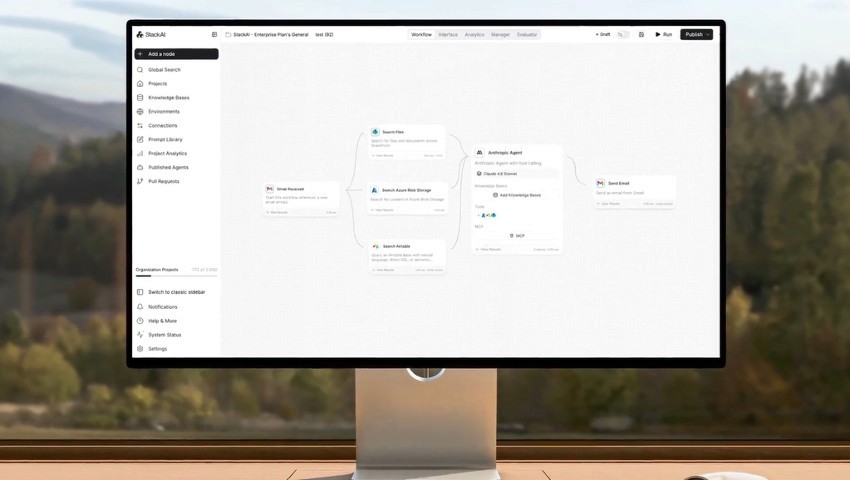
Who Stack AI Is For: Technical and enterprise teams that need a no-code platform to build, deploy, and manage AI-powered workflows and assistants, with SOC 2 compliance and enterprise security baked in.
Why Seek a Stack AI Alternative: Stack AI is a builder platform, it gives teams the tools to create AI workflows, but the client owns the design, testing, and implementation. It requires in-house technical capability to get value, doesn't ship with deployment engineering support, and has limited reach into legacy enterprise systems without APIs.
Best Overall Alternative: Noxus; it goes where Stack AI can't, executing operations work inside complex, legacy-heavy enterprise environments under governance and full audit, with deployment engineering included in the first engagement.
What Sets Noxus Apart: Noxus is the only platform on this list that connects directly to legacy enterprise systems without an API layer, while writing outcomes back to source systems under compliance and governance from day one.
How to Choose: Identify whether you need a builder platform (to create AI applications) or an execution platform (to run AI operations work). Then audit your system landscape and compliance requirements before evaluating tools.
Table of Contents
Top Stack AI Alternatives in 2026 at a Glance
Tool | Best For | Key Features | Pros | Cons | Pricing Starts |
Noxus | Enterprise AI operations execution across legacy systems | End-to-end execution across legacy systems, full audit trail, BYOK, air-gapped deployment | Executes end-to-end on legacy systems; full compliance architecture; 45-day production deployment | Not a builder platform; not suited for prototype or PoC work | Usage-based; custom per deployment |
Lindy | Business teams automating tasks with AI agents | No-code agent builder, email/calendar integrations, trigger-based automations | Accessible to non-technical users; fast setup | Limited for complex, multi-system enterprise operations; no free tier | Plus at $29.99/user/month (7-day trial) |
n8n | Developer-friendly open-source automation | Self-host option, 400+ integrations, code nodes | Flexible, affordable, self-hosted option | Requires technical setup; limited AI agent depth | Free (self-hosted); €20/month (cloud) |
Zapier | Non-technical teams automating simple workflows | 7,000+ app integrations, simple trigger-action builder | Huge integration library, easy to use | Limited AI logic depth; not suited for complex enterprise operations | Free (100 tasks/mo); from $19.99/mo |
UiPath Agentic Automation | Enterprise RPA and agentic AI at scale | Agentic process automation, RPA + AI, enterprise governance | Strong enterprise track record; large installed base | High cost; brittle to UI changes; structured process dependency | Custom pricing (enterprise-focused) |
Relevance AI | Teams building AI agents and sales/support automations | Freemium, agent builder, tool calling, LLM support | Flexible; model-agnostic | Pricing split between Actions and Vendor Credits adds complexity | Freemium; Enterprise custom |
Retool | Internal tool builders on databases and APIs | Drag-and-drop UI, database connectors, Retool Workflows | Fast internal app development | Not AI-first; limited agentic depth | Free; custom (Team/Business) |
Flowise | Developers building LLM apps and RAG chains | LangChain visual builder, self-hosted, open-source | Free, open-source, fast PoC | Technical setup required; not enterprise-ready out of the box | Free; $35/month (Starter) |
Dynamiq | Technical enterprise teams building multi-agent AI apps | Multi-agent, RAG, observability, guardrails, evaluations | Strong AI governance; regulated industry focus | Custom pricing; requires technical resources | Custom pricing |
Cassidy AI | Business teams building AI-powered internal workflows | Knowledge base, AI assistants, integrations, workflow automation | Easy to use; 14-day free trial | Credit-based pricing; limited for complex legacy system operations | 14-day free trial; custom Business pricing |
Why Consider Stack AI Alternatives?
What Stack AI Does Well?
Stack AI is built on a genuine insight: connecting data sources and LLMs into connected AI workflows shouldn't require a large engineering team. That idea has attracted over 200 enterprise customers and backing from Y Combinator, Gradient Ventures, and others.
The platform does that job well. Stack AI provides a no-code visual builder for creating AI workflows, AI assistants, and automated pipelines.
It handles RAG (retrieval-augmented generation) pipelines, document ingestion, model selection across major providers, and API publishing. For enterprise teams that want to build their own AI applications without writing code, it's a capable tool.
Its compliance architecture: SOC 2 certification, HIPAA compliance, GDPR support, and self-hosted deployment options - addresses the security requirements that enterprise procurement typically demands.
For teams in healthcare, finance, and regulated sectors that need a compliant AI builder, Stack AI covers that baseline.
Where Stack AI Falls Short?
Stack AI is a builder platform, and that distinction comes with real limitations for enterprise operations teams looking for execution, not tools.
You own the implementation: Stack AI gives teams the interface to build AI workflows. It doesn't provide deployment engineering to get those workflows live on your actual systems. Teams without strong internal AI capability often stall between "we built this" and "it's running in production."
Limited reach into legacy systems: Stack AI connects to enterprise systems via APIs and connectors. That works well for modern SaaS environments. It doesn't work for SAP ECC, COBOL-era banking cores, Guidewire, or the proprietary legacy platforms that most European enterprises still run their core operations on.
Produces applications, not operational resolutions. Stack AI agents generate outputs: responses, structured data, completed forms. They don't execute operational work: updating ERP records, writing back to source systems, closing compliance cases under audit. A human still has to act on what Stack AI produces.
Pricing complexity at scale: Custom pricing based on API calls and usage can make total cost of ownership difficult to model before a board-level business case. Teams that need predictable cost forecasting often find this a barrier.
Technical setup is still required: Despite the no-code positioning, Stack AI workflows require technical understanding of data models, API connections, and RAG configurations. It's more accessible than pure developer tools but less accessible than operations-first platforms.
Best Stack AI Alternatives: In-Depth Review & Comparison
Here are the top 10 Stack AI alternatives you can choose from:
1. Noxus
Overview
Noxus is an AI operations platform founded in 2023 and backed by Antler, Seaya, and Bynd Venture Capital.
While Stack AI gives teams tools to build AI workflows, Noxus runs operational work end-to-end: claims processing, billing disputes, compliance document handling, and product catalog operations across SAP ECC, Guidewire, COBOL-era cores, ServiceNow, Oracle, and proprietary platforms.
No API layer required. No infrastructure modernization as a prerequisite.
Our 3-layer platform covers workflow design, system integration and orchestration, and an execution runtime that writes outcomes back to source systems under full governance, audit trail, and RBAC.
Some of our top clients include Santander, Fidelidade, Jeronimo Martins, CUF/Jose de Mello, and Sky/Comcast. Zero churn to date, with 3-5x ROI across documented case studies.
The best part? Our AI workflows can start production in 45-80 days on real client systems with live data.
Ideal For
Enterprise operations teams at organizations with €500M+ revenue running legacy-heavy system environments who need AI agents that execute work, not build applications
Financial services and insurance operations handling high-volume, multi-system case resolution: claims, billing disputes, account changes, compliance documents
Healthcare organizations processing patient and administrative communications at scale under GDPR Article 9 requirements
Retail and FMCG operations teams managing product catalog classification, enrichment, and PIM write-back across thousands of daily listings
Digital transformation and AI leaders who have exhausted pilots without reaching production need a partner with proven production credentials to build the internal case for operations deployment.
Top Features
End-to-end execution runtime: The execution runtime doesn't draft or suggest; it runs full operational workflows, performing multi-system lookups, applying business rules, writing outcomes back to source systems, and closing cases under audit. This is what separates Noxus from builder platforms that produce outputs but leave humans to act on them.
Legacy system integration without APIs: Noxus connects to SAP ECC, Guidewire, ServiceNow, Oracle, COBOL-era cores, and proprietary platforms the way your operations teams do today, navigating interfaces, performing lookups, writing back results. No API layer required, no middleware project.
Full audit trail and governance: Every agent decision, action, and output is logged, traceable, and replayable. Business rules - not AI models - determine regulated outcomes. Confidence-based escalation routes edge cases to humans with full context assembled. Certified: SOC 2 Type II, ISO 27001, GDPR Article 28, HIPAA.
Flexible deployment with data sovereignty: Three deployment options, fully managed SaaS, self-managed VPC, or on-premises/air-gapped, ensure data never leaves client control unless they choose otherwise. BYOK model routing across Azure AI Foundry, AWS Bedrock, and Google Vertex AI.
Deployment engineering included: First engagement includes deployment engineering alongside the platform license. First workflows go live in approximately 45 days on the client's actual systems with live data. Subsequent use cases deploy at 85-90% platform margin.
Why We're the Best Stack AI Alternative?
While Stack AI helps teams build AI applications, Noxus helps them run production operations. Teams can start with a RAG pipeline, AI assistant, or document workflow in Stack AI, but when those need real systems, business rules, and production case resolution, our platform is what comes into the picture.
We include deployment engineering from day one, and the first workflow goes live in 45 days on real systems. Stack AI relies on modern APIs, along with our platform which works natively across legacy environments and handles unstructured, judgment-based work.
If the goal is to move work off headcount and onto software that completes it, we can help you solve the more urgent problems.
Pros
Executes end-to-end operational work across legacy systems, writing outcomes back to source systems under governance
45-day production deployment on real client systems with live data; not a sandbox or prototype environment
Full compliance architecture: SOC 2 Type II, ISO 27001, GDPR Article 28, HIPAA - structural, not contractual
Deployment engineering included in first engagement; no internal AI engineering team required
Zero churn across all clients with 3-5x ROI documented across case studies
Cons
Not suited for developers or teams whose primary need is building AI applications, assistants, or RAG pipelines; lighter tools on this list serve those use cases faster and at lower cost
Purpose-built for enterprise operations teams running legacy-heavy environments; not the right entry point for organizations without a defined high-volume operations use case to automate.
Pricing
We operate on a monthly platform license with consumption-based pricing. You pay for the operations completed, not for seats or tokens. Pricing scales with operational volume and deployment complexity.
The economics improve structurally with each additional workflow deployed on the same infrastructure, as the integration layer is already operational for subsequent use cases.
Final Verdict
Noxus is the right choice for any enterprise that needs AI to execute operations work - not assist with it or build applications for it.
If the goal is production operations automation on legacy enterprise systems, under governance, in 45 days, no other Stack AI alternative on this list delivers that combination.
For developer tooling, AI application building, or simple task automation, look elsewhere.
2. Lindy
Overview
Lindy is an AI agent platform designed for business teams that want to automate repetitive tasks and workflows without writing code.
It targets the growing segment of knowledge workers and operations teams who need AI to handle administrative work: email triage, calendar management, meeting prep, research, and customer outreach - without requiring an engineering team to set it up.
The platform provides a no-code agent builder, pre-built agent templates for common business workflows, and integrations with Gmail, Outlook, Slack, Salesforce, HubSpot, and other SaaS tools that business teams already use. Agents can be triggered by events (a new email, a calendar invite, a form submission) and can chain multiple steps together without manual intervention.
Lindy positions itself as a personal AI for business work, a more capable alternative to hiring assistants or using basic automation tools like Zapier for tasks involving judgment and language.
Ideal For
Business and operations teams that need AI to handle repetitive knowledge work without engineering support
Sales and revenue operations teams automating outreach, research, follow-ups, and CRM updates
Executive assistants and operations managers looking to reduce manual administrative workload across email, calendar, and document tools
SMBs and mid-market teams that need fast, accessible AI automation without technical implementation cycles
Top Features
No-code agent builder: Create multi-step AI agents that execute sequences of tasks across connected tools without writing code, with pre-built templates for common use cases.
Email and calendar integration depth: Native integration with Gmail, Outlook, and calendar tools gives agents context and execution capability across communication workflows that many automation platforms handle poorly.
Trigger-based automation: Agents activate on defined events - new emails, form submissions, calendar changes - without requiring manual initiation, enabling genuinely autonomous workflows.
Credit-based usage model: Task costs vary by model and workflow complexity, giving teams flexibility to use different AI capabilities for different automation needs without fixed tier limitations.
Why It's a Strong Stack AI Alternative?
Lindy is one of the more practical Stack AI alternatives for business teams that need accessible AI agent automation without technical complexity.
While Stack AI is a builder platform requiring technical configuration, Lindy is deployable by any business user in hours.
Its focus on communication and knowledge work workflows makes it one of the stronger choices for teams whose automation needs center on email, calendar, and SaaS tools.
Pros
Accessible to non-technical business users; no engineering required for setup
Strong email and calendar integration for communication workflow automation
Pre-built agent templates for common business tasks reduce setup time
Tiered pricing accessible to SMBs and mid-market teams
Cons
Limited for complex, multi-system operations involving legacy enterprise platforms or regulated workflows
Not designed for end-to-end operational execution with ERP write-back under compliance governance
Credit-based pricing can become unpredictable at high agent usage volumes
Compliance architecture (SSO, SCIM, audit logs) is limited to Enterprise tier
Pricing
Lindy has no permanent free plan. Paid tiers are per user per month: Plus at $29.99 with 3,000 credits, Pro at $99.99 with 15,000 credits and Max at $199.99 with 35,000 credits, with a 7-day free trial and custom Enterprise pricing. Credits pool across the team rather than being locked to a seat. The Enterprise tier adds compliance and admin features including SSO, SCIM, and audit logs.
Pricing uses a credit-based system where task cost depends on model and workflow complexity.
Final Verdict
Lindy is recommended for business teams that need accessible AI agent automation for communication and knowledge work. It's one of the more practical Stack AI alternatives for non-technical teams running on modern SaaS stacks.
Not a fit for enterprise operations in legacy-heavy environments, regulated industries with strict compliance requirements, or teams needing end-to-end system execution under governance.
3. N8n
Overview
n8n is an open-source workflow automation tool that gives technical teams full flexibility to build automated workflows with code, visual nodes, or a combination of both. With 400+ built-in integrations, self-hosting support, and an active open-source community, n8n has become one of the most widely adopted developer-friendly automation platforms.
Its open-source license means technical teams can inspect, modify, and deploy n8n on their own infrastructure without licensing constraints. The cloud version adds managed hosting, team collaboration, and higher execution limits for teams that prefer not to manage their own infrastructure.
n8n occupies a position between simple no-code automation tools and developer frameworks, providing a visual interface that accelerates development while still allowing full code access when needed.
Ideal For
Developer and technical teams that want maximum flexibility in workflow automation without building from scratch
Organizations with data sovereignty requirements that need self-hosted automation infrastructure
Teams building complex integrations across APIs, databases, and services that simpler tools can't handle
Engineering teams that want to automate internal workflows without paying per-task pricing at scale
Top Features
Self-hosted deployment: Full control over infrastructure with Docker or npm deployment, keeping data within the organization's environment without cloud dependency.
Code nodes alongside visual nodes: Combine drag-and-drop workflow building with JavaScript/Python code blocks for logic that visual nodes can't handle.
400+ integrations: Wide coverage across APIs, databases, communication tools, and business systems with webhook support for anything not natively covered.
AI agent nodes: Native LLM integration with tool calling, memory, and multi-step reasoning in agentic workflows.
Why It's a Strong Stack AI Alternative?
n8n is one of the strongest Stack AI alternatives for developer and technical teams that need broad workflow automation flexibility with self-hosting options.
While Stack AI is focused on enterprise AI application building, n8n covers a wider range of automation types and is often faster to set up for technical teams already working in automation tooling.
Its self-hosted option also addresses data sovereignty needs that cloud-only platforms can't meet.
Pros
Open-source with full self-hosting control
Wide integration coverage across 400+ connectors
Flexible hybrid of visual and code-based workflow building
Affordable; free for self-hosted deployments
Cons
Requires technical setup and ongoing infrastructure maintenance for self-hosted deployments
AI agent capabilities are functional but less mature than dedicated enterprise platforms
Not suited for regulated enterprise operations requiring end-to-end execution under governance and audit
Pricing
The self-hosted Community Edition is free. Cloud starts at €20/month for Starter on annual billing (€24 monthly) and €50/month for Pro.
Business is €667/month billed annually and Enterprise is quote-based, both available hosted by n8n or self-hosted. There is no longer a free cloud tier.
Billing is per workflow execution rather than per step, which keeps costs predictable as workflows get longer.
Final Verdict
n8n is recommended for technical teams that need flexible, self-hosted, best workflow automation software at an affordable price. It covers a wider automation scope than Stack AI for general workflow needs.
Not a fit for non-technical teams, enterprise operations requiring legacy system depth, or regulated industries needing compliance-grade AI deployment.
4. Zapier
Overview
Zapier is one of the most widely used automation platforms available. With over 7,000 app integrations, a simple trigger-action model, and a no-code interface that requires no technical background, it has made basic workflow automation accessible to millions of business users.
Zapier sits at the accessible end of the automation spectrum. It's built for connecting apps and automating repetitive tasks - moving data between systems, triggering notifications, syncing records - rather than building complex agentic workflows. Its AI features have expanded in recent years, including AI steps, a chatbot builder, and Canvas for visual workflow building.
For non-technical teams automating straightforward tasks across common SaaS tools, Zapier remains one of the fastest paths from "I want to automate this" to "it's running."
Ideal For
Non-technical business users who need to automate repetitive tasks between SaaS applications without writing code
Small to mid-market teams running on common SaaS stacks who need quick integrations without development cycles
Operations and admin teams handling data entry, notifications, approvals, and cross-app record syncing
Teams starting with automation who need fast setup and a broad integration library
Top Features
7,000+ app integrations: The widest integration library in consumer automation, covering virtually every SaaS tool a business team uses.
Simple trigger-action model: Each Zap follows a clear "when this happens, do this" structure that non-technical users can build and modify without training.
AI steps and Canvas: Native AI capabilities for text generation, classification, and summarization within automations.
Instant publishing: New automations go live immediately without testing or deployment steps.
Why It's a Strong Stack AI Alternative?
Zapier is one of the strongest Stack AI alternatives for non-technical teams running simple to moderate automations across modern SaaS tools.
Where Stack AI requires technical configuration and a builder mindset, Zapier is deployable by any business user in minutes.
For the large segment of teams that need task automation rather than AI application building, Zapier covers the use case faster and more cheaply.
Pros
Widest integration library available with over 7,000+ apps
No-code setup accessible to any business user
Fast deployment; new automations go live immediately
Well-established with strong documentation and community support
Cons
Limited AI logic depth for complex, multi-step agentic workflows
Task-based pricing becomes expensive at high volume
Not suitable for legacy enterprise systems, regulated industries, or end-to-end operational execution
Pricing
Zapier's Free plan covers 100 tasks a month. Professional starts at $19.99/month and Team at $69/month, both billed annually, which saves 33% against monthly billing. Enterprise is quote-based.
Pricing increases with more tasks and collaboration features, and enterprise customers can connect with their sales team to get a custom quote.
Final Verdict
Zapier is recommended for non-technical teams automating straightforward tasks across common SaaS tools.
Not a fit for complex agentic workflows, AI-heavy operations, or enterprise environments requiring legacy system depth or compliance architecture.
5. UiPath Agentic Automation
Overview
UiPath is one of the most established names in enterprise automation, with a large installed base of RPA deployments across financial services, healthcare, manufacturing, and logistics.
Its recent expansion into agentic AI: combining traditional RPA robots with AI agents that can handle unstructured inputs and judgment-based tasks - positions it as one of the more significant Stack AI competitors in the enterprise automation space.
UiPath Agentic Automation allows enterprises to deploy agents that can reason, decide, and act across workflows, combining the structured execution strength of RPA with AI reasoning layers. For organizations with existing UiPath deployments, the addition of agentic capabilities reduces the switching cost of moving from pure RPA to AI-augmented automation.
The platform carries UiPath's enterprise pedigree: governance, audit trail, access controls, and deployment flexibility that large regulated organizations expect.
Ideal For
Large enterprises with existing UiPath RPA deployments looking to add AI reasoning to structured workflows
Financial services, healthcare, and insurance organizations with high-volume, structured operations that are already partially automated
Organizations with IT governance requirements that need enterprise-grade audit trails, RBAC, and deployment control
Teams where a significant portion of operations involve well-defined processes with some unstructured input handling
Top Features
Agentic process automation: Combines AI agents with RPA robots, allowing automated workflows to handle both structured data and unstructured inputs like emails and documents in a single execution layer.
Enterprise governance and audit trail: Full action logging, role-based access, and compliance controls built into the platform's execution architecture.
Integration with UiPath's existing RPA infrastructure: Existing robot deployments can be extended with agentic capabilities without rebuilding from scratch, preserving prior automation investments.
Orchestration at scale: Manages agent and robot fleets across multiple processes and business units from a central orchestration layer.
Why It's a Strong Stack AI Alternative?
UiPath is one of the stronger Stack AI alternatives for large enterprises with existing RPA deployments that want to add agentic AI capabilities without rebuilding their automation infrastructure.
While Stack AI is a builder platform for new AI workflows, UiPath extends proven enterprise automation with AI reasoning - a meaningful distinction for organizations that have already invested heavily in RPA.
Pros
Strong enterprise track record and large installed base
Combines proven RPA execution with AI reasoning for hybrid workflows
Enterprise governance, audit, and deployment flexibility
Familiar procurement and vendor relationship for existing UiPath customers
Cons
Brittle to UI changes: RPA components still break when ERP interfaces update without API backing
High cost and complexity for organizations not already in the UiPath ecosystem
Cannot handle genuinely unstructured, exception-heavy multi-system operations at the same depth as purpose-built agentic platforms
Mostly enterprise-focused with quote-based pricing; limited entry points for mid-market teams
Pricing
UiPath's pricing is enterprise-focused and quote-based. Plan options scale by users, robots, and deployment needs. A lower entry tier exists for individuals or small teams, but larger use cases require contacting sales for a custom plan.
Final Verdict
UiPath Agentic Automation is another tool to consider when looking for a Stack AI competitor, and is best suited for large enterprises with existing RPA investments to extend automation with AI reasoning capabilities.
It's not a fit for organizations whose operations involve genuinely legacy systems without APIs, teams needing faster deployment, or mid-market organizations that can't justify UiPath's enterprise contract structure.
6. Relevance AI
Overview
Relevance AI is an AI agent building platform that targets business and technical teams who need flexible, model-agnostic AI agents for sales, support, research, and internal operations. It provides a no-code agent builder, tool calling capabilities, LLM flexibility across providers, and a freemium pricing model that makes it accessible for teams experimenting with AI agent deployment.
The platform is used broadly across sales automation (prospecting, outreach, qualification), customer support (ticket handling, knowledge retrieval), and research workflows. Its freemium entry point and transparent tooling have attracted a growing developer and business user community.
Relevance AI positions itself as accessible and composable - teams can build custom AI agents tailored to their specific workflows without committing to a vendor-specific model stack or expensive enterprise contracts upfront.
Ideal For
Sales and revenue teams building AI agents for prospecting, outreach, and qualification workflows
Business teams that need flexible, model-agnostic AI agents without committing to a fixed vendor model
Technical teams experimenting with agent building before committing to an enterprise platform
Customer support and operations teams building AI-assisted workflows on modern SaaS stacks
Top Features
No-code agent builder with tool calling: Build AI agents that can use external tools, run multi-step workflows, and connect to data sources without writing code.
Model-agnostic infrastructure: Use any major LLM provider without vendor lock-in, keeping AI provider relationships and costs under team control.
Freemium entry point: Teams can start building and deploying agents without upfront payment, making evaluation and experimentation more accessible.
Pre-built agent templates: Ready-made agents for sales, support, and research workflows that teams can customize and deploy without starting from scratch.
Why It's a Strong Stack AI Alternative?
Relevance AI is one of the more flexible Stack AI alternatives for teams that need model-agnostic agent building with a lower barrier to entry.
Stack AI focuses on enterprise compliance and structured workflow automation. In contrast, Relevance AI prioritizes accessibility and composability.
For teams experimenting with AI agents across sales and support workflows on modern SaaS stacks, Relevance AI offers a practical starting point.
Pros
Freemium entry point makes experimentation accessible without upfront commitment
Model-agnostic approach avoids AI provider lock-in
Pre-built agent templates for common sales and support use cases
Flexible and composable for teams building custom agent workflows
Cons
Pricing split between Actions and Vendor Credits adds cost complexity at scale
Limited for regulated industries with strict compliance requirements - no air-gapped deployment
Less depth on legacy enterprise system integration for complex multi-system operations
Pricing
Relevance AI does not publish a public rate card. Billing is usage-based and split between Actions, which track workflow activity, and Vendor Credits, which track AI model consumption, so the bill moves with both how often agents run and which models they call. Plans and enterprise terms are quoted through sales.
Final Verdict
Relevance AI is recommended for sales, support, and operations teams building flexible AI agents on modern SaaS stacks with a lower initial cost commitment.
Not a fit for regulated industries requiring structural compliance architecture, enterprise operations needing legacy system depth, or teams that need predictable cost modeling at scale.
7. Retool
Overview
Retool is an internal tool builder that lets development teams create business applications on top of databases, APIs, and internal systems using a drag-and-drop UI builder, pre-built components, and JavaScript logic.
It's one of the most widely adopted platforms for operations teams that need custom internal tools without building front-end interfaces from scratch.
Retool's value is in application development speed. Engineers can connect to a database, API, or service and surface that data in a functional internal application in hours rather than weeks.
Its expansion into Retool Workflows and Retool AI adds automation and AI capabilities alongside the core application builder.
Ideal For
Engineering and technical teams building internal tools and operations applications on top of databases and APIs
Operations teams that need custom dashboards, admin panels, and approval workflows connected to internal systems
Organizations with existing modern databases and APIs that want to surface them in functional internal tools quickly
Teams that need both application UI and workflow automation in a single platform without maintaining separate tools
Top Features
Drag-and-drop UI builder: Build internal application interfaces with tables, forms, charts, buttons, and custom components without front-end development work.
Database and API connectors: Connect directly to PostgreSQL, MySQL, MongoDB, REST APIs, GraphQL, and major cloud services.
Retool Workflows: A workflow automation layer for building automated processes - data pipelines, scheduled jobs, and triggered workflows.
Retool AI: Native AI capabilities for adding LLM-powered steps to tools and workflows, including text generation, classification, and question-answering.
Why It's a Strong Stack AI Alternative?
Retool is one of the stronger Stack AI alternatives for engineering teams that need to build operational tooling around existing databases and APIs.
While Stack AI focuses on AI workflow building and AI assistant deployment, Retool covers a broader surface area - combining the application UI layer, the automation layer, and the AI layer together.
For teams whose need is custom internal tooling with AI capabilities embedded, Retool covers more ground.
Pros
Fast internal tool development without front-end engineering work
Broad database and API connector coverage
Combines application UI, workflow automation, and AI in one platform
Strong documentation and active developer community
Cons
Not an AI-first platform; AI capabilities are additive and not core functions
Per-builder and per-user pricing can become expensive for larger teams
Limited depth for complex agentic AI workflows or legacy enterprise system integration
Pricing
Retool has a free plan for small teams. Paid plans include Team and Business tiers that charge separately for builders and end users, which can make pricing more efficient as usage grows. Annual billing discounts are available.
A self-hosted Business option provides more security and control. Enterprise pricing is custom.
Final Verdict
Retool is a decent Stack AI alternative, recommended for technical teams building internal operational tools on top of modern databases and APIs. It covers more ground than Stack AI for teams that need application UI alongside automation and AI.
Not a fit for non-technical teams, organizations needing legacy system depth without APIs, or enterprise operations requiring compliance-grade AI execution.
8. Flowise
Overview
Flowise is an open-source, low-code tool for building LLM-powered applications using a visual drag-and-drop interface.
Built on top of LangChain, it lets developers connect language models, vector stores, document loaders, and tools into agentic chains and workflows without writing LangChain boilerplate from scratch.
It's primarily used for prototyping and building AI applications - chatbots, RAG systems, document Q&A tools, and simple agent workflows - with self-hosting as a core feature. For developers familiar with LangChain concepts, Flowise significantly reduces the time required to go from idea to working demo.
Ideal For
Developers and AI engineers building LangChain-based LLM applications without writing raw boilerplate
Technical teams prototyping RAG systems, chatbots, and agent workflows before committing to a production architecture
Organizations with self-hosting requirements that want an open-source, cost-free LLM application builder
Individual developers building AI tools without enterprise procurement cycles
Top Features
Visual LangChain builder: Drag-and-drop interface for connecting LangChain components - LLMs, chains, agents, tools, memory, and retrievers - into functional workflows without writing code.
RAG pipeline support: Built-in support for document loading, text splitting, embedding, and vector store integration.
Agentflow builder: A separate multi-step agent workflow builder for constructing more complex agentic tasks.
Self-hosted, open-source: MIT license with Docker deployment at no software cost.
Why It's a Strong Stack AI Alternative?
Flowise is one of the most direct Stack AI alternatives for developers who want an open-source, self-hosted LLM application builder.
While Stack AI is a managed, compliance-focused enterprise platform, Flowise is free, open-source, and faster to get running for developers already in the LangChain ecosystem.
For teams with self-hosting requirements and developer resources, it provides a cost-effective path to LLM application building.
Pros
Free and open-source with self-hosting via Docker
Visual interface significantly speeds up LangChain-based development
Good RAG pipeline support for knowledge-base-augmented applications
Active community and growing template library
Cons
Technical knowledge of LangChain concepts is still required
Not enterprise-ready out of the box - limited RBAC, audit trail, and governance
Not suited for legacy enterprise system integration or end-to-end operational execution under compliance
Pricing
Flowise has a free plan. The Starter plan is priced at $35/month.
The Enterprise plan is $65/month. Larger deployment pricing is available on request.
Final Verdict
Flowise is recommended for developers and AI engineers building LangChain-based applications who want an open-source, self-hosted alternative to Stack AI.
Not designed for production operations in enterprise environments, non-technical teams, or teams needing compliance-grade deployment.
9. Dynamiq
Overview
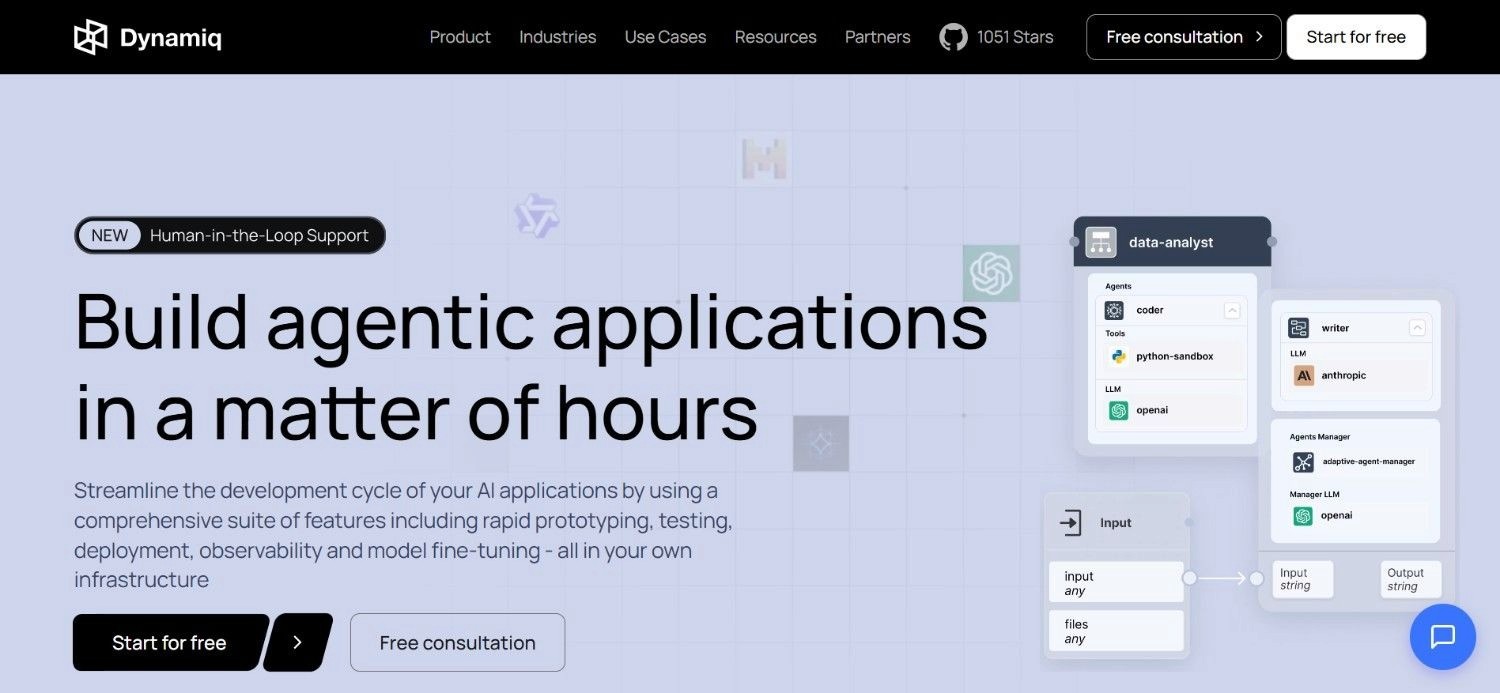
Dynamiq is an enterprise-grade AI agent orchestration platform designed for technical teams building production AI applications. It provides multi-agent support, RAG pipeline management, evaluations, guardrails, fine-tuning, and observability in a single platform - covering the full lifecycle of enterprise AI application development from prototype to production.
Dynamiq targets AI and engineering teams at enterprise organizations that need more governance, observability, and deployment flexibility than standard builder platforms provide.
The platform is open-core with an active GitHub community alongside the commercial offering.
Ideal For
AI and engineering teams at enterprise organizations building complex, multi-agent AI applications in production
Organizations in regulated sectors needing AI governance, observability, guardrails, and compliant deployment
Technical teams that want more enterprise structure without building infrastructure from scratch
Teams managing multiple AI agents across complex workflows with evaluation and fine-tuning requirements
Top Features
Multi-agent orchestration: Design and deploy workflows involving multiple AI agents with structured communication, tool use, memory, and step-by-step reasoning.
Built-in observability and cost tracking: Monitor agent performance, trace execution paths, and track model costs across production deployments.
Guardrails: Define and enforce content policies, safety rules, and behavioral constraints on AI agent outputs.
Evaluations: Built-in evaluation framework for testing and benchmarking AI agent outputs against defined quality criteria.
RAG and knowledge management: Connect and manage knowledge bases with governance controls over what data agents can access.
Why It's a Strong Stack AI Alternative?
Dynamiq is one of the stronger Stack AI alternatives for technical enterprise teams that need a more governed, production-ready AI agent framework.
While Stack AI provides a no-code builder with compliance features, Dynamiq adds evaluations, guardrails, fine-tuning, and observability for teams managing AI agents in consequential production workflows.
It's one of the more mature options for teams building multi-agent applications at enterprise scale.
Pros
Strong multi-agent orchestration with governance and guardrails
Built-in observability and cost tracking for production deployments
Evaluation framework for systematic agent quality management
Regulated industry focus with IBM partnership for enterprise credibility
Cons
Custom pricing with no public starting rate
Requires technical resources for implementation and ongoing management
Not designed for legacy system integration without APIs or air-gapped enterprise deployment
Pricing
Dynamiq offers custom pricing. Book a demo or free consultation with their team for a custom quote based on requirements.
Final Verdict
Dynamiq is recommended for technical enterprise teams building complex, multi-agent AI applications who need more governance and production readiness than Stack AI provides.
Not a fit for non-technical teams, organizations needing legacy system depth without APIs, or teams that need operational execution with end-to-end system write-back.
10. Cassidy AI
Overview
Cassidy AI is a business-focused AI platform that helps teams build AI-powered internal workflows, assistants, and knowledge bases without writing code.
It positions itself as the AI layer for business operations, connecting to existing tools, learning from company knowledge, and automating tasks that currently require manual effort.
The platform targets SMBs and mid-market teams that want AI to handle internal workflows: document processing, knowledge retrieval, customer communication, research, and operational tasks.
Its integrations cover common business tools (Slack, Notion, Google Drive, Salesforce, HubSpot) and its assistant builder lets teams create AI agents that use company-specific knowledge.
Ideal For
Business and operations teams that need AI-powered internal workflows without technical implementation cycles
SMBs and mid-market companies building AI assistants for customer operations, knowledge management, and internal processes
Teams with existing SaaS stacks who want AI to augment workflows across Slack, Notion, Salesforce, and similar tools
Organizations looking for an accessible AI workflow builder with a 14-day free trial and transparent entry pricing
Top Features
Knowledge base integration: Cassidy learns from company documents, tools, and data sources, allowing AI agents to answer questions and complete tasks with company-specific context.
AI workflow builder: Design automated workflows that trigger on defined events, connect to business tools, and complete multi-step tasks without code.
Business tool integrations: Native connections to Slack, Notion, Google Drive, Salesforce, HubSpot, Zendesk, and other common business tools.
AI credits model: Higher tiers add more users, premium models, deeper controls, and real-time syncing, giving teams flexibility to scale AI usage as needs grow.
Why It's a Strong Stack AI Alternative?
Cassidy AI is one of the more practical Stack AI alternatives for business teams that need accessible AI workflow automation without technical complexity.
While Stack AI targets enterprise technical teams building compliant AI applications, Cassidy focuses on accessible, knowledge-driven automation for SMBs and mid-market teams. Its 14-day free trial and transparent entry pricing make it easier to evaluate before committing.
Pros
Accessible to non-technical business teams without engineering support
Knowledge base integration allows AI agents to use company-specific context
14-day free trial for hands-on evaluation before commitment
Clean interface with good integration coverage for common business tools
Cons
Credit-based pricing can become expensive at high usage volumes
Limited for complex legacy system integration or regulated enterprise operations requiring governance and audit trails
Not designed for end-to-end operational execution with ERP write-back under compliance
Pricing
Cassidy offers a 14-day free trial, then a Starter plan and custom Business/Enterprise pricing based on seats, features, and support.
It uses AI credits, with higher tiers adding more users, premium models, deeper controls, and real-time syncing.
Final Verdict
Cassidy AI is recommended for SMBs and mid-market business teams that need accessible AI workflow automation connected to their existing SaaS tools and company knowledge.
Not a fit for regulated industries requiring structural compliance architecture, enterprise operations needing legacy system depth, or teams that need predictable cost modeling at high AI usage volumes.
Why Noxus Works Across Multiple Use Cases?
Financial Services Customer Operations
Financial services operations teams face the same structural problem at every scale: each case: a complaint, a billing dispute, an account change - moves through multiple systems that weren't designed to talk to each other. Staff manually bridge those gaps at every step.
Noxus executes the full case lifecycle across core banking, SAP, CRM, and email - performing multi-step lookups, applying policy, writing outcomes back to source systems, and closing cases under audit.
The Santander deployment reached production in 45 days at 95% AI precision, and branch operations now run as a governed process across five countries on the bank's own infrastructure.
That is what AI operations execution looks like in regulated financial services. The case is opened, evidenced, decided against policy, written back to the system of record and closed, with every step replayable.
For operations leaders evaluating their options, the best workflow automation software for enterprise environments is the one that resolves work end-to-end, not the one that assists with it
Healthcare Communication Triage
Healthcare organizations process thousands of patient and administrative communications per month across clinical and administrative systems under GDPR Article 9 compliance requirements.
Noxus processed 10,000+ communications per month at CUF/José de Mello with 96% precision and full GDPR Article 9 compliance from day one.
No AI model makes clinical or compliance-relevant decisions in our deployments. Business rules execute the process; AI handles the unstructured input.
Retail Catalogue Operations
Large retail and FMCG operations teams managing thousands of daily product listings face a bottleneck that headcount alone can't solve: manual classification, enrichment, competitive pricing, and PIM write-back across constantly changing catalog data.
Noxus automates the full product data pipeline - classification, description enrichment, category assignment, specification extraction, pricing recommendations, and direct write-back into PIM systems and marketplace APIs. The Jerónimo Martins deployment handled 15,000+ daily listings with 90% precision and a 5x ROI.
For retail operations teams, this is the kind of AI execution that shows up on a P&L.
Financial Back-Office and Reconciliation
Vendor invoice matching, compliance validation, and document extraction across SAP, Oracle, and SharePoint represent some of the most time-consuming back-office operations in any large organization.
The problem isn't just volume - it's that each reconciliation step requires movement between disconnected systems with no automation layer.
Noxus replaces manual reconciliation workflows with execution infrastructure that performs multi-system document extraction, applies matching logic, validates compliance, and writes results back to ERP records with full audit trail.
Unlike RPA tools that break when ERP UIs update, Noxus handles the unstructured inputs and judgment steps that structured automation has never been able to address.
IT Service Management
IT service management teams using ServiceNow, Jira, and Outlook spend a disproportionate share of their time on classification and routing rather than resolution. Ticket triage: reading the request, determining priority, assigning to the right queue, gathering initial diagnostic information - is high-volume, repetitive work that AI should handle.
Noxus auto-triages and routes service tickets across platforms, compressing the classification and handoff steps that dominate ticket lifecycle.
The result is faster resolution, more consistent categorization, and operations staff focused on resolution rather than intake processing.
What Makes a Good Stack AI Alternative?
1. Execution Over Application Building
Stack AI gives teams tools to build AI applications. A genuine alternative for enterprise operations teams should execute work: updating records, writing back to systems, closing cases under audit. Platforms that produce outputs for humans to act on still require a human in the loop. Genuine alternatives close that loop.
If you are at the evaluation stage, the best workflow automation software is the one that executes work end-to-end on the systems you already run.
2. Legacy System Reach Without an API Layer
Most enterprise operations run on systems that predate modern APIs.
A credible Stack AI alternative for regulated industries should operate inside legacy platforms: SAP ECC, Guidewire, COBOL-era cores, without requiring API modernization as a prerequisite.
If it only works on modern SaaS stacks, it doesn't reach the systems that actually run enterprise operations.
3. Compliance Architecture That's Structural
For regulated industries, SOC 2, HIPAA, GDPR Article 28, and ISO 27001 compliance needs to be architectural: air-gapped deployment, BYOK model routing, tamper-evident audit trails, and deterministic rule enforcement.
Compliance documentation in a vendor contract is not the same as compliance built into the platform's deployment architecture.
4. Deployment Support, Not Just Tools
Stack AI is a platform you build with. A genuine operations execution alternative should come with deployment engineering support that gets the first workflow live on real systems within a defined timeline.
Teams should not have to own implementation risk alone.
5. Predictable Pricing at Operational Scale
API call-based or credit-based pricing creates unpredictability as operational volume grows.
A good alternative should price against operational value delivered, with a model that finance teams can forecast accurately before a board-level business case is built.
How to Choose the Right Stack AI Alternative for Your Needs?
Here's a quick, 5-step checklist to help you choose the right Stack AI competitor for your business/use case:
Separate Builder Platforms from Execution Platforms
Stack AI is a builder platform; you use it to create AI applications. Noxus is an execution platform; it runs operations work in production.
Lindy, Cassidy, and Relevance AI are closer to Stack AI - accessible builders for business workflows. Clarify which category you actually need before evaluating features.
Audit Your System Landscape First
If your core operations run on SAP, Guidewire, Oracle, or legacy proprietary systems, your options narrow significantly. Most platforms on this list assume modern, API-accessible systems.
Only a small subset can operate inside legacy enterprise architectures without an infrastructure modernization project.
Define Compliance Requirements Before Evaluating Vendors
SOC 2, HIPAA, GDPR Article 28, ISO 27001, air-gapped deployment, RBAC, and audit trails need to be defined before any vendor conversation begins.
Rule out platforms that can't demonstrate structural compliance during the evaluation process.
Verify Deployment Speed with Named References
Ask every vendor: "What's your documented deployment timeline on real client systems?"
Documented case studies with named clients and production timelines are a more reliable signal than demo performance or feature lists.
Model Total Cost of Ownership
Platform license, implementation engineering, integration development, ongoing maintenance, and AI inference costs all matter.
Credit-based and API-call-based pricing models can look affordable at low volume and become expensive fast at operational scale.
Build a full cost model before comparing headline prices.
Everything You Need to Know About Stack AI Alternatives
Category | Key Considerations |
Top 3 Alternatives | Noxus (enterprise operations execution), Lindy (business team agent automation), n8n (developer-friendly open-source automation) |
Best Overall Option | Noxus; we execute end-to-end operations on legacy enterprise systems, under audit, with 45-day production deployment and zero churn across all clients |
Why Look for Stack AI Alternatives? | Stack AI requires client-owned implementation, has limited legacy system reach without APIs, produces applications rather than operational resolutions, and can be difficult to cost-model at scale |
How to Choose? | Separate builder platforms from execution platforms; audit your system landscape; define compliance requirements; verify deployment timelines with named references |
Price Range | Free (n8n Community Edition, Flowise, Zapier free tier) to usage-based enterprise (Noxus, custom per deployment); most business tools start at $19.99-$99.99/month |
Ease of Switching | No-code tools (Zapier, Lindy, Cassidy) take days to get running; developer tools (n8n, Flowise) take weeks; enterprise execution platforms (Noxus, UiPath) require structured deployment but ship production results in 45-80 days |
Must-Have Features | End-to-end execution with system write-back (for operations teams); legacy system connectivity; structural compliance architecture; deployment support; predictable pricing |
Mistakes You Shouldn't Make | Treating Stack AI as an operations execution platform when it's a builder platform; evaluating headline price without modeling cost at operational volume; choosing a platform that assumes modern APIs without auditing your actual system landscape |
Ready to Move On from Stack AI? Try Noxus
Noxus executes real operations work: end-to-end, under audit, on the systems you already run. Where Stack AI gives teams tools to build AI applications, Noxus runs production operations: resolving cases, writing outcomes back to source systems, and closing work under full governance.
The infrastructure is already built. The compliance architecture is structural.
The first deployment goes live in 45 days on your actual systems, with your actual data, at your actual operational volume. Subsequent use cases deploy at 85-90% platform margin because the infrastructure is already running.
Our platform is ideal for enterprise operations teams in financial services, insurance, healthcare, retail, and logistics who have five AI pilots and zero in production - and have run out of patience depending on such tools.
Request a consultation now to scope how we fit in your own internal workflows and processes - with production results in under 45 days.
FAQs About Stack AI Alternatives
What is Stack AI used for?
Stack AI is a no-code enterprise AI workflow platform for technical and enterprise teams, allowing them to build and deploy AI applications, RAG pipelines, and assistants by connecting data sources, LLMs, and APIs without writing code. It functions as a builder platform focused on application creation, not operational execution, and is compliant with SOC 2, HIPAA, and GDPR.
What are the best Stack AI alternatives in 2026?
The best alternative for enterprise operations execution is Noxus, which is designed for operational work inside complex legacy systems. Other top alternatives cater to different needs: Lindy for business team agent automation, n8n for developer-friendly self-hosted automation, Relevance AI for flexible model-agnostic agent building, and Dynamiq for governed multi-agent applications for technical teams. The final choice depends on whether your goal is building applications, automating workflows, or executing end-to-end operational work in complex environments.
What features should I look for in a Stack AI alternative?
Look for end-to-end execution that writes outcomes back to source systems, with native connectivity to your actual system landscape (including legacy platforms if relevant)and structural compliance architecture for regulated industries. The alternative tool should also have deployment support that gets workflows live on real systems, and pricing that is predictable at operational scale. Builder platforms and execution platforms are different categories - be clear which one you need.
How to choose the best Stack AI alternative for your needs?
To choose the best Stack AI alternative, first separate builder platforms (Stack AI, Flowise, Dynamiq, Cassidy) from execution platforms (Noxus, UiPath) and general automation tools (Zapier, n8n, Lindy). Then audit your system landscape for legacy dependencies and define your compliance requirements before evaluating any vendor. You'll also need to verify deployment timelines with named client references and model total cost of ownership at your expected operational volume.
Is it easy to switch from Stack AI to an alternative?
Switching from Stack AI to an alternative depends on the platform. No-code tools like Zapier, Lindy, or Cassidy can be running in days. Developer tools like n8n or Flowise take weeks. Enterprise execution platforms like Noxus require a structured deployment engagement but produce first production results in 45 days on real systems. The more complex your legacy system landscape, the more value a platform with deployment engineering support provides.
Can Noxus replace Stack AI for enterprise operations execution?
Noxus is a different category from Stack AI. Stack AI builds enterprise AI applications, while Noxus executes operational work inside existing enterprise systems, including legacy platforms that Stack AI cannot reach without APIs. If teams still needed humans to do the actual work after using Stack AI, Noxus closes that gap. For production automation on legacy enterprise systems, we help solve a problem Stack AI was not built for.
Is Stack AI good for regulated industries?
Stack AI provides a compliance baseline for regulated industries (SOC 2, HIPAA support, self-hosted deployment options) for teams needing an enterprise-compliant AI application builder. However, for organizations requiring structural depth; such as air-gapped deployment, deterministic policy enforcement on regulated decisions, and full audit trail replayability expected by European regulators; purpose-built enterprise platforms like Noxus offer more comprehensive coverage.
What is the main difference between Noxus and Stack AI?
The main difference between Noxus and Stack AI is who does the building. Stack AI hands your team a no-code environment and the team designs, tests and maintains the workflow. Noxus arrives with deployment engineering included, maps the process, and runs it in production on your live systems. Stack AI is a tool you operate; Noxus is an operation that runs.
Do Stack AI alternatives work with legacy systems that have no API?
Most Stack AI alternatives do not work with legacy systems that have no API, because they assume a modern SaaS stack with documented endpoints. Builder platforms, workflow automation tools and agent frameworks all connect through connectors or REST calls, so SAP ECC, Guidewire and COBOL-era cores sit outside their reach without a middleware project first. Noxus is the exception on this list: it operates inside those systems the way an operations team does today, navigating the interface, performing lookups and writing results back, with no API layer required.