Best Lorikeet Alternatives in 2026 (Top Competitors Reviewed & Compared)
Looking for Lorikeet alternatives? This comparison covers ten of them, from support-desk AI to full operations execution, on resolution depth, legacy system reach, compliance architecture and pricing model.
Key Takeaways (TL;DR)
Who Lorikeet Is For: Lorikeet is built for regulated industries: fintechs, healthtechs, and insurers - that need AI-driven customer support resolution across chat, email, voice, SMS, and WhatsApp. It focuses on front-end ticket resolution at scale, priced per resolved outcome.
Why Seek a Lorikeet Alternative?: Lorikeet is strong for customer-facing support automation, but it does not execute end-to-end operations across legacy enterprise systems. Teams that need AI to work inside SAP, Guidewire, Oracle, or proprietary back-office platforms - not just resolve support tickets, will hit the ceiling quickly.
Best Overall Alternative: Noxus is the best Lorikeet alternative. It goes beyond front-end support resolution to execute full operations workflows end-to-end across the legacy systems your teams already use, under complete audit and governance.
What Sets Noxus Apart?: Noxus is the only option on this list that operates natively inside legacy enterprise systems; including SAP ECC, Guidewire, and COBOL-era cores - without requiring API modernisation or middleware, with every action governed, traceable, and replayable.
How to Choose the Best Lorikeet Alternatives?: Focus on three factors: whether the tool can operate inside your existing system architecture; whether it meets your compliance and data sovereignty requirements; and whether pricing scales with outcomes rather than headcount.
Table of Contents
Top Lorikeet Alternatives in 2026 at a Glance
Tool | Best For | Key Features | Pros | Cons | Pricing Starts |
Noxus | Enterprise ops automation across legacy systems | End-to-end multi-system resolution; full audit trail; BYOK deployment | Executes real operations; works on legacy systems; SOC 2, ISO 27001, GDPR compliant | Not designed for simple front-end chatbot use cases | Consumption-based; contact for pricing |
Helply | SMB and mid-market support automation | Usage-based AI support; unlimited agents and seats | Simple pricing, no per-seat fees | Minimum $3,000/year commitment | $1/ticket (min. 250/month) |
Plain | Developer-focused support tooling | API-first support workflows; AI agents; integrations | Clean interface; developer-friendly | Limited enterprise governance features | $35/month |
Zendesk AI | Large support teams with existing Zendesk investment | AI-powered ticket triage; knowledge management; copilot features | Large integration ecosystem; mature product | Per-seat pricing adds up at scale | $19/agent/month |
Decagon AI | Enterprise customer support automation | Custom AI agents; multi-channel support; enterprise integrations | Strong enterprise positioning | No public pricing; steep onboarding | Custom |
Sierra AI | Consumer-facing AI customer experience | Conversational AI; natural language resolution; CRM integrations | Natural interaction quality | Outcome-based pricing; no public rates | Custom |
Fin by Intercom | Intercom users wanting AI resolution | $0.99/resolution pricing; works with other helpdesks | Low published per-resolution rate | Requires Intercom plan for full feature set | $0.99/resolution |
Ceven | B2B support teams with complex workflows | AI-native support; workflow builder; integrations | Focused B2B positioning | No public pricing; limited public track record | Custom |
Ada | High-volume enterprise CX automation | Omnichannel AI; brand voice controls; CRM integrations | Mature enterprise product; large client base | Per-conversation pricing model; limited legacy depth | Custom |
Gradient Labs | Regulated industries needing AI support | Outcomes-based pricing; compliance-aware AI; no platform fees | No platform fees; regulated-industry focus | Limited to support use cases; no back-office execution | Custom |
Why Consider Lorikeet Alternatives?
What Lorikeet Does Well?
Lorikeet targets regulated industries: fintechs, healthtechs, and insurers - where standard chatbots fall short because queries are complex and the compliance bar is high.
It charges per resolved ticket (approximately $0.80 per chat, email, or SMS resolution and approximately $1.00 per voice resolution), aligning incentives with outcomes rather than deflection volume.
The platform's transparency features are a genuine differentiator: teams can replay AI decisions and audit ticket-level behaviour, which matters where compliance sign-off is required.
Multi-channel coverage across chat, email, voice, SMS, and WhatsApp further means support teams can operate from a single platform.
For teams that have outgrown basic deflection bots, Lorikeet is a legitimate front-line option.
Where Lorikeet Falls Short
Lorikeet is built for the front-end of customer interactions - it resolves support tickets but does not execute the multi-system operations behind them.
When a billing dispute requires pulling data from core banking, applying a policy rule, and writing back to a CRM, Lorikeet hands it off to humans. That handoff is where most operational costs live.
There is no native integration with SAP, Guidewire, or COBOL-era systems. No process design layer for multi-step, multi-system workflows. Plus, the SaaS-only deployment architecture creates friction for enterprises with strict data residency requirements.
For organisations seeking Lorikeet alternatives that execute operations end-to-end, the tool reaches its limits quickly.
Best Lorikeet Alternatives in 2026: In-Depth Review & Comparison
1. Noxus
Overview
Noxus is an AI operations platform that executes complex, multi-system operations end-to-end across legacy enterprise environments. Founded in 2023, we built Noxus to address the core failure mode of enterprise AI: most tools draft or suggest but never resolve, and none survive contact with the layered, interdependent system architectures that define regulated industries.
We execute real operational work: complaints, billing disputes, claims processing, account mutations - across the exact legacy stack the enterprise already runs, with every action governed, traceable, and replayable.
Unlike other Lorikeet alternatives that focus on front-end customer support, Noxus operates natively inside SAP, Guidewire, ServiceNow, Oracle, and proprietary in-house systems, without requiring migration or API modernisation.
One of our customers Santander achieved 3x ROI in 45 days to production - a deployment that ran across seven systems with zero API modernisation.
Building on that foundation, CUF/José de Mello followed a similar path, reaching 96% precision on 10,000+ monthly communications under full GDPR Article 9 compliance.
Ideal For
COOs, VPs of Operations, and Heads of Customer Operations at regulated enterprises (financial services, insurance, healthcare) running high-volume, multi-system operations workflows
IT and Architecture Leaders at organisations with legacy SAP, Guidewire, or COBOL-era systems who need an AI operations layer that does not require API modernisation
CFOs and Finance Directors evaluating AI investments with a clear payback model; Noxus pricing scales with operational volume, not headcount
Digital and AI Transformation Leaders at mid-to-large enterprises with multiple failed pilots seeking a production-ready operations execution layer
Mid-market COOs and Managing Directors who own the full buying decision and need measurable operational impact within 90 days
Top Features
End-to-end multi-system operations resolution: Noxus handles unstructured intake, performs multi-step lookups across legacy systems, applies business rules, executes actions, and writes outcomes back to source systems - all in a single governed workflow. No human handoffs required.
Process Intelligence Runtime with full audit trail: Every decision, action, and output produces a complete, replayable trace. Compliance teams can replay any process run. Operations teams use it to identify failure points. IT teams use it to debug and trust the system.
Native legacy system integration without APIs: Noxus interacts with SAP ECC, Guidewire, COBOL-era cores, ServiceNow, and Oracle the way your operations teams do today; navigating interfaces, performing lookups, writing back results. No middleware. No API prerequisites.
Deployment sovereignty: Three architectures: fully managed SaaS, self-managed VPC, or air-gapped on-premises. BYOK model routing across Azure AI Foundry, AWS Bedrock, and Google Vertex AI. Certified: SOC 2 Type II, ISO 27001, GDPR Article 28, HIPAA.
Confidence-based human escalation: When AI confidence drops below your configured threshold, the process escalates to a human with full context already assembled. Your rules define the confidence floor. AI interprets; your logic executes.
Why We're the Best Lorikeet Alternative?
Unlike Lorikeet (which resolves customer support tickets), we resolve the operations behind those tickets.
While Lorikeet's architecture stops at the front-end - Noxus reaches into the back-office, executes the full workflow, and writes the outcome back into your systems under audit.
Our workflow automation capability runs natively inside the legacy environments most Lorikeet competitors will not touch.
Clients go from contract to production in 45 days, on their actual systems, with their actual data - no sandbox or paid pilot required.
Pros
Executes real operations end-to-end across legacy systems, not just front-end ticket resolution
Full audit trail and replayability built into the architecture, meeting EU AI Act, GDPR, DORA, and NIS2 requirements
Works inside SAP ECC, Guidewire, COBOL-era cores, and proprietary platforms without API prerequisites
Deployment flexibility: SaaS, VPC, or air-gapped on-premises with BYOK
Zero client churn across all deployments; 3-5x ROI across documented case studies
Cons
Not designed for simple FAQ deflection or front-end chatbot use cases; over-specified for those scenarios
Enterprise-grade depth means onboarding involves deployment engineering, which is more involved than a plug-and-play SaaS tool
Primarily targeting European enterprises; North American organisations without existing European relationships are outside the current primary GTM motion
Pricing
Noxus operates on a monthly platform licence with consumption-based pricing. You pay for the operations completed, not for seats or tokens.
Pricing scales with operational volume and deployment complexity. The economics improve structurally with each additional workflow deployed on the same infrastructure, as the integration layer is already operational for subsequent use cases.
A structured pilot on your actual workflows is available before full commitment. Contact the team directly for pricing aligned to your use case and scale.
Final Verdict
Noxus is the strongest option for organisations that need AI to execute operations inside complex, legacy-heavy environments - not just triage and respond at the surface.
If your use case requires SAP data, policy application, and a CRM write-back under audit, Noxus closes that loop end-to-end.
It is not the right tool for teams that need a lightweight chatbot. It is the right tool for teams that have outgrown front-end support resolution and need AI to do the actual work.
2. Helply
Overview
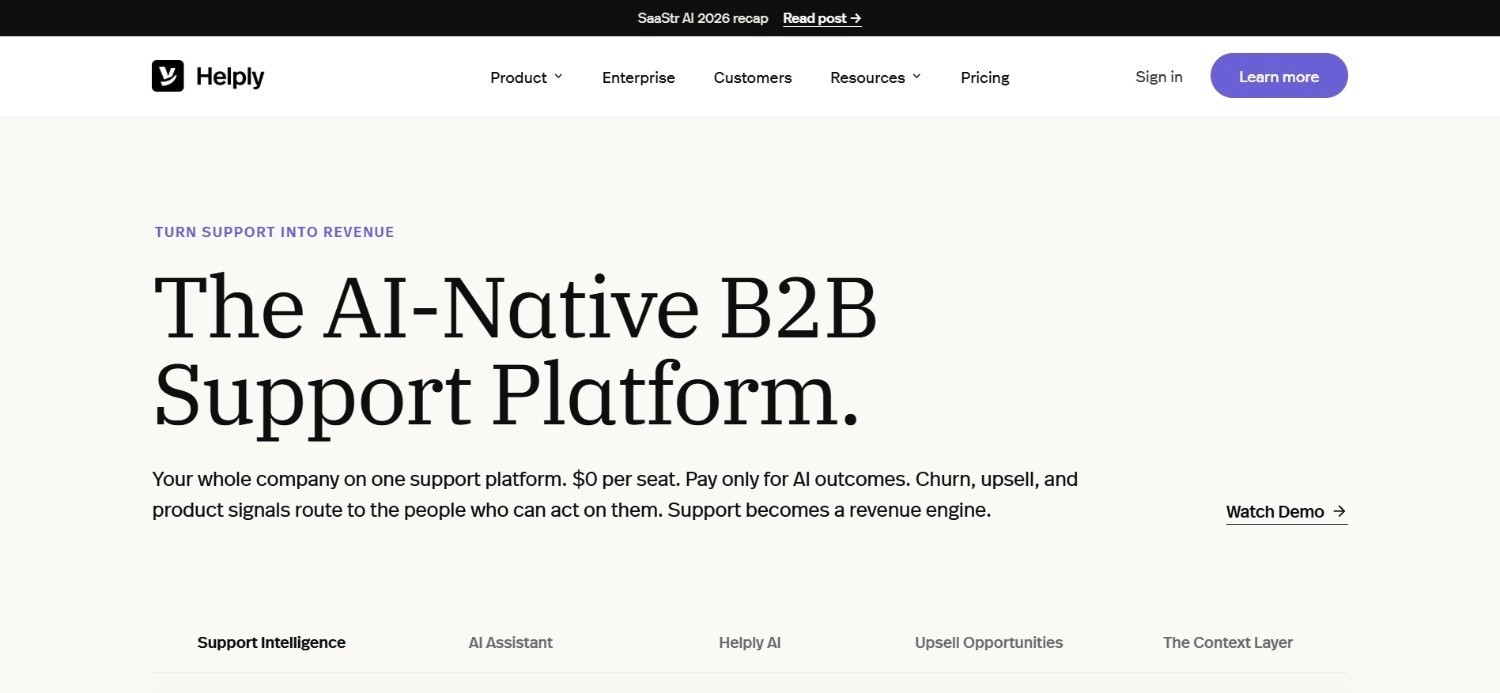
Helply is an AI customer support tool built for SMBs and growing mid-market teams that need to automate a high volume of support tickets without paying per seat or per agent. Its model is straightforward: $1 per resolved ticket, with a minimum commitment of 250 tickets per month.
Teams get unlimited AI usage, unlimited agents, and unlimited seats under a single usage-based fee.
Helply sits in the category of Lorikeet alternatives at the lighter end of the market - not built for multi-system enterprise operations or legacy system integration, but well-suited for teams where most ticket volume is repeatable and document-backed.
Volume discounts are available as ticket counts grow, making the economics improve with scale.
Ideal For
Customer support managers at SMBs and early-stage scale-ups handling 250-2,000 tickets per month who need AI resolution without per-seat pricing
Head of Support at SaaS companies with consistent, document-backed query types well-suited to AI deflection
COOs at fast-growing mid-market businesses looking for a cost-predictable support automation layer before committing to enterprise tooling
Operations leads evaluating usage-based alternatives to Lorikeet with a lower minimum spend
Top Features
Usage-based AI ticket resolution at $1/ticket: Charges only for resolved tickets, with no per-seat or per-agent fees. Unlimited agents and seats are included at every volume tier.
Unlimited AI usage across channels: Handles support queries across multiple inbound channels without additional charges per interaction or per agent.
Volume discount structure: Per-ticket cost decreases as volumes increase beyond the minimum commitment, making the economics improve with scale rather than penalising growth.
Why It's a Strong Lorikeet Alternative
Helply is a straightforward option among Lorikeet alternatives for teams where pricing simplicity and predictable cost per ticket matter more than enterprise governance features.
The $1/ticket model with no per-seat charges gives support teams a clear cost structure, which is the primary advantage over Lorikeet's per-resolution pricing at similar volume levels.
For SMBs and mid-market teams that do not need legacy system integration or multi-system orchestration, Helply offers a capable support automation layer at a lower barrier to entry.
Pros
Simple, predictable pricing: $1 per resolved ticket with no seat or agent fees
Unlimited agents and seats at all tiers remove headcount constraints from the cost model
Lower minimum commitment than most enterprise-tier alternatives
Volume discounts reward growth rather than penalising high-volume users
Cons
Minimum $3,000 annual commitment is a meaningful ask for early-stage teams
Limited enterprise governance, audit trail, and compliance features relative to regulated-industry needs
Not built for multi-system back-office operations; stops at front-end ticket resolution
Pricing
Helply charges $1 per resolved ticket with a minimum commitment of 250 tickets per month, totalling $3,000 annually at the floor.
Unlimited AI usage, unlimited agents, and unlimited seats are included at all tiers. Volume discounts apply as monthly ticket counts grow.
Final Verdict
Helply is a sensible choice for SMB and growth-stage mid-market teams that need to reduce support ticket costs without complex enterprise tooling. The $1/ticket model is transparent and easy to model for budget purposes.
The limitation is depth: Helply does not handle legacy system integration, multi-step operational workflows, or the compliance requirements that regulated industries need.
Teams at that scale should look at options with more governance infrastructure.
3. Plain
Overview
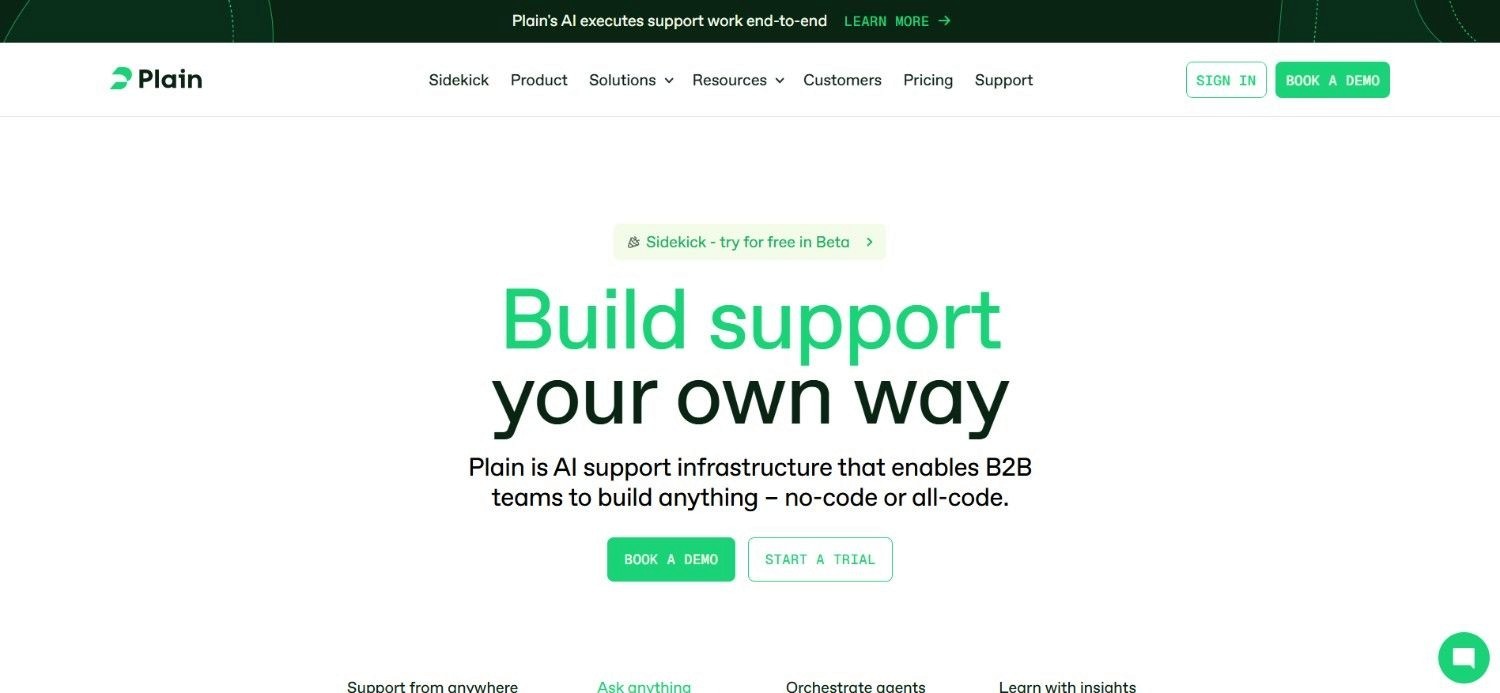
Plain is a developer-focused customer support tool designed for engineering and product teams that need API-first control over their support workflows.
The platform positions itself as a modern alternative to legacy helpdesk tooling, with a clean interface, strong API access, and AI capabilities built into the core workflow.
As one of the more technical Lorikeet alternatives, Plain appeals to teams where the engineering team owns the support tooling decision and wants flexibility over out-of-the-box configurability.
It is not designed for legacy enterprise environments or regulated-industry compliance at depth, but for developer-native teams, the API-first approach sets it apart.
Ideal For
Engineering leads and CTOs at developer-native SaaS companies that want API-first control over their support tooling
Head of Support at product-led growth companies where the support workflow is tightly integrated with the product itself
Early-stage and mid-stage startups looking for a clean, modern helpdesk with AI capabilities at a low entry price
Technical operations managers at companies that build custom integrations and need a support platform that exposes a full API surface
Top Features
API-first architecture: Exposes a comprehensive API layer that allows engineering teams to build custom integrations, automate workflows, and embed support directly into their product.
AI agents within workflow builder: Includes AI-driven agents that resolve queries autonomously using your documentation and knowledge base, with escalation to human agents when confidence is low.
Foundation plan AI credits: The entry-level plan at $35/month includes 2,000 AI credits, AI agents, and workflow automation, giving small teams access to AI-driven resolution without enterprise pricing.
Why It's a Strong Lorikeet Alternative
Plain is a strong option among alternatives to Lorikeet for developer-led teams where API control matters more than out-of-the-box setup.
The Foundation plan at $35/month gives small teams access to AI-driven support at a fraction of Lorikeet's per-resolution cost at low volumes.
For teams building tightly integrated support workflows into their product, Plain's API-first design enables a level of customisation that most support tools do not offer.
Pros
API-first design gives engineering teams fine-grained control over support workflows
Low entry price ($35/month) with AI capabilities included from the Foundation tier
Clean, modern interface that reduces the friction of support tooling adoption
Free trial available for evaluating the platform before committing
Cons
Not designed for enterprise-scale regulated industries; lacks the governance depth needed for financial services or healthcare compliance
AI credit model on lower tiers creates usage friction as volume grows
Limited legacy system integration; designed for modern SaaS stacks, not COBOL-era infrastructure
Pricing
Plain offers three plans: Foundation at $35/month (2,000 AI credits, AI agents, workflows, free trial), Horizon at $299/month (expanded credits, more integrations, advanced features), and Frontier at custom pricing for enterprise requirements.
Plans scale through additional AI credits, seats, and integrations.
Final Verdict
Plain is worth evaluating for developer-native teams that need API-first support tooling at a low entry cost. The AI capabilities on the Foundation plan are strong relative to the price.
The limitation is reach: Plain is not built for multi-system enterprise operations, regulated-industry compliance at scale, or legacy system integration.
Teams with those requirements will outgrow it.
4. Zendesk AI
Overview
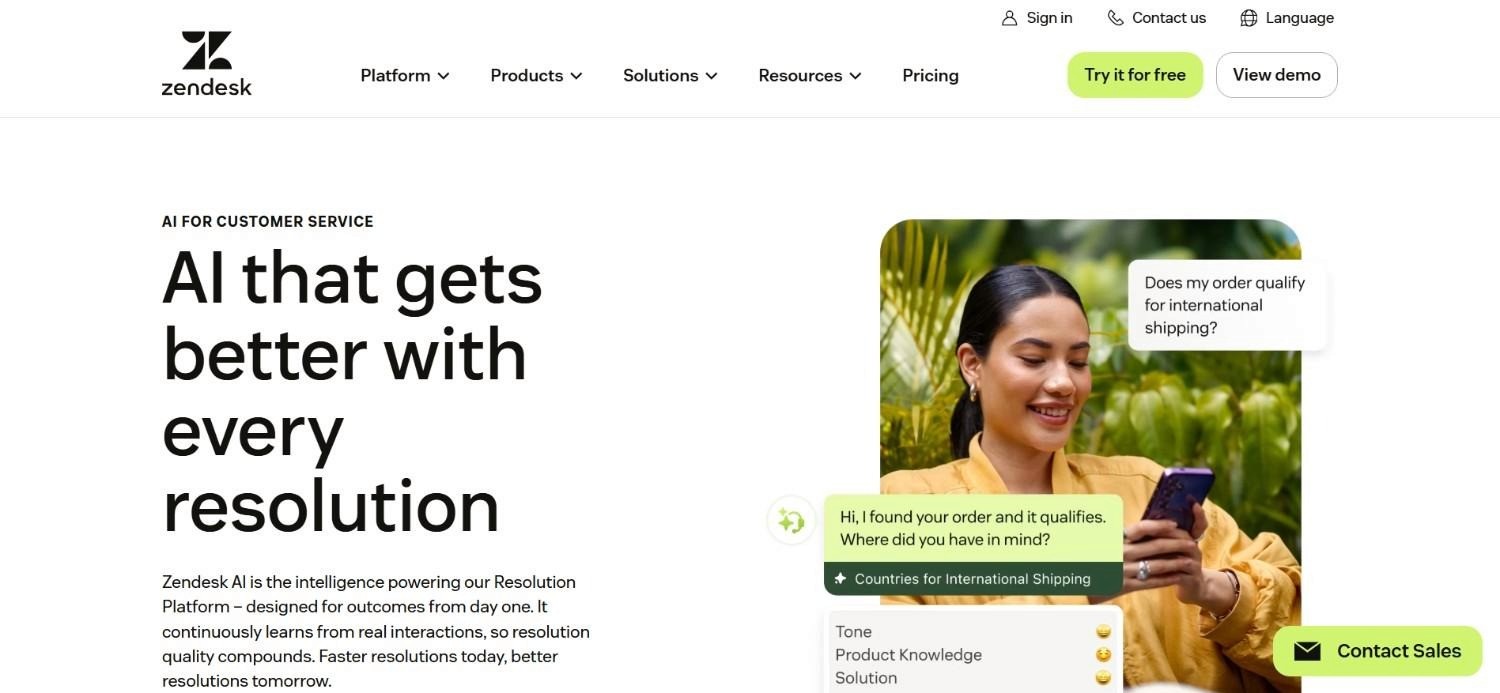
Zendesk AI is the AI layer embedded within the Zendesk support suite, offering ticket triage, agent copilot features, knowledge management, and automation capabilities to support teams already operating within the Zendesk ecosystem.
As one of the most widely deployed Lorikeet competitors in the enterprise support market, Zendesk AI benefits from a mature integration ecosystem, a large user base, and deep familiarity among support operations teams.
The platform isn't a standalone AI product, but an AI capability/feature built into an existing helpdesk, which is both its strength and its structural constraint.
Ideal For
VP of Customer Support and Head of CX at large enterprises already running Zendesk as their primary helpdesk
Support operations managers looking to add AI-driven triage and copilot capabilities to an existing Zendesk deployment without switching platforms
IT leaders at organisations where Zendesk is deeply embedded in the tech stack and switching costs are high
Operations teams at mid-to-large companies handling high support ticket volumes that benefit from AI-assisted routing and response drafting
Top Features
AI-powered ticket triage and routing: Analyses inbound tickets and routes them to the appropriate team or agent automatically, reducing manual classification time and improving first-response SLAs.
Agent copilot and response suggestions: Agents get real-time AI-generated response suggestions based on ticket context, knowledge base content, and historical resolution data, reducing handle time per ticket.
Knowledge management with AI-driven content gaps: Identifies gaps in your knowledge base based on unresolved ticket patterns and suggests new content, improving self-service resolution rates over time.
Why It's a Strong Lorikeet Alternative
Zendesk AI is one of the most established alternatives to Lorikeet for teams already embedded in the Zendesk ecosystem.
The per-seat model is predictable for teams with stable agent headcount, and the product maturity reduces deployment risk.
For organisations that need AI to augment human agents rather than replace manual operations end-to-end, Zendesk AI covers the use case within a familiar infrastructure.
Pros
Large, mature integration ecosystem across CRM, helpdesk, and communication tools
Low barrier to adoption for existing Zendesk customers; no platform migration required
Consistent AI-driven triage and routing at scale, with measurable impact on SLA compliance
Strong knowledge management capabilities that improve self-service resolution rates over time
Cons
Per-seat pricing scales linearly with headcount; costs grow as support teams expand
AI capabilities are augmentative, not autonomous; agents still close most tickets manually
Not designed for back-office multi-system operations or legacy system integration; stops at helpdesk-level automation
Pricing
Zendesk AI is included within four Zendesk support suite plans: Support Team at $19/agent/month, Suite Team at $55/agent/month, Suite Professional at $115/agent/month, and a custom-priced Suite Enterprise + Copilot tier.
All plans are billed annually. AI capabilities deepen at higher tiers.
Final Verdict
Zendesk AI is the sensible choice for large support teams already on Zendesk that want AI capabilities without a platform change. The integration depth and product maturity reduce risk.
The limitation is architectural: Zendesk AI assists agents; it does not execute operations.
Teams that need AI to resolve complex, multi-system workflows without human involvement will need to look beyond helpdesk-layer tooling.
5. Decagon AI
Overview
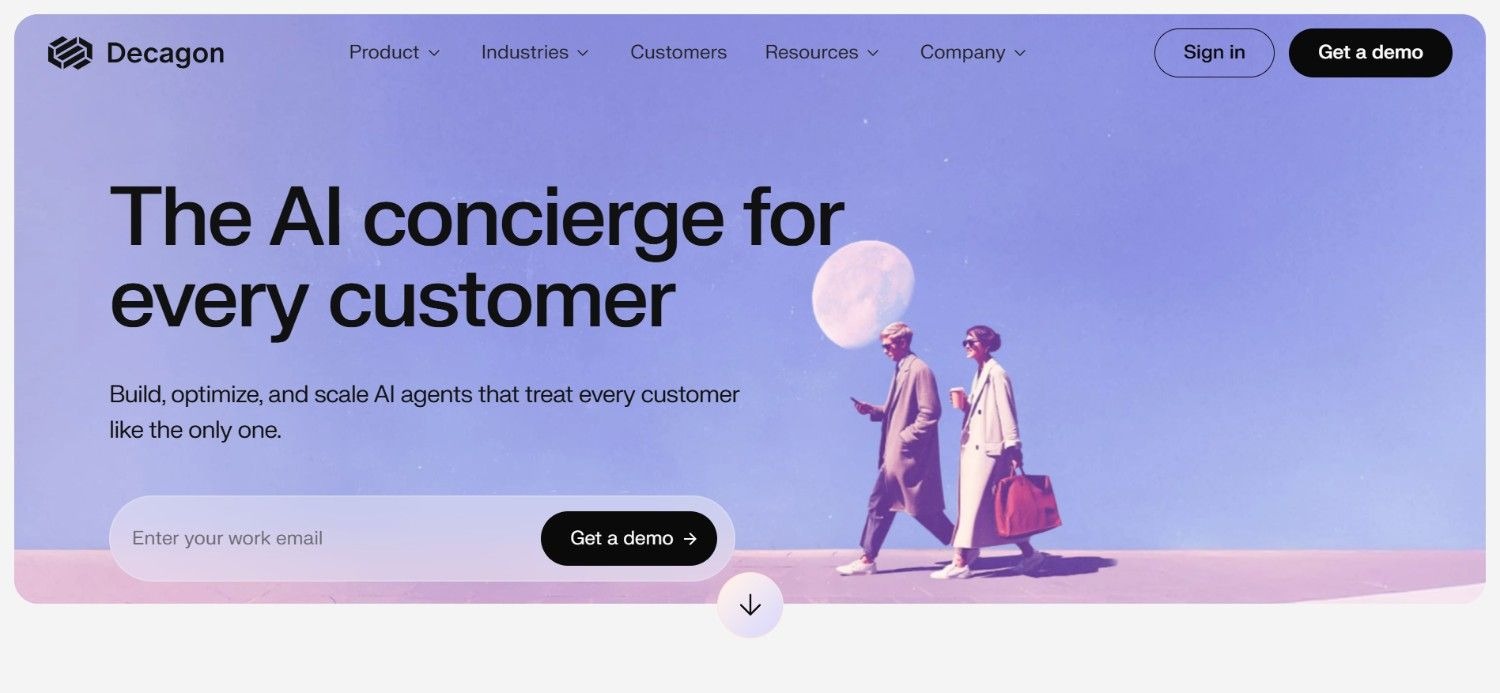
Decagon AI is an enterprise-focused customer support automation platform that deploys custom AI configurations for high-volume support operations. It targets companies that have outgrown standard helpdesk tooling and need AI that can handle complex, multi-step support interactions across channels.
Decagon positions itself as one of the stronger Lorikeet competitors in the enterprise segment, with a deployment model that involves close configuration work to align AI behaviour with each client's knowledge base, policies, and support processes. Pricing is custom, typically structured per conversation or per resolution on annual contracts.
The platform suits regulated and high-complexity environments where off-the-shelf AI behaviour is insufficient, though integration depth into legacy enterprise systems is not its primary strength.
Ideal For
Head of Customer Operations and CX Leaders at high-volume enterprise companies handling complex support interactions at scale
Operations teams at financial services, insurtech, and healthtech companies that need AI tuned to their policies and processes, not generic behaviour
IT leaders evaluating Lorikeet alternatives for enterprise deployment who need custom configuration over out-of-the-box setup
COOs at growth-stage companies whose ticket volume has outpaced human support capacity and need AI that handles genuine complexity
Top Features
Custom AI configuration per client: Configures AI to the client's specific knowledge base, policies, and support logic, reducing generic responses and improving resolution quality on complex queries.
Multi-channel enterprise support automation: Handles inbound support across chat, email, and messaging with consistent AI-driven resolution behaviour across surfaces.
Enterprise integration layer: Connects to the client's existing helpdesk and CRM infrastructure to pull context and update records as part of the resolution flow.
Why It's a Strong Lorikeet Alternative
Decagon is one of the stronger alternatives to Lorikeet for large enterprise support teams that need custom-configured AI rather than a standard deployment.
The enterprise focus and close configuration process mean AI behaviour aligns more tightly with client policies than most self-serve platforms.
For organisations with high inbound complexity and the budget for an enterprise-tier tool, Decagon is worth evaluating.
Pros
Custom AI configuration aligned to client-specific policies and knowledge bases
Strong enterprise positioning with dedicated deployment support
Multi-channel support automation across chat, email, and messaging at scale
Cons
No public pricing; contract negotiation required before evaluation
Limited transparency on integration depth with legacy enterprise systems
Primarily focused on support automation; does not execute multi-system back-office operations
Pricing
Decagon uses custom enterprise pricing. Rates are typically structured per conversation or per resolution on annual contracts, with pricing tailored to ticket volume, integration complexity, and deployment requirements.
Prospective customers need to contact the sales team for a quote.
Final Verdict
Decagon is a credible enterprise-tier option for high-volume support teams that need more than off-the-shelf AI configuration. The custom deployment model is an advantage for organisations with complex policies.
The limitation is that Decagon remains focused on support layer automation; it does not execute the operational workflows that sit behind the tickets it resolves.
6. Sierra AI

Overview
Sierra AI is a conversational AI platform built for consumer-facing customer experience, with a focus on natural language resolution quality and brand voice consistency.
It targets enterprise consumer brands that want AI-driven CX at scale without sacrificing conversational quality that affects customer satisfaction scores.
Sierra charges per successfully resolved interaction on a custom, outcome-based model, making it one of the more direct Lorikeet competitors on pricing structure.
The platform is not designed for back-office operations or legacy system integration; its strength is in the front-line customer interaction layer - particularly for brands where the quality and tone of AI responses carry brand risk.
Ideal For
Chief Experience Officers and VP of CX at large consumer brands where AI conversation quality and brand voice consistency are as important as resolution rate
Head of Customer Operations at enterprise B2C companies handling millions of inbound interactions annually across chat and messaging channels
Digital transformation leaders at consumer-facing companies evaluating outcome-priced AI without wanting per-seat model lock-in
Marketing and CX leadership at brands in retail, travel, and financial services where customer experience quality directly affects retention
Top Features
Brand voice and persona controls: Allows organisations to configure the AI's tone, persona, and response style to align with brand guidelines, reducing the risk of off-brand interactions at scale.
Natural language resolution across channels: Handles multi-turn conversational interactions that require contextual understanding across a full conversation thread, not just single-turn query matching.
Outcome-based pricing model: Pricing is tied to successfully resolved interactions, aligning vendor incentives with actual customer outcomes rather than interaction volume or seat count.
Why It's a Strong Lorikeet Alternative
Sierra is a strong option among Lorikeet alternatives for consumer brands where conversation quality is a strategic priority.
The outcome-based pricing mirrors Lorikeet's model, making cost comparisons straightforward. For organisations where the brand experience layer of AI interactions matters as much as resolution rate, Sierra's focus on tone and persona control is a genuine differentiator.
Pros
Strong brand voice and persona customisation for consumer-facing deployments
Outcome-based pricing aligns costs with resolved interactions, not seat count
High natural language understanding quality for complex, multi-turn conversations
Cons
No public pricing; requires direct sales engagement for evaluation
Not designed for back-office or multi-system operations execution
Primarily a consumer brand tool; less suited to B2B enterprise operations contexts
Pricing
Sierra AI uses custom, outcome-based enterprise pricing. Customers pay per successfully resolved interaction. Pricing is tailored to deployment size, integration complexity, and support requirements.
No public rates are available; contact the sales team for a quote.
Final Verdict
Sierra AI is worth evaluating for consumer-facing enterprise brands where AI conversation quality and brand voice control are primary selection criteria. The outcome pricing model is straightforward to compare against Lorikeet.
The limitation is scope: Sierra does not execute operational workflows or integrate with legacy enterprise systems.
For teams that need AI beyond the front-line customer conversation, Sierra reaches its limit quickly.
7. Fin by Intercom
Overview
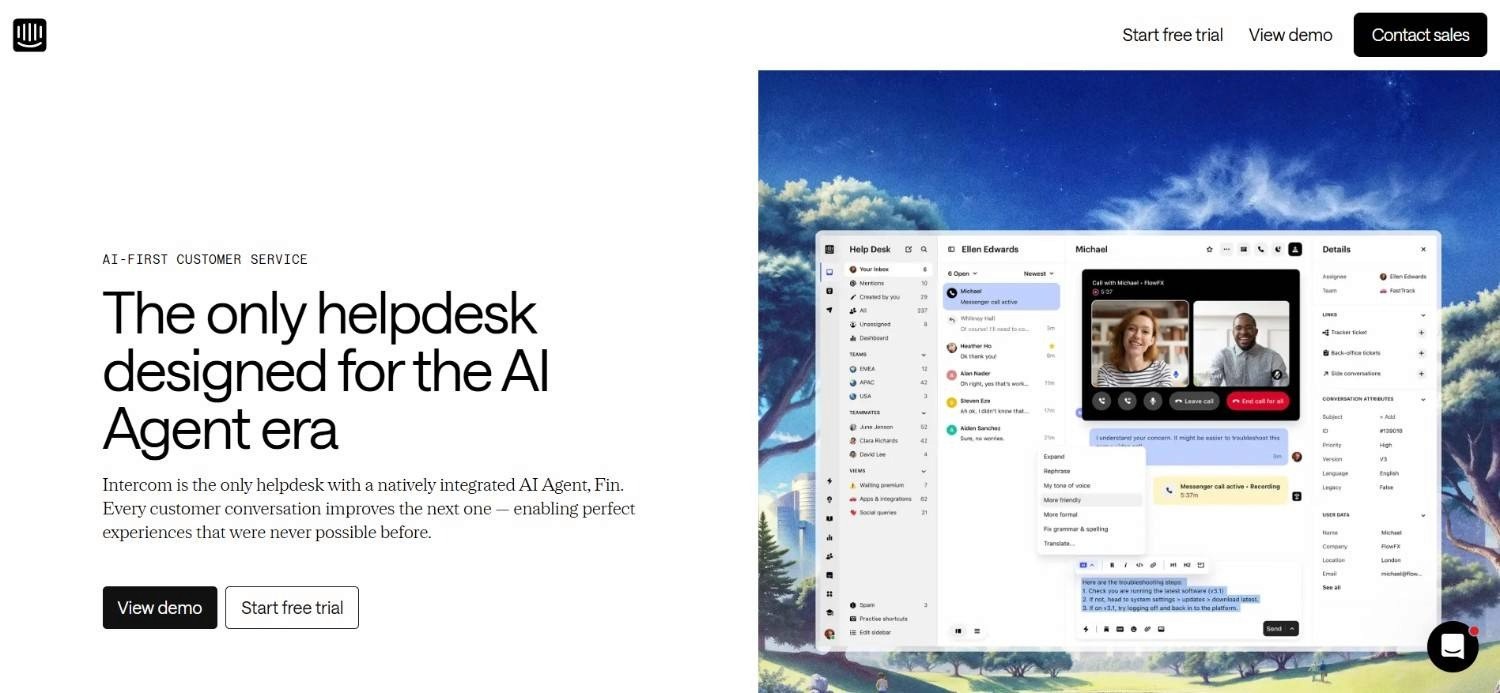
Fin is Intercom's AI resolution product, priced at $0.99 per resolved conversation - one of the most clearly published per-resolution rates in the category.
It operates within the Intercom ecosystem but also runs as a standalone resolution layer on top of other helpdesks, charging only $0.99 per outcome with no seat fees for teams using a non-Intercom helpdesk.
That combination makes Fin one of the more accessible Lorikeet alternatives for teams already using Intercom or evaluating a resolution-only AI layer.
The AI-powered tool is trained on your documentation and knowledge base, handles multi-turn conversations, and escalates to human agents when resolution confidence is low.
Its scope is front-end ticket and conversation resolution, making Fin a direct competitor to Lorikeet at the customer support layer.
Ideal For
Head of Support at Intercom-native companies that want AI resolution without switching platforms
Customer success and support leads at SaaS companies evaluating alternatives to Lorikeet at a lower per-resolution cost
Operations managers at mid-market companies using a non-Intercom helpdesk who want resolution-only AI without seat fees
IT leaders evaluating straightforward resolution AI with a published, predictable pricing model
Top Features
$0.99 per resolved conversation: Fully published pricing makes cost modelling straightforward. Teams on non-Intercom helpdesks pay only the per-resolution fee with no seat charges.
Cross-helpdesk deployment: Runs as a standalone resolution layer on top of Zendesk, Salesforce Service Cloud, and other helpdesks, without requiring platform migration.
Knowledge base-driven resolution: Trains on your existing documentation, help centre content, and product knowledge to resolve queries using your own content as the authoritative source.
Why It's a Strong Lorikeet Alternative
Fin is one of the most straightforward Lorikeet alternatives for teams where pricing transparency and low per-resolution cost are the primary evaluation criteria.
At $0.99 per resolution, it undercuts Lorikeet's published rates and offers a clear comparison point.
For Intercom-native teams, the integration is trivial. For teams outside the stack, the standalone deployment option removes the platform dependency from the cost model.
Pros
Fully published $0.99/resolution pricing makes cost modelling and comparison transparent
Runs on top of other helpdesks without requiring platform migration
No seat fees for teams using external helpdesks; pay only for resolved outcomes
Cons
Full feature set requires an Intercom plan on top of per-resolution fees, which complicates the "simple pricing" narrative
Knowledge base-dependent; resolution quality degrades if documentation is incomplete or outdated
No back-office execution, legacy system integration, or multi-system workflow capability
Pricing
Fin charges $0.99 per resolved conversation. Teams using Intercom as their helpdesk pay per resolution plus the Intercom plan cost (starting at $19/seat/month, billed annually).
Teams using another helpdesk pay only the $0.99 per-resolution fee with no seat charges.
Final Verdict
Fin by Intercom is the clearest pricing option among Lorikeet competitors and the logical choice for Intercom-native teams or teams that want a resolution-only AI layer on top of their existing helpdesk.
The $0.99 rate is competitive against Lorikeet at comparable volumes. The limitation is depth: Fin resolves customer queries; it does not execute the operational workflows that sit behind them.
8. Ceven
Overview
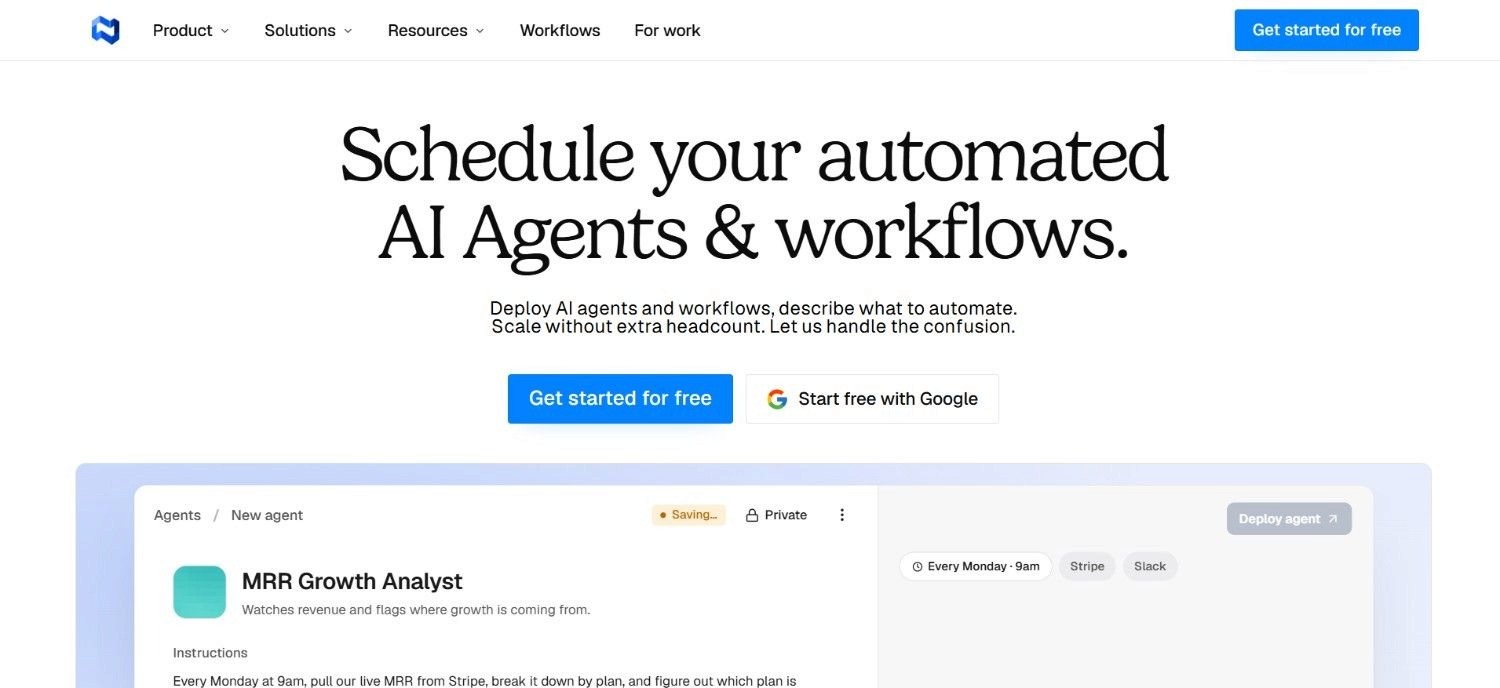
Ceven is an AI-native support tool built for B2B companies with complex support workflows. It focuses on teams where support interactions require multi-step reasoning, cross-team coordination, and structured workflows - rather than simple FAQ deflection.
Ceven's positioning among Lorikeet alternatives centres on B2B workflow depth: the ability to build structured resolution flows that match complex B2B support logic, rather than relying on generic AI behaviour trained on documentation alone.
The platform is relatively early in market traction compared to larger Lorikeet competitors, but its B2B workflow focus gives Ceven a distinct angle for teams whose support complexity outpaces what standard tools can handle.
Ideal For
Head of Support and Customer Success at B2B SaaS companies with structured, multi-step support workflows that generic AI handles poorly
Operations managers at mid-market B2B companies evaluating Lorikeet alternatives with stronger workflow builder capabilities
Customer operations leaders at companies where support interactions regularly involve cross-team handoffs, escalation paths, and structured resolution logic
IT leaders at B2B firms evaluating workflow-centric support AI with modern API connectivity
Top Features
AI-native workflow builder: Allows support teams to build structured resolution workflows that incorporate AI decision-making at each step, rather than applying AI as a single layer on top of a static flow.
B2B-focused resolution logic: Tuned for the multi-step, context-dependent queries typical in B2B support interactions, where a single ticket may require coordination across product, billing, and technical teams.
Custom enterprise integrations: Connects to the client's CRM, helpdesk, and data sources to pull context into resolution workflows and update records on resolution.
Why It's a Strong Lorikeet Alternative
Ceven is an interesting option among alternatives to Lorikeet for B2B support teams where workflow structure matters as much as AI accuracy.
The workflow builder approach gives teams more control over how AI behaviour is applied at each decision point in a resolution flow - a meaningful advantage for complex B2B support contexts compared to Lorikeet's more automated resolution model.
Pros
B2B-focused workflow design gives teams more structured control over AI resolution behaviour
AI-native architecture rather than AI layered onto a legacy helpdesk
Custom integration support for connecting to existing CRM and operational data sources
Cons
No public pricing; requires sales engagement to evaluate cost
Limited public track record and client base compared to more established Lorikeet competitors
Not designed for back-office multi-system operations or legacy enterprise system integration
Pricing
Ceven uses custom enterprise pricing based on the number of AI configurations, workflows, integrations, and deployment scope. Prospective customers need to contact the sales team for a quote.
Final Verdict
Ceven is worth evaluating for B2B support teams that have outgrown the resolution logic of standard AI tools and need structured workflow control over AI behaviour at each decision point.
The B2B workflow focus is a genuine differentiator within the Lorikeet alternatives space.
The limitation is that Ceven remains a support-layer tool; it does not execute the operational workflows that require back-office system access.
9. Ada
Overview
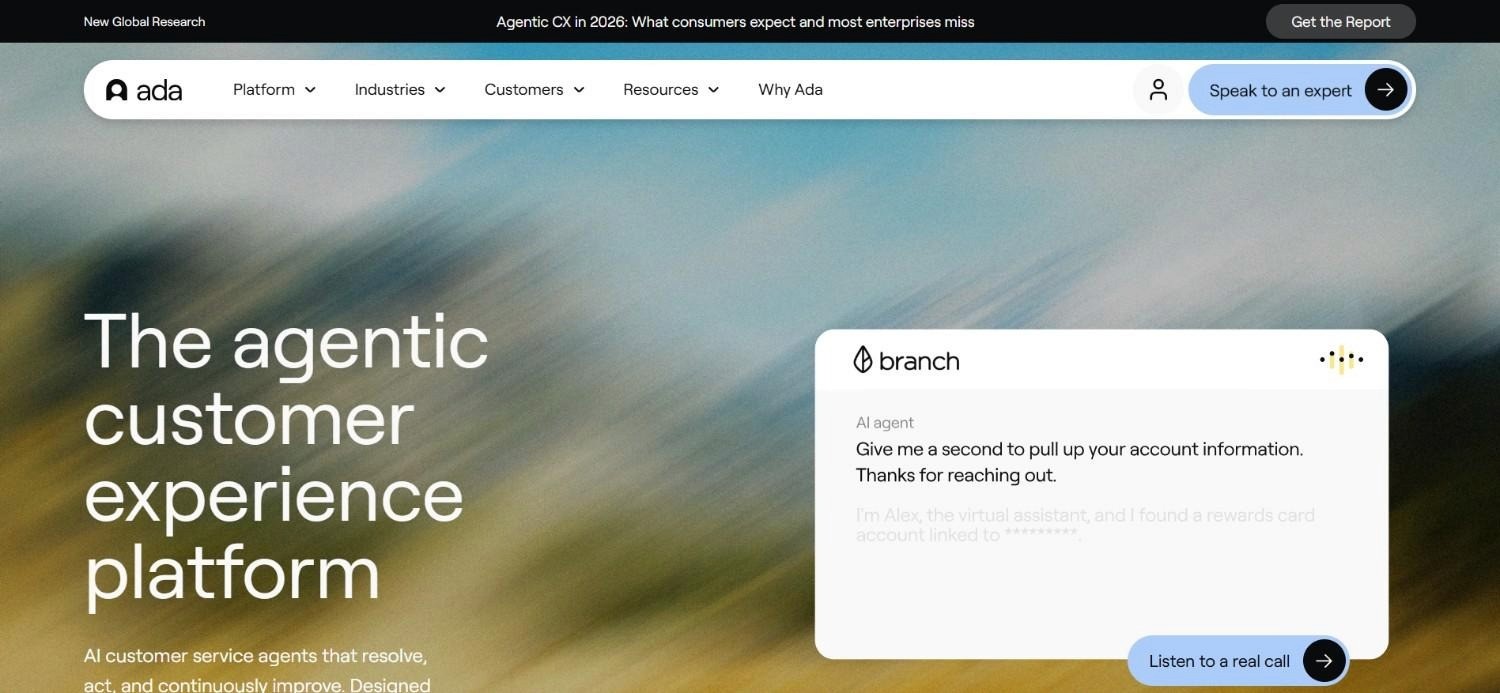
Ada is an enterprise customer experience automation platform with a large installed base across retail, telecommunications, and financial services.
It is one of the more mature Lorikeet competitors in the enterprise CX category, with multi-channel AI resolution across chat, email, and voice, and a strong focus on brand voice consistency and CRM integration.
Ada's pricing is custom, based primarily on conversation volume, with an optional resolution-based model for specific deployments.
The platform suits large enterprises running high conversation volumes across multiple channels and geographies, where consistent AI behaviour and brand control are central requirements.
Ideal For
VP of CX and Head of Digital Channels at large consumer enterprises handling millions of AI-driven interactions per year across chat, email, and voice
IT and platform leaders at organisations where multi-channel consistency and brand voice governance are non-negotiable requirements
Operations executives at retail, telecom, and financial services companies evaluating mature, enterprise-grade alternatives to Lorikeet with proven scale
Digital transformation leaders at large enterprises where AI CX has board-level visibility and deployment risk must be minimal
Top Features
Omnichannel AI resolution: Handles customer interactions across chat, email, voice, and messaging channels, maintaining consistent resolution behaviour and brand voice across all surfaces.
Brand voice and persona controls: Organisations configure Ada's tone, language, and escalation behaviour to match brand guidelines, reducing off-brand interaction risk at high volume.
CRM and helpdesk integration: Connects to Salesforce, Zendesk, and other enterprise CRM systems to pull customer context and update records as part of the resolution flow.
Why It's a Strong Lorikeet Alternative
Ada is one of the stronger alternatives to Lorikeet for large enterprises that need a mature, multi-channel AI resolution product with proven scale.
The platform's longevity in the market and large client base reduce deployment risk relative to newer entrants. For organisations where multi-channel consistency and brand governance are the primary selection criteria - Ada's depth is a genuine advantage over Lorikeet's more focused regulated-industry positioning.
Pros
Mature enterprise product with a large client base and proven scale across high-volume deployments
Strong omnichannel capability across chat, email, voice, and messaging
Proven brand voice and persona controls for consumer-facing enterprises
Cons
No public pricing; custom enterprise contracts require sales engagement before evaluation
Per-conversation model can become expensive at high volumes relative to outcome-based alternatives
Not designed for back-office operations or legacy system integration
Pricing
Ada uses custom enterprise pricing based primarily on conversation volume, with an optional resolution-based model for specific use cases.
Pricing is tailored to deployment scale, channels, integrations, and support requirements. No public rates are available.
Final Verdict
Ada is the appropriate choice for large consumer enterprises running high conversation volumes across multiple channels where brand consistency and product maturity are the primary priorities.
The limitation is that Ada operates at the front-line customer interaction layer; it does not execute the multi-system operational workflows behind those interactions.
10. Gradient Labs

Overview
Gradient Labs is an AI customer support tool specifically built for regulated industries, positioning itself as one of the more compliance-aware Lorikeet alternatives in the market.
It uses outcomes-based pricing, i.e. - charging only for successful AI query resolutions with no platform fees or per-seat charges, which makes the cost model straightforward to evaluate.
Gradient Labs focuses on accuracy in high-stakes, regulated environments where AI errors carry compliance or financial risk, targeting teams in financial services, insurance, and healthcare - where standard AI support tools fail on complexity or compliance.
The company is a newer entrant relative to established Lorikeet competitors, but its regulated-industry focus and outcomes-based pricing give it a clear positioning angle.
Ideal For
Head of Customer Operations and Compliance at regulated financial services and insurance companies evaluating alternatives to Lorikeet with stronger compliance awareness
Operations managers at fintechs, healthtechs, and insurers that need AI support accuracy guarantees in environments where resolution errors have regulatory consequences
CX leaders at regulated enterprises where outcomes-based pricing with no platform fees is a procurement requirement
IT leaders evaluating Lorikeet competitors for regulated industry deployments where SaaS data handling practices require scrutiny
Top Features
Outcomes-based pricing with no platform fees: Charges only for successful AI resolutions, with no platform or per-seat fees. Removes fixed cost from the model and aligns spend directly with resolved outcomes.
Compliance-aware AI resolution: Built for regulated industry contexts where AI resolution behaviour needs to align with compliance policies and avoid the generic responses that create regulatory risk.
Regulated industry knowledge base integration: Integrates with the client's policy documentation and compliance knowledge base to ground AI resolution behaviour in accurate, policy-aligned responses.
Why It's a Strong Lorikeet Alternative
Gradient Labs is a targeted option among Lorikeet alternatives for regulated industries that find Lorikeet's compliance features insufficient for their specific requirements.
The no-platform-fee pricing model is attractive for procurement teams that need to model total cost of ownership without a fixed base charge.
For teams in financial services or insurance where compliance accuracy is the primary AI selection criterion, Gradient Labs is worth including in an evaluation.
Pros
Outcomes-based pricing with no platform or per-seat fees provides a transparent cost model
Regulated-industry focus reduces the risk of generic AI behaviour in compliance-sensitive contexts
No fixed platform cost means the model scales from lower volumes without a heavy base commitment
Cons
Limited to support use cases; does not execute back-office operations or integrate with legacy enterprise systems
Newer entrant with less publicly available track record compared to established Lorikeet competitors
Requires sales engagement for pricing; no self-serve evaluation path
Pricing
Gradient Labs uses outcomes-based pricing, charging only for successful AI query resolutions with no platform fees or per-seat charges.
Pricing is customised based on support volume and business requirements. Interested customers need to contact the sales team for a quote.
Final Verdict
Gradient Labs is a credible option for regulated industry support teams that need compliance-aware AI resolution on an outcomes-only cost model. The no-platform-fee structure is a genuine advantage for procurement teams managing total cost of ownership.
The limitation is that Gradient Labs resolves support queries but does not execute the multi-system operational workflows behind them.
Why Noxus Works Across Multiple Use Cases
1. Noxus for Banking and Financial Services Operations
Banking operations teams face a specific problem: every customer case - a billing dispute, a refund request, an account change - touches multiple disconnected systems before it is closed. A human agent manually bridges every gap between core banking, SAP, CRM, and compliance documentation.
Noxus eliminates that bridging work by running the entire process end-to-end, from unstructured intake to write-back into source systems, under full audit.
Santander achieved 3x ROI, 95% AI precision on live data, and a 45-day path from contract to production.
For banking operations teams evaluating Lorikeet alternatives that go beyond front-end ticket resolution, this is where Noxus proves its case.
2. Noxus for Insurance Claims Operations
Insurance claims processing is one of the hardest operational environments for AI: high document complexity, strict regulatory requirements, legacy system dependency, and real financial consequences for errors.
Noxus deploys inside Guidewire and legacy claims management systems without requiring API modernisation. Deterministic policy enforcement ensures no AI model makes claims decisions - your rules execute, AI interprets. Every decision is replayable.
That architecture is why our best workflow automation software deployments in insurance show 90%+ precision and zero client churn.
For insurers evaluating Lorikeet alternatives that cover back-office claims operations, Noxus covers both layers.
3. Noxus for Healthcare Communication Triage
Healthcare operations teams process thousands of patient and administrative communications per month - document requests, appointment coordination, billing inquiries, referral management. The constraint is GDPR Article 9: high-sensitivity health data requires deterministic compliance enforcement.
Noxus runs communication triage end-to-end on client infrastructure, with policy enforcement ensuring no AI model makes clinical or compliance-relevant decisions. CUF/José de Mello processes 10,000+ communications per month at 96% precision with full GDPR Article 9 compliance maintained throughout.
For healthcare operations teams that have found Lorikeet's SaaS-only architecture incompatible with their data residency requirements, Noxus resolves that constraint at the architecture level.
4. Noxus for Retail and FMCG Operations
Retail and FMCG operations teams face a scale problem that does not fit neatly into any support tool category: tens of thousands of daily operational tasks - product data enrichment, pricing updates, catalogue classification, PIM write-backs - that require AI execution across multiple systems simultaneously.
Lorikeet and most of its alternatives are not designed for this category of work. Jerónimo Martins automates 15,000+ daily product listings at 90% precision and 5x ROI through Noxus, with direct write-back into PIM infrastructure and marketplace connectors.
For retail and FMCG operations leaders evaluating alternatives to Lorikeet that can handle back-office complexity, this use case demonstrates why execution depth matters.
5. Noxus for IT Service Management
IT operations teams spend a disproportionate amount of time on ticket classification, handoff coordination, and context assembly before a single technical issue is addressed. Noxus auto-triages and routes service tickets across ServiceNow, Jira, and Outlook; compressing the classification and handoff steps that dominate ticket lifecycle.
The difference from Lorikeet and other support-focused Lorikeet competitors is that Noxus closes the loop: it does not route tickets for humans to resolve; it executes the resolution steps within your systems and logs the outcome.
For IT service management teams with high inbound volume and complex routing logic, the time-to-resolution improvement is measurable and attributable.
What Makes a Good Lorikeet Alternative?
1. End-to-End Operations Execution, Not Just Ticket Resolution
The fundamental gap in most Lorikeet alternatives is the same gap in Lorikeet itself: they resolve what is visible to the customer without executing the operational work behind it.
A good alternative should close the full loop - from unstructured intake to system write-back - without human intervention at each boundary. That requires a process execution layer, not just a conversational AI layer.
2. Native Legacy System Integration Without Prerequisites
Most enterprises cannot replace SAP, Guidewire, or their core banking systems on the timeline of an AI deployment project. A genuine Lorikeet alternative must work inside those environments as they exist today, without API modernisation, middleware projects, or infrastructure re-architecture as a prerequisite.
If the vendor's integration story starts with "first, you'll need to...", that is a cost that belongs in the evaluation.
3. Compliance Architecture That Holds Up to Regulated-Industry Scrutiny
Regulated industries: financial services, insurance, healthcare; cannot treat compliance as a contractual assurance. It needs to be structural: deterministic policy enforcement, complete audit trails, replayable decision traces, and deployment architectures that keep data inside the client's control.
A good Lorikeet alternative for customer support in these sectors must meet GDPR, EU AI Act, DORA, NIS2, SOC 2, and ISO 27001 requirements by design, not by attestation.
4. Pricing That Scales with Outcomes, Not Headcount
Per-seat models penalise growth. As operations teams scale, the cost of per-seat tooling scales in the same direction as the headcount problem they are trying to solve.
Usage-based or outcome-based pricing aligns vendor incentives with actual resolution value and keeps total cost of ownership predictable for finance teams building a business case.
5. Production Credibility on Real Enterprise Systems
The AI operations market has a large population of tools that work in demos and sandboxes but fail on production enterprise data.
A credible Lorikeet alternative should be able to demonstrate production deployments on real client systems - not synthetic data environments, with measurable outcomes: ROI multiples, precision on live data, time from contract to production.
Those numbers distinguish a production tool from a pilot.
How to Choose the Right Lorikeet Alternative for Your Needs?
1. Map Your Actual Use Case Scope
Start by identifying where your operational problem sits.
If the need is front-end customer support automation - resolving tickets, deflecting FAQs, routing inbound queries; then tools like Fin by Intercom, Zendesk AI, or Helply cover that scope at accessible price points.
If the need extends to the back-office workflows behind those tickets: claims processing, billing dispute resolution, account mutations, compliance document handling - then you need a tool with genuine system integration depth, and the evaluation should include Noxus.
2. Audit Your System Architecture Before Selecting a Vendor
The most common evaluation mistake is selecting a tool based on feature comparisons before checking whether it can run inside your actual system environment.
If your operations run across SAP ECC, Guidewire, legacy core banking platforms, or proprietary in-house systems, most Lorikeet competitors will not integrate without significant infrastructure work.
Clarify vendor integration requirements before shortlisting.
3. Define Your Compliance Requirements at the Architecture Level
For regulated industries, compliance is not a feature checklist - it is an architectural requirement.
Before evaluating alternatives to Lorikeet, define the data residency requirements, the audit trail standards your compliance team needs, and whether a SaaS-only deployment architecture is acceptable.
If the answer is no, the evaluation list narrows significantly.
4. Model Total Cost of Ownership, Not Sticker Price
Per-resolution and per-seat pricing models look different at different volumes. A $1/ticket tool that requires 500 tickets/month to become viable may be more expensive than a usage-based platform at higher volumes.
Build a total cost of ownership model that includes: base platform costs, per-unit resolution fees at your projected volume, integration and deployment costs, and the cost of human labour that will not be displaced.
That model reveals the real comparison.
5. Require a Production Proof Point, Not a Demo
Demos are controlled environments.
Before selecting any tool from this list of the best Lorikeet alternatives for customer support, request a reference call with a client in a comparable industry and operational context.
Ask for production metrics; including precision on live data, time from contract to deployment, operations volume resolved per month.
Tools that cannot provide those figures are not production-ready.
Everything You Need to Know About Lorikeet Alternatives
Category | Key Considerations |
Top 3 Alternatives | Noxus (end-to-end enterprise operations), Zendesk AI (large support teams on existing Zendesk), Fin by Intercom (transparent per-resolution pricing) |
Best Overall Option | Noxus - executes end-to-end operations across legacy systems, not just front-end ticket resolution |
Why Look for Lorikeet Alternatives? | Lorikeet covers customer support ticket resolution; it does not execute multi-system back-office operations, integrate with legacy enterprise systems, or support air-gapped deployment for strict data residency requirements |
How to Choose the Best Lorikeet Competitors? | Map your actual use case scope; audit your system architecture; define compliance requirements at the architecture level; model total cost of ownership, not sticker price |
Price Range | From $35/month (Plain Foundation) to consumption-based (Noxus) to custom enterprise pricing across most of the list |
Ease of Switching | Front-end support tools (Fin, Helply, Plain) have fast onboarding; enterprise operations platforms (Noxus) involve deployment engineering but are live in 45-80 days on real client systems |
Must-Have Features | End-to-end resolution; full audit trail; legacy system integration; compliance architecture; outcome-based pricing |
Mistakes You Shouldn't Make | Selecting based on sticker price without modelling total cost of ownership; skipping architecture compatibility checks; accepting demo performance as proxy for production performance |
Ready to Move On from Lorikeet? Try Noxus
Most Lorikeet alternatives swap one front-end support tool for another. Noxus executes the operational work that sits behind the customer interactions those tools resolve.
Three things no other tool on this list fully replicates: we run natively inside legacy systems - SAP, Guidewire, COBOL-era cores - without API prerequisites; every action is governed, traceable, and replayable by your compliance team; and our deployment architecture gives you full control over where your data lives.
We are built for operations leaders and IT architects at regulated enterprises who need AI that executes real work, under governance, on the systems they already run. If your operations volume has outpaced your headcount, we can be live in production in 45-80 days.
FAQs About Lorikeet Alternatives
What is Lorikeet used for?
Lorikeet is used for AI-driven customer support ticket resolution in regulated industries including fintech, healthtech, and insurance. It resolves multi-step interactions across chat, email, voice, SMS, and WhatsApp, charging approximately $0.80 per chat/email/SMS resolution and $1.00 per voice resolution. It is not designed for back-office multi-system operations or legacy enterprise system integration.
What are the best Lorikeet alternatives in 2026?
Noxus is the strongest Lorikeet alternative in 2026 for organisations that need AI to execute operations end-to-end across legacy enterprise systems, not just resolve front-end support tickets. Clients like Santander achieve 3-5x ROI and go live in 45 days on their actual systems.
What features should I look for in a Lorikeet alternative?
The most important features in a Lorikeet alternative are: end-to-end operations execution; native legacy system integration without API prerequisites; a full audit trail with replayable decision traces; deployment flexibility covering SaaS, VPC, and on-premises; and outcome-based pricing that scales with resolved volume. For regulated industries, GDPR Article 28, SOC 2, and ISO 27001 compliance should be architectural, not contractual.
How to choose the best Lorikeet alternative for your needs?
To choose the right Lorikeet alternative, map your use case scope first: front-end ticket resolution points to Fin by Intercom or Zendesk AI; back-office operations execution points to Noxus. Then audit your system architecture, define compliance requirements at the architecture level, and model total cost of ownership at your actual volume. Require a production proof point from a comparable client before committing.
What is the main difference between Noxus and Lorikeet?
The main difference between Noxus and Lorikeet is where the work stops. Lorikeet resolves the customer-facing conversation across chat, email, voice, SMS and WhatsApp, and prices per resolved ticket. Noxus resolves the operation behind that conversation, performing the lookups, applying policy and writing the outcome back into the system of record under audit. A refund request illustrates it: Lorikeet can tell the customer the refund is being processed, while Noxus is what processes it in the core banking system.
How does per-resolution pricing compare with the Noxus model?
Per-resolution pricing charges for each ticket the AI closes, which makes support costs easy to forecast but ties spend to conversation volume rather than to work completed. Noxus operates on a monthly platform licence with consumption-based pricing, where the unit is the operation completed rather than the ticket answered. The models suit different problems: per-resolution rewards deflecting inbound contacts, while the Noxus model rewards removing the back-office work that generated the contact in the first place.
Do Lorikeet alternatives work with legacy enterprise systems?
Most Lorikeet alternatives do not work natively with legacy enterprise systems. Tools like Fin by Intercom, Helply, and Sierra AI are built for modern SaaS stacks and do not integrate with SAP ECC, Guidewire, or COBOL-era cores without significant middleware work. Noxus is the exception: it operates inside legacy systems the way your operations teams do today, without API prerequisites or infrastructure modernisation.