Best Financial Services Software in 2026 (Top-Rated Tools Reviewed & Compared)
Discover the best financial services software for banking, insurance and fintech. Compare top brands, including Noxus, based on features, pricing and use cases.

Key Takeaways (TL;DR)
The Best Overall Financial Services Software: Noxus is the top choice, especially for banks, insurers and financial operations groups who need AI to execute complex, multi-system workflows on legacy banking and ERP infrastructure. While most financial service AI tools draft, summarise or suggest - we execute end-to-end, under audit, with deterministic business rule governance.
Why Do You Need It: Financial services organisations are running high-volume operations across legacy systems with growing compliance obligations and shrinking operational headcount. Automating those workflows with an AI layer that actually executes, rather than assists, reduces cost, error rate, and regulatory exposure simultaneously.
Who It's For: COOs, Head of Operations, CTOs, and Digital Transformation Leaders at banks, insurers, and financial services groups whose operational automation needs have outgrown RPA and general-purpose AI tools.
How to Choose the Right One: Verify the tool can execute workflows on your actual legacy system landscape; confirm GDPR, SOC 2 Type II, and DORA compliance as architectural requirements rather than contractual add-ons; and require production evidence from comparable financial services deployments, not demo performance.
Expected Price: Noxus operates on a usage-based model: you pay for the operations your AI workers complete, not a fixed per-seat subscription. A structured pilot on your actual workflows is available before full commitment. Across the market, pricing for the best financial services platform ranges from Rasa's free developer edition through Zapier's $29.99/month entry point up to the likes of Kore AI, Workiva, Glean, and Unique AI that require custom quotes based on deployment scope.
Table of Contents
Top Financial Services Software in 2026 at a Glance
← scroll to see all columns →
| Company | Best For | Key Features | Pricing |
|---|---|---|---|
| Noxus | Banks and insurers needing agentic workflow execution on legacy core banking and ERP systems | Process intelligence runtimeMulti-system workflow executionSAP/Oracle/Guidewire integrationFull audit trailGDPR/DORA/SOC 2 | Usage-based; custom per deployment |
| Neuron Labs | Financial services teams wanting AI agent deployment for BFSI and accounting automation | AI agent orchestrationBFSI-specific workflowsDocument processingAccounting automation | Custom pricing via sales |
| Kore AI | Large financial institutions building conversational AI and process automation at scale | AI agent builderBanking-specific NLUOmnichannel deploymentCompliance controls | Session, usage, or per-seat; custom for enterprise |
| DataSnipper | Audit and assurance teams needing AI to extract, validate, and cross-reference financial documents | Document intelligenceAutomated cross-referencingAudit trailExcel integration | Basic, Professional, Enterprise; custom pricing |
| Workiva | Finance and compliance teams managing reporting, ESG, and regulatory filings | Connected reportingCompliance workflowsAudit trailsMulti-entity management | Custom pricing via sales |
| Glean | Financial services organisations needing AI-powered enterprise search and knowledge retrieval | Enterprise searchAI assistantDocument retrievalKnowledge management | Custom pricing based on users and deployment |
| Unique AI | Wealth management, investment banking, and financial advisory teams | AI-powered meeting intelligenceClient interaction captureDeal flow management | Custom enterprise pricing |
| Zowie | Fintechs and digital banks wanting deterministic AI for customer support and operations | Deterministic AI agentsCRM/ERP integrationSOC 2 and GDPR complianceAI Supervisor | Conversation-based pricing; custom via sales |
| Rasa | Technical teams needing an open-source, self-hosted conversational AI framework for finance | Open-source NLUCustom dialogue managementSelf-hosted optionEnterprise security | Free Developer Edition Enterprise: custom |
| Zapier | Finance operations teams wanting to automate repetitive data-moving tasks across SaaS tools | 7,000+ app integrationsMulti-step automationsNo-codeAI actions | Free From $29.99/month |
What Is Financial Services Software?
Financial services software refers to a broad category of technology products designed to support the operational, compliance, analytical, and customer-facing functions of banks, insurers, asset managers, fintechs, and other regulated financial institutions.
The category covers everything from core banking systems and insurance policy administration through to AI-powered workflow automation, compliance reporting, customer engagement, and document intelligence.
In 2026, the most actively evaluated segment in this category is agentic AI: platforms that deploy AI agents capable of executing operational workflows rather than simply answering queries or producing summaries.
This distinction matters in financial services more than in almost any other industry, because the workflows that generate the most cost in a bank or insurer are not conversational. They are operational: complaint resolution, claims adjudication, billing dispute handling, invoice reconciliation, KYC document processing, and account change management.
The gap between AI tools that assist and AI tools that execute is particularly sharp in financial services because the execution layer requires connecting to legacy infrastructure that has been in place for decades. Core banking systems from the 1990s, insurance policy administration platforms built on COBOL, and ERP environments with no modern API layer are not going to be replaced in the near term. Any tool that cannot operate inside those environments is not solving the real operational problem.
The regulatory dimension adds a further layer of complexity. Financial services organisations in Europe operate under GDPR Article 28 (data processing obligations), the Digital Operational Resilience Act (DORA), the EU AI Act's provisions on high-risk AI systems, and sector-specific FCA and PRA requirements in the UK.
Any financial services software deployed in an operational context must satisfy those frameworks at an architectural level, not as a contractual addition.
According to McKinsey & Company, financial services companies could automate 50–60% of their operational activities using AI and automation technologies available in 2025.
The gap between that potential and current deployment represents the business case most operations leaders are being asked to close.
Why Do Financial Services Organisations Need AI?
The fundamental driver is the same across every bank, insurer, and financial services group evaluating AI in 2026: transaction volume is growing faster than the headcount that processes it, and the cost of manual processing is no longer sustainable.
A large retail bank processing 50,000 customer service contacts per month, across complaints, billing disputes, account changes, and fraud queries, requires hundreds of operations staff simply to triage and route those contacts before resolution begins. Each contact involves manual lookup across three to seven systems: the core banking platform, the CRM, the payment system, the dispute management system, and sometimes a document repository. Staff manually bridge those systems for every case. The error rate from manual bridging runs at 3-8% at scale, according to operational benchmarking data. Each error produces downstream rework: a dispute reopened, a payment reversed, a regulatory report corrected.
The compliance costs of unresolved complaints and processing errors in financial services extend beyond the operational rework. The FCA's supervisory programme on complaint handling resulted in £176 million in fines against UK-based financial services firms in 2024 alone, according to FCA enforcement data. A meaningful portion of those cases traced back to manual processing failures: cases that were not logged correctly, handled inconsistently, or resolved outside the required timeframe.
RPA attempted to solve part of this problem and largely failed. Bots broke when core banking interfaces updated. The maintenance cost consumed the savings. Credibility with leadership was damaged. Most large financial services organisations now have a graveyard of inactive RPA deployments alongside an active search for the replacement.
The best financial services software in 2026 does not replicate the RPA failure mode. It uses AI to handle the unstructured, judgment-intensive intake that RPA could never reach, applies deterministic business rules for the governed decisions, and writes outcomes back to source systems with a complete, tamper-evident audit trail.
That is the combination that produces the operational cost reduction financial services leaders are accountable for delivering.
Who Needs Financial Services Software?
1. Operations Leaders at Banks and Retail Financial Services Groups
VP Operations, Head of Customer Operations, and COO roles at large banks and retail financial services groups whose primary problem is the volume and complexity of inbound operational work: complaints, billing disputes, account changes, and document requests processed manually across legacy systems.
They need software that executes complete workflows end-to-end rather than tools that assist at individual steps.
Their decision criterion is measurable operational cost reduction on real-world data, not proof-of-concept performance.
2. Technology and Architecture Leaders at Financial Institutions
CTOs, CIOs, and Enterprise Architects at financial institutions whose approval is required before any AI system connects to core banking infrastructure.
Their concerns are architectural: does the tool meet GDPR Article 28 data processing obligations; can it be deployed on the institution's own infrastructure without data leaving the organisation's control; does it produce a replayable audit trail that satisfies DORA operational resilience requirements; and is the vendor certified for SOC 2 Type II and ISO 27001?
For this audience, the best financial services platform is the one that closes the compliance checklist, not the one with the most impressive demo.
3. Insurance Claims and Operations Leaders
Head of Claims, Director of Operations, and COO roles at insurance companies and Lloyd's of London syndicates where claims processing, policy administration, and document handling represent the primary operational cost.
Their specific challenge is the Guidewire and legacy policy administration environment: most agentic AI tools cannot operate inside Guidewire or the COBOL-era cores that still power a significant portion of UK insurance operations.
The right product for this audience is the one that can reach those systems without requiring a platform migration first.
4. Finance and Compliance Leads at Asset Managers and Investment Firms
Finance Directors, Compliance Officers, and CFOs at asset managers, private equity firms, and investment banks needing AI to support compliance reporting, ESG data aggregation, audit trail generation, and regulatory filing preparation.
This audience evaluates the best financial services platforms primarily on data integrity, audit trail completeness, and the ability to connect financial data from multiple sources into a single governed reporting environment.
Hallucination risk is a hard disqualifier; deterministic, rules-based output is a procurement requirement.
5. Digital Transformation Leaders Accountable for AI Delivery
Chief Digital Officers, Heads of AI, and Digital Transformation Directors at financial institutions who have accumulated AI pilots that have not reached production.
Their evaluation criterion is evidence of comparable production deployments at financial institutions with similar legacy system environments. They have seen AI pilots stall at the legacy system integration layer and are specifically not interested in another sandbox test.
This audience usually needs a partner with documented production ROI in financial services, not a platform that promises to deliver it.
Best Financial Services Software: In-Depth Review & Comparison
1. Noxus

Overview
We built Noxus to address the specific infrastructure problem that stops AI from reaching production inside financial services organisations.
Every bank and insurer knows which processes should be automated: complaint handling, billing disputes, claims processing, account changes, invoice reconciliation. The AI models are capable. The problem is the system landscape those processes run on: SAP ECC, Oracle EBS, Guidewire, COBOL-era core banking platforms, and proprietary legacy systems with no modern API.
No other tool on this list for the best financial services platform connects to those systems without a middleware project that takes 12 months and costs seven figures. We do not have that constraint. The platform interacts with legacy systems the way your operations teams do today: navigating interfaces, performing multi-step lookups, applying business rules, and writing outcomes back with a complete audit trail. No API required. No infrastructure modernisation as a prerequisite.
We are in production in financial services. Santander runs customer operations automation across up to 15 regions using Noxus, with 3x ROI and 95% AI precision in 45 days. Abanca uses Noxus for operations automation. Fidelidade, one of Portugal's largest insurance groups, uses Noxus for claims operations and document processing. These are not pilots on synthetic data. They are production deployments on live systems with real operational volumes.
For UK financial services leaders evaluating the best financial services software that can execute in their actual environment, Noxus is the infrastructure layer that makes agentic operations automation real where it is hardest.
Ideal For
COOs and Head of Operations at large banks and retail financial services groups managing high-volume complaint, billing, and account change workflows that currently require manual swivel-chair work across SAP, Oracle, and legacy core banking systems
CTOs and IT Directors at UK financial institutions where GDPR Article 28, SOC 2 Type II, ISO 27001, DORA, and deployment sovereignty requirements are non-negotiable procurement gates
Head of Claims and Insurance Operations Leaders at insurers running Guidewire or COBOL-era policy administration platforms where standard agentic AI tools cannot reach
Digital Transformation Leaders at financial institutions whose AI programmes have stalled at the legacy system integration layer, and who need a partner with documented production ROI at companies like Santander, Abanca, and Fidelidade to build the internal case for moving from pilot to production
CFOs and Finance Directors approving AI operations investment on the basis of measurable ROI, with 3-5x ROI benchmarks from comparable financial services production deployments available for board-level business cases.
Top Features
Agentic Workflow Execution on Legacy Financial Systems: The process intelligence runtime executes complete operational workflows from unstructured input through core banking, ERP, and insurance system lookup through write-back, without requiring API modernisation of legacy infrastructure. Operates inside SAP ECC, Oracle EBS, Guidewire, COBOL-era cores, and proprietary financial platforms that other AI vendors will not touch.
Deterministic Business Rule Governance: Your compliance policies, SOP-based decision rules, and regulatory constraints are hard-coded into the workflow execution layer. The AI interprets unstructured communications and documents; your rules govern every regulated decision. When AI confidence drops below a configured threshold, the case escalates to a human with full context assembled.
Full Audit Trail Satisfying GDPR, DORA, and FCA Requirements: Every workflow execution produces a tamper-evident trace of every action at every step. Compliance teams use it to satisfy GDPR Article 28 requirements and DORA operational resilience obligations. FCA complaint handling and audit teams use it to demonstrate consistent, documented process execution.
Deployment Sovereignty (SaaS, VPC, On-Premises): Three deployment architectures including fully air-gapped on-premises for institutions with strict data residency requirements. BYOK model routing across Azure AI Foundry, AWS Bedrock, and Google Vertex AI. Certified against SOC 2 Type II, ISO 27001, GDPR Article 28, and HIPAA.
400+ Native Connectors Including Financial Services Systems: Connects to Salesforce, ServiceNow, SAP, Oracle, Guidewire, Outlook, SharePoint, Snowflake, and 380+ additional tools out of the box. Deployment team handles integration setup without a large internal IT project.
Why We Stand Out?
The difference between Noxus and every other entrant on this list of the best financial services software comes down to one thing: we execute workflows inside the legacy systems financial services organisations actually run, without requiring those systems to be modernised first.
Most of the competing tools require modern APIs or assume a contemporary system architecture. Guidewire, SAP ECC, and COBOL cores do not have those APIs. That is where our deployments go that other tools cannot reach.
We also do not let AI make financial decisions. The AI handles unstructured input; your policies determine every outcome. No AI model approves a claim, initiates a payment, or changes an account. That architectural constraint is exactly what the FCA, GDPR Article 22, and the EU AI Act's high-risk AI provisions require.
Explore a broader range of enterprise AI use cases we support in financial services, or see how our approach to production deployment works while deploying our AI-powered workflows for enterprise.
Pros
Proven production deployments in financial services: Santander, Abanca, and Fidelidade with documented 3-5x ROI
Operates inside legacy financial systems (SAP ECC, Guidewire, COBOL cores) without API prerequisites
Deterministic governance layer satisfies GDPR Article 22, FCA operational requirements, and DORA
Three deployment options including air-gapped on-premises for institutions with strict data residency requirements
Usage-based pricing; free test tier before any financial commitment
Cons
Purpose-built for banks, insurers, and financial services groups managing complex, high-volume operational workflows across legacy system environments; not suited to small financial advisory firms, early-stage fintechs, or organisations with straightforward API-accessible system landscapes
Operates as an operational automation layer, not a conversational AI tool, a financial analytics product, or a reporting tool; financial institutions needing those capabilities should evaluate the specialist tools on this list for those specific use cases
Pricing
Noxus operates on a monthly platform licence with consumption-based pricing. You pay for the operations your AI co-workers complete, not for seats or tokens. Pricing scales with operational volume and deployment complexity.
The economics improve structurally with each additional workflow deployed on the same infrastructure, as the integration layer is already operational for subsequent use cases. A structured pilot on your actual workflows is available before full commitment.
Contact the team directly for pricing aligned to your use case and scale.
Final Verdict
Noxus is the best financial services platform for any bank, insurer or financial services group where the primary operational challenge is high-volume, multi-system workflow complexity on legacy infrastructure.
If your team is manually bridging SAP and your complaints management system, manually triaging thousands of customer contacts per month, or manually reconciling vendor invoices across disconnected financial systems, we automate those complete workflows on the systems you already run.
For financial institutions needing conversational AI for front-office customer engagement, enterprise search and knowledge management, compliance reporting, or audit intelligence specifically, the other tools on this list address those use cases more directly.
2. Neuron Labs
Overview
Neuron Labs occupies the second spot on our list of the best financial services platforms. It is an AI agent deployment specialist focused on the BFSI (banking, financial services, and insurance) and accounting sectors.
Their product covers AI agent orchestration for specific high-frequency financial workflows: document processing, KYC automation, accounts payable, accounts receivable, and financial reconciliation.
Neuron Labs positions itself as a vertical-specific option for finance and accounting operations teams that want purpose-built AI agents rather than general-purpose automation builders they need to configure from scratch.
Ideal For
Accounting and finance operations teams at mid-market financial services organisations wanting AI agents pre-configured for BFSI-specific document and workflow contexts
Financial controllers and AP/AR teams at organisations needing AI to handle invoice processing, reconciliation, and KYC document extraction without a general-purpose workflow builder
Digital transformation leads at regional banks and insurance companies wanting a vertical-focused AI agent option rather than a horizontal enterprise automation tool
CFOs at mid-market financial services companies evaluating AI for finance operations with a shorter procurement and implementation cycle than large enterprise platforms
Top Features
BFSI-Specific AI Agent Templates: Pre-built AI agent configurations for common financial services operations use cases, including KYC document processing, invoice matching, reconciliation, and claims document extraction, reducing the configuration work required to deploy for finance-specific workflows.
Document Processing and Data Extraction: AI-powered extraction from financial documents including invoices, bank statements, insurance policy documents, and KYC identity packs, feeding structured data into downstream financial systems without manual re-entry.
Accounting Workflow Automation: Coverage of accounts payable, accounts receivable, and financial close workflows with AI agents that execute routine reconciliation steps and flag exceptions for human review.
Why They Stand Out?
Neuron Labs is one of the more vertically focused options in the category, specifically targeting the BFSI and accounting operations context rather than positioning as a generic AI agent builder with financial services use cases added on.
Pros
BFSI-focused with purpose-built agent configurations for financial operations
Document processing covers common financial document types without extensive configuration
Accounting workflow coverage relevant to mid-market finance teams
Vertical specialisation reduces time-to-value compared to horizontal AI builders
Cons
Custom pricing only; no published tiers for early budget assessment
Less proven in large-enterprise, multi-region deployments compared to established enterprise AI platforms on this list
Limited public production evidence at Tier 1 bank or major insurer scale
Pricing
Neuron Labs uses custom pricing for AI agent deployment in finance, BFSI, and accounting-related use cases. Contact their sales team for a direct quote based on your workflow volume and deployment requirements.
Final Verdict
Neuron Labs is worth evaluating for mid-market financial services and accounting teams wanting AI agents pre-configured for BFSI-specific workflows without the implementation overhead of general-purpose enterprise automation platforms. For large financial institutions needing production evidence at scale, multi-legacy system depth, or regulated operational governance at enterprise level, a more established enterprise platform provides greater deployment confidence.
3. Kore AI
Overview
Kore AI is an enterprise AI platform with significant investment in financial services, specifically banking and insurance conversational AI.
Their AI agent builder supports multi-turn conversational flows, banking-specific natural language understanding, omnichannel deployment across voice, chat, and digital banking interfaces, and compliance controls for regulated financial environments.
Kore.ai is deployed at major banks and financial institutions globally, including several US and European Tier 1 banks, making it one of the more established names in the best financial services platform category for front-office and mid-office AI automation.
Ideal For
Large banks and financial institutions deploying AI agents across customer-facing channels including mobile banking, IVR, webchat, and digital branch interactions
Insurance companies wanting AI agents that handle policy enquiries, claims status updates, and first-notice-of-loss intake across multiple channels
Head of Digital Banking and Chief Customer Officer roles at institutions where conversational AI at scale, across multiple languages and channels, is the primary requirement
Technology leaders at financial institutions evaluating AI agent builders with deep financial services NLU training rather than general-purpose models applied to banking contexts
Top Features
Banking-Specific Natural Language Understanding: Kore.ai's NLU models are trained on financial services-specific language and intent patterns, reducing the hallucination and misclassification risks that affect general-purpose LLMs applied to regulated financial contexts.
Omnichannel AI Agent Deployment: AI agents deploy across voice IVR, webchat, mobile banking apps, WhatsApp, and digital branch interfaces from a single configuration, reducing the fragmentation of managing separate AI tools for each customer channel.
Compliance Controls for Regulated Financial Environments: Built-in compliance guardrails include audit logging, PII handling, consent management, and configurable response controls for regulated financial services interactions.
Why They Stand Out?
Kore AI is one of the more established names for front-office and mid-office conversational AI in banking and insurance.
The financial services NLU training and omnichannel deployment capabilities distinguish it from general-purpose conversational AI platforms.
Pros
Deep financial services NLU training reduces misclassification risk versus general-purpose AI
Omnichannel deployment covers all major banking customer interaction channels from a single platform
Proven deployment at major financial institutions globally
Compliance controls relevant for regulated financial services environments
Cons
Primarily a conversational AI and front-office automation platform; less suited to complex back-office operational workflow execution on legacy core banking systems
Flexible pricing model with session-based, usage-based, and per-seat options can be complex to model at scale before committing
Large enterprise deployments require significant professional services investment and extended implementation timelines
Pricing
Kore AI offers flexible pricing including session-based, usage-based, and per-seat models with tiered volume pricing for large-scale deployments. Contact their sales team directly for a quote based on your channel volume, use case scope, and deployment architecture.
Final Verdict
Kore is a strong choice for large financial institutions deploying conversational AI across multiple customer-facing channels at scale, where financial services-specific NLU accuracy is a critical requirement. For organisations whose primary AI priority is back-office operational workflow execution on legacy systems, Kore.ai's conversational focus means the deeper system integration layer would need to be supplemented or replaced.
4. DataSnipper
Overview
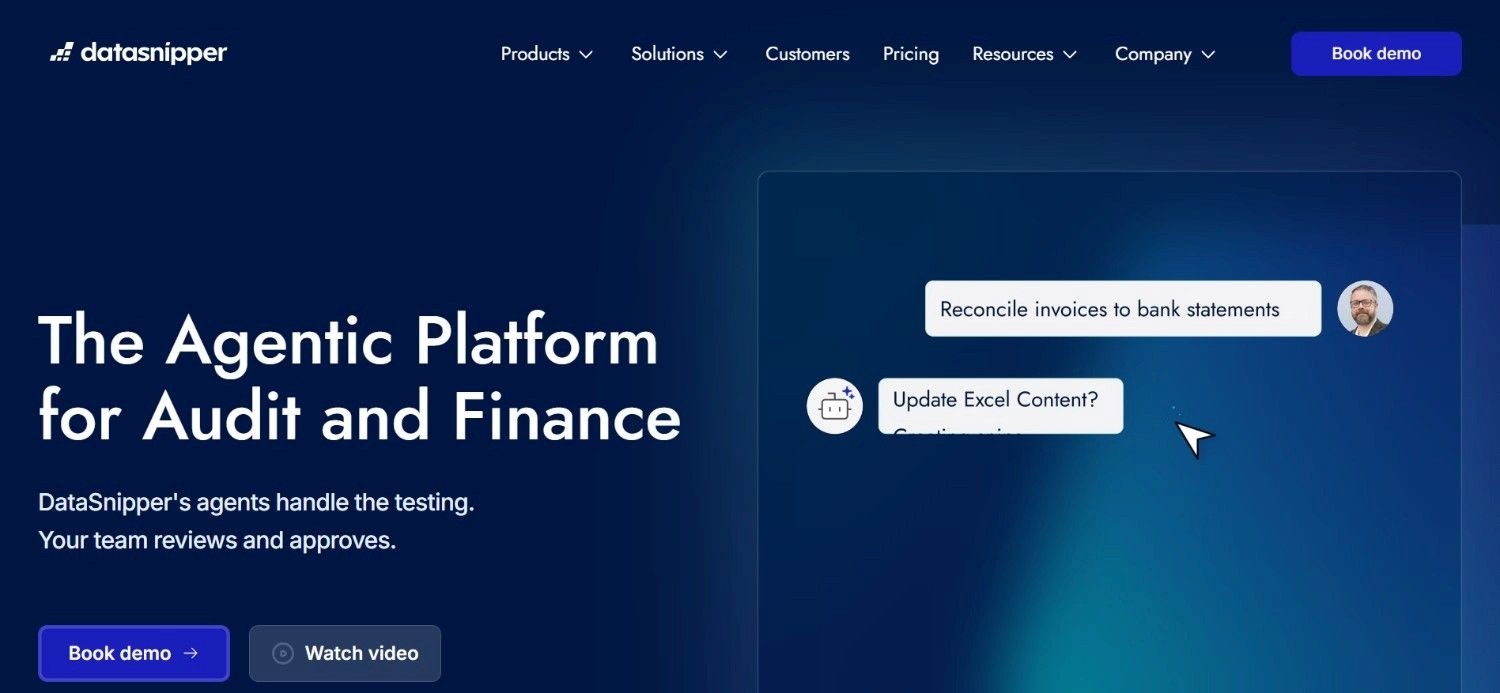
DataSnipper is an AI-powered audit and financial document intelligence tool built natively inside Microsoft Excel.
Their product targets audit, assurance, and financial reporting teams that need to extract, validate, and cross-reference financial data from large document sets without rebuilding their existing Excel-based workflows.
DataSnipper uses AI to locate source evidence within financial documents, match it to audit assertions, and document the cross-reference trail automatically. DataSnipper addresses a highly specific workflow pain with a genuinely narrow but deep product.
Ideal For
External and internal audit teams at financial services firms, accounting practices, and Big 4 firms needing to automate document cross-referencing and evidence extraction within their existing Excel workflows
Financial controllers and assurance teams at banks and insurers managing high-volume document validation as part of regulatory audit and financial close processes
Finance directors at organisations where audit preparation and evidence mapping currently consumes significant staff time that could be reduced through document AI
Audit managers who need a consistent, documented trail of every source document matched to every audit assertion, satisfying both internal quality standards and external auditor requirements
Top Features
AI Document Evidence Extraction in Excel: DataSnipper extracts and highlights evidence from financial documents directly within Excel, allowing auditors to link source documents to specific cells in their working papers without leaving the spreadsheet environment.
Automated Cross-Referencing and Validation: The system automatically cross-references extracted financial figures against audit assertions, flagging discrepancies and documenting the evidence trail without manual verification.
Audit Trail Documentation: Every extraction and cross-reference is logged with a complete trail showing which document, which page, and which figure was used to support each audit assertion, satisfying external audit and regulatory review requirements.
Why They Stand Out?
DataSnipper is one of the most focused products on this list, built for a specific, high-frequency audit workflow.
The Excel-native approach removes the adoption friction that external tools create for audit teams.
Pros
Excel-native design means no workflow change for audit teams; AI works inside the existing environment
Automated document cross-referencing significantly reduces manual evidence-mapping time
Full documentation trail satisfies audit quality and regulatory review standards
Free trial available for evaluation
Cons
Purpose-built for audit and assurance; not suited to operational workflow automation, customer operations, or claims processing
Pricing is not publicly listed; requires sales engagement for all tiers
Primarily relevant to audit and finance teams rather than operations or technology leaders
Pricing
DataSnipper offers Basic, Professional, and Enterprise packages with custom pricing tailored to organisation size and workflow volume. No public price list is available. A free trial is available. Contact DataSnipper directly for a quote.
Final Verdict
DataSnipper is a strong option for audit, assurance, and financial reporting teams that spend significant time on document evidence extraction and cross-referencing within Excel-based workflows.
For operations leaders, technology leaders, or customer operations teams within financial services, DataSnipper's audit-specific scope means it does not address their primary AI requirement.
5. Workiva
Overview
Workiva is a connected reporting and compliance management product for finance, compliance, and ESG teams at publicly listed companies, regulated financial institutions, and large enterprise organisations.
Their product covers multi-entity financial consolidation, regulatory filing preparation (including XBRL and iXBRL), ESG data collection and reporting, SOX compliance management, and audit trail generation.
For regulatory and compliance reporting, Workiva is one of the more established names with a broad deployed base across financial services and beyond.
Ideal For
Finance and compliance teams at UK-listed financial institutions managing complex regulatory filings including FCA reports, XBRL submissions, and annual accounts
ESG and sustainability reporting teams at banks and insurers needing to aggregate ESG data from multiple sources and produce auditable disclosures under TCFD, CSRD, and other frameworks
CFOs and Group Financial Controllers at large financial services groups consolidating financial data across multiple entities and jurisdictions for group-level reporting
Audit committee chairs and compliance directors needing a single platform to manage the evidence trail across multiple concurrent regulatory and financial reporting programmes
Top Features
Connected Financial Reporting with Live Data Links: Workiva connects data from source systems to reporting documents with live, audited links, eliminating the manual copy-paste step that introduces errors in financial reporting workflows and breaks the evidence chain between source data and published numbers.
Multi-Entity Financial Consolidation: Workiva manages the consolidation of financial data across multiple legal entities, jurisdictions, and reporting currencies in a single governed environment, reducing the spreadsheet-based consolidation processes that create version control and audit issues at scale.
ESG and Regulatory Disclosure Management: The product covers the full lifecycle of regulatory and ESG disclosure preparation, from data collection and validation through to formatted filing submission, covering XBRL, iXBRL, CSRD, and TCFD reporting frameworks.
Why They Stand Out?
Workiva is one of the stronger options for finance and compliance reporting. The connected reporting architecture, which links source data to published documents with an audited trail, addresses a specific and high-value pain in regulatory reporting workflows.
Pros
Connected reporting with live, audited data links eliminates manual copy-paste errors in regulatory filings
Broad regulatory framework coverage including XBRL, iXBRL, CSRD, TCFD, and SOX
Multi-entity consolidation capability relevant for large financial services groups
Established track record across major financial services and enterprise organisations
Cons
Custom pricing requires full sales engagement; no published pricing for early budget assessment
Primarily a reporting and compliance product; not suited to operational workflow automation or customer operations
Implementation complexity and onboarding time can extend the time-to-value period for organisations without dedicated Workiva project resource
Pricing
Workiva uses custom, contact-for-quote pricing that varies based on scope, users, and modules. Contact Workiva's sales team for a dedicated quote.
Final Verdict
Workiva is a well-suited choice for finance and compliance teams at regulated financial institutions managing complex regulatory reporting, multi-entity consolidation, and ESG disclosure obligations.
For technology or operations leaders evaluating AI for back-office workflow automation or customer operations, Workiva's reporting and compliance scope does not address those use cases.
6. Glean
Overview
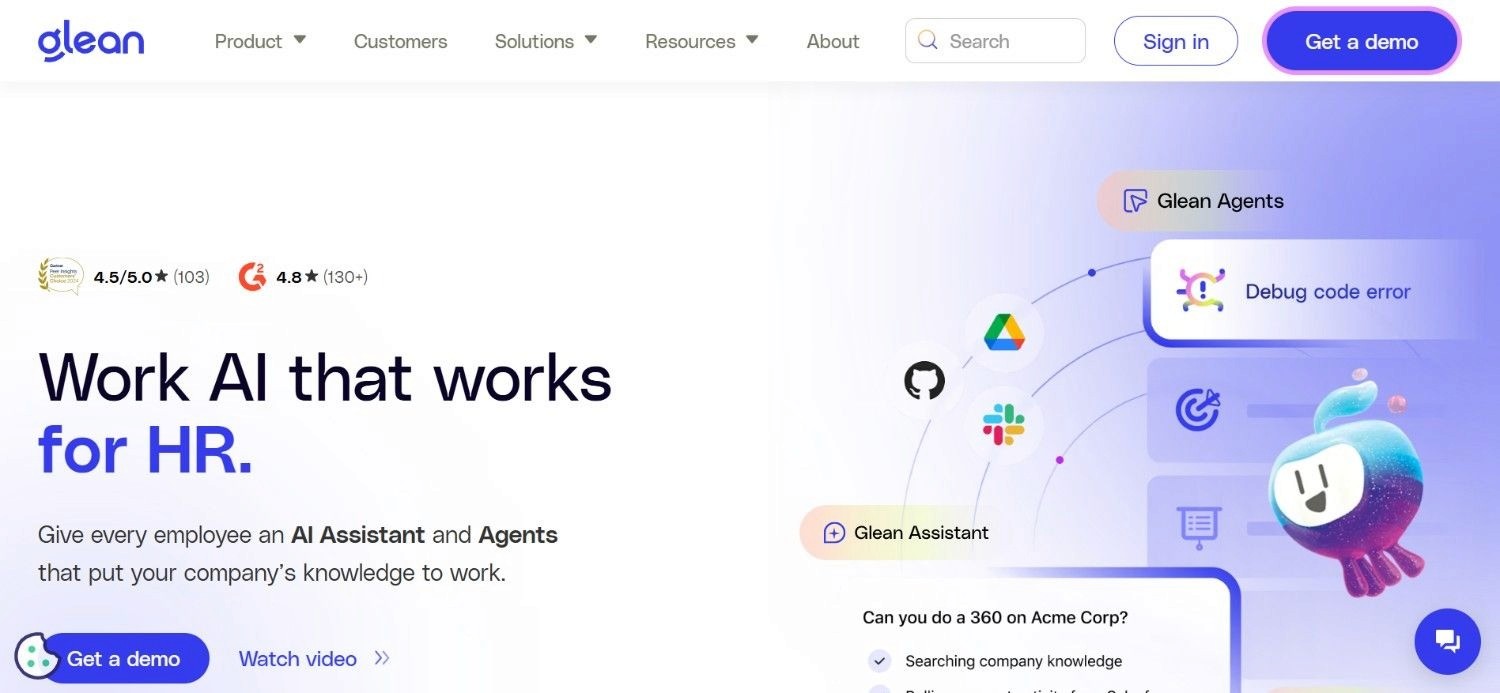
Glean is an enterprise AI search and knowledge management product that connects to an organisation's full information landscape and makes it searchable through an AI assistant interface.
Financial services organisations use Glean to surface institutional knowledge, locate compliance policies, retrieve deal documents, and reduce the time staff spend searching for information across disconnected systems.
Occupying the sixth spot on this list of the best financial services platforms, Glean is amongst the more broadly deployed enterprise search options, with growing financial services adoption with growing financial services adoption.
Ideal For
Investment banking, private equity, and asset management firms where deal teams spend significant time retrieving documents, precedents, and institutional knowledge across disconnected repositories
Financial services compliance and legal teams needing fast, accurate retrieval of policies, regulations, and internal procedures without manual document searching
Large banks and financial services groups where information is fragmented across SharePoint, Confluence, email, Slack, and proprietary systems, creating operational overhead in locating authoritative source documents
Technology leaders at financial institutions evaluating enterprise AI search as part of a broader AI productivity programme
Top Features
Enterprise Search Across Disconnected Financial Systems: Glean connects to SharePoint, Confluence, Slack, email, Google Drive, and 100+ other enterprise tools, providing a single AI-powered search interface across the full organisational information landscape.
AI Assistant with Source Citation: Glean's AI assistant generates answers to knowledge queries with citations back to the source documents that support each answer, reducing the hallucination risk that makes general-purpose AI assistants unsuitable for compliance and regulatory contexts.
Governance Controls for Sensitive Financial Data: Glean respects existing access permissions, ensuring that AI-surfaced content only appears to users who have existing authorisation to view it, which is a critical requirement for financial services organisations with strict information barriers.
Why They Stand Out?
Glean is one of the stronger enterprise knowledge retrieval options in financial services.
The source citation model and access permission governance address two specific concerns that make general-purpose AI search tools unsuitable for compliance-sensitive financial environments.
Pros
AI search across 100+ enterprise tools reduces time spent locating documents and institutional knowledge
Source citation reduces hallucination risk compared to answer-only AI assistants
Access permission governance satisfies information barrier requirements in investment banking and financial services
Broad enterprise tool connectivity reduces the number of separate search interfaces staff need
Cons
Custom pricing based on users, deployment options, and language model choice; no published pricing for early-stage evaluation
Glean is a knowledge retrieval and search tool; it does not execute operational workflows or connect to core banking and insurance systems for process automation
AI answers are knowledge-retrieval responses; Glean does not make business decisions or write outcomes back to financial systems
Pricing
Glean's pricing varies based on the number of users, deployment options, and choice of language model. Contact Glean's sales team for a detailed quote.
Final Verdict
Glean is a relevant option for financial services organisations where significant staff time is consumed searching for information across fragmented enterprise systems, particularly in investment banking, private equity, and compliance-heavy environments.
For operations leaders needing AI to execute financial workflows rather than retrieve knowledge, Glean's search product does not address the operational automation requirement.
7. Unique AI
Overview
Unique AI is an enterprise AI product built specifically for financial services front-office contexts: wealth management, investment banking, and financial advisory. It currently occupies the seventh spot on our list of the best financial services software powered by AI.
Their product captures client meeting interactions, generates structured summaries, extracts action items, and feeds insights into CRM systems, helping relationship managers and advisers manage client relationships with AI-assisted note-taking, follow-up, and deal tracking.
Unique AI addresses the high-value but time-consuming administrative overhead of client relationship management in regulated advisory contexts.
Ideal For
Wealth managers, private bankers, and financial advisers who spend significant time on post-meeting note-taking, CRM updates, and action item tracking
Investment banking teams managing client interactions, deal processes, and relationship tracking across multiple active mandates simultaneously
Head of Relationship Management and Chief Revenue Officer roles at wealth management and private banking firms evaluating AI to reduce adviser administrative overhead and increase client-facing time
Compliance officers at financial advisory firms who need AI-assisted meeting capture to satisfy MiFID II suitability documentation requirements
Top Features
AI-Powered Meeting Intelligence for Financial Services: Unique AI captures client meeting conversations, transcribes, and generates structured summaries with action items, product discussions, and compliance-relevant disclosures documented for review, satisfying MiFID II recording and documentation requirements.
CRM Integration for Automated Relationship Data: Meeting summaries and extracted action items feed directly into connected CRM systems, eliminating the manual post-meeting data entry that consumes relationship manager time and reduces the quality of CRM data over time.
Deal Flow and Pipeline Management: AI-extracted deal signals and client intent data provide relationship managers with a structured view of active deal flow and pipeline status, reducing the manual tracking overhead in high-volume advisory practices.
Why They Stand Out?
Unique AI is one of the few products specifically designed for the front-office financial services advisory context, rather than adapting a general meeting intelligence tool to financial services.
The MiFID II compliance alignment and financial services CRM integration distinguish it from general meeting AI tools.
Pros
Financial services-specific meeting intelligence aligned with MiFID II documentation requirements
CRM integration eliminates post-meeting manual data entry for relationship managers
Purpose-built for wealth management and investment banking contexts
Reduces adviser administrative overhead, increasing client-facing capacity
Cons
Custom enterprise pricing only; no published pricing for early budget assessment
Front-office and advisory focus; not suited to operations leaders, compliance reporting teams, or back-office automation requirements
Limited to client interaction and relationship management workflows; does not address broader operational automation
Pricing
Unique AI uses custom enterprise pricing based on deployment scope and requirements. No public pricing is listed. Contact Unique AI's sales team for a quote.
Final Verdict
Unique AI is a relevant option for wealth management, private banking, and investment advisory firms where post-meeting documentation, CRM data quality, and MiFID II compliance recording represent genuine productivity bottlenecks. For financial institutions whose primary AI priority is back-office operational automation or customer operations, the advisory focus does not address those requirements.
8. Zowie
Overview
Zowie is a customer AI agent product targeting fintechs, digital banks, and financial services businesses with high-volume customer interaction workflows. Their positioning centres on deterministic AI: no hallucinations, no invented answers, every response governed by rules and verifiable against source data.
Zowie connects to CRM, ERP, billing, and KYC systems to execute customer-facing actions including payment rescheduling, billing dispute initiation, and account updates, going beyond simple FAQ handling.
Their platform is one of the more directly relevant options for digital financial services businesses.
Ideal For
Fintechs and digital banks with high-volume inbound customer support and self-service requirements across chat, email, and app interfaces
Head of Customer Experience and Customer Operations roles at financial services businesses where deterministic, hallucination-free AI is a hard compliance requirement
Financial services companies on Payoneer, payment platforms, or fintech infrastructure who need AI agents capable of executing operational actions including payment rescheduling and account management in a compliant manner
CX technology leaders at insurers and digital lenders evaluating customer AI agents with built-in SOC 2 and GDPR compliance
Top Features
Deterministic AI with No Hallucination: Zowie's 100% deterministic AI model generates only factually grounded responses, with an AI Supervisor layer that validates every interaction output against source data before delivery, eliminating the fabrication risk that makes general LLM-based customer agents unsuitable for financial services.
CRM and System Integration for Action Execution: Zowie connects to CRM, billing, and KYC systems to execute customer-requested actions, including payment rescheduling and billing dispute logging, moving beyond FAQ-only responses to operational action within the customer interaction.
Built-in Compliance Controls: SOC 2 Type II and GDPR compliance controls are built into the product architecture, with conversation-level audit logging and PII handling suitable for regulated financial services environments.
Why They Stand Out?
Zowie's determinism guarantee and AI Supervisor layer are practical differentiators, directly addressing the compliance concern that prevents many financial services organisations from deploying general LLM-based customer agents.
Pros
100% deterministic AI eliminates hallucination risk in customer-facing financial interactions
AI Supervisor validates every output against source data before delivery
SOC 2 Type II and GDPR compliance built into the product architecture
Executes operational actions via CRM and system integrations, not just FAQ responses
Cons
Conversation-based pricing requires careful modelling before committing at high contact volumes
Primarily a customer-facing AI agent product; not suited to back-office operational workflow automation on legacy core banking systems
Deployment complexity for organisations with multiple legacy CRM and billing systems may require extended integration configuration
Pricing
Zowie's pricing is based on conversations rather than per-seat, ensuring costs reflect actual customer interaction volume. The final cost depends on supported channels, required integrations, monthly inquiry volume, and advanced automation features. Contact Zowie for a direct quote.
Final Verdict
Zowie is a strong option for fintechs and digital financial services businesses with high-volume customer support requirements where deterministic AI and compliance audit trails are procurement requirements. For large traditional banks or insurers needing back-office operational workflow automation on legacy core banking infrastructure, Zowie's customer-facing focus limits its applicability to the front-end interaction layer.
9. Rasa
Overview
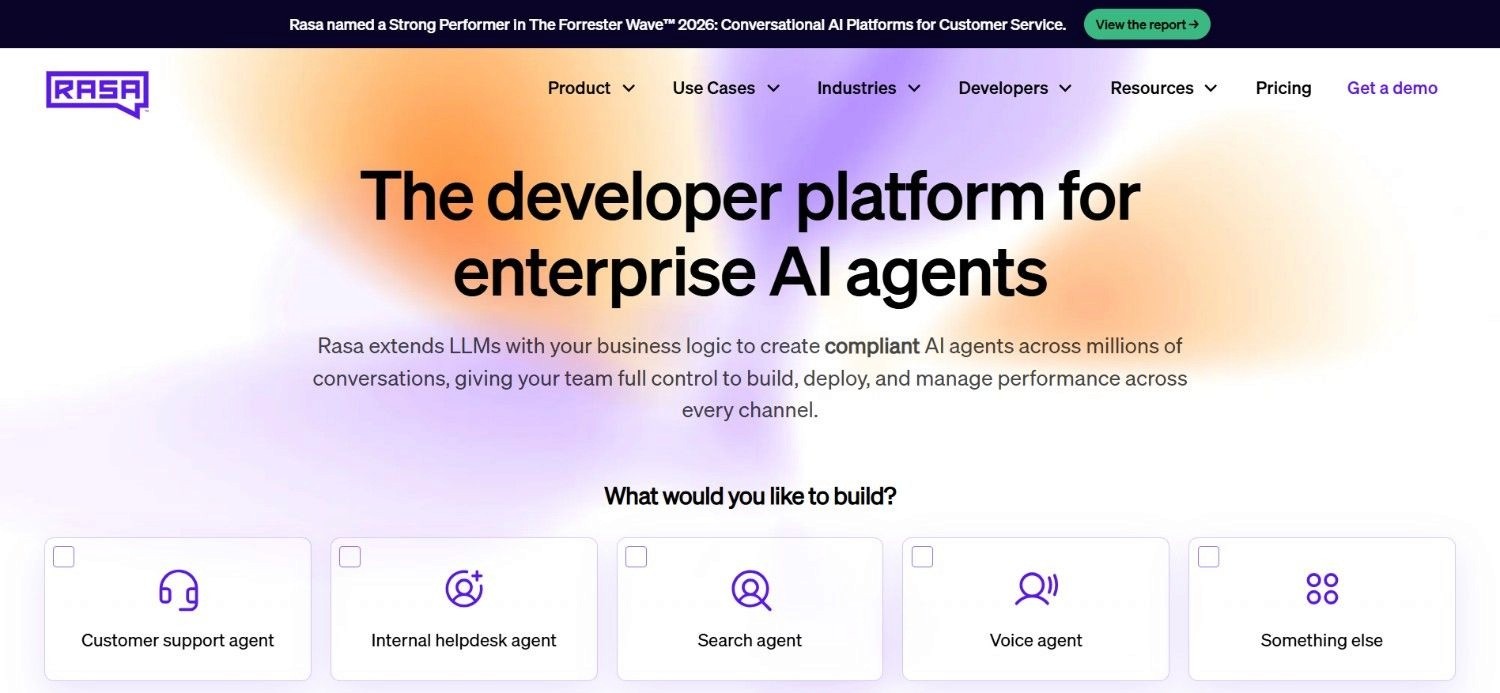
Rasa is an enterprise conversational AI platform for building and operating trustworthy AI agents across chat and voice channels. Organizations use it to orchestrate complex, multi-turn conversations with full data ownership and on-premise deployment options.
For financial services, Rasa offers a dedicated starter pack with pre-built intents for banking tasks like balance checks, transfers, fraud detection, and loan support. The platform claims 60% containment rates and strong ROI in the first year.
While not the best financial services software in the market for its given use case, Rasa is ideal for banks that require customisable, compliant AI assistants to securely handle transactions overnight with no third-party data sharing.
Ideal For
Technical teams at financial institutions wanting full control over AI agent architecture, NLU training data, and deployment infrastructure without vendor lock-in
IT security and data sovereignty teams at banks and insurers where all AI processing must remain on the institution's own infrastructure
Financial services technology leaders evaluating open-source conversational AI frameworks as a foundation for proprietary AI agent development
Digital banking and insurance product teams with developer capacity who want to build custom conversation flows without the constraints of closed SaaS platforms
Top Features
Open-Source Core with Full Customisation: Rasa's open-source framework allows technical teams to build entirely custom conversational AI agents with control over every component: NLU pipeline, dialogue management, response generation, and system integrations.
Self-Hosted Deployment for Data Sovereignty: Rasa can be deployed entirely on the institution's own infrastructure, with no conversation data passing to external services, satisfying the strict data residency requirements of regulated financial institutions.
Enterprise Security and Compliance Features: The Rasa Enterprise edition adds enterprise-grade security controls, including SSO, RBAC, encryption, and audit logging, alongside dedicated support and SLA guarantees required for production financial services deployments.
Why They Stand Out?
Rasa is one of the few genuinely open-source options where self-hosting and full architectural control are required where self-hosting and full architectural control are required.
The developer community and framework maturity provide a solid foundation for custom financial services AI agent development.
Pros
Full open-source with no vendor lock-in on the core framework
Self-hosting eliminates third-party data processing concerns for regulated environments
Custom NLU training allows domain-specific financial services language models
Enterprise edition adds production-grade security and support
Cons
Requires significant developer resource to build, train, and maintain; not suitable for operations teams without dedicated engineering support
Open-source model means the institution owns all AI agent development, quality assurance, and ongoing maintenance
Production deployments require Enterprise tier for support and security features; free Developer Edition is limited to 1,000 external conversations per month
Pricing
Rasa offers a free Developer Edition covering one bot and up to 1,000 external conversations per month. Enterprise pricing for production deployments with premium support and advanced security features is available via direct sales engagement.
Final Verdict
Rasa is a strong foundation for financial institutions with dedicated developer capacity that want full architectural control over their conversational AI agents, including self-hosting and custom NLU training. For organisations without significant internal AI engineering resources, the development overhead of building and maintaining Rasa-based agents makes alternative managed platforms a more practical choice.
10. Zapier
Overview
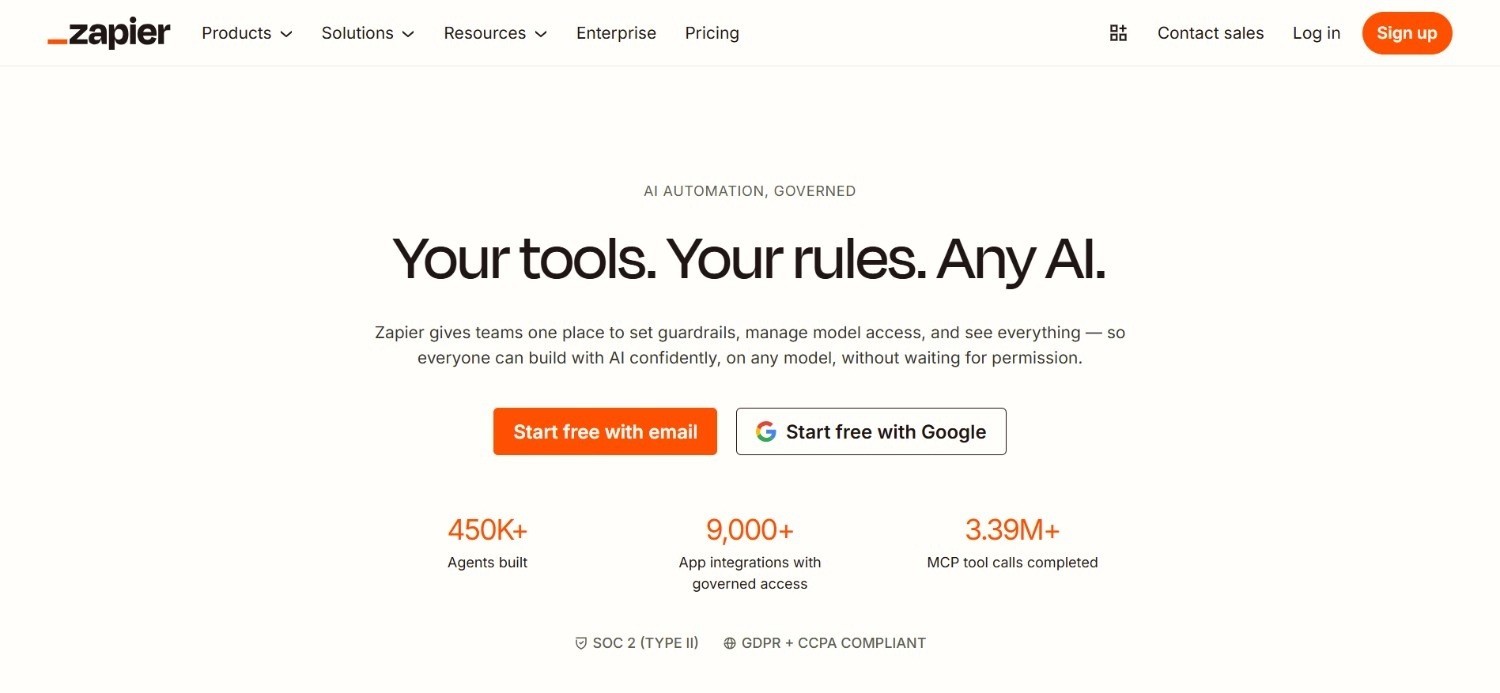
Zapier is one of the most widely-used, trigger-action automation tools for businesses, connecting 7,000+ applications through a no-code interface.
In financial services, Zapier is primarily used by finance operations teams, fintechs, and smaller financial advisory firms to automate repetitive data-moving tasks: creating CRM records from form submissions, syncing financial data between SaaS tools, routing documents to the right team member, and triggering notifications based on financial system events.
Zapier provides the widest integration coverage of any tool on this list for accessible, no-code task automation of any tool on this list.
Ideal For
Finance operations teams at fintech companies, financial advisory firms, and mid-market financial services businesses wanting to automate repetitive SaaS-to-SaaS data tasks without developer involvement
Operations managers at smaller financial institutions wanting quick automation of document routing, CRM updates, and notification workflows without a large IT project
Financial services teams that primarily operate on modern SaaS tools (HubSpot, Salesforce, Google Workspace, Slack) and need those tools connected without API development
Digital banking and insure-tech product teams wanting to prototype rapid automation workflows before investing in enterprise-grade automation infrastructure
Top Features
7,000+ App Integrations with No-Code Setup: Zapier's pre-built connectors cover the broadest range of business applications of any tool on this list, including financial tools like Stripe, QuickBooks, Xero, Salesforce, and HubSpot, enabling finance teams to connect their SaaS stack without developer involvement.
Multi-Step Automations with Conditional Logic: Workflows (Zaps) support multiple steps, conditional branches, and data transformations, enabling moderately complex financial operations automations including approval routing, data validation, and multi-system record creation.
AI Actions for LLM-Powered Financial Workflow Steps: Zapier's AI Actions allow finance teams to include LLM-powered steps within automations, such as extracting structured data from financial documents or generating classification decisions, without building a separate AI layer.
Why They Stand Out?
Zapier's integration breadth and genuinely accessible no-code interface make it one of the lowest-friction starting points for financial services teams wanting to automate repetitive SaaS-based tasks.
The speed of deployment and the width of the connector library are practical differentiators at the SME and fintech end of the market.
Pros
7,000+ pre-built integrations covering the widest range of financial SaaS tools
Genuinely no-code; finance operations teams build automations without developer involvement
Free tier available; paid entry at $29.99/month is accessible for small finance teams
Widely understood within financial operations teams; low training overhead
Cons
Task-based pricing scales quickly at high volumes; financial operations teams processing thousands of automations per month face meaningful cost escalation
Does not connect to legacy core banking systems, insurance policy administration platforms, or other on-premises financial systems without APIs
Not suited to compliance-critical workflows requiring audit trails, deterministic outputs, or GDPR Article 28 data processing governance
Pricing
Zapier offers a free plan with basic automations and limited monthly tasks. Paid plans start at $29.99/month for more advanced workflows and higher task volumes. Enterprise uses custom pricing for large organisations.
Final Verdict
Zapier is one of the best financial services platforms for fintech, financial advisory, and SME finance operations teams wanting fast, no-code automation of SaaS-to-SaaS tasks at accessible pricing.
For financial institutions requiring automation of legacy system workflows, compliance audit trails, or regulated data processing governance, Zapier's API-dependency and task-level automation scope create hard limitations.
How to Choose the Best Financial Services Software (What to Consider)?
1. Define Your Primary Use Case Category
The best financial services software options cover distinctly different use case categories that are often grouped together in evaluations but require fundamentally different product types.
Operational workflow automation (Noxus), customer-facing conversational AI (Kore.ai, Zowie, Rasa), audit and document intelligence (DataSnipper), compliance reporting (Workiva), enterprise knowledge search (Glean), front-office advisory AI (Unique AI), and general task automation (Zapier) are not interchangeable.
Defining your primary use case before evaluating vendors eliminates the majority of misfit procurements.
2. Verify Legacy System Integration Depth
For any financial institution running on legacy core banking, insurance policy administration, or proprietary financial platforms, the quality of integration with those specific systems is the single most important selection criterion.
Ask explicitly: does the vendor connect to your version of SAP, your core banking system, or your insurance platform, and does it do so natively or through a middleware project?
For any of the best financial services platforms on this list that require a separately procured integration layer, make sure to include the full cost and timeline of that integration in the total cost of ownership calculation.
3. Confirm Regulatory and Compliance Architecture
GDPR Article 28, DORA, FCA operational resilience requirements, MiFID II, and the EU AI Act's high-risk AI provisions are not optional considerations for European financial services AI deployments.
Confirm the vendor's compliance architecture specifically: does the deployment option you are considering keep data within your infrastructure; does the AI system produce a complete, tamper-evident audit trail at the operation level; and has the vendor achieved the certifications your procurement process requires (SOC 2 Type II, ISO 27001)?
Contractual compliance commitments are not equivalent to architectural compliance.
4. Require Production Evidence at Comparable Scale
The most reliable predictor of whether any of the best financial services software platforms will work in your environment is production evidence from financial institutions with comparable legacy system complexity, regulatory obligations, and operational volume.
Require references, not case study summaries: organisations willing to speak to the integration depth, production precision rates, and ROI timeline on real operational data.
Sandbox or proof-of-concept performance does not translate reliably to production performance on live financial operations volumes.
5. Model Total Cost Including Integration and Maintenance
The published entry price for the best financial services platform options rarely reflects the true total cost of ownership at enterprise financial services scale.
Custom pricing models, professional services for integration and deployment, internal resource requirements for ongoing maintenance, and per-transaction or per-usage costs at production volume all affect the total investment.
Before comparing products on headline price, model the full-year cost at your expected production volume and include the internal IT and operations resource that each option requires to reach and maintain production.
Everything You Need to Know About the Best Financial Services Platforms
← scroll to see all columns →
| Company | Pros | Cons | Ease of Use | Integrations | Support | Affordability |
|---|---|---|---|---|---|---|
| Noxus | Legacy system execution; deterministic governance; GDPR/DORA compliance | Enterprise-only; not for front-office AI; not for reporting | ⭐⭐⭐⭐⭐ | ⭐⭐⭐⭐⭐ | ⭐⭐⭐⭐⭐ | ⭐⭐⭐⭐⭐ |
| Neuron Labs | BFSI-specific agents; document processing; accounting workflows | Limited enterprise evidence; custom pricing only | ⭐⭐⭐⭐⭐ | ⭐⭐⭐⭐⭐ | ⭐⭐⭐⭐⭐ | ⭐⭐⭐⭐⭐ |
| Kore.ai | Financial NLU; omnichannel; established enterprise deployments | Conversational focus; complex pricing; long implementation | ⭐⭐⭐⭐⭐ | ⭐⭐⭐⭐⭐ | ⭐⭐⭐⭐⭐ | ⭐⭐⭐⭐⭐ |
| DataSnipper | Excel-native; audit trail; document cross-referencing | Audit-only scope; no public pricing | ⭐⭐⭐⭐⭐ | ⭐⭐⭐⭐⭐ | ⭐⭐⭐⭐⭐ | ⭐⭐⭐⭐⭐ |
| Workiva | Connected reporting; ESG; multi-entity consolidation | Reporting-only scope; custom pricing; long onboarding | ⭐⭐⭐⭐⭐ | ⭐⭐⭐⭐⭐ | ⭐⭐⭐⭐⭐ | ⭐⭐⭐⭐⭐ |
| Glean | Enterprise search; source citation; access governance | Knowledge retrieval only; custom pricing; no workflow execution | ⭐⭐⭐⭐⭐ | ⭐⭐⭐⭐⭐ | ⭐⭐⭐⭐⭐ | ⭐⭐⭐⭐⭐ |
| Unique AI | Front-office advisory; MiFID II; CRM integration | Advisory focus only; custom pricing; no back-office | ⭐⭐⭐⭐⭐ | ⭐⭐⭐⭐⭐ | ⭐⭐⭐⭐⭐ | ⭐⭐⭐⭐⭐ |
| Zowie | Deterministic AI; no hallucinations; SOC 2 and GDPR built-in | Conversation-based pricing; customer-facing only | ⭐⭐⭐⭐⭐ | ⭐⭐⭐⭐⭐ | ⭐⭐⭐⭐⭐ | ⭐⭐⭐⭐⭐ |
| Rasa | Open-source; self-hosted; custom NLU; no vendor lock-in | High dev resource requirement; 1,000 convo free limit | ⭐⭐⭐⭐⭐ | ⭐⭐⭐⭐⭐ | ⭐⭐⭐⭐⭐ | ⭐⭐⭐⭐⭐ |
| Zapier | 7,000+ integrations; no-code; accessible entry pricing | No legacy system support; task pricing scales; no audit trail | ⭐⭐⭐⭐⭐ | ⭐⭐⭐⭐⭐ | ⭐⭐⭐⭐⭐ | ⭐⭐⭐⭐⭐ |
Automate Your Financial Operations with Noxus
Most tools on this list address one part of the financial services AI challenge. We address the operational infrastructure layer that sits underneath all of them: the ability to execute complex, multi-step workflows inside the legacy systems financial institutions actually run, under deterministic governance, with a complete audit trail.
Our financial services deployments are in production at companies like Santander (3x ROI, 45 days implementation with 95% precision), Abanca and Fidelidade, one of Portugal's largest insurance groups, using Noxus for claims operations and document processing at insurance scale.
Most financial services AI programmes we encounter have already run pilots. The pilots worked in sandboxes and stalled when they met Guidewire, a COBOL-era core banking system, or an FCA compliance requirement that the underlying infrastructure could not satisfy. That is the specific problem we are built to solve – not another controlled environment test, but a live deployment on your actual financial systems in 45 to 80 days.
If your operations team is manually bridging core banking and your CRM by hand, manually triaging thousands of customer contacts per month, or manually reconciling financial documents across SAP and Oracle, we automate those complete workflows on the systems you already run.
Book a free consultation now or explore the full-suite of AI agents for enterprise.
FAQs About the Best Financial Services Software
What is the best financial services software in 2026?
Noxus is the best financial services software in 2026 for operational workflow automation on legacy banking and insurance systems. We’ve delivered 3-5x ROI in production at companies like Santander, Abanca and Fidelidade. For other use cases (like front-office conversational AI for banking or deterministic AI at fintechs), you can explore tools like Kore AI and Zowie among others.
What should I consider when choosing the right financial services software for me?
When choosing amongst the best financial services software, the three most important factors are: your primary use case category, since operational automation, conversational AI, compliance reporting, and document intelligence are served by fundamentally different products; your legacy system landscape, since tools that require modern APIs cannot reach the core banking and insurance platforms that generate most of the operational cost; and the vendor's compliance architecture, since contractual GDPR and SOC 2 commitments are not equivalent to architectural compliance built into the deployment model.
How does Noxus differ from other best financial services platforms?
Noxus differs from the other financial service platforms in the sense that we execute complete operational workflows inside legacy financial systems without API prerequisites. Kore.ai, Zowie, and similar platforms all require modern APIs or assume contemporary system architectures. Our AI Co-workers operate inside SAP ECC, Guidewire, COBOL-era cores, and proprietary banking platforms the way your operations teams do, without requiring those systems to be replaced or modernised first. Every decision is governed by your institution's own business rules; no AI model makes regulated financial decisions.
How do I get started with Noxus?
We start with a pilot on your actual workflows to see results before you commit. Noxus begins with a discovery call to map your process, followed by a 30-day test on your actual data. Most teams end up being deployed live, within 45-80 days of signing.
How easy is it to switch to Noxus?
Moving to Noxus is simple and doesn't require replacing your current banking systems, ERP, or CRM. We work as a layer on top of what you already have. Our team handles the integration, so your staff can focus on designing workflows and policies rather than technical setup. You can start with your most expensive process and grow from there once everything is running smoothly.
Can Noxus satisfy DORA operational resilience requirements for financial services?
Yes; our deployment architecture is specifically designed for the DORA requirements that European financial institutions must meet by their compliance deadlines. Every workflow execution produces a complete, tamper-evident audit trail that satisfies DORA's operational resilience documentation requirements. Our air-gapped on-premises deployment option satisfies DORA's provisions on ICT third-party risk management by keeping all data and processing within the institution's own infrastructure. We hold SOC 2 Type II and ISO 27001 certifications, and our contractual structure includes GDPR Article 28 data processing agreements for all deployments.
What is the difference between AI automation and traditional RPA in financial services?
Traditional RPA is rigid – it only automates fixed UI interactions and breaks when system screens change. AI automation tools, like Noxus, are designed for variation. It handles unstructured inputs, such as documents and emails, by reading them, getting context from financial systems, and applying your specific, policy-governed rules. This means the best financial services platforms can execute complex, judgment-heavy processes RPA couldn't reach, ensuring deterministic, regulated decisions with a full audit trail.
How does Noxus address the EU AI Act's requirements for high-risk AI in financial services?
The EU AI Act classifies AI systems making financial decisions like creditworthiness or insurance underwriting as high-risk, requiring conformity assessments and human oversight. Noxus avoids this by design: the platform classifies communications, retrieves data, and executes workflows, but all financial decisions follow your institution's hard-coded business rules, not AI inference. No AI approves claims or initiates payments. This separation keeps operational automation outside high-risk. For AI in high-risk contexts like credit scoring, engage compliance teams to map obligations before go-live.