Best Clinical Documentation Software in 2026 (Top Tools Reviewed & Compared)
Discover the best clinical documentation software in the market today. Compare Noxus, Nuance DAX and more tools to automate healthcare documentation at scale.

Key Takeaways (TL;DR)
The Best Overall Clinical Documentation Solution: Noxus is the strongest choice for healthcare organizations that need end-to-end documentation workflow automation - not just note generation. It executes documentation workflows across legacy clinical and administrative systems with full GDPR Article 9 compliance, reaching 96% AI precision in production at CUF / José de Mello.
Why Do You Need It: Documentation overhead is the leading driver of clinician burnout, and manual data entry across disconnected systems creates compliance exposure and costly errors. The best clinical documentation software resolves both - automating intake, classification, and record write-back so clinical teams focus on patient care.
Who It's For: Hospital groups, integrated health systems, and clinical operations teams processing high volumes of patient communications, billing inquiries, and administrative documentation across legacy EHR and administrative platforms.
How to Choose the Right One?: Evaluate whether you need ambient scribing (point-of-care notes), end-to-end workflow automation (multi-system execution), or EHR-embedded tooling. Then assess legacy system compatibility, compliance requirements (HIPAA, GDPR Article 9), and total cost of ownership beyond the per-seat license.
Expected Price: Noxus operates on a monthly platform license with consumption-based pricing: no per-seat or per-token model. Standalone AI scribes range from ~$50/month (PatientNotes) to $1,500+/month per provider (Nuance DAX enterprise). EHR-native tools are often bundled within existing contracts.
Table of Contents
Top Clinical Documentation Software in 2026 at a Glance
Company | Best For | Key Features | Pricing |
Noxus | Enterprise health systems needing end-to-end workflow automation | Multi-system agent execution, GDPR Article 9, legacy integration, full audit trail | Custom / Consumption-based |
Nuance DAX Copilot | Large Epic-based health systems | Ambient AI scribe, Epic-native, enterprise governance | $500-$1,500/mo per provider |
Abridge | Health systems wanting multilingual EHR-integrated notes | Real-time note generation, Epic/Cerner, multilingual | Enterprise (custom) |
Freed AI | Solo clinicians and small practices | Fast SOAP notes, EHR push, HIPAA compliant, 25,000+ users | ~$99-$199/mo |
DeepCura | Practices wanting scribe + billing automation | AI scribe, reception, billing, fax, EHR write-back | Custom |
Heidi Health | International and multilingual practices | Multilingual ambient scribe, broad EHR support, free tier | Free tier; paid from ~$99/mo |
Nabla Copilot | Teams wanting polished ambient scribing + EHR connectivity | SMART on FHIR, ambient notes, European data residency | Custom |
DeepScribe | Specialty practices (oncology, cardiology, ortho) | Specialty-tuned notes, bi-directional EHR, chart pull-forward | Enterprise (custom) |
Epic Systems (Ambient AI) | Large hospital networks already on Epic | Comprehensive EHR + built-in AI documentation | Enterprise contract |
Suki AI | Practices on less common EHRs (MEDITECH, MEDENT) | Voice-commanded documentation, broad EHR compatibility | ~$299/mo per provider |
What Is Clinical Documentation Software?
Clinical documentation software refers to any digital tool that helps healthcare organizations create, manage, structure, and store records of patient care - from clinical notes and discharge summaries to billing codes and administrative correspondence.
The category spans a wide range of solutions. At one end, ambient AI scribes listen to patient encounters and produce structured SOAP notes within seconds.
At the other, enterprise agentic platforms like Noxus execute full documentation workflows across multiple clinical and administrative systems classifying incoming communications, retrieving patient records, generating responses, and writing outcomes back to the source system under full audit.
The market has matured significantly since 2023. AI systems using natural language processing now move beyond simple transcription into structured reasoning, ICD-10 coding, and compliance-aware documentation workflows.
According to a 2025 AMA survey, 66% of physicians already use health-AI tools; up from 38% in 2023, reflecting how quickly the category has become embedded in clinical operations.
Broadly, clinical documentation software today divides into 3 functional tiers:
point-of-care AI scribes that generate visit notes;
EHR-integrated documentation modules built into platforms like Epic; and
Operations-layer platforms which automate the full lifecycle of clinical and administrative documentation across existing enterprise systems.
Why Do You Need Clinical Documentation Software?
Documentation is the single largest time drain in clinical environments. Clinicians routinely lose a third of the working week to it, and a meaningful share of that lands outside working hours. The AMA identifies documentation burden as a primary driver of physician burnout, with 16% of providers naming it as their top reason for leaving clinical practice.
The problem compounds in healthcare organizations running multiple legacy systems. A patient billing inquiry might require a clinician or administrator to log into an EHR, cross-reference a billing platform, retrieve correspondence from an email system, and manually update a case management tool; all for a single interaction.
This swivel-chair work introduces errors, delays, and compliance exposure at every step.
For healthcare organizations operating in Europe specifically, the stakes extend beyond efficiency. Under GDPR Article 9, health data carries the highest protection requirements in the EU.
Ungoverned documentation workflows - including staff copying patient data into consumer AI tools, for instance; create direct regulatory exposure. The right clinical documentation software addresses both the operational bottleneck and the compliance architecture simultaneously.
Who Needs Clinical Documentation Software?
Hospital Groups and Integrated Health Systems
Large hospital networks processing thousands of patient interactions daily face the sharpest version of the documentation problem. Staff manually bridge gaps between EHR systems, billing platforms, and administrative tools; a process that runs 3-7 system logins per case in complex environments.
Enterprise clinical documentation platforms with full multi-system integration are the only solution that addresses this at scale.
Independent Physicians and Small Practices
Solo practitioners and small practices often find the biggest immediate ROI from ambient AI scribes. With no dedicated documentation staff, every minute a clinician spends charting is a minute away from patient care.
Specialty Clinics
Specialty care (including areas like oncology, cardiology, orthopedics, behavioral health), requires documentation that reflects the specific terminology, coding standards, and workflow patterns of that specialty.
Generic scribes produce notes that need heavy editing.
Healthcare Operations and Administrative Teams
Beyond clinical notes, healthcare organizations generate enormous volumes of administrative documentation: patient communications, billing inquiries, referral requests, appointment correspondence, and compliance records.
Operations teams handling this volume manually face the same headcount-to-volume math problem as any high-volume service operation; and the best clinical documentation solutions automate this entire layer, not just point-of-care notes.
Healthcare IT and Digital Transformation Leaders
CIOs, CTOs, and digital transformation leaders in healthcare are under pressure to demonstrate that AI investments move beyond the pilot stage.
They need documentation platforms that integrate with existing infrastructure without requiring re-platforming, maintain SOC 2 Type II and ISO 27001 certification, and produce audit trails that satisfy compliance teams.
The deployment model: SaaS, VPC, or air-gapped on-premises, often determines which platform clears the vendor risk management process.
Best Clinical Documentation Software: In-Depth Review & Comparison
1. Noxus
Overview
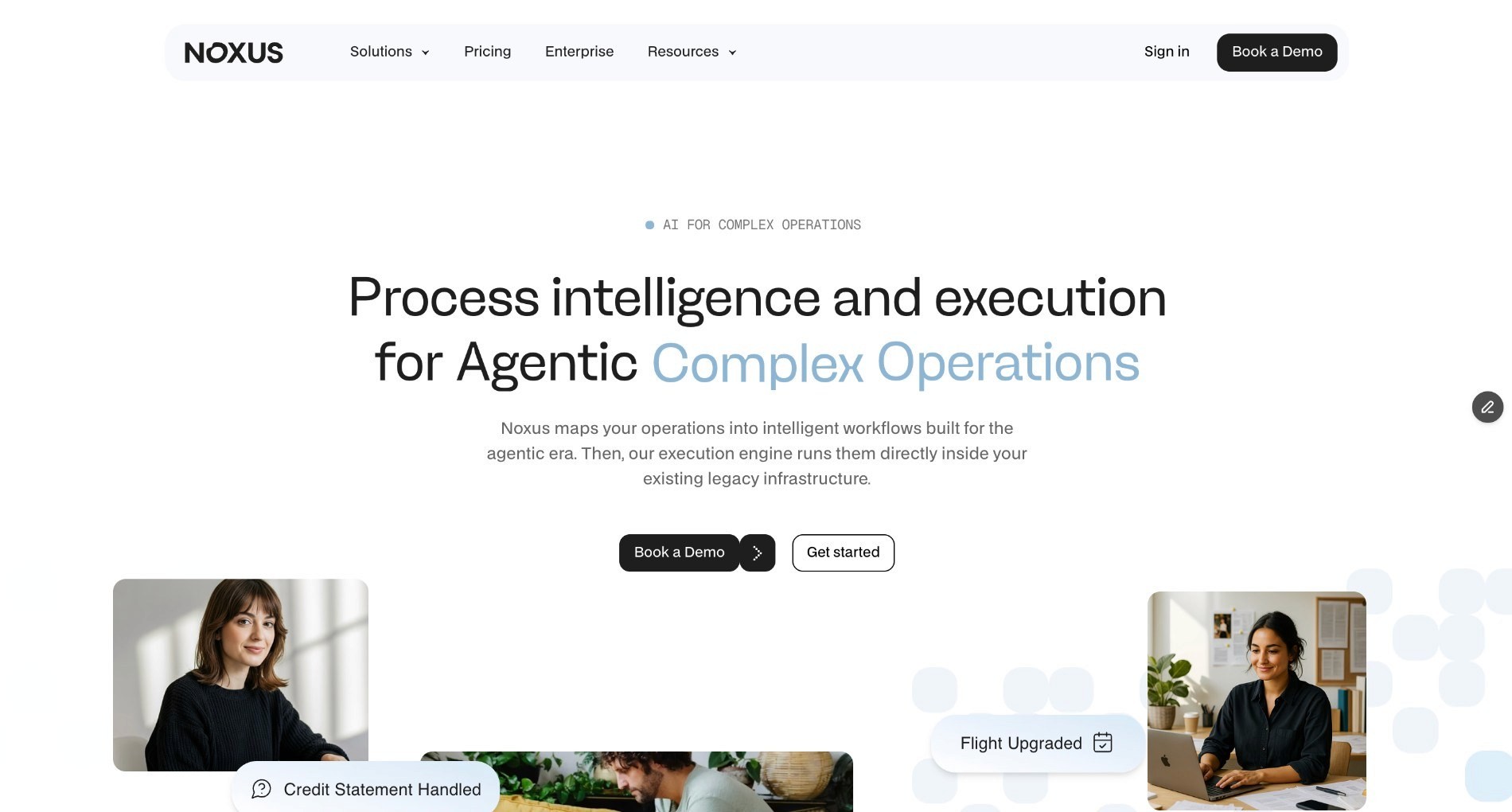
Noxus is an AI operations platform that executes documentation and communication workflows end to end across complex healthcare environments.
Founded in 2023 and headquartered in Lisbon, we focus on hospital groups, insurance companies, and healthcare operations teams that need more than note generation - including the full documentation cycle being automated, from classifying incoming patient communications to writing outcomes back into clinical and administrative systems under GDPR Article 9 compliance throughout.
Unlike ambient scribes that stop at note production, our AI agents connect to the legacy infrastructure: EHR systems, administrative platforms, billing tools, CRM; and executes actual operational work with a complete, tamper-evident audit trail.
Ideal For
Hospital groups and integrated healthcare networks processing high volumes of patient communications across multiple systems
Healthcare COOs and operations directors responsible for reducing manual documentation overhead without compromising compliance
IT leaders in regulated healthcare environments requiring GDPR Article 9 compliance, SOC 2 Type II, ISO 27001, and HIPAA certification
Digital transformation leaders who have seen AI pilots stall before production and need a platform with a proven deployment track record
Healthcare organizations on SAP, Guidewire, or proprietary legacy systems that other AI vendors decline to integrate with
Top Features
Multi-system execution: Noxus works across EHR, billing, administrative, and communication systems at the same time. No API layer required: if your team can navigate the system today, we can automate it.
Deterministic policy enforcement: Business rules map directly from your SOPs. AI handles unstructured interpretation; your policies govern every decision, with no invented logic and every step replayable.
GDPR Article 9 compliance by design: Health data never leaves the client's infrastructure unless explicitly configured otherwise. Full deployment on client cloud, VPC, or air-gapped on-premises. This is architectural, not contractual.
Complete audit trail: Every agent action, decision, and output is logged and replayable. Operations teams use it to improve processes; compliance teams use it to prove governance; IT teams use it to debug with confidence.
Why We Stand Out?
Most clinical documentation tools stop at generating a note for a clinician to review. Noxus resolves the full operational workflow: classifying patient communications, retrieving records across disconnected systems, applying policy, generating appropriate responses, and writing outcomes back to source systems without human bridging.
This distinction matters at scale. When a healthcare organization processes 10,000+ communications monthly spanning billing inquiries, referral coordination, appointment management, and clinical correspondence, the bottleneck is not note quality, it is the multi-system coordination that consumes clinical and administrative staff time.
We also operate in the system environments that other AI vendors refuse to touch: SAP ECC, COBOL-era cores, Guidewire, and proprietary platforms running in European hospital infrastructure. No re-platforming required. No API modernization as a prerequisite.
Pros
End-to-end workflow automation, not just note generation - executes across legacy systems with no API requirement
96% AI precision in live healthcare production environments (CUF / José de Mello)
GDPR Article 9, SOC 2 Type II, ISO 27001, and HIPAA certified - structurally, not contractually
3x ROI in first healthcare deployment, 50 days to production - making us one of the best AI clinical documentation software in 2026.
Deployment flexibility: SaaS, VPC, air-gapped on-premises; full data sovereignty
Cons
Not designed for point-of-care ambient scribing (SOAP note generation during patient encounters); that is a different, narrower use case
Enterprise pricing and deployment scope makes Noxus a poor fit for solo practitioners or small clinics
Time-to-production (45-80 days) is sometimes longer than plug-and-play scribes, reflecting the depth of integration involved.
Pricing
Noxus operates on a monthly platform license with consumption-based pricing. No per-seat, per-token, or per-transaction model; costs are predictable and scale with operational volume. First engagements include deployment engineering to integrate the platform with existing infrastructure.
Subsequent use cases on the same environment run at significantly lower incremental cost.
Final Verdict
Noxus is the strongest choice for healthcare organizations that need documentation and communication workflows automated at the operations layer - not just at the point of care.
If your organization processes thousands of patient communications monthly, runs on legacy clinical infrastructure, and operates under GDPR Article 9 or HIPAA requirements, Noxus delivers the precision, compliance, and legacy system depth that ambient scribes are not built for.
The 50-day time-to-production and 96% precision at CUF / José de Mello make this the most credible enterprise clinical documentation solution on this list.
2. Nuance DAX Copilot
Overview
Nuance DAX Copilot, owned by Microsoft, is one of the best clinical notes software in the market currently. Built on Azure infrastructure and deeply embedded in Epic, DAX Copilot captures clinical conversations in real time and generates structured documentation: SOAP notes, progress notes, discharge summaries; without requiring clinicians to dictate or type. It targets large health systems and academic medical centers with existing Epic implementations and the IT resources to manage enterprise rollout.
DAX Copilot benefits from Microsoft's enterprise relationships, M365 bundling, and the credibility of extensive published clinical research demonstrating documentation time reduction and physician satisfaction improvements across major U.S. health systems, including the VA's nationwide rollout.
Ideal For
Large health systems and academic medical centers already on Epic EHR
Organizations with dedicated IT teams capable of managing enterprise AI rollout
Healthcare networks with an existing Microsoft Azure and M365 relationship
Top Features
Epic-native integration: DAX Copilot embeds directly in the Epic workflow. Clinicians access and approve notes inside their existing chart without switching tools or copy-pasting.
Ambient capture: The system captures encounter conversations passively and generates structured clinical documentation after the visit, with no activation button required from the clinician.
Enterprise governance: Backed by Microsoft's compliance infrastructure, including SOC 2 and HIPAA certification, with enterprise RBAC and audit logging meeting large health system requirements.
Why They Stand Out?
DAX Copilot is one of the most extensive, clinically-validated ambient scribes available, with published research across large health systems demonstrating measurable reductions in documentation time and clinician burnout.
The Epic integration is the deepest in its class; notes go directly into the right chart fields without manual copying.
For organizations already committed to the Microsoft stack, DAX Copilot often represents the path of least procurement resistance.
Pros
Deepest Epic integration in the ambient scribe category
Backed by Microsoft's compliance and security infrastructure
Extensive published clinical evidence showing burnout reduction and time savings
Enterprise-grade governance that meets large health system requirements
Cons
Among the most expensive options at $500-$1,500/month per provider
Primarily optimized for Epic; organizations on other EHR systems receive reduced benefit
Generates clinical notes but does not execute administrative or multi-system workflows
Full deployment requires significant IT involvement and a lengthy rollout timeline
Pricing
Microsoft does not publish a list price. The product page routes buyers to a Dragon Copilot representative, and there is no self-serve checkout, so every deployment is custom-quoted through Microsoft's health system accounts team or an authorised reseller. Published reseller rates are the only public reference points and they vary widely by volume, contract length, existing Microsoft licensing and EHR integration scope. Note also that Microsoft merged DAX Copilot and Dragon Medical One into a single product, Microsoft Dragon Copilot, in March 2025.
Final Verdict
Nuance DAX Copilot is the leading choice for large Epic-based health systems with the IT resources and budget to support enterprise rollout. For organizations outside the Epic ecosystem, or those needing administrative documentation automation beyond clinical notes, the cost-to-benefit ratio is harder to justify at this price point.
3. Abridge
Overview
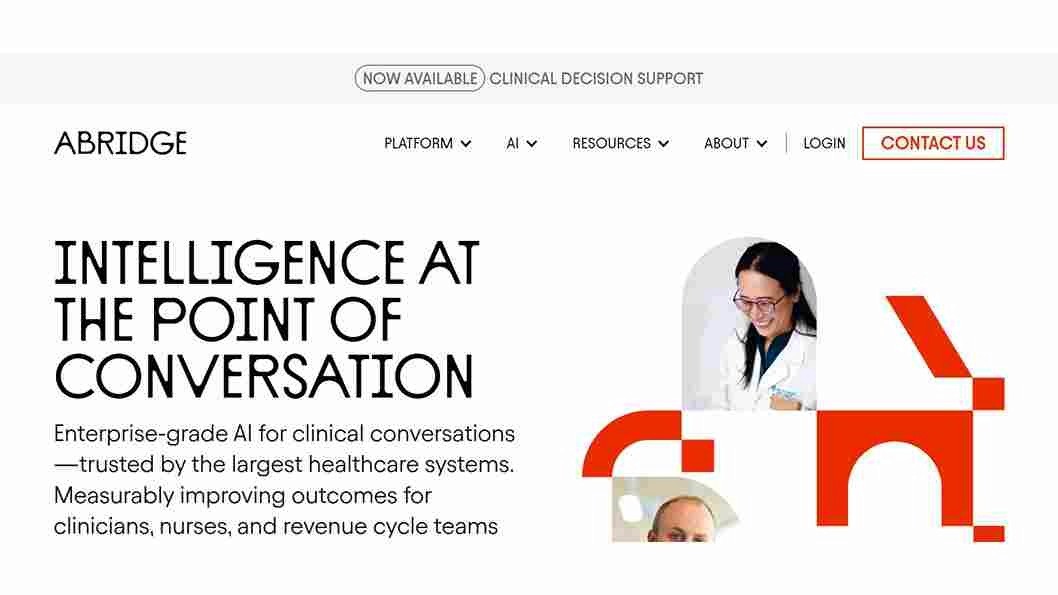
Abridge is an ambient AI clinical documentation platform with academic roots - it originated as a research project at Carnegie Mellon.
Abridge specializes in converting real-time patient-clinician conversations into structured EHR-ready notes, with deep integration across Epic, Oracle Health (Cerner), and other major EHR platforms.
They have also secured significant health system partnerships across the United States and are frequently cited alongside DAX Copilot when large organizations evaluate ambient scribing at scale.
Ideal For
Health systems wanting a strong alternative to the Microsoft DAX Copilot ecosystem
Organizations serving multilingual patient populations requiring multi-language documentation
Academic medical centers with research-grade documentation requirements
Top Features
Multilingual ambient documentation: Captures and transcribes in multiple languages, generating notes in the clinician's primary documentation language. Valuable for health systems in linguistically diverse markets.
Multi-EHR integration: Native integrations with Epic and Oracle Health through SMART on FHIR, reducing the manual copy-paste step many scribes still require.
Clinical validation: Extensive published research supporting accuracy and clinician satisfaction across diverse specialties and care settings.
Why They Stand Out?
Abridge is one of the best clinical documentation solutions for health systems that want a clinically validated ambient scribe without locking into the Microsoft stack.
Its multilingual capability is among the best in the category, and its research-led product development means clinical documentation quality is thoroughly benchmarked against real-world performance metrics.
Pros
Strong multilingual capability across patient and documentation languages
Deep EHR integrations (Epic, Oracle Health) with SMART on FHIR
Research-validated clinical accuracy and provider satisfaction outcomes
Cons
Enterprise-only pricing and sales process, which makes it unsuitable for small or independent practices
Limited to clinical note generation; does not automate administrative documentation workflows
Rollout complexity comparable to DAX Copilot for smaller organizations
Pricing
Enterprise pricing via direct sales engagement. Specific rates are not publicly disclosed.
Final Verdict
Abridge is a strong clinical notes software, especially for larger health systems serving multilingual populations or seeking a DAX Copilot alternative. Like DAX, it handles clinical note generation well but does not extend into administrative or multi-system workflow automation. Organizations with those broader needs should evaluate Noxus alongside Abridge.
4. Freed AI
Overview
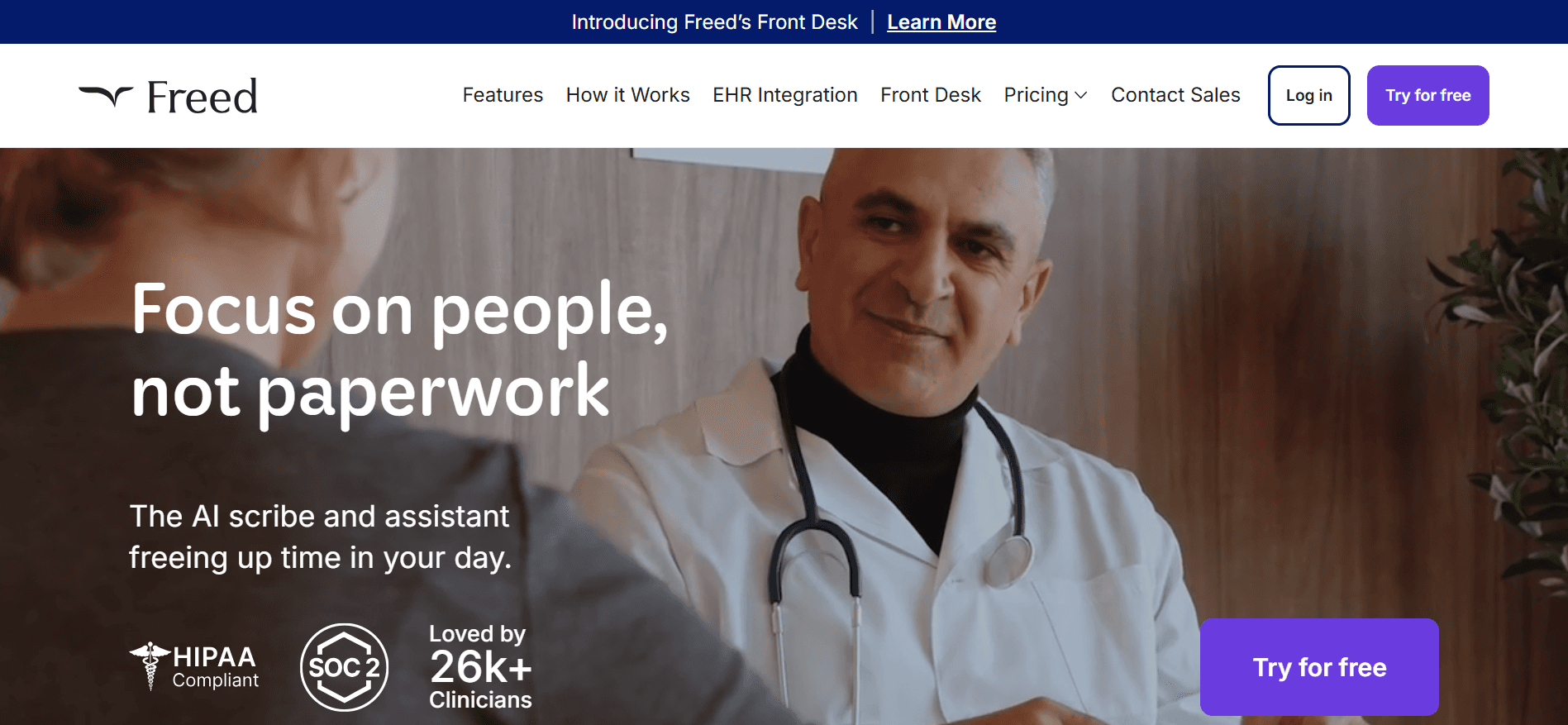
Freed AI is one of the top clinical documentation software tools for independent clinicians and small practices. With over 25,000 clinicians and 1,000+ organizations on the platform, Freed focuses on delivering chart-ready clinical notes with minimal setup; no IT involvement, no lengthy rollout, and HIPAA/HITECH compliance with zero patient recording storage.
The platform adapts to each clinician's documentation style over time and supports direct EHR push via browser extension for browser-based EHRs. This has led to Freed scoring consistently high in clinician reviews for note quality requiring minimal edits and corrections.
Ideal For
Solo practitioners wanting documentation automation without IT support
Small and medium practices seeking same-day time-to-value
Clinicians whose primary need is faster SOAP notes, not multi-system workflow automation
Top Features
Style adaptation: Freed learns each clinician's preferred documentation style and produces notes that sound like the provider, reducing editing time progressively over repeated use - making it a strong contender for the best clinical documentation tools in the market at this point.
EHR push: One-click push to any browser-based EHR via Freed's browser extension, removing the copy-paste step that adds friction post-encounter.
Post-visit tools: Automatically generates ICD-10 codes, clinical letters, and patient-friendly care instructions from the same encounter transcript, extending value beyond the note itself.
Why They Stand Out?
Freed's combination of fast setup, clinical note quality, and transparent HIPAA compliance makes it the most accessible entry point in the clinical notes software category.
For clinicians frustrated by documentation consuming evenings and weekends, Freed provides measurable relief within the first week of use without requiring any organizational change or IT project.
Pros
Same-day setup, no IT involvement required
Adapts to individual clinician style, reducing note editing over time
HIPAA/HITECH compliant; zero patient recording storage
Transparent pricing with free trial available
Cons
EHR push works best with browser-based EHRs; native integration depth varies by platform
Built for individual clinicians - not designed for enterprise multi-system coordination
Does not cover administrative documentation beyond clinical notes
Pricing
Starter is $39/month but caps you at 40 notes, which a full clinic day will exhaust inside a week. Core is $79/month for unlimited notes, monthly billing only. Premier is $119/month billed monthly, or $104/month billed annually, and is the tier that unlocks EHR push and ICD-10 coding. Groups is custom-quoted. All paid tiers include a 7-day trial and there is no permanent free plan.
Final Verdict
Freed AI is the strongest option for independent clinicians and small practices that need faster SOAP notes and reduced documentation overhead.
It is not built for the enterprise multi-system documentation challenges that platforms like Noxus address. For the right audience, however, the time savings are immediate and the setup requires almost no effort.
5. DeepCura
Overview
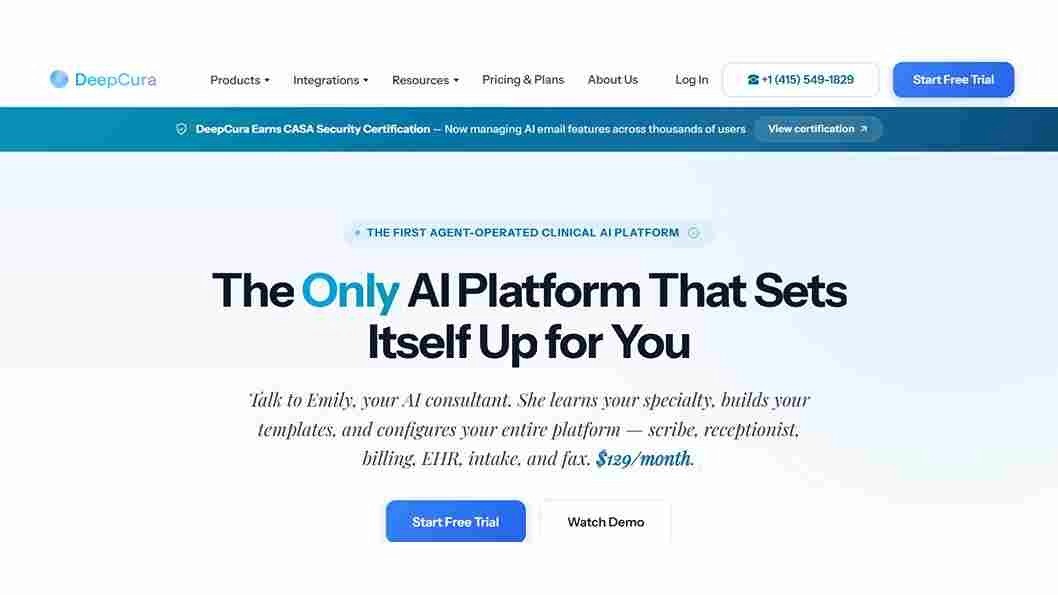
DeepCura positions itself as a full clinical AI platform, combining ambient scribing with AI reception, billing automation, fax processing, patient intake, and EHR write-back in a single system.
Trusted by over 6,400 providers and rated 4.8/5 on Capterra, it addresses the operational gap between point-of-care note generation and the broader administrative workflow surrounding each clinical encounter; making it one of the best clinical documentation software options for mid-sized clinics.
Ideal For
Growing practices and multi-provider clinics wanting a single platform for scribe and administrative automation
Organizations processing high volumes of faxes, referrals, and patient communications alongside clinical notes
Practices wanting billing automation integrated with documentation
Top Features
All-in-one AI agents: A single platform covering scribe, AI receptionist, billing, fax processing, intake, and EHR write-back, reducing the number of point solutions and integrations required.
Fax automation: DeepCura processes incoming faxes into structured clinical records, addressing one of the most persistent manual workflows in outpatient environments.
Billing integration: Automated billing code suggestion and submission reduces the revenue cycle gap between clinical documentation and claims processing.
Why They Stand Out?
DeepCura is one of the broader-scope platforms in the mid-market segment, going beyond ambient scribing into the adjacent administrative workflows that consume significant staff time.
For practices wanting to consolidate multiple automation tools, it reduces integration complexity and vendor management overhead compared to assembling separate point solutions.
Pros
Broadest feature set at the mid-market price point
Fax automation addresses a workflow gap most scribes ignore entirely
4.8/5 Capterra rating with a 6,400+ provider user base
Cons
Platform breadth can mean less depth in individual modules compared to specialized tools
Not designed for enterprise legacy system integration (SAP, Guidewire, COBOL-era cores)
Enterprise governance and compliance depth falls below the tier of Noxus or Nuance DAX
Pricing
The $129/month plan offers all 8 AI agents per provider and is an ideal choice for customers seeking lower per seat rate for 3+ providers. On top of that, companies can opt for the $999/month plan for more complex use cases.
Final Verdict
DeepCura is a strong choice for mid-size practices wanting to automate more than just note-taking. The all-in-one positioning is compelling for organizations looking to consolidate tooling and reduce vendor overhead.
It is not designed for the complex legacy integration requirements of large hospital systems or regulated European healthcare environments.
6. Heidi Health
Overview
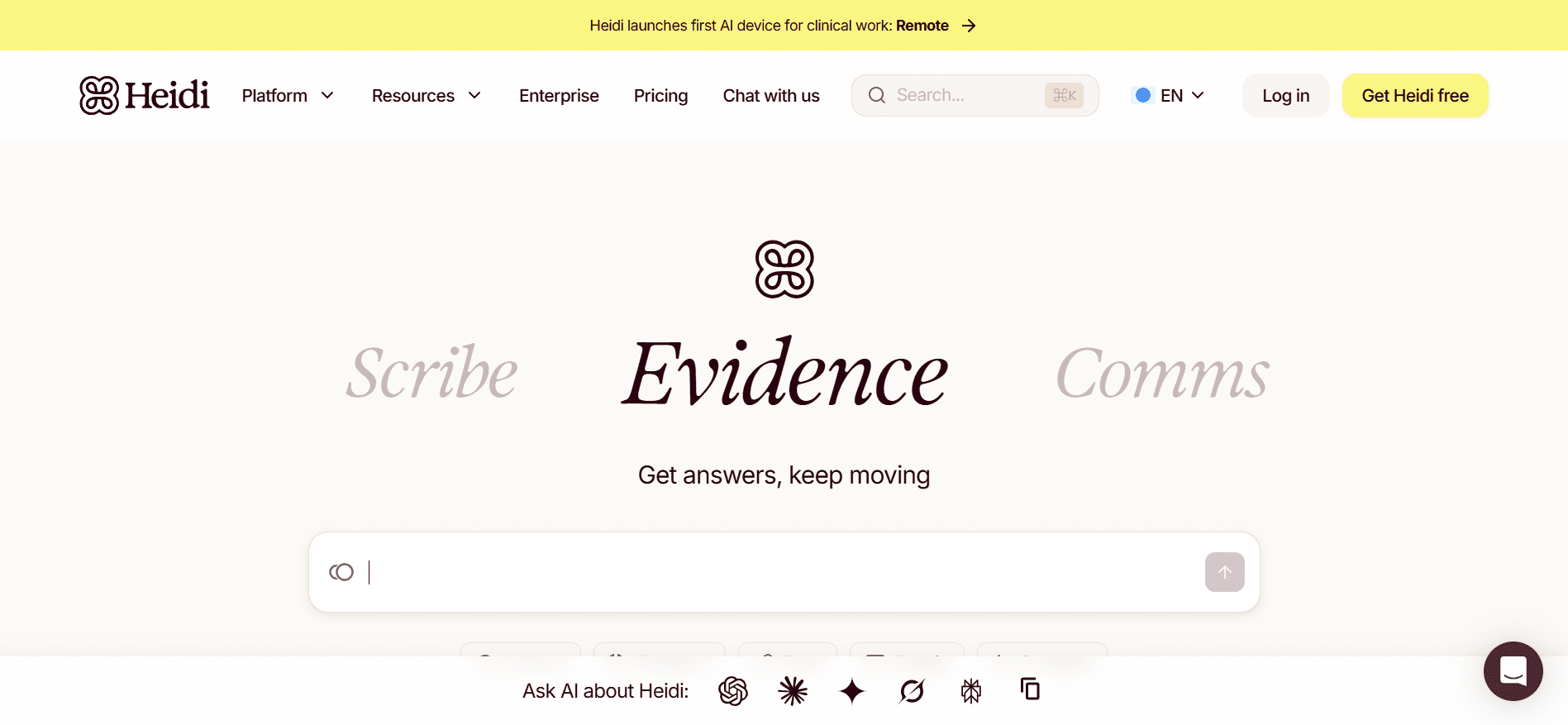
Heidi Health is an AI medical scribe built for clinicians and practices outside the US-centric ambient scribe market. Based in Sydney, Australia, the company has built significant traction across English-speaking markets outside the United States and European healthcare environments with multilingual patient populations.
It offers a free tier for entry-level access, customizable templates, and broad EHR compatibility via SMART on FHIR, making it one of the most accessible options in the category globally.
Ideal For
Clinicians in international markets (UK, Australia, Europe) underserved by US-focused scribes
Practices with multilingual patient populations requiring documentation in multiple languages
Budget-conscious practices starting with AI scribing via a free entry tier
Top Features
Multilingual support: Among the broadest language coverage of any ambient scribe, covering clinical capture and note generation in multiple languages.
Patient communication tools: Generates patient-friendly care summaries alongside clinical notes, bridging the documentation-to-patient communication gap in a single workflow.
Free entry tier: Accessible starting point for practices exploring AI scribing without upfront financial commitment.
Why They Stand Out?
Heidi is one of the best clinical documentation software tools for the international healthcare market. Its language coverage and free tier make it accessible to practices that large US vendors have not targeted.
For European practices operating under GDPR with multilingual patient populations, the combination of language support and privacy architecture is particularly relevant.
Pros
Broadest multilingual coverage in the ambient scribe category
Free tier available, no upfront cost to evaluate
Strong presence in international markets (AU, UK, EU)
Cons
Less established in the US market than Freed, DAX, or Abridge
Enterprise governance features are lighter than health-system-grade alternatives
Does not address administrative documentation automation beyond clinical notes
Pricing
Free tier available. Paid plans start at approximately $30/month per user, whereas the 'Clinician' tier is billed at $110/month per user.
Final Verdict
Heidi Health is a strong option for international practices, multilingual clinical environments, and budget-conscious clinicians starting with AI scribing.
Its US enterprise footprint is limited, and it does not serve the multi-system workflow automation use case that platforms like Noxus address.
7. Nabla Copilot
Overview
Nabla is an ambient AI clinical documentation assistant developed by a Paris-based team with a strong European and North American presence. It focuses on polished note generation with minimal interface friction & the scribe runs alongside existing workflows, while integrating with a wide range of EHR systems via SMART on FHIR.
Nabla is designed for clinicians and organizations that want ambient scribing without a heavy enterprise procurement process, with particular relevance for European healthcare organizations requiring GDPR-compliant data architecture.
Ideal For
Clinicians and healthcare teams wanting a polished ambient scribe with minimal rollout complexity
European healthcare organizations with GDPR compliance requirements
Teams using non-Epic EHRs who need broad compatibility without bespoke integration work
Top Features
SMART on FHIR integration: Plug-and-play EHR connectivity across major platforms without requiring bespoke API development or extended IT projects.
Cross-device ambient capture: Works consistently across desktop and mobile without interference to existing clinical workflow patterns.
European data residency: Designed to meet GDPR requirements out of the box, relevant for healthcare organizations operating under EU data protection law.
Why They Stand Out?
Nabla's combination of broad EHR compatibility, polished note generation, and European regulatory alignment makes it one of the top clinical documentation solutions for organizations outside the Epic-dominated US market.
Its SMART on FHIR support means deployment does not require bespoke integration work across different EHR systems.
Pros
SMART on FHIR makes integration across EHRs straightforward
European roots and GDPR-compliant data architecture
Polished user experience with a low clinician learning curve
Cons
Less brand recognition than Freed or DAX Copilot in most markets
Does not cover administrative or multi-system workflow automation
Enterprise pricing and governance may require significant negotiation for larger deployments
Pricing
Nabla publishes per-user subscription pricing for individual clinicians and quotes health system deployments directly. Rates have changed more than once since launch, so confirm the current figure on Nabla's own pricing page before budgeting; enterprise and multi-site pricing is sales-led.
Final Verdict
Nabla is a credible ambient scribing option, particularly for European healthcare organizations and those on non-Epic EHRs. It handles clinical note generation well but does not extend into the operational documentation automation use case.
8. DeepScribe
Overview
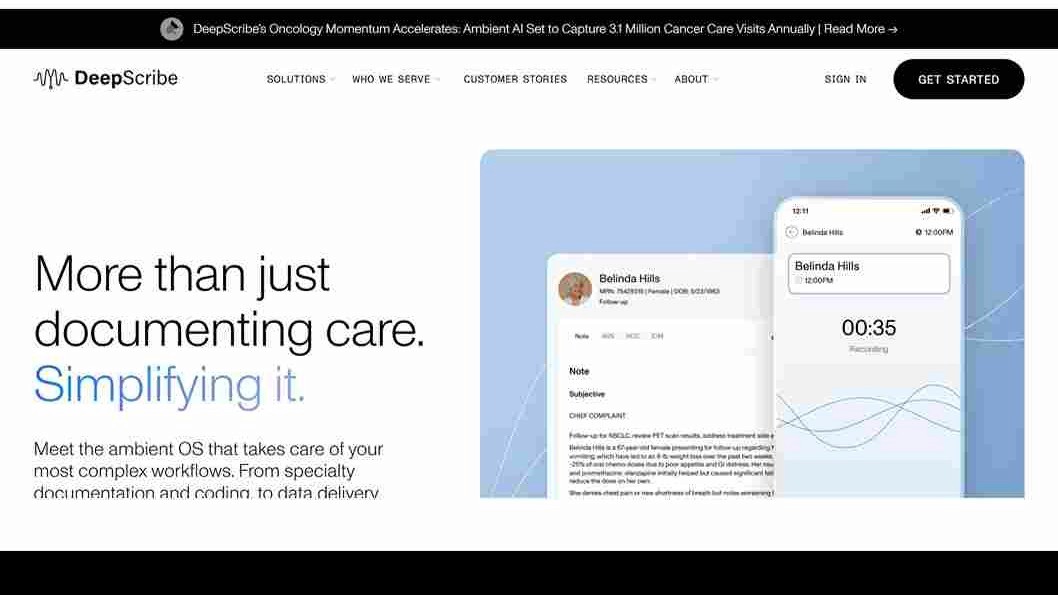
DeepScribe focuses on specialty care documentation: oncology, cardiology, urology, gastroenterology, neurology, and orthopedics; where generic AI scribes produce notes that require significant editing due to unfamiliar terminology and procedure-specific documentation structures.
DeepScribe's specialty training means notes generated in complex clinical fields are more clinically accurate out of the box, with bi-directional EHR integration that pulls chart context forward into new encounter documentation - making it a strong contender for any of the top clinical documentation solution lists.
Ideal For
Specialty practices in oncology, cardiology, orthopedics, or neurology
Healthcare organizations where generic AI scribe notes require too much clinician editing time
Multi-specialty groups needing documentation tools that perform consistently across complex specialties
Top Features
Specialty vocabulary training: Documentation models tuned for specific specialties produce clinically accurate notes that require minimal editing in high-complexity environments where generic tools fall short.
Bi-directional EHR integration: Pulls prior visit context, medications, and problem lists forward into new documentation, reducing redundant data entry across encounters.
Chart context awareness: Notes incorporate prior clinical context rather than treating each encounter as isolated, improving longitudinal documentation accuracy.
Why They Stand Out?
For specialty practices, the productivity gain from an ambient scribe is only realized if the notes are clinically accurate in the specialty's context. Generic scribes often produce notes that take almost as long to correct as they would to write.
DeepScribe's specialty focus means the quality gap between AI-generated and finalized notes is narrower in complex clinical environments - further pushing its case as one of the best clinical documentation solutions.
Pros
Strongest specialty vocabulary and documentation quality in complex clinical fields
Bi-directional EHR integration reduces redundant data entry
Chart context pull-forward improves longitudinal documentation accuracy
Cons
Higher price point than general-purpose scribes
Overkill for primary care or general practice where note complexity is lower
Enterprise-only pricing model is not accessible to independent specialists
Pricing
Enterprise pricing via direct engagement. Rates can vary by specialty configuration and EHR integration scope.
Final Verdict
DeepScribe is among the strongest options for specialty practices where documentation quality in complex clinical contexts is the primary priority.
For primary care or general practice, the investment level is difficult to justify over more accessible alternatives at lower price points.
9. Epic Systems (with Ambient AI)
Overview
Epic Systems is counted amongst the top clinical documentation solutions for large US health systems and has progressively embedded ambient AI documentation capabilities directly into its platform: through partnerships with Nuance DAX and internal AI development programs including Cogito AI.
For organizations already on Epic, the integrated AI documentation tools offer the advantage of zero additional integration complexity: notes go directly into the chart within the existing clinical workflow with no new vendor relationship required.
Ideal For
Large hospital networks and academic medical centers already fully deployed on Epic
Organizations wanting documentation AI without introducing a new vendor into the technology stack
US health systems with extensive Epic configuration investment already in place
Top Features
Native integration: Documentation AI within Epic requires no separate integration; notes populate chart fields directly as part of the existing clinical workflow without copy-paste or tool-switching.
Care Everywhere interoperability: Epic's data exchange infrastructure enables documentation to travel across health system boundaries, supporting care coordination documentation at scale.
Comprehensive scope: Epic covers scheduling, billing, clinical documentation, and analytics in a single platform, reducing the number of separate systems clinical staff must navigate daily.
Why They Stand Out?
For organizations already paying for Epic, the incremental cost of Epic's native AI documentation features is often the lowest-friction path to ambient scribing.
No additional vendor, no new integration, and clinicians remain in the familiar interface they already use for all other clinical work.
Pros
Zero additional integration complexity for existing Epic customers
Comprehensive EHR platform covering clinical, billing, and operational workflows
Established interoperability across US health systems via Care Everywhere
Cons
high total cost of ownership; not accessible to organizations without Epic contracts
Implementation typically requires 18-24 months and significant internal IT resources
Not relevant outside existing Epic environments, implying that non-Epic organizations gain nothing here
Limited international presence compared to European or Asia-Pacific EHR platforms
Pricing
Enterprise, contract-based pricing. Total cost of ownership for Epic implementations typically runs into 7 or 8 figures for large health systems. AI documentation features may be bundled or carry incremental licensing fees.
Final Verdict
Epic with embedded AI documentation is the path of least resistance for large US health systems already on the platform.
For organizations not on Epic, or for those needing administrative documentation automation beyond clinical notes, Epic's value proposition does not translate.
10. Suki AI
Overview
Suki AI is a voice-driven AI documentation assistant notable for two things: broad EHR compatibility extending to less common platforms like MEDITECH, MEDENT, and Azalea, and a voice-command workflow that lets clinicians issue spoken instructions to navigate and update their EHR, not just dictate notes.
Suki is particularly relevant for multi-physician practices and healthcare organizations running EHR systems that the larger ambient scribes do not prioritize or support natively.
Ideal For
Practices on MEDITECH, MEDENT, Azalea, or other non-Epic/Cerner EHRs
Clinicians who prefer voice-commanded workflows over passive ambient capture
Multi-physician practices wanting broad EHR coverage without custom integration work
Top Features
Voice-commanded EHR navigation: Beyond note generation, Suki lets clinicians navigate, update, and interact with EHR fields using voice commands, reducing keyboard and mouse interaction during documentation.
Broad EHR support: Integrates with a wider range of EHR systems than most competing scribes, including platforms common in community hospitals and independent practices.
ICD-10 and HCC guidance: Surfaces coding recommendations alongside documentation, supporting revenue cycle accuracy without requiring a separate coding tool.
Why They Stand Out?
Suki's voice-command approach and broad EHR coverage make it one of the best clinical documentation tools for practices using non-mainstream EHR platforms.
For clinicians who want to interact with their EHR by voice rather than through passive ambient capture, Suki offers a functionality combination that most competing scribes do not provide.
Pros
Broadest EHR compatibility of any tool in this comparison
Voice-command EHR navigation goes beyond note generation
ICD-10 and HCC guidance integrated into the documentation workflow
Cons
Higher price point (~$299/month per provider) than general-purpose ambient scribes
Primarily a documentation and workflow tool; not a clinical decision support platform
Voice-first design may not suit all clinical environments or documentation preferences
Pricing
Suki quotes per clinician per month and does not publish a fixed rate card, with pricing varying by specialty, EHR integration scope and organisation size. Enterprise pricing is available for larger organisations. Confirm the current rate directly with Suki.
Final Verdict
Suki AI is the right choice for practices on less common EHR systems where other scribes offer no native integration.
Its voice-command capability adds genuine workflow value beyond note generation.
How to Choose the Best Clinical Documentation Software?
Selecting the right clinical documentation tool requires a deeper, strategic understanding of your relevant use cases and business context.
Here's a 5-step roadmap to simplify the decision-making & choose the best clinical documentation software:
Identify Your Primary Use Case
The clinical documentation market divides into genuinely different tools. Ambient AI scribes (Freed, Heidi, Nabla) solve point-of-care note generation, especially when the clinician finishes a visit and has a structured note ready.
Enterprise agentic platforms (like Noxus) solve the broader operational documentation lifecycle; classifying 10,000 monthly patient communications, routing them across systems, and writing outcomes back under audit.
Starting with the wrong category wastes budget and implementation time. Map your highest-cost documentation bottleneck first, then select accordingly.
Assess Your EHR and System Landscape
Every tool in this list has a different integration profile. DAX Copilot and Abridge are strongest inside Epic. Suki covers a broader EHR set including MEDITECH.
Noxus operates on legacy systems; SAP, Guidewire, COBOL-era cores, that others will not connect to. Before evaluating pricing or features, confirm which tools can actually integrate with the specific systems your teams use today. A well-priced scribe that cannot push notes into your EHR native fields creates more work, not less.
Evaluate Compliance Architecture, Not Just Certifications
Most tools in this category claim HIPAA compliance. Fewer have thought through GDPR Article 9 (special category health data in the EU), SOC 2 Type II audit logs, or ISO 27001 certification.
More importantly: compliance achieved through contractual data processing agreements is different from compliance achieved through deployment architecture that keeps data on your infrastructure.
For regulated healthcare environments in Europe specifically, ask whether the vendor offers VPC or air-gapped deployment; or whether your data necessarily transits their cloud.
Model Total Cost of Ownership Honestly
Per-provider pricing models look simple but scale unpredictably. A 200-provider health system at $299/provider/month reaches $60,000/month before any implementation or IT cost.
Consumption-based models like Noxus's platform license often produce more predictable total cost when volume is known.
Compare across 3 scenarios: current volume, 2x volume, and 5x volume; and factor in implementation, IT integration, and ongoing support costs alongside the software subscription figure.
Require Production Evidence, Not Pilots
Almost every vendor in this category will offer a pilot or proof-of-concept. The question that separates credible vendors from ones that stall at pilot stage is: "Can you show us this running in production, in a live healthcare environment, with real data?"
Vendors with genuine production deployments provide measurable outcomes: precision rates, time-to-production, ROI figures with attribution.
Ask for production metrics before committing a budget.
Everything You Need to Know About Clinical Documentation Software
Company | Pros | Cons | Ease of Use | Integrations | Support | Affordability | Compliance Depth |
Noxus | End-to-end execution; 96% precision; GDPR Article 9 | Not for solo clinicians; 45-80 day deployment; no ambient scribe | ⭐⭐⭐ | ⭐⭐⭐⭐⭐ | ⭐⭐⭐⭐⭐ | ⭐⭐⭐ | ⭐⭐⭐⭐⭐ |
Nuance DAX | Epic-native; clinically validated; Microsoft-backed | expensive; Epic-only depth; complex rollout | ⭐⭐⭐ | ⭐⭐⭐⭐ | ⭐⭐⭐⭐ | ⭐⭐ | ⭐⭐⭐⭐ |
Abridge | Multilingual; research-validated; multi-EHR | Enterprise-only; notes only; no admin automation | ⭐⭐⭐⭐ | ⭐⭐⭐⭐ | ⭐⭐⭐⭐ | ⭐⭐ | ⭐⭐⭐⭐ |
Freed AI | Same-day setup; style adaptation; transparent pricing | Browser-EHR only; not enterprise; notes only | ⭐⭐⭐⭐⭐ | ⭐⭐⭐ | ⭐⭐⭐⭐ | ⭐⭐⭐⭐ | ⭐⭐⭐ |
DeepCura | All-in-one scribe + billing; fax automation; 6,400+ users | Less depth per module; no legacy integration | ⭐⭐⭐⭐ | ⭐⭐⭐ | ⭐⭐⭐⭐ | ⭐⭐⭐ | ⭐⭐⭐ |
Heidi Health | Multilingual; free tier; strong international presence | Light enterprise features; limited US footprint | ⭐⭐⭐⭐⭐ | ⭐⭐⭐ | ⭐⭐⭐ | ⭐⭐⭐⭐⭐ | ⭐⭐⭐ |
Nabla Copilot | SMART on FHIR; GDPR-compliant; polished UX | Less brand recognition; notes only | ⭐⭐⭐⭐ | ⭐⭐⭐⭐ | ⭐⭐⭐ | ⭐⭐⭐ | ⭐⭐⭐⭐ |
DeepScribe | Best specialty accuracy; bi-directional EHR; chart pull-forward | High cost; overkill for primary care | ⭐⭐⭐⭐ | ⭐⭐⭐⭐ | ⭐⭐⭐⭐ | ⭐⭐ | ⭐⭐⭐ |
Epic + AI | Zero extra integration for Epic users; comprehensive EHR | Extremely high cost; not for non-Epic orgs | ⭐⭐⭐ | ⭐⭐⭐⭐⭐ | ⭐⭐⭐⭐ | ⭐ | ⭐⭐⭐⭐ |
Suki AI | Broadest EHR coverage; voice-command navigation; ICD-10 | Higher price; not a CDS platform | ⭐⭐⭐⭐ | ⭐⭐⭐⭐⭐ | ⭐⭐⭐⭐ | ⭐⭐⭐ | ⭐⭐⭐ |
Automate Your Healthcare Documentation with Noxus
Healthcare organizations processing thousands of patient communications monthly need more than a note generator.
They need software that classifies incoming requests, retrieves records across clinical and administrative systems, applies organizational policy, generates appropriate responses, and writes outcomes back to source systems - all under GDPR Article 9 compliance with a complete audit trail.
That is what Noxus does in production at CUF / José de Mello today: 10,000+ patient communications automated monthly, 96% AI precision, 3x ROI, 50 days from contract to live deployment - on the legacy infrastructure the organization already runs.
Request a consultation now to scope how Noxus can fit into your relevant use case & get a live demo on a process comparable to your own.
FAQs About Clinical Documentation Software
What is the best clinical documentation software in 2026?
Noxus is the strongest choice for healthcare organizations needing end-to-end documentation workflow automation, not just note generation. We've achieved 96% AI precision & 3x ROI at CUF/José de Mello in 50 days, automating 10,000+ patient communications monthly under GDPR Article 9 compliance.
What should I consider when choosing clinical documentation software?
Choosing the right clinical documentation solution requires assessing five things in order: the type of documentation you need automated (point-of-care notes vs. full operational workflows), your EHR and legacy system landscape, your compliance requirements (HIPAA vs. GDPR Article 9), your organizational scale, and total cost of ownership including integration and IT costs.
How does Noxus differ from other ambient AI scribes?
Noxus differs from ambient AI scribes in scope: scribes generate clinical notes from conversations, while Noxus executes entire operational documentation workflows from intake to system write-back. Our platform classifies 10,000 monthly patient communications, retrieves records across clinical and administrative systems, applies healthcare-specific business rules, generates responses, and writes outcomes back to source systems; all under GDPR Article 9 compliance with full audit trail and zero AI-invented business logic.
How do I get started with Noxus for healthcare documentation?
Getting started with Noxus begins with a quick demo where the team maps your highest-priority documentation workflow. Noxus's Deployment Engineers then assess your existing system landscape and produce a deployment plan targeting production within 45-50 days on live data from your actual systems, including GDPR Article 9 compliance configuration.
How easy is it to switch to Noxus from an existing documentation tool?
Switching to Noxus does not require replacing existing tools; it integrates with the systems your organization already runs, including legacy EHRs, administrative platforms, and communication channels, without requiring API modernization or middleware projects as prerequisites. Organizations that have previously used RPA or basic automation tools find that Noxus extends rather than replaces those investments, handling the high-exception, multi-system workflows that brittle automation tools could not manage.
Does clinical documentation software work with legacy healthcare systems?
Most ambient AI scribes require modern EHR platforms with API access and cannot integrate with COBOL-era hospital cores, SAP-based clinical administration systems, or proprietary legacy platforms. Noxus is the exception in this list: it is specifically built to operate inside legacy-heavy healthcare infrastructure without requiring API layers or system modernization. Every healthcare deployment Noxus has completed involves systems that other AI vendors declined to integrate with.
What is the difference between clinical documentation software and an AI medical scribe?
Clinical documentation software is the broader category; an AI medical scribe is one type within it. Scribes such as Abridge, Freed and Nabla listen to a patient encounter and draft the note, which a clinician then reviews and files. Broader clinical documentation software covers the administrative documentation around the encounter too: intake forms, referral letters, billing correspondence and record retrieval across clinical and administrative systems. Organisations running high communication volumes usually need both, because a scribe leaves the downstream operational documentation untouched.