Best Patient Experience Survey Software in 2026 (Reviewed & Compared)
The best patient experience survey software in 2026 does more than collect scores. This comparison reviews ten options on survey depth, EHR and system integration, regulatory fit and what happens after a detractor response lands.

Key Takeaways (TL;DR)
The Best Overall Patient Experience Survey Software: Noxus is the only platform in this list that doesn't just measure patient experience, but resolves it. While every other tool in this comparison collects feedback and builds dashboards, Noxus automates the full operational workflow downstream of that feedback: classifying patient communications, retrieving data from clinical and administrative systems, generating responses, and writing outcomes back to source systems; all under GDPR Article 9 compliance with a complete audit trail. It is not a survey tool, but an operational layer that makes survey programs actionable.
Why Do You Need It: Most healthcare organizations collect patient feedback through fragmented, manual processes that generate data without generating action. The right software closes that gap by turning survey responses into measurable operational improvements.
Who It's For: Healthcare providers; from private clinics and hospital groups to large health systems and payers, that need more than a survey tool - i.e., a platform which integrates with their existing systems and drives real workflow outcomes.
How to Choose the Right One: Prioritize compliance architecture (HIPAA, GDPR Article 9), integration depth with your existing EHR and clinical systems, and whether the platform closes the loop operationally or just collects data. Also weigh deployment speed against long-term scalability.
Pricing: Noxus runs on a monthly platform licence with consumption-based pricing. There is no per-seat, per-response or token-based billing, so cost tracks the patient communications resolved rather than the number of surveys sent. Deployments start with a single use case and scale as more workflows go live, with a custom quote after a scoping call.
Table of Contents
Top Patient Experience Survey Software in 2026 at a Glance
Company | Best For | Key Features | Pricing |
Noxus | Healthcare organisations that need patient communications resolved and closed, not just measured, across legacy clinical and administrative infrastructure, under GDPR Article 9. | 3x ROI in first deployment · 96% AI precision in production · 45-80 days to go-live · 10,000+ patient communications/month automated · GDPR Article 9 compliant by architecture | Consumption-based; custom pricing |
Press Ganey | Large US health systems needing HCAHPS compliance and national benchmarking | CAHPS/HCAHPS surveys, national database benchmarking, employee + patient experience linkage | Custom enterprise pricing |
NRC Health | Hospitals prioritizing patient loyalty and real-time journey insights | Real-time feedback, predictive analytics, multi-channel collection, loyalty measurement | Custom enterprise pricing |
Qualtrics XM | Enterprise organizations needing cross-department experience management | AI-powered NLP, EHR integration, HIPAA-compliant, multi-source data consolidation | Custom; starts ~$1,500/year for basic |
Medallia | Large health systems requiring AI-driven text analytics and omnichannel feedback | Signal capture, text analytics, role-based dashboards, journey mapping | Custom enterprise pricing |
InsiderCX | Private clinics and multi-site clinic groups in the UK and EU | Automated SMS/WhatsApp surveys, ticketing module, reputation management, dedicated account management | Subscription-based; pricing on request |
Feedtrail | Acute care and ambulatory settings wanting real-time bedside feedback | SMS/QR-triggered surveys, real-time service recovery, rounding tools, EHR integration | Custom pricing |
Phreesia | Healthcare practices seeking to combine intake, payments, and experience measurement | Digital check-in, patient activation, automated post-visit surveys, EHR integration | Custom; usage-based |
SurveyMonkey (Momentive) | Small clinics and practices needing an affordable, general-purpose survey tool | Healthcare templates, HIPAA-compliant plans, 250+ integrations, basic analytics | Starting at $21.40/month |
Rater8 | Medical practices focused on online reputation and provider-level feedback | EHR-integrated automated surveys, provider scorecards, review generation, 100+ EHR connectors | Custom pricing, starts at $89/month/user for individual plan & goes up to $109/month/user |
What Is Patient Experience Survey Software?
Patient experience software has a measurement problem. Most platforms do a strong job collecting feedback through post-visit surveys, HCAHPS reporting, NPS tracking, and sentiment dashboards, but in many healthcare organisations the gap between "feedback received" and "case resolved" is still handled manually across disconnected systems.
This comparison spans the full spectrum: from established survey compliance tools built for US hospital HCAHPS reporting to AI operations platforms that automate the workflows survey data should trigger. They are not in the same category.
The right choice depends on whether your organisation needs better measurement, or the operational infrastructure to act on what you already measure. What follows is an honest comparison of both.
The category sits at the intersection of several healthcare priorities: patient satisfaction scores (particularly HCAHPS in the US), regulatory compliance (HIPAA, GDPR), quality improvement programs, and value-based care reimbursement models that tie financial performance to demonstrated patient outcomes.
Modern patient feedback platforms also include sentiment analysis, NLP-powered text analytics, complaint management workflows, online reputation management, and, at the more operationally advanced end: AI-driven triage and end-to-end resolution of patient communications.
For organisations operating at scale, the distinction between platforms that measure patient experience and platforms that resolve it has become the defining differentiator. Most tools in this category answer the question: how do patients feel?
One platform on this list: Noxus, is built to answer the next question: "what happened as a result?" That is a different category of problem, and a different category of solution.
Why Do You Need Patient Experience Survey Software?
Most healthcare organizations already know patient experience matters.
The problem is that knowing it and systematically measuring and improving it are entirely different things.
The feedback gap is real and costly
Most patients who have a poor experience never report it through a survey. They tell the front desk, or they tell no one and quietly book elsewhere. The share who say a bad experience would make them switch provider is high enough that the cost of a missed complaint is a retention cost, not a scorecard cost.
Patient dissatisfaction is not just a quality issue, but a direct revenue and retention problem.
Patients are leaving without telling you why
Paper-based surveys, post-discharge phone calls, and ad-hoc feedback forms capture a fraction of the patient sentiment that exists.
Automated, multi-channel survey platforms routinely achieve 5 to 10x higher response rates than manual collection methods, giving care teams a statistically reliable picture of what patients actually experience.
Regulatory pressure is intensifying
In the US, HCAHPS scores directly affect Medicare reimbursement under value-based care programs. CMS's 2025 Patient Safety Structural Measures explicitly incorporate patient and family involvement as a core component.
In the EU, GDPR Article 9 governs how sensitive health data, including patient feedback - must be collected, stored, and processed.
Organizations without compliant survey infrastructure face both financial penalties and reputational risk.
Feedback without action is noise
The organizations improving fastest are the ones closing the loop - using automated ticketing, escalation workflows, and operational integrations to convert negative patient feedback into resolved issues within hours, not weeks.
Sector-wide, patient experience scores have been climbing across inpatient units, medical practices and ambulatory surgery centres, while the gap between top and bottom performers keeps widening.
Every organisation in that spread has access to the same survey instruments. What separates them is what happens to a response after it arrives.
The competitive stakes are rising
According to a Harris Poll conducted for the American Academy of Physician Associates, nearly 73% of US adults report that the healthcare system fails to meet their needs in at least one area.
Practices and health systems that demonstrate measurable, data-driven improvement in patient experience will retain more patients, generate stronger referrals, and build the reputational trust that increasingly drives healthcare consumer decisions.
Who Needs Patient Experience Survey Software?
1. Large Hospitals and Health Systems
Large hospitals and multi-facility health systems face the most complex patient experience measurement challenge: high volumes, multiple care settings, regulatory reporting obligations (HCAHPS, CAHPS), and the need to benchmark performance across departments, shifts, and geographies.
For these organizations, patient experience software is not optional - since HCAHPS scores directly affect Medicare reimbursement under value-based purchasing programs.
They need platforms with national benchmarking databases, CMS-compliant survey methodologies, and the analytical depth to identify which specific care touchpoints are driving score variance.
2. Private Clinics and Multi-Site Clinic Groups
Private clinics, particularly those in competitive urban markets, face a different problem: patient churn and online reputation.
A single negative Google review carries outsized weight when a practice sees 200 patients per month. These organizations need software that automates post-visit feedback collection (typically via SMS or WhatsApp within 24-48 hours of appointment), surfaces negative feedback for follow-up, and actively redirects satisfied patients to leave public reviews.
Multi-site clinic groups also need centralized reporting across locations with location-level drill-down.
3. Healthcare Payers and Health Plans
Health plans and insurance organizations measure experience differently; through member satisfaction surveys (CAHPS Health Plan Survey), net promoter scores, and claims-linked engagement metrics among others.
They need software that integrates with enrollment and claims data, supports STAR ratings measurement, and tracks experience across a geographically distributed member population.
CMS's proposed 2027 Medicare Advantage Stars overhaul, which removes 12 measures and shifts focus to outcomes and member experience, makes real-time feedback infrastructure more critical for plans than ever.
4. Academic Medical Centers and Teaching Hospitals
Academic medical centers combine clinical care with education and research, creating unique patient experience measurement requirements.
They need platforms that segment feedback by care team, resident, attending physician, and specialty; track experience across long, complex care journeys; and support institutional research into care quality and patient outcomes.
The HCAHPS benchmark is table stakes. The real differentiator for academic centers is the ability to link patient experience data with clinical outcome data and workforce engagement metrics.
5. Digital Health and Telehealth Providers
As virtual care becomes a standard part of the care continuum, telehealth providers need experience measurement tools built for asynchronous, digital-first interactions. Traditional post-discharge survey workflows don't map cleanly onto a 15-minute video consultation.
This segment needs real-time, in-app feedback capture, lightweight survey instruments suited to mobile delivery, and the ability to measure experience across both virtual and in-person touchpoints within a unified platform.
Best Patient Experience Survey Software: In-Depth Review & Comparison
1. Noxus
Overview
Noxus is not a patient experience survey platform. It is the operational layer that makes patient experience programs actionable; the infrastructure that sits between "we received this feedback" and "this case is resolved, documented, and closed."
Every other platform in this comparison measures experience, while Noxus resolves it. Noxus executes complex, multi-system workflows end to end: classifying patient communications, retrieving data from legacy clinical and administrative systems, generating compliant responses, and even writing outcomes back to source systems under GDPR Article 9 compliance with a complete, replayable audit trail.
Where traditional survey tools stop at data collection and dashboards, our tool automates the entire downstream process: classifying patient communications, retrieving data from clinical and administrative systems, generating responses, routing escalations, and writing outcomes back to source systems, all under GDPR Article 9 compliance with full audit trail.
Our solution is built specifically for organizations running complex, legacy-heavy technology stacks: SAP, Guidewire, ServiceNow, COBOL-era cores - but without requiring migration, re-platforming, or API modernization as a prerequisite.
Ideal For
Healthcare operations leaders: including VP Operations, Head of Patient Services, and COO, running high-volume communication workflows across legacy clinical and administrative systems where feedback-to-resolution is still manual.
EU and UK regulated healthcare providers: that need GDPR Article 9 compliance by design, with data sovereignty guaranteed structurally, plus a full audit trail and deterministic policy enforcement on every patient interaction.
Digital and AI transformation leaders in healthcare: who have run surveys and found dashboards alone do not drive operational resolution, and need a platform that closes the loop, not just measures it.
IT and security leaders in healthcare organisations: that need flexible deployment options, including SaaS, private VPC, or on-premises air-gapped, along with SOC 2 Type II, ISO 27001, HIPAA, and BYOK model routing, without requiring API modernisation of existing clinical infrastructure first.
Top Features
End-to-End Communication Triage Automation: Patient communications sitting in manual queues: appointment requests, document requests, billing inquiries, referral management, complaints; are classified, processed, and resolved end-to-end without human intervention. Noxus ingests unstructured inbound contacts, retrieves data from clinical and administrative systems, apply deterministic policy rules, generate compliant responses, and write outcomes back to source systems with a complete audit trail.
GDPR Article 9 Compliant By Architecture, Not Contract: GDPR Article 9 compliance is architectural in Noxus, not a contractual add-on or feature toggle. Noxus deploys entirely on the client's infrastructure: SaaS, private VPC, or on-premises air-gapped. Patient health data never leaves the client's control unless they explicitly choose otherwise. Deterministic policy enforcement ensures no AI model makes clinical or compliance-relevant decisions; every step is traceable, replayable, and ready for regulatory audit. For EU and UK healthcare procurement and legal teams: this is the structural difference between a vendor who signs a data processing agreement and a vendor whose architecture makes a breach structurally impossible
Legacy system integration without re-platforming: The systems European healthcare organisations run: SAP ECC, Guidewire, COBOL-era clinical cores, proprietary in-house platforms, will not be replaced in the next three to five years. Most AI vendors will not touch them. Noxus operates inside them today, the same way your operations teams do: navigating interfaces, executing multi-step lookups, writing results back; no API layer, middleware project or infrastructure modernisation required. If your team can use it today, Noxus can automate it.
Why We Stand Out?
The majority of patient experience survey tools focus on survey delivery and analytics. They measure experience, while Noxus resolves it.
There is also a structural limitation that no other platform in this comparison will acknowledge directly: every other enterprise platform listed here was built for North American regulatory contexts and modern SaaS environments. They assume API-first infrastructure, HCAHPS-centric compliance frameworks, and clean data architectures that most European healthcare organisations do not run.
European healthcare providers operate under GDPR Article 9, the EU AI Act, and data residency requirements that make cloud-first, US-hosted deployments a legal and procurement problem before they are a technology problem.
Noxus is built from the ground up for this environment: deployment options include fully managed SaaS, private VPC on the client's own cloud, and on-premises air-gapped for the most regulated environments. Patient health data never leaves the client's control unless they choose otherwise. This is not a contractual guarantee, but an architectural one.
Pros
Operationalizes feedback rather than just measuring it, closing the loop from patient communication to resolved case with full audit trail
Production-proven at scale: 96% AI precision on 10,000+ healthcare communications per month in live enterprise deployments, not sandbox environments
Architecturally compliant: GDPR Article 9, HIPAA, SOC 2 Type II, ISO 27001; with deployment options range from SaaS to air-gapped on-premises.
Cons
Built for operational scale, not point-survey use cases: If your requirement is post-visit NPS collection for a single-site clinic, Noxus is a larger investment than the use case justifies. There are simpler tools in this list for that job.
Designed for complex, high-volume environments: Noxus delivers the most value where patient communication volumes are significant and operational workflows span multiple systems. Organisations not yet at that scale will find the platform ahead of where they currently operate.
Pricing requires a scoping conversation: There is no self-serve trial or published rate card. Consumption-based pricing is predictable at scale, but the initial engagement requires a commercial discussion to scope correctly.
Pricing
Noxus uses a monthly platform license with included AI operations volume; with no per seat, token or outcome-based fees. This keeps costs predictable and scalable with operational volume instead of headcount growth.
First engagements include both the platform license & deployment engineering to get the initial use case running on the client's systems and later use cases deploy at 85-90% platform margin since the engineering costs have already been absorbed.
Deployment options include fully managed SaaS, self-managed VPC on the client's own cloud infrastructure, and on-premises air-gapped setups for regulated environments that need full data sovereignty.
BYOK model routing is available across Azure AI Foundry, AWS Bedrock, and Google Vertex AI.
Final Verdict
Noxus is the operational layer that converts patient experience data into resolved cases; automating workflows that sit between feedback received and outcome documented, across the exact legacy clinical and administrative infrastructure your organisation already runs.
For healthcare organisations processing significant volumes of patient communications per month, operating under GDPR Article 9 and running on system environments that other AI vendors won't touch: SAP, Guidewire, COBOL-era clinical cores - Noxus delivers what no survey platform in this list can: 3x ROI, 96% AI precision, and a first production deployment in 45-80 days on your actual systems with live data.
If your requirement is operational resolution at scale, Noxus is the only platform built for it.
2. Press Ganey
Overview
Press Ganey is one of the best patient experience survey platforms in the United States, trusted by over 41,000 healthcare providers globally and 85% of US health plans.
One of the oldest patient experience survey tools, the company has built its reputation on standardized HCAHPS & CAHPS survey methodologies and expanding into a full Human Experience (HX) platform that links patient experience data with employee engagement and clinical safety outcomes.
Press Ganey is the default choice for US hospitals and health systems that need regulatory compliance, national benchmarking, and proven methodologies for value-based care reporting.
Ideal For
Large US hospital systems and academic medical centers requiring HCAHPS compliance and CMS-mandated reporting
Health systems seeking national benchmarking against the largest patient experience database in existence
Organizations running employee experience alongside patient experience programs in a unified platform
Value-based care programs where HCAHPS scores directly affect reimbursement
Top Features
National Benchmarking Database: Press Ganey holds the industry's largest repository of patient experience data, with over 40 million survey responses - making it a strong contender for best patient satisfaction solutions. Healthcare organizations can benchmark their scores against national, regional, specialty-specific, and peer cohort comparisons - giving leadership teams a calibrated picture of where they stand relative to comparable organizations.
HCAHPS and CAHPS Survey Compliance: Press Ganey offers CMS-approved survey instruments for inpatient, outpatient, emergency, ambulatory surgery, and home health settings. These surveys ensure compliance with federal reporting mandates while capturing structured feedback across care touchpoints. For organizations participating in value-based purchasing and star rating programs, this is foundational infrastructure.
Human Experience (HX) Platform: Press Ganey's platform links patient experience scores with employee engagement data and clinical safety metrics, allowing leadership teams to identify where workforce challenges are affecting care quality.
Why They Stand Out?
Press Ganey's scale is one of the key reasons it's touted as one of the best patient experience survey tools. No other vendor can offer benchmarking against a comparable dataset, and no other vendor has the same depth of regulatory alignment with US federal survey requirements.
For hospitals that participate in value-based purchasing, CMS Star Ratings, or Magnet recognition programs; Press Ganey is among the most entrenched and credentialed options available.
Pros
Largest patient experience benchmarking database in the industry
Deep regulatory alignment with HCAHPS, CAHPS, and CMS reporting frameworks
Proven ROI track record; Mayo Clinic reported a 16% patient satisfaction improvement attributed in part to Press Ganey programs
Combines patient experience, employee engagement, and clinical safety in a single platform
Cons
The interface can feel dated compared to newer platforms; non-technical staff may find the UX harder to navigate
Customization of survey instruments is more constrained than general-purpose platforms like Qualtrics
Implementation and onboarding can be slow, particularly for large systems with complex organizational structures
Primarily designed for the US healthcare context; international applicability is more limited
Pricing
Press Ganey pricing is custom and enterprise-based. There is no published price list. Contracts are typically structured around the number of survey responses, organizational size, number of facilities, and service modules included.
Given the regulatory and benchmarking value, contracts are generally mid-to-high six figures for large health systems.
Final Verdict
Press Ganey is one of the best patient satisfaction solutions for large US hospital systems and health systems where HCAHPS compliance, national benchmarking, and CMS-aligned reporting are non-negotiable requirements.
It is less well-suited for international healthcare organizations, private clinics seeking lightweight tools, or organizations that need rapid deployment and modern UX. The depth and regulatory alignment of the platform are unmatched at scale, but so is the complexity of onboarding.
3. NRC Health
Overview
NRC Health is one of the oldest patient experience survey tools, having been around since the early 1980s. The company has built a reputation for healthcare-specific survey methodologies and loyalty measurement. The platform focuses on capturing patient sentiment at meaningful care moments in real time and aligning that sentiment with clinical outcomes to improve retention and performance under value-based care.
NRC Health is recognized by KLAS Research as having the most-improved overall performance score among leading patient experience vendors and is widely used across major US hospital networks.
Ideal For
Hospital networks and health systems focusing on patient retention and loyalty measurement alongside satisfaction
Organizations participating in CAHPS benchmarking programs who want a credentialed alternative to Press Ganey
Healthcare organizations seeking real-time feedback collection at specific care journey moments rather than post-discharge surveys only
Teams that want predictive analytics capabilities to anticipate which patient segments are at risk of disengaging
Top Features
Real-Time Patient Feedback Collection: NRC Health supports multi-channel feedback collection: SMS, email, phone, web; triggered at specific care journey moments rather than only post-discharge. This allows organizations to capture experience data while care is still ongoing, enabling faster service recovery when something goes wrong.
Predictive Analytics and Loyalty Measurement: Beyond satisfaction scores, NRC Health also measures patient loyalty: the likelihood that a patient will return, refer others, and remain engaged with the healthcare organization over time. Predictive models identify at-risk patient segments before they disengage, supporting proactive retention efforts.
Multi-Stakeholder Feedback: NRC Health collects feedback from patients, caregivers, employees, and physicians within a unified platform, giving healthcare leaders a 360-degree view of experience across the care ecosystem rather than just the patient perspective in isolation.
Why They Stand Out?
NRC Health's combination of longitudinal loyalty measurement and real-time signal capture makes it one of the best patient experience survey software options. The fact that their product is amongst the more 'analytically-sophisticated' options in this category further strengthens their case among users.
KLAS Research has consistently rated NRC Health customers as reporting meaningful outcomes improvement, with the vendor posting the strongest year-over-year performance improvement score among major patient experience platforms in recent assessments.
Pros
Strong CAHPS benchmarking credentials; also used by many of the top US hospital networks for compliance reporting
Loyalty and retention analytics go beyond satisfaction scores to measure long-term patient behavior
KLAS-rated as highest year-over-year performance improvement among leading vendors
Multi-stakeholder feedback design captures employee and caregiver experience alongside patient data
Cons
Like Press Ganey, it is one of the best patient satisfaction solutions optimized for the US healthcare context and US regulatory frameworks
Less suited to private clinics or smaller practices that don't need the full depth of enterprise analytics
Custom pricing with no published rate card makes budget evaluation difficult at early stages
Implementation timelines can be extended for complex, multi-facility deployments
Pricing
NRC Health pricing is custom and enterprise-based, scoped by organization size, number of facilities, survey volume, and modules included. It is available on request only.
Final Verdict
NRC Health is a credible, analytically sophisticated option for US hospital systems and health networks that want CAHPS compliance with stronger predictive analytics and loyalty measurement than Press Ganey's core offering provides.
It is less appropriate for international organizations, smaller practices, or organizations that need rapid deployment without extended enterprise procurement cycles.
4. Qualtrics XM for Healthcare
Overview
Qualtrics is an enterprise experience management platform that extends into healthcare through its XM (Experience Management) suite.
Unlike Press Ganey or NRC Health - which are purpose-built for healthcare, Qualtrics brings a horizontal AI and analytics infrastructure that healthcare organizations configure for patient experience measurement.
The platform excels in multi-source data integration, AI-powered NLP, and cross-functional experience management; allowing large healthcare organizations to run patient, employee, and operational experience programs from a single infrastructure.
Ideal For
Large health systems and integrated delivery networks with complex, cross-functional experience measurement needs
Organizations that want to consolidate patient feedback with employee experience and operational data in a single platform
Academic medical centers and large specialty networks requiring advanced survey customization and statistical analysis
Healthcare organizations where IT and analytics teams need developer-level API access and data modeling capability
Top Features
AI-Powered Natural Language Processing (NLP) Qualtrics uses NLP and sentiment analysis through its Stats iQ and XM Discover tools to extract structured insights from unstructured patient comments at scale.It can detect sentiment, urgency, recurring themes, and intent across tens of thousands of open-ended responses - a significant capability for large organizations that collect high volumes of qualitative feedback.
Multi-Source Data Integration: The platform consolidates patient feedback from SMS, email, web, call centers, EHRs, and third-party review platforms into a single unified view. This cross-channel data model supports journey mapping across complex, multi-touchpoint care experiences.
HIPAA-Compliant Enterprise Architecture: Qualtrics supports HIPAA-compliant deployment for healthcare organizations handling protected health information. Combined with its deep integration ecosystem (Epic, Cerner, Salesforce Health Cloud), it functions as an analytics layer on top of existing clinical infrastructure.
Why They Stand Out?
Qualtrics occupies a distinct niche in the healthcare experience market: it offers more analytical flexibility and customization depth than purpose-built healthcare platforms, at the cost of requiring more configuration effort.
Some research firms also report that Qualtrics customers are among the most likely to report improved visibility into patient experience and greater clarity on where to focus improvement efforts.
Pros
Most flexible survey customization and advanced branching logic among enterprise options
Strong AI-powered text analytics for high-volume qualitative feedback analysis
Deep API ecosystem supports integration with Epic, Cerner, and other EHR platforms
Cross-industry expertise transfers well to healthcare's increasingly consumer-oriented expectations
Cons
Not a healthcare-native platform; HCAHPS compliance and CAHPS benchmarking require additional configuration compared to Press Ganey or NRC Health
High implementation complexity; a well-resourced internal team or implementation partner is typically required to get full value
Pricing escalates significantly with usage volume and advanced module access
Less prescriptive guidance on healthcare-specific survey design than specialized vendors
Pricing
Qualtrics pricing is usage-based and scales with response volume, number of users, and modules.
Final Verdict
Qualtrics is amongst the best patient experience survey software tools for large healthcare organizations; having strong internal analytics and cross-functional experience measurement features.
It is less appropriate for organizations that need out-of-the-box HCAHPS compliance, healthcare-specific benchmarking, or low-configuration deployment. The platform rewards sophisticated buyers; it is not a turnkey solution.
5. Medallia
Overview
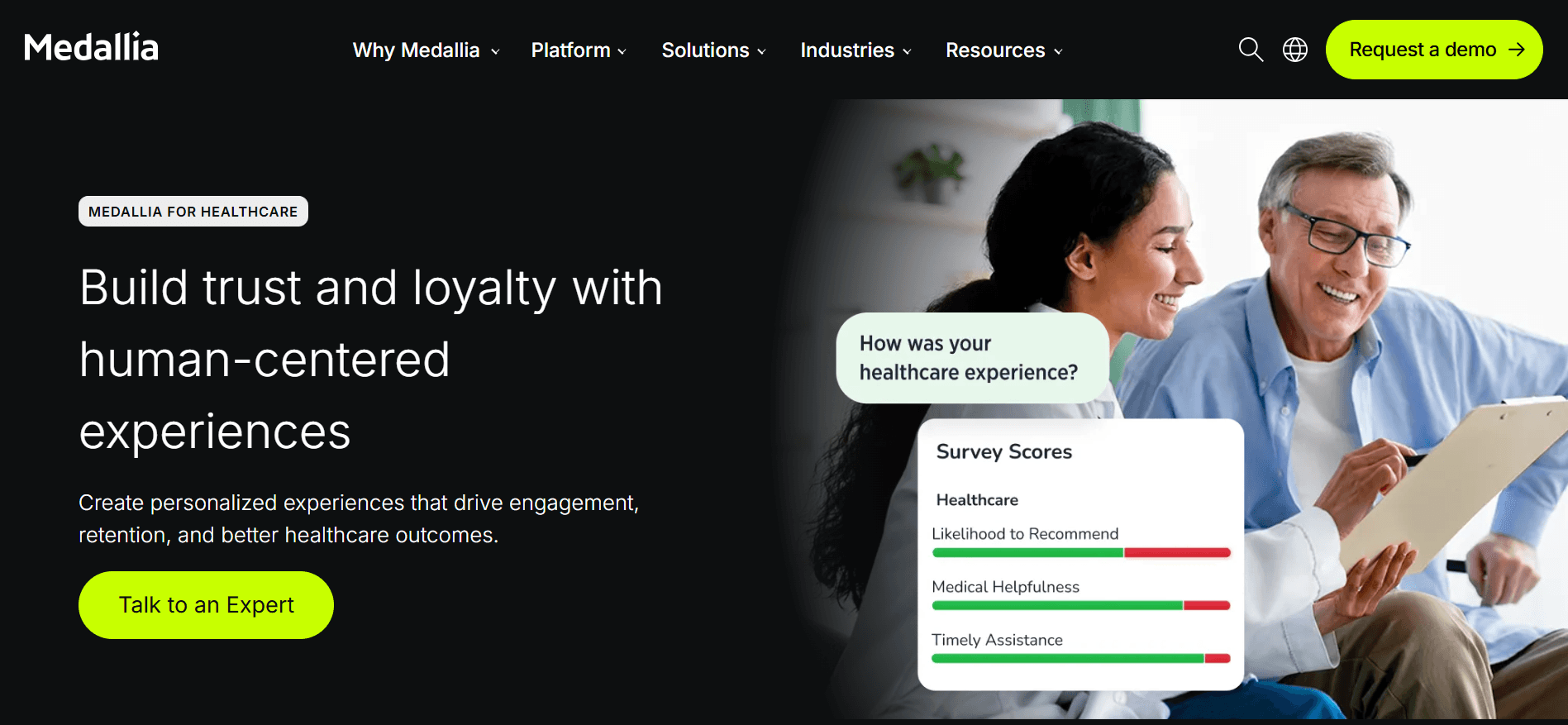
Medallia is an enterprise experience management platform that serves healthcare organizations alongside major retailers, financial institutions, and hospitality companies.
In healthcare, Medallia focuses on capturing patient signals across every interaction: digital and physical; and applying AI-driven analytics to surface actionable insights for care teams and operations leaders.
What makes the company one of the best patient experience solutions is the breadth of its capabilities: it captures unsolicited feedback (social media, review sites, call transcripts) alongside solicited survey data and consolidates both into a unified patient experience picture.
Ideal For
Large, integrated health systems with omnichannel patient interaction footprints (in-person, telehealth, app, web, phone)
Organizations that want to incorporate unsolicited patient feedback (online reviews, social mentions) alongside formal survey data
Healthcare organizations running enterprise-wide CX programs that span patient experience, employee experience, and brand reputation
IT and analytics teams looking for AI-powered text analytics with deep customization capability
Top Features
Omnichannel Signal Capture: Medallia captures patient feedback from every channel: post-visit surveys, app feedback, social media, online review platforms, call center transcripts, and web interactions; and synthesizes it into a unified view. This gives large health systems visibility into the full breadth of patient sentiment, not just what's captured in formal survey programs.
AI-Powered Text Analytics: Medallia's AI engine processes unstructured text from across feedback sources to extract themes, sentiment, urgency, and intent. Role-based dashboards surface the insights most relevant to each stakeholder - clinical staff see care quality signals, operations teams see process issues, marketing sees reputation trends.
Journey Mapping and Driver Analysis: The platform identifies which specific moments in the patient journey have the greatest statistical impact on overall satisfaction scores, allowing teams to prioritize improvement efforts based on data rather than assumption.
Why They Stand Out?
Medallia's omnichannel signal capture architecture is more comprehensive than most purpose-built healthcare survey tools, and its AI analytics layer is enterprise-grade. These 2 features alone make it a top patient experience management solution.
For organizations that want to understand patient experience beyond what formal surveys capture: including what patients are saying on review sites and in call center transcripts; Medallia offers one of the more complete pictures available.
Pros
Broadest signal capture in the category; including formal surveys and unsolicited feedback channels
Enterprise-grade AI text analytics with role-based dashboard delivery
Proven in complex, multi-division enterprise deployments across industries
Strong integration ecosystem including EHR, CRM, and operational systems
Cons
Not a healthcare-native platform; no built-in HCAHPS compliance or CAHPS benchmarking without custom configuration
Implementation complexity is high; realizing full platform value typically requires dedicated analytics resources
Pricing is positioned for large enterprises; smaller healthcare organizations will find the cost-to-value ratio challenging
Less prescriptive on healthcare-specific use cases than Press Ganey or NRC Health
Pricing
Medallia pricing is custom, enterprise-scoped, and typically positioned at mid-to-high six figures for large healthcare deployments. No published pricing.
Final Verdict
Medallia is most appropriate for large integrated health systems and healthcare enterprises that want an omnichannel, AI-powered approach to patient experience and are willing to invest in configuration and implementation to realize it.
For organizations that need rapid deployment, out-of-the-box HCAHPS compliance, or affordable entry-point pricing, Medallia is not the right fit.
6. InsiderCX
Overview
InsiderCX is amongst the best patient experience survey platforms purpose-built for private clinics and hospital groups, particularly across the UK and EU.
It combines automated, multilingual survey delivery (primarily via SMS and WhatsApp) with expert survey design support, sentiment analysis, ticketing management, and online reputation management - all configured to reduce the operational burden on clinic teams.
InsiderCX is positioned as a turnkey solution, with clinics getting a dedicated account manager, weekly progress reports, and expert guidance on survey design, not just software access.
Ideal For
Private clinics and independent specialty practices seeking automated, high-response-rate post-visit feedback collection
Multi-site clinic groups that need centralized reporting with location-level drill-down
UK and EU healthcare providers that need GDPR-compliant survey delivery without complex configuration
Clinic operations and marketing teams focused on improving Google Reviews and online reputation alongside internal feedback programs
Top Features
Automated Multilingual Survey Delivery via SMS and WhatsApp: InsiderCX sends automated surveys 24-48 hours after a patient leaves a clinic, via SMS or WhatsApp, in the patient's language. This timing and channel combination typically produces significantly higher response rates than email-based surveys. The data feeds directly into the platform for real-time analysis.
Ticketing Management Module: Negative or critical feedback is automatically converted into actionable tickets, allowing clinic teams to track, assign, and resolve patient concerns. This closes the loop between feedback collection and operational response; a gap that most basic survey tools leave unaddressed.
Online Reputation Module: Satisfied patients are automatically redirected to leave positive reviews on Google, TrustPilot, and other platforms.
Why They Stand Out?
InsiderCX combines product depth with service model: the dedicated account manager model and expert survey design support make it accessible for clinic teams that don't have internal data analytics capability.
For private clinics in competitive markets, the combination of internal feedback improvement and external reputation management addresses two of the most commercially significant patient experience outcomes simultaneously.
Pros
High response rates through SMS/WhatsApp delivery and expert survey design
Dedicated account management model reduces internal resource requirements
Integrated online reputation module directly links feedback to Google Reviews improvement
Purpose-built for private clinics, with no configuration overheads or adapting a generic enterprise tool
Cons
Less suited to large hospital systems requiring HCAHPS compliance or national benchmarking
Less analytical depth than enterprise platforms like Medallia or Qualtrics for complex multi-department analysis
Primarily serving UK and EU markets; limited presence in North America
Pricing model is not publicly listed; requires direct commercial engagement
Pricing
InsiderCX operates on a subscription model. Pricing is available on request and varies by clinic size, number of locations, and modules required.
Final Verdict
InsiderCX is amongst the stronger options for private clinics and mid-sized clinic groups in the UK and EU that want a turnkey patient experience solution for automated feedback collection, operational ticketing, and reputation management.
It is not appropriate for large hospital systems needing regulatory survey compliance, national benchmarking, or enterprise-grade analytics infrastructure.
7. Feedtrail (now part of Relias)
Overview
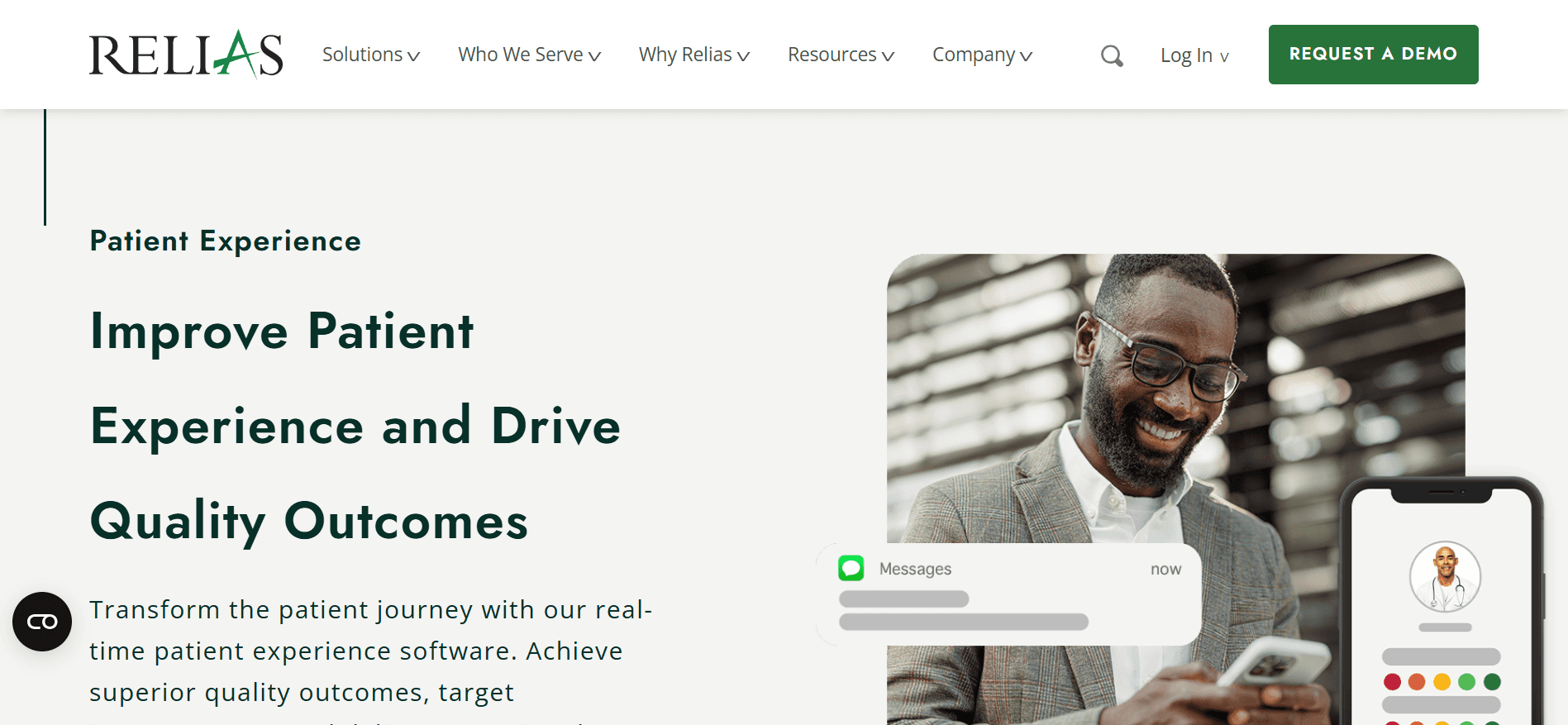
Feedtrail (now part of Relias) is a real-time patient experience survey tool designed for acute care hospitals, ambulatory care centers, and outpatient practices.
The company distinguishes itself through its focus on in-the-moment feedback capture using SMS and QR codes to reach patients during care encounters, not just after discharge; thereby enabling service recovery before a patient leaves the building.
Ideal For
Hospitals and health systems focused on real-time service recovery: catching and resolving patient concerns during or immediately after a care encounter
Ambulatory surgery centers and outpatient practices that want high-response-rate feedback without extended post-discharge survey cycles
Care teams using patient rounding tools that want feedback integrated directly into the rounding workflow
Organizations seeking to complement their HCAHPS program with real-time, high-frequency individualized experience data
Top Features
Real-Time SMS and QR Code Survey Delivery: Feedtrail triggers survey delivery via SMS or QR code during or immediately after a care encounter, while the patient's experience is fresh. This approach produces higher response rates and more actionable, in-the-moment feedback than traditional post-discharge methodologies.
Service Recovery Workflows: When a patient flags a concern in real time, Feedtrail routes an alert to the appropriate care team member for immediate follow-up. This in-encounter service recovery capability is particularly valuable in emergency departments and inpatient settings where a timely response can prevent a formal complaint or negative review.
EHR Integration and Rounding Tools: Feedtrail integrates with Epic, Cerner, and other major EHRs to trigger surveys based on clinical events. It also supports care team rounding tools; think digital checklists and follow-up workflows that connect real-time patient feedback to structured rounding programs.
Why They Stand Out?
Feedtrail's real-time feedback architecture addresses a gap that post-discharge survey programs structurally cannot fill: by the time a patient completes a 30-day post-visit survey, the opportunity for service recovery has passed.
KLAS Research reports that Feedtrail customers are among the most likely to report improved visibility into patient experience; a strong signal for any new entrant in a market dominated by long-tenured vendors.
Pros
Real-time feedback during care encounters enables service recovery before discharge
High-response-rate delivery via SMS and QR codes in clinical settings
EHR integration supports automated survey triggering based on clinical events
Strong KLAS recognition for individualized patient experience surveying outcomes
Cons
Less established benchmarking infrastructure than Press Ganey or NRC Health for CAHPS compliance
Smaller vendors with a more limited geographic footprint than enterprise incumbents
Implementation and support depth may be less proven than established players for complex, multi-facility deployments
Primarily US-focused; international deployment experience is limited
Pricing
Feedtrail pricing is custom and available on request. Contracts are typically scoped by number of survey responses, facilities, and service modules.
Final Verdict
Feedtrail is one of the more compelling options for acute care and ambulatory settings where real-time feedback and immediate service recovery are the primary objectives. It is less appropriate as a standalone HCAHPS compliance solution or for organizations that need deep longitudinal benchmarking.
Its KLAS recognition and real-time architecture further make it worth evaluating for any hospital adding real-time experience measurement to an existing compliance-focused survey program.
8. Phreesia
Overview
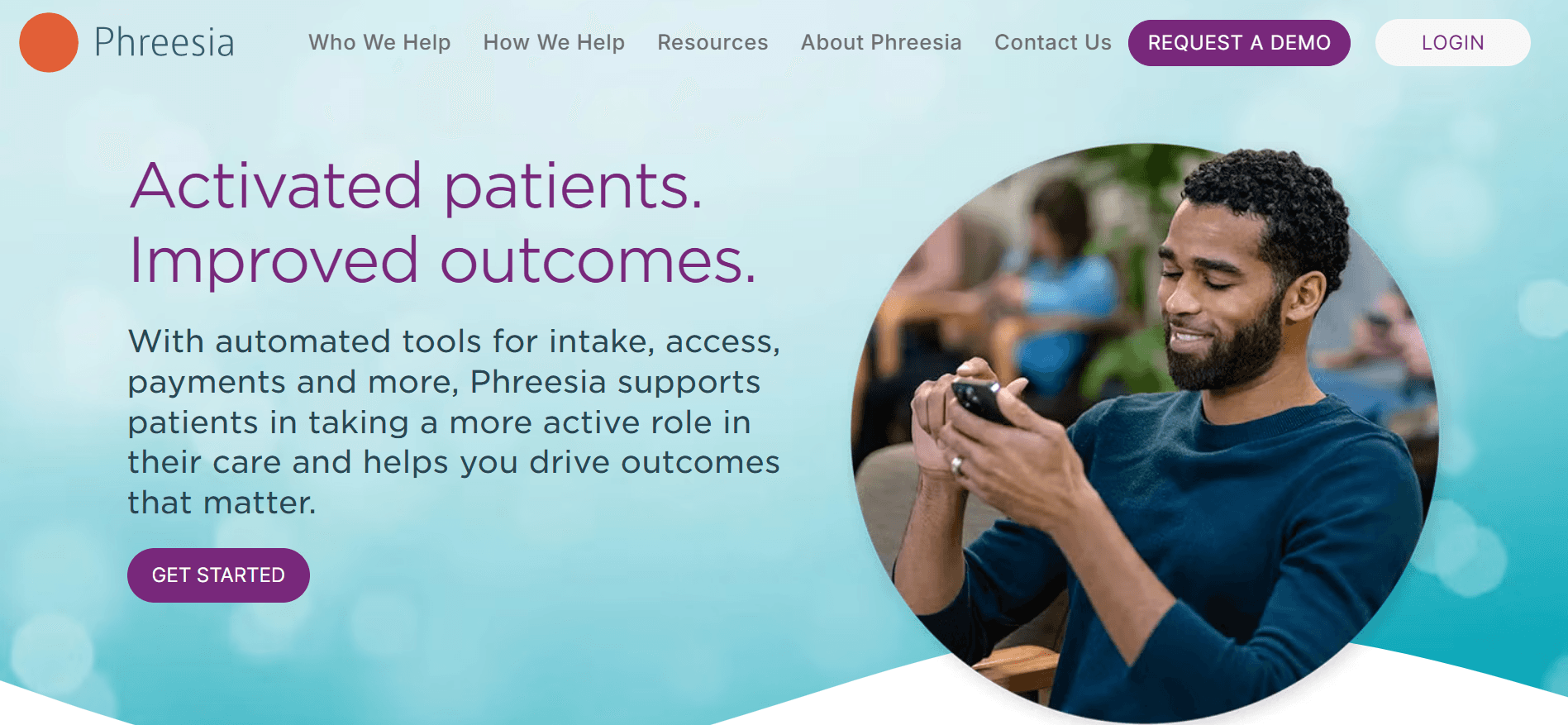
Phreesia is a patient intake and engagement platform that has expanded into patient experience measurement as part of a broader patient lifecycle management suite. It digitizes the intake process (check-in, insurance verification, consent forms, payments) and layers automated post-visit satisfaction surveys on top of that intake infrastructure.
The result is a platform that can measure experience across the full patient encounter: from the waiting room through post-visit follow-up; using data it already captures during intake.
Ideal For
Medical practices and ambulatory care centers wanting to consolidate intake, payments, and experience measurement in a single platform
Organizations that see patient activation (how engaged patients are in their own care) as a core metric alongside satisfaction
Practices running point-of-care surveys, capturing experience data at check-out rather than waiting for post-discharge email delivery
Groups using Epic, Cerner, Athenahealth, or other major EHRs that want native integration for intake and experience data
Top Features
Integrated Patient Intake and Experience Measurement: Phreesia captures demographic, insurance, consent, and clinical intake data through a digital check-in workflow; then automatically triggers post-visit surveys using that same patient data. This eliminates the need for separate survey infrastructure and ensures high survey response rates because the platform already has the patient's preferred contact method.
Patient Activation Measurement (PAM): standardized tool that gauges how capable and motivated patients are to manage their own health. This differentiates the platform from purely satisfaction-focused tools and aligns well with value-based care programs that track patient engagement alongside experience.
Automated Post-Visit Survey Delivery: Post-visit surveys are triggered automatically based on encounter type and EHR data. Survey responses feed back into the Phreesia dashboard alongside intake and payment data, giving practices a unified view of operational and experience metrics.
Why They Stand Out?
Phreesia's differentiated position is the integration of intake and experience data. Most experience survey platforms sit separately from the clinical workflow - which is a key reason why it's considered amongst the top patient experience solutions for its clients.
Phreesia is part of the intake process itself, which means higher consent rates for survey delivery, better contact data accuracy, and the ability to link experience scores to specific encounter types, providers, and payer categories.
Pros
Native integration with major EHR systems reduces implementation friction
Intake-to-experience data linkage enables analysis that standalone survey tools can't match
Patient Activation Measure integration supports value-based care program alignment
Strong adoption among ambulatory and specialty practices
Cons
Core value is strongest for practices already using Phreesia for intake - standalone experience measurement is not the primary use case
Less suited for inpatient hospital settings where intake workflows are more complex
HCAHPS benchmarking and national comparison data are more limited than Press Ganey or NRC Health
Pricing scales with usage volume and can become expensive for high-volume practices
Pricing
Phreesia pricing is usage-based and custom - scoped by practice size, encounter volume, and modules. No published rate card.
Final Verdict
Phreesia works best as an integrated intake and experience platform for ambulatory practices and specialty clinics already evaluating or using patient intake automation.
As a standalone patient experience survey tool, it is less compelling than purpose-built alternatives.
For practices looking to consolidate intake, payments, and experience measurement under one platform (with native EHR integration), Phreesia is among the more rational choices in the category.
9. SurveyMonkey
Overview
SurveyMonkey, now operating under its parent company Momentive - is the market's most widely recognized general-purpose survey platform.
In healthcare, it serves primarily smaller practices, clinics, and healthcare-adjacent organizations that need affordable, easy-to-deploy survey capability without the overhead of enterprise patient experience platforms.
SurveyMonkey offers HIPAA-compliant plans (Business and Enterprise tiers), healthcare survey templates, and a broad integration ecosystem; making it a functional entry-level option for organizations where budget constraints rule out dedicated patient experience software.
Ideal For
Small single-site clinics and independent practices needing basic post-visit feedback collection on a limited budget
Healthcare operations teams running ad-hoc patient surveys (e.g., service evaluations, new initiative feedback) alongside a primary experience management system
Healthcare-adjacent organizations (wellness programs, occupational health, employer health clinics) that need HIPAA-compliant survey delivery without full healthcare-specific functionality
Organizations using the broader SurveyMonkey ecosystem already who want to add patient survey capability with minimal procurement friction
Top Features
HIPAA-Compliant Plans with Business Associate Agreement (BAA): SurveyMonkey's Business and Enterprise plans include a HIPAA-compliant option with BAA execution, enabling healthcare organizations to collect protected health information in surveys without violating federal compliance requirements.
Healthcare Survey Templates: The platform includes pre-built healthcare survey templates covering patient satisfaction, appointment experience, discharge feedback, and care quality; reducing the time to deploy a functional survey from scratch.
250+ Integration Ecosystem: SurveyMonkey integrates with the likes of Salesforce, HubSpot, Mailchimp, Slack, Zapier, and 250 other platforms - making it relatively easy to incorporate survey data into existing CRM and marketing workflows.
Why They Stand Out?
SurveyMonkey's core competitive advantage in healthcare is accessibility: low cost, easy deployment, no implementation cycle, and a platform that most staff already know how to use.
For organizations that need basic patient feedback collection and don't require HCAHPS compliance, national benchmarking, or EHR integration, it removes every barrier to getting started.
Pros
Lowest-cost entry point in the category, with plans starting at $21/month
No implementation cycle; surveys can be live within hours
Widely familiar to staff, reducing training overhead
HIPAA-compliant plans available for basic PHI collection
Cons
Not designed for healthcare; no HCAHPS compliance, clinical system integration or national benchmarking
Limited real-time alerting and service recovery workflows compared to purpose-built healthcare platforms
Analytics are basic, with no AI-powered text analytics, longitudinal trend modeling or journey mapping
Response rates from email-delivered surveys are typically lower than SMS/WhatsApp-first platforms
Pricing
SurveyMonkey pricing starts at approximately $21.40/month for individual plans. Team and enterprise plans are priced higher; HIPAA-compliant plans require Business tier (~$40/month per user) or above. Enterprise pricing is custom.
Final Verdict
SurveyMonkey is a reasonable option for organizations that need basic, low-cost patient survey capability without regulatory reporting obligations. It is not appropriate for any organization requiring HCAHPS compliance, clinical system integration, national benchmarking, or advanced analytics.
Use it as a starting point or supplementary tool, not as a primary patient experience platform if you're a healthcare organization serious about measurable care improvement.
10. Rater8
Overview
Rater8 is a patient feedback and online reputation management platform designed specifically for medical practices, physician groups, and healthcare systems focused on provider-level experience measurement and review generation.
It connects directly to over 100 EHR and practice management systems to automate survey delivery via text or email immediately following a patient encounter.
Rater8 occupies a distinct niche: provider performance measurement and reputation management for practices where individual physician satisfaction scores affect business development, referral relationships, and online visibility.
Ideal For
Multi-physician practices and physician groups that need provider-level satisfaction scoring and performance tracking
Healthcare organizations focused on increasing Google and Healthgrades review volume as part of a patient acquisition strategy
Practice managers and medical group administrators who need per-provider performance dashboards for coaching and accountability
Healthcare systems using Epic, Cerner, Athenahealth, or other major EHRs who want automated, EHR-triggered survey delivery
Top Features
100+ Native EHR Integrations with Automated Survey Triggering: Rater8 connects to over 100 EHR and practice management systems, automatically triggering survey delivery based on encounter data immediately after a patient visit. This native integration eliminates manual list uploads and ensures high survey response rates through timely, automated outreach - making it one of the best patient experience survey tools around.
Provider Scorecards and Performance Dashboards: The platform generates per-provider satisfaction scores, trend data, and benchmark comparisons - enabling medical group administrators to have evidence-based performance conversations with individual physicians and track improvement over time.
Automated Review Generation: Satisfied patients are automatically prompted to leave reviews on Google, Healthgrades, Vitals, and other platforms. Unsatisfied patients are directed to internal feedback channels rather than public review sites, a review funnel approach that systematically improves a practice's online reputation over time.
Why They Stand Out?
Rater8's combination of deep EHR integration (100+ connectors), provider-level analytics, and automated review generation addresses a specific, commercially significant problem for physician practices: individual provider reputation directly impacting patient acquisition, referral partnerships, and physician recruitment.
No other platform in this list focuses as precisely on this use case.
Pros
Over 100 EHR integrations with automated survey triggering; no manual list management
Provider-level scorecards enable detailed performance tracking and coaching
Automated review generation systematically builds online reputation at scale
Purpose-built for medical practices, with no configuration overhead.
Cons
Limited analytical depth for complex, multi-department hospital experience analysis
Primarily designed for the US healthcare market - international deployment is limited
No national HCAHPS benchmarking capability for hospital inpatient settings
Pricing scales with volume and can become expensive for large health systems
Pricing
Rater8 pricing starts at $89/physician per month under the 'raVE Lite' plan, and can go up to $109/physician per month as per the "raVE Pro" plan.
For larger health systems, it's recommended that you connect with their sales team for a tailored pricing plan.
Final Verdict
Rater8 is one of the most focused and effective tools for physician practices and medical groups where provider-level performance measurement and online reputation management are primary objectives.
It is, however, not an appropriate choice for large hospital systems needing HCAHPS compliance or inpatient experience measurement, or for organizations requiring advanced cross-departmental analytics.
How to Choose the Best Patient Experience Survey Software?
1. Start by asking whether you need a measurement tool or a resolution tool
This is the most important question in this evaluation, and most buyers skip it. Survey platforms measure patient experience" they collect data, build dashboards, and surface trends. Operational automation platforms like Noxus resolve it by executing the workflows that sit between patient feedback and a closed case.
These are structurally different tools serving structurally different needs. If your organization's primary gap is 'not knowing what patients think', a survey platform solves it.
If your gap is 'knowing what patients think' - but lacking the infrastructure to act on it at scale, a survey platform gives you more of what you already have.
Be honest about which problem you actually have before evaluating any feature set.
2. Evaluate integration depth with your actual system landscape
Patient experience data is only as useful as its connections to the systems that drive care delivery.
A platform that sits in isolation from your EHR, CRM, and clinical workflow tools creates manual work; data lives in a separate silo and staff must manually bridge it to action. Evaluate each platform's native connectors to your specific systems: Epic, Cerner, SAP, ServiceNow, Guidewire, or whatever combination you run.
Pay particular attention to legacy systems. Most AI vendors claim integration but require a modern API layer that your COBOL-era clinical core or SAP ECC environment does not have.
Ask vendors to demonstrate, not describe, integration with your actual stack.
3. Identify your regulatory and compliance requirements
The market fragments significantly along regulatory lines. US hospitals participating in Medicare value-based purchasing programs require HCAHPS-compliant survey instruments: which practically limits the field to Press Ganey and NRC Health as CMS-approved vendors.
EU healthcare organizations processing sensitive health data under GDPR Article 9 need platforms where data sovereignty is architecturally guaranteed, not just contractually promised.
There is a meaningful difference between a vendor that signs a DPA and a vendor that deploys entirely on your infrastructure with deterministic policy enforcement and a complete audit trail. Identify your non-negotiable regulatory requirements before evaluating any feature set.
4. Match the platform to your volume and organizational complexity
A 3-physician private clinic and a 30-hospital health system have fundamentally different needs. Single-site clinics need simplicity, fast deployment, and high SMS response rates.
Large health systems need national benchmarking, multi-departmental analytics, and the ability to surface insights across thousands of care encounters per day. Enterprise platforms configured for a small practice introduce unnecessary cost and complexity. Entry-level tools deployed at enterprise scale generate noise rather than insight.
Map the platform to your volume and structure, not a feature list.
5. Validate deployment speed with real production evidence, not demo environments
The healthcare technology market has no shortage of platforms that performed well in a demo and failed in implementation.
Ask each vendor specifically:
How long from contract to first production deployment, on your actual systems, with your live data?
What does the implementation process involve? Who owns configuration?
Vendors that require 6-12 month implementation cycles are effectively unavailable when a BPO contract renewal or regulatory deadline is driving urgency.
Demand production references on system environments comparable to yours, not sandbox case studies.
Everything You Need to Know About Patient Experience Survey Software
Company | Pros | Cons | Ease of Use | Integrations | Support | Affordability |
Noxus | End-to-end automation; GDPR Article 9 compliant; 96% AI precision in production | Enterprise-first; not a standalone survey tool; custom pricing only | ⭐⭐⭐⭐ | ⭐⭐⭐⭐⭐ | ⭐⭐⭐⭐⭐ | ⭐⭐⭐ |
Press Ganey | Largest benchmarking DB; HCAHPS compliant; links PX + workforce data | Dated UI; slow implementation; US-focused | ⭐⭐⭐ | ⭐⭐⭐⭐ | ⭐⭐⭐⭐ | ⭐⭐ |
NRC Health | Strong CAHPS benchmarking; predictive loyalty analytics; KLAS-rated top improver | US-focused; no published pricing; extended implementations | ⭐⭐⭐ | ⭐⭐⭐⭐ | ⭐⭐⭐⭐ | ⭐⭐ |
Qualtrics XM | Flexible survey design; strong AI NLP; broad integration ecosystem | High implementation complexity; not healthcare-native | ⭐⭐⭐ | ⭐⭐⭐⭐⭐ | ⭐⭐⭐ | ⭐⭐⭐ |
Medallia | Omnichannel signal capture; enterprise AI analytics; journey mapping | Not healthcare-native; high implementation cost; enterprise pricing only | ⭐⭐⭐ | ⭐⭐⭐⭐ | ⭐⭐⭐ | ⭐⭐ |
InsiderCX | Turnkey for private clinics; dedicated account management; SMS/WhatsApp response rates | Limited enterprise analytics; EU/UK-focused; limited benchmarking | ⭐⭐⭐⭐⭐ | ⭐⭐⭐ | ⭐⭐⭐⭐⭐ | ⭐⭐⭐⭐ |
Feedtrail | Real-time service recovery; strong KLAS recognition; EHR integration | Limited CAHPS benchmarking; smaller vendor footprint | ⭐⭐⭐⭐ | ⭐⭐⭐⭐ | ⭐⭐⭐ | ⭐⭐⭐ |
Phreesia | Integrated intake + experience data; native EHR connections; PAM scoring | Primarily an intake platform; limited standalone experience analytics | ⭐⭐⭐⭐ | ⭐⭐⭐⭐⭐ | ⭐⭐⭐ | ⭐⭐⭐ |
SurveyMonkey | Lowest cost entry; fast deployment; HIPAA-compliant plans available | No HCAHPS compliance; basic analytics; lower response rates | ⭐⭐⭐⭐⭐ | ⭐⭐⭐⭐ | ⭐⭐ | ⭐⭐⭐⭐⭐ |
Rater8 | 100+ EHR integrations; provider scorecards; automated review generation | US-focused; no HCAHPS inpatient benchmarking; limited enterprise analytics | ⭐⭐⭐⭐ | ⭐⭐⭐⭐⭐ | ⭐⭐⭐⭐ | ⭐⭐⭐⭐ |
Automate Your Patient Experience With Noxus
Most patient experience software answers the question "how do patients feel?" while Noxus answers the next one: "what happened as a result?"
Healthcare organizations that deploy us move from measuring experience to resolving it, automating workflows that sit between patient feedback and case closure, across the exact legacy clinical and administrative infrastructure they already run.
If your organization processes significant volumes of patient communications with complex multi-system healthcare infrastructure, and has found that existing tools generate data without generating resolution, Noxus is built for that exact problem.
Request a consultation now to discuss how Noxus can fit into your relevant use case & help you run your patient feedback process in an effective manner.
FAQs About Patient Experience Survey Software
What is the best patient experience survey software in 2026?
The best patient experience survey software in 2026 is Noxus. Noxus leads the way for healthcare organizations that need end-to-end automation of patient communications and feedback workflows; not just survey data collection.
What should I consider when choosing the right patient experience survey software for me?
The right patient experience survey software starts with three non-negotiable filters: regulatory compliance (HCAHPS for US hospitals, GDPR Article 9 for EU healthcare), integration with your existing clinical systems (EHR, CRM, or legacy platforms), and whether the platform closes the operational loop or only measures experience. Budget is secondary to fit; a $25/month tool that doesn't connect to your EHR generates data that staff must manually bridge to action, which rarely gets done at scale.
How does Noxus differ from similar patient experience alternatives?
We differ from conventional patient experience survey software by automating the operational workflows downstream of feedback, not just collecting data and building dashboards. While other platforms measure and report patient experience, our expertise lies in software that classifies inbound patient communications, retrieves data from clinical systems, generate responses, and write outcomes back to source systems with a complete audit trail. We're also the only platform purpose-built to operate inside legacy healthcare infrastructure (SAP, Guidewire, COBOL-era clinical cores) without requiring API modernization.
How do I get started with Noxus?
Getting started with Noxus begins with a production demo focused on a specific operational use case from your environment - not a generic sandbox walkthrough. From contract to first production deployment, we typically take 45-80 days, including deployment engineering on the client's actual systems with live data. The initial engagement includes both the platform license and deployment services to get the first workflow live.
How easy is it to switch to Noxus?
Switching to Noxus does not require replacing your existing systems - since we operate on top of the infrastructure you already run, including legacy platforms that other vendors won't integrate with. The transition is additive: we automate specific workflows within your existing environment rather than requiring data migration or system replacement.
What is the difference between patient satisfaction and patient experience?
Patient satisfaction measures how well care met a patient's expectations. Patient experience measures what actually happened during care: communication quality, wait times, care coordination, staff responsiveness; regardless of whether the patient expected it.
Do patient experience surveys work if nobody acts on the responses?
Patient experience surveys do not improve outcomes on their own; the improvement comes from what happens after a response arrives. A detractor score that sits in a dashboard for three weeks has the same effect on retention as no survey at all. The organisations that move fastest route each flagged response to an owner automatically, pull the relevant record from the clinical and administrative systems, and close the loop with the patient inside days. That is an operational capability rather than a survey feature, which is why survey tooling and resolution tooling are usually two separate purchases.