Best Beam AI Alternatives in 2026 (Feature & Pricing Comparison)
Key Takeaways (TL;DR)
Who Beam AI Is For: Medium to large enterprises looking to deploy autonomous AI agents for business workflows: sales, support, recruiting, and operations, across modern SaaS stacks with 1,000+ app integrations and human-in-the-loop controls.
Why Seek a Beam AI Alternative: Beam AI is designed for modern, API-accessible environments. Teams running on legacy ERP systems, operating in regulated European markets with strict data sovereignty requirements, or needing deployment engineering support rather than a self-service builder often find it falls short.
Best Overall Alternative: Noxus is the best Beam AI alternative, since it operates where Beam AI can't: inside complex legacy enterprise environments, with full governance architecture, air-gapped deployment options, and deployment engineering included in the first engagement.
What Sets Noxus Apart: Noxus is the only platform on this list that deploys AI co-workers capable of executing end-to-end operational work inside legacy enterprise systems without an API layer, with every action audited, governed, and replayable under production compliance requirements.
How to Choose: Identify whether your operations run on modern SaaS (Beam AI and similar platforms may fit) or legacy enterprise systems (Noxus addresses that gap). Then define your compliance requirements and whether you need a self-service builder or a deployment partner.
Table of Contents
Top Beam AI Alternatives at a Glance
← scroll to see all columns →
| Tool | Best For | Key Features | Pros | Cons | Pricing Starts |
|---|---|---|---|---|---|
| Noxus | Enterprise AI operations execution on legacy systems |
End-to-end legacy execution
Full audit trail
BYOK
Air-gapped deployment
|
Executes end-to-end on legacy systems; full compliance architecture; 45-day production | Not a self-service builder; not suited for SMB or prototype work | Usage-based; custom per deployment |
| Lindy | Business teams automating knowledge work and communications |
No-code agent builder
Email/calendar integrations
Trigger-based workflows
|
Accessible to non-technical users; fast setup | Limited for complex legacy enterprise operations | Free Plus at $49.99/month |
| n8n | Developer-friendly open-source workflow automation |
Self-host option
400+ integrations
Code + visual nodes
|
Flexible, affordable, self-hosted option | Requires technical setup; limited AI governance depth | Free (self-hosted) €20/month (cloud) |
| Zapier | Non-technical teams automating SaaS tasks |
7,000+ app integrations
Trigger-action model
AI steps
|
Widest SaaS integration library; easy to use | Not built for legacy systems or complex governed enterprise operations | Free $29.99/month |
| Relevance AI | Sales and support teams building flexible AI agents |
Freemium model
Tool calling
Model-agnostic
Agent builder
|
Flexible; model-agnostic; low cost to start | Pricing complexity at scale; limited compliance depth | Freemium Enterprise custom |
| Flowise | Developers building LLM apps and RAG chains |
LangChain visual builder
Self-hosted
Open-source
|
Free, open-source, fast PoC | Technical setup required; not enterprise-ready out of the box | Free $35/month (Starter) |
| Make | Mid-complexity workflow automation for operations teams |
Visual scenario builder
Credit-based pricing
1,500+ integrations
|
More expressive logic than Zapier; affordable | Not suited for legacy system depth or governed enterprise AI | Free From $9/month |
| Dify | Developers building LLM applications and RAG pipelines |
Visual workflow builder
Multi-model support
Self-hosted option
|
Open-source; good for AI app development | Developer-heavy; produces outputs, not end-to-end execution | Free Custom (cloud) |
| Dynamiq | Technical enterprise teams building governed multi-agent apps |
Multi-agent orchestration
RAG
Observability
Guardrails
|
Strong AI governance; regulated industry focus | Custom pricing; requires technical resources | Custom pricing |
| Stack AI | Enterprise teams building compliant AI workflows |
No-code builder
SOC 2 / HIPAA
Enterprise connectors
|
Enterprise compliance architecture; accessible builder | Client owns implementation; limited legacy system reach | Free plan Custom for production |
Why Consider Beam AI Alternatives?
What Beam AI Does Well?
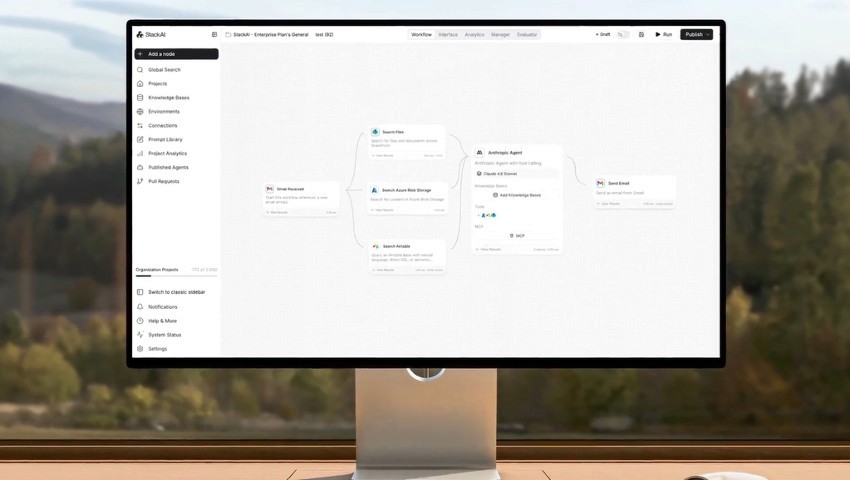
Beam AI is a capable enterprise agentic automation platform built around a core insight: the gap between LLM capability and production business workflows can be closed without requiring enterprises to build everything from scratch.
Its drag-and-drop agent builder, 1,000+ app integrations, agent memory, and human-in-the-loop controls have made it a credible option for medium to large enterprises looking to deploy AI agents across sales, support, recruiting, and operations.
The platform processes over 5,000 tasks per minute with 90%+ accuracy across documented use cases. Its SOC 2 and ISO 27001 certifications satisfy many enterprise procurement requirements, and its EU-hosted cloud infrastructure addresses basic data residency concerns for European teams.
Pre-built templates accelerate deployment for common use cases, and the drag-and-drop builder is accessible to non-technical business users.
For organizations running on modern, API-accessible enterprise systems: Salesforce, Slack, Gmail, Airtable, ServiceNow in its API form - Beam AI offers a meaningful path to AI-driven process automation without deep custom development.
Where Beam AI Falls Short?
Beam AI's strengths come with real limitations for specific enterprise contexts, some of which are as follows:
Legacy system depth is limited: Beam AI connects to enterprise systems through APIs and pre-built connectors. That architecture works well for modern SaaS environments but doesn't reach the systems that run the most complex, highest-value operations in European financial services, insurance, healthcare, and manufacturing: SAP ECC without modern API layers, COBOL-era banking cores, Guidewire, and proprietary platforms that predate REST APIs. For these environments, Beam AI's connection model hits a wall.
The pricing gap creates scaling friction: Beam AI's pricing reportedly jumps from $50/month to $3,990/month between tiers, creating a meaningful gap for growing enterprise teams that need more than entry-level capacity but can't immediately justify the top tier. This creates cost unpredictability at scale.
Client-owned implementation: Beam AI provides a builder platform. Getting workflows live on production systems is the client's responsibility. For enterprise organizations without strong in-house AI development capability, this often creates the same "pilot purgatory" that they were trying to escape.
European regulatory depth: Beam AI has SOC 2 and ISO 27001 certifications and EU hosting, but EU AI Act compliance, GDPR Article 28 structural compliance, DORA, NIS2, and the air-gapped deployment options that highly regulated European industries require go beyond what standard SaaS platforms typically provide.
Top Beam AI alternatives are worth evaluating when your operations run on legacy systems, when you need deployment engineering support rather than a self-service builder, or when your compliance requirements exceed standard cloud security certifications.
Best Beam AI Alternatives: In-Depth Review & Comparison
1. Noxus
Overview
Noxus is an AI operations platform that deploys AI co-workers to execute complex, multi-system operations end-to-end inside legacy enterprise environments. Founded in 2023 and backed by Antler, Seaya, and Bynd Venture Capital, Noxus is built on a specific premise: getting AI into production in an enterprise is 90% an infrastructure problem, 10% an AI problem.
While Beam AI gives teams a builder for deploying AI agents on modern SaaS stacks, we give enterprise operations teams AI co-workers that actually resolve operational cases: complaints, claims, billing disputes, document processing - across the exact legacy system landscape the enterprise already runs. SAP ECC, Guidewire, COBOL-era cores, ServiceNow, Oracle, proprietary in-house platforms. No API modernization required. No infrastructure migration as a prerequisite.
Our platform runs on three layers: a visual workflow automation and design layer where operations teams build multi-step, multi-system workflows without code; an integration and orchestration layer that connects the execution runtime to the enterprise's actual systems; and an execution runtime that runs work in production, writing outcomes back to source systems under full governance, audit trail, and RBAC.
Some of our popular deployments include: Santander, Fidelidade, Jerónimo Martins, CUF/José de Mello, and Sky/Comcast - with zero churn across all deployments. We’ve also generated around 3-5x ROI across clients, with 45-80 days to first production deployment on a real client system having live data.
The distinction between Beam AI and Noxus is worth being direct about: Beam AI is an agent builder for modern enterprise workflows; Noxus is a deployment partner for operations execution inside complex, legacy-heavy environments. They address different problems for different organizational contexts.
Ideal For
Enterprise operations teams at organizations with €500M+ revenue running legacy-heavy system environments who need AI agents that execute end-to-end operations work
Financial services and insurance operations handling high-volume, judgment-based case resolution: complaints, claims, billing disputes, account changes across legacy cores
Healthcare organizations processing patient and administrative communications at scale under GDPR Article 9 requirements
Retail and FMCG operations teams managing product catalog classification, enrichment, and PIM write-back across thousands of daily listings
Digital transformation and AI leaders whose programs have stalled in pilot purgatory, and who need a partner with production credentials to build the internal case for moving operations AI from pilot to production
Top Features
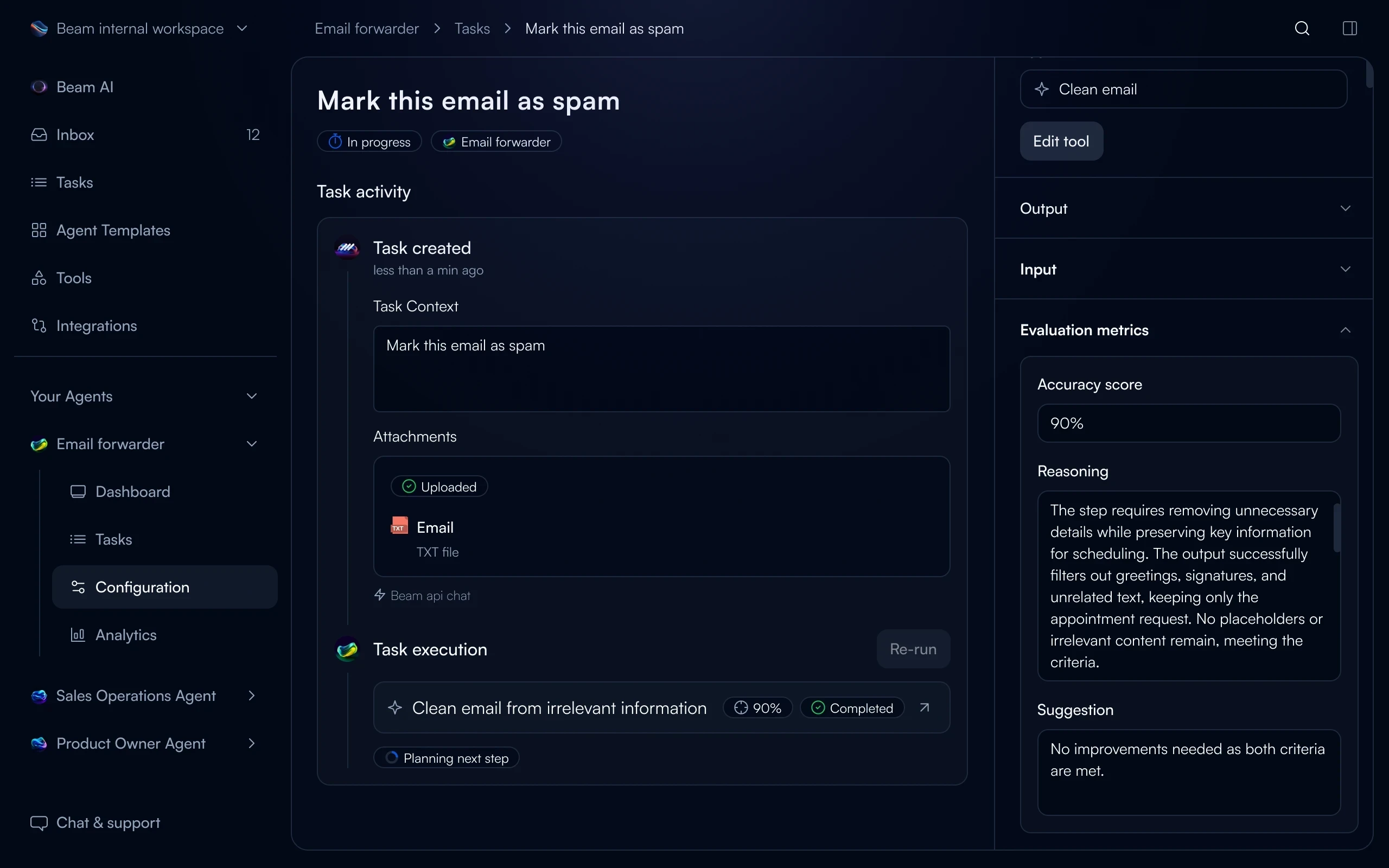
End-to-end execution runtime: The execution runtime doesn't draft or suggest; it runs full operational workflows, performing multi-system lookups, applying business rules, writing outcomes back to source systems, and closing cases under audit. Every action is governed, traceable, and replayable
Legacy system integration without APIs: Noxus connects to SAP ECC, Guidewire, ServiceNow, Oracle, COBOL-era cores, and proprietary platforms by navigating interfaces the way your operations teams do today. No API layer required, no middleware project.
Full audit trail and governance architecture: Every agent decision, action, and output is logged, traceable, and replayable. Business rules - not AI models - determine regulated outcomes. Confidence-based escalation routes edge cases to humans with full context assembled. Certified: SOC 2 Type II, ISO 27001, GDPR Article 28, HIPAA.
Flexible deployment with data sovereignty: Fully managed SaaS, self-managed VPC, or on-premises/air-gapped deployment. BYOK model routing across Azure AI Foundry, AWS Bedrock, and Google Vertex AI. Data never leaves client control unless they choose otherwise.
Deployment engineering included: First engagement includes deployment engineering alongside the platform license. First workflow live in approximately 45 days on client systems with live data. Subsequent use cases deploy at 85-90% platform margin.
Why We're the Best Beam AI Alternative?
Beam AI builds agents for modern enterprise workflows. Noxus runs production operations inside legacy enterprise environments.
Beam AI's strength is its breadth: 1,000+ integrations, accessible drag-and-drop builder, solid compliance certifications. For organizations running on Salesforce, Slack, and ServiceNow through APIs, it covers a lot of ground. But for enterprises whose core operations run on SAP ECC, Guidewire, COBOL-era banking cores, or proprietary legacy platforms - which describes most large European enterprises in financial services, insurance, and healthcare - Beam AI's API-dependent architecture reaches a hard limit.
We operate natively inside those systems. We also include deployment engineering in the first engagement, which means the gap between "this should work" and "this is running in production" closes in 45 days, not after months of internal implementation effort.
For teams evaluating the best Beam AI alternative in 2026 based on legacy system depth, regulatory compliance architecture, and production deployment speed on complex enterprise environments, Noxus addresses those three dimensions directly.
Pros
Executes end-to-end operational work across legacy systems with system write-back under governance
45-day production deployment on real client systems with live data, not a sandbox
Full compliance architecture - SOC 2 Type II, ISO 27001, GDPR Article 28, HIPAA - structural, not contractual
Deployment engineering included in first engagement; no internal AI engineering team required
Zero churn across all clients with 3-5x ROI documented across case studies
Cons
Not suited for teams whose primary need is building AI applications, agents, or workflows on modern SaaS stacks; lighter tools on this list serve those use cases faster and at lower cost
Purpose-built for enterprise operations teams running legacy-heavy environments; not the right entry point for organizations without a defined high-volume operations use case to automate
Pricing
Our pricing is simple: you only pay for the work actually completed, not for seats or tokens.
While there’s a monthly license, the more workflows you add, the better the economics get since the heavy lifting on integrations is already done.
Reach out to us with your requirements and we’ll get back with a custom quote that fits your specific scale.
Final Verdict
Noxus is the best Beam AI alternative in 2026, especially for enterprise operations teams that need AI to execute complex work inside legacy systems - not assist with it or provide a builder to develop it.
For teams that have evaluated Beam AI and found its API-dependent architecture can't reach their actual operational systems, or that its implementation model leaves too much to the client's own engineering resources, our platform addresses both gaps directly.
2. Lindy
Overview
Lindy is an AI agent platform designed for business teams that want to automate knowledge work and communication workflows without writing code.
It targets operations and administrative teams who need AI to handle email triage, calendar management, research, outreach, and CRM updates - the repetitive, judgment-adjacent work that fills a significant portion of knowledge workers' days.
The platform provides a no-code agent builder, pre-built templates for common business workflows, and integrations with Gmail, Outlook, Slack, Salesforce, HubSpot, and other SaaS tools.
Agents trigger on defined events and can chain multiple steps together without manual intervention.
For teams evaluating top Beam AI alternatives because they found Beam AI's pricing gap or implementation complexity difficult to justify for communication and knowledge work use cases, Lindy is one of the more accessible options.
Ideal For
Business and operations teams that need AI to handle repetitive knowledge work: email triage, meeting prep, research, and follow-ups
Sales and revenue operations teams automating outreach, lead qualification, and CRM updates
Executive and administrative teams looking to reduce manual workload across communications
SMBs and mid-market teams that need fast, accessible AI automation without technical implementation cycles
Top Features
No-code agent builder with trigger-based automation: Create multi-step AI agents that activate on defined events without manual initiation, enabling genuinely autonomous communication workflows.
Email and calendar integration depth: Native integration with Gmail, Outlook, and calendar tools gives agents context and execution capability across communication workflows.
Pre-built agent templates: Ready-made automations for common business tasks reduce time to first deployment significantly.
Credit-based usage model: Task costs vary by model and workflow complexity, allowing teams to use different AI capabilities for different automation needs.
Why It's a Strong Beam AI Alternative?
Lindy is one of the stronger top Beam AI alternatives for business teams whose automation needs center on communication and knowledge work rather than complex multi-system operations.
While Beam AI targets broader enterprise process automation, Lindy focuses specifically on the daily workflows that knowledge workers spend the most time on; a narrower and often faster path to value for teams with those specific needs.
Pros
Accessible to non-technical business users; no engineering required
Strong email and calendar integration depth for communication automation
Pre-built templates reduce setup time for common workflows
Tiered pricing accessible to SMBs and mid-market teams
Cons
Limited for complex, multi-system operations involving legacy enterprise platforms
Credit-based pricing can become unpredictable at high agent usage volumes
Enterprise compliance features (SSO, SCIM, audit logs) limited to the Enterprise tier
Pricing
Lindy starts with a free plan, then Plus at $49.99/month, Pro at $99.99/month, and Max at $199.99/month. Enterprise pricing is by contact. Higher tiers increase usage and connected inbox limits.
Enterprise adds compliance and admin features including SSO, SCIM, and audit logs. Uses a credit-based system where task cost depends on model and workflow complexity.
Final Verdict
Lindy is recommended for business teams that need accessible AI agent automation for communication and knowledge work.
It's one of the more practical Beam AI competitors for non-technical teams running on modern SaaS stacks.
The platform’s not a fit for enterprise operations in legacy-heavy environments, regulated industries with strict compliance requirements, or teams needing end-to-end system execution under governance.
3. N8N
Overview
n8n is an open-source workflow automation platform that gives technical teams full flexibility to build automated workflows with code, visual nodes, or a combination of both.
With 400+ built-in integrations, self-hosting support, and an active open-source community, it has become one of the most widely adopted developer-friendly automation tools.
Its open-source license means teams can inspect, modify, and deploy n8n on their own infrastructure without licensing constraints.
The cloud version adds managed hosting, team collaboration, and higher execution limits. n8n occupies a middle position between simple no-code automation tools and developer frameworks: visual where that helps, code-accessible where that's needed.
Ideal For
Developer and technical teams that want maximum flexibility in workflow automation without building from scratch
Organizations with data sovereignty requirements that need self-hosted automation infrastructure
Teams building complex integrations across APIs, databases, and services that simpler tools can't handle
Engineering teams that want to automate internal workflows without per-task pricing at scale
Top Features
Self-hosted deployment: Full control over infrastructure with Docker or npm deployment, keeping data within the organization's environment.
Code nodes alongside visual nodes: Combine drag-and-drop workflow building with JavaScript/Python code blocks for logic that visual nodes can't handle.
400+ integrations: Wide coverage across APIs, databases, communication tools, and business systems.
AI agent nodes: Native LLM integration with tool calling, memory, and multi-step reasoning in agentic workflows.
Why It's a Strong Beam AI Alternative?
n8n is one of the stronger Beam AI competitors for developer and technical teams that need broad workflow automation flexibility with self-hosting options.
While Beam AI is a managed platform targeting enterprise deployment, n8n is open-source and self-hostable - a meaningful advantage for teams with data sovereignty requirements or budget constraints.
For teams whose primary need is workflow integration across many systems rather than AI agent orchestration specifically, n8n often covers more ground at lower cost.
Pros
Open-source with full self-hosting control and no licensing fees
Wide integration coverage across 400+ connectors
Flexible hybrid of visual and code-based workflow building
Affordable - free for self-hosted deployments
Cons
Requires technical setup and ongoing infrastructure maintenance for self-hosted deployments
AI agent capabilities are functional but less mature than dedicated enterprise agent platforms
Not suited for regulated enterprise operations requiring end-to-end execution under governance
Pricing
n8n offers a free self-hosted option. Cloud pricing starts at €20/month. Higher plans add more executions, security controls, and enterprise features.
Final Verdict
n8n is recommended for technical teams that need flexible, self-hosted best workflow automation software at an affordable price. It covers a wider automation scope than Beam AI for general workflow needs at lower cost.
Not a fit for non-technical teams, enterprise operations requiring legacy system depth, or regulated industries needing compliance-grade AI deployment.
4. Zapier
Overview
Zapier is one of the most widely used automation platforms available. With over 7,000 app integrations and a simple trigger-action model, it makes basic workflow automation accessible to virtually any business user.
It's not an AI agent platform in the same sense as Beam AI - its value is in connecting modern SaaS applications through API-based workflows, not orchestrating autonomous agents across enterprise systems.
For teams evaluating Beam AI alternatives because their automation needs are primarily around connecting SaaS tools rather than enterprise agent orchestration, Zapier is one of the fastest and most accessible paths to value.
Ideal For
Non-technical business users who need to automate repetitive tasks between SaaS applications
Small to mid-market teams running on common SaaS stacks who need quick integrations
Operations and admin teams handling data entry, notifications, approvals, and cross-app record syncing
Teams starting with automation who need fast setup and a broad integration library
Top Features
7,000+ app integrations: The widest integration library in the SaaS automation space, covering virtually every business application in common use.
Simple trigger-action model: Non-technical users can build and modify automations in minutes without training.
AI steps: Native AI capabilities for text generation, classification, and summarization within automations.
Instant publishing: New automations go live immediately without testing or deployment steps.
Why It's a Strong Beam AI Alternative?
Zapier is one of the strongest top Beam AI alternatives for teams whose automation needs center on connecting modern SaaS tools rather than deploying AI agents across enterprise systems.
For teams that found Beam AI's agent architecture more complex than their actual use cases require, Zapier covers straightforward SaaS integration faster, cheaper, and without implementation overhead.
Pros
Widest SaaS integration library; 7,000+ apps
No-code setup accessible to any business user
Fast deployment with no maintenance overhead
Free entry tier available
Cons
Not an AI agent platform - limited for complex, judgment-based multi-system workflows
Task-based pricing becomes expensive at high volume
Not suitable for legacy enterprise systems or regulated operations requiring governance
Pricing
Zapier has a free plan for simple automations. Paid plans begin at $29.99/month. Pricing increases with more tasks and collaboration features.
Enterprise customers get custom quotes.
Final Verdict
Zapier is recommended for non-technical teams automating straightforward tasks across common SaaS tools.
If the reason for looking at Beam AI alternatives is that Beam AI's scope was too broad for simple integration needs, Zapier is one of the most practical choices.
Not a fit for enterprise AI agent operations, legacy system automation, or regulated industries.
5. Relevance AI
Overview
Relevance AI is an AI agent building platform targeting business and technical teams who need flexible, model-agnostic AI agents for sales, support, research, and internal operations.
It provides a no-code agent builder, tool calling capabilities, LLM flexibility across providers, and a freemium entry point that makes experimentation accessible.
The platform is used broadly across sales automation (prospecting, outreach, qualification), customer support (ticket handling, knowledge retrieval), and research workflows.
Its freemium model and composable agent architecture have attracted a growing community of business users and developers building custom agent workflows.
Ideal For
Sales and revenue teams building AI agents for prospecting, outreach, and qualification
Business teams that need flexible, model-agnostic AI agents without committing to a vendor model stack
Technical teams experimenting with agent building before committing to an enterprise platform
Customer support and operations teams building AI-assisted workflows on modern SaaS stacks
Top Features
No-code agent builder with tool calling: Build AI agents that use external tools, run multi-step workflows, and connect to data sources without writing code.
Model-agnostic infrastructure: Use any major LLM provider without vendor lock-in.
Freemium entry point: Teams can start building and deploying agents without upfront payment.
Pre-built agent templates: Ready-made agents for sales, support, and research workflows.
Why It's a Strong Beam AI Alternative?
Relevance AI is one of the more flexible Beam AI alternatives for teams that need model-agnostic agent building at a lower barrier to entry.
While Beam AI is a more structured enterprise platform with a significant pricing gap between tiers, Relevance AI's freemium model and composable architecture make it accessible for teams that want to experiment before committing.
It's a strong option for sales and support automation on modern SaaS stacks.
Pros
Freemium entry point makes experimentation accessible without upfront commitment
Model-agnostic approach avoids AI provider lock-in
Pre-built templates for common sales and support use cases
Flexible and composable for teams building custom agent workflows
Cons
Pricing split between Actions and Vendor Credits adds cost complexity at scale
Limited for regulated industries with strict compliance requirements
Less depth on legacy enterprise system integration for complex multi-system operations
Pricing
Relevance AI uses a freemium model with paid plans that scale by usage.
Its Enterprise tier is quote-based. Pricing is split between Actions and Vendor Credits, so costs depend on both workflow activity and AI model usage.
Final Verdict
Relevance AI is recommended for sales, support, and operations teams building flexible AI agents on modern SaaS stacks at a lower initial cost.
Not a fit for regulated industries requiring structural compliance architecture, enterprise operations needing legacy system depth, or teams needing predictable cost modeling at high usage volumes.
6. Flowise
Overview
Flowise is an open-source, low-code tool for building LLM-powered applications using a visual drag-and-drop interface.
Built on top of LangChain, it lets developers connect language models, vector stores, document loaders, and tools into agentic chains and workflows without writing raw LangChain boilerplate.
It's primarily used for prototyping and building AI applications: chatbots, RAG systems, document Q&A tools, and simple agent workflows, with self-hosting as a core feature.
For developers who want the flexibility of open-source LangChain development with a visual interface that accelerates iteration, Flowise is a strong starting point.
Ideal For
Developers and AI engineers building LangChain-based LLM applications without raw boilerplate
Technical teams prototyping RAG systems, chatbots, and agent workflows before committing to production architecture
Organizations with self-hosting requirements that want an open-source, cost-free LLM application builder
Individual developers and small technical teams building AI tools without enterprise procurement cycles
Top Features
Visual LangChain builder: Drag-and-drop interface for connecting LangChain components: LLMs, chains, agents, tools, memory, and retrievers - into functional workflows.
RAG pipeline support: Built-in support for document loading, text splitting, embedding, and vector store integration.
Agentflow builder: A multi-step agent workflow builder for more complex agentic tasks beyond simple chain execution.
Self-hosted, open-source: MIT license with Docker deployment at no software cost.
Why It's a Strong Beam AI Alternative?
Flowise is one of the most direct Beam AI alternatives for developers who want an open-source, self-hosted LLM application builder with lower implementation cost.
While Beam AI is a managed, commercial platform, Flowise is free and open-source; a meaningful advantage for technical teams with developer resources and data residency requirements.
For teams whose primary need is building AI applications rather than deploying enterprise operations agents, Flowise is faster to get started with.
Pros
Free and open-source with self-hosting via Docker
Visual interface significantly speeds up LangChain-based development
Good RAG pipeline support for knowledge-base-augmented applications
Active community and growing template library
Cons
Technical LangChain knowledge still required to use effectively
Not enterprise-ready out of the box: limited RBAC, audit trail, and governance
Not suited for legacy enterprise system integration or end-to-end operational execution under compliance
Pricing
Flowise has a free plan. The Starter plan is $35/month. The Enterprise plan is $65/month.
Final Verdict
Flowise is recommended for developers and AI engineers building LangChain-based applications who want an open-source, self-hosted alternative to Beam AI.
Not designed for production enterprise operations, non-technical teams, or teams needing compliance-grade governance.
7. Make
Overview
Make (formerly Integromat) is a visual workflow automation platform that sits between Zapier's simplicity and developer tooling in terms of complexity.
Its credit-based execution model and visual scenario builder support more complex multi-step logic, conditional branching, error handling, and data transformation than Zapier's linear trigger-action format.
Like Zapier, Make connects systems through API-based integrations rather than deploying autonomous AI agents across enterprise environments. Its value is in giving operations teams a more expressive automation tool for SaaS-connected workflows.
Ideal For
Operations and business teams that need more automation logic depth than Zapier provides but don't want developer tooling
Mid-market organizations building moderate-complexity workflows across SaaS applications
Teams that have outgrown Zapier's linear automation model but don't need enterprise agent platforms
Agencies and operations professionals building multi-step automations at an affordable price point
Top Features
Visual canvas-based scenario builder: Modules connect visually with routing, branching, and error handling - more expressive than linear trigger-action tools.
Credit-based execution model: Priced per execution credit, making cost more predictable for variable-volume workflows.
Data transformation functions: Built-in functions for mapping, filtering, and aggregating structured data between systems.
1,500+ integration connectors: Coverage of most major SaaS applications with API customization for less common connections.
Why It's a Strong Beam AI Alternative?
Make is one of the more practical Beam AI alternatives for business teams that need SaaS workflow automation with more logic depth than Zapier provides.
While Beam AI is a full enterprise AI agent platform, Make is a workflow automation tool: simpler, more affordable, and faster to deploy for teams whose needs are primarily around connecting modern applications rather than orchestrating AI agents.
Pros
More expressive workflow logic than Zapier at a lower cost than enterprise platforms
Credit-based pricing gives better cost visibility for variable workloads
Accessible to non-technical users with moderate complexity tolerance
1,500+ integrations for common business applications
Cons
Not an AI agent platform: limited for complex, judgment-based multi-system operations
Not suited for compliance-grade enterprise operations or unstructured input handling
Logic complexity hits limits in genuinely complex enterprise workflows
Pricing
Make uses a credit-based pricing model. The free plan includes 1,000 credits/month. The Make Plan starts at $9/month. Higher tiers add more credits and collaboration or security features.
Final Verdict
Make is recommended for business and operations teams that need SaaS workflow automation with more logic depth than Zapier at an affordable price.
Not a fit for enterprise AI agent operations, legacy system automation, or regulated operations requiring governance and audit trails.
8. Dify
Overview
Dify is an open-source LLM application platform that brought AI workflow development closer to non-engineers. Its visual workflow builder, built-in RAG dataset management, and support for multiple model providers: OpenAI, Claude, Gemini, Mistral, and others - make it useful for product and engineering teams building AI-powered applications.
Dify handles prompt engineering, knowledge base management, agent orchestration, and basic observability in one place.
Self-hosting via Docker makes it attractive for teams with data residency requirements. Like Flowise, it's primarily a builder and developer tool rather than a production operations execution platform.
Ideal For
Developer and product teams building LLM applications with RAG pipelines and visual workflow builders
Technical teams moving from prototype to production on modern, API-accessible systems
Organizations that need self-hosted AI application infrastructure with multi-model provider support
Teams experimenting with AI agent development before committing to a commercial enterprise platform
Top Features
Visual workflow builder: Connect LLMs, tools, knowledge bases, and logic steps in a visual interface accessible to non-engineers.
Built-in RAG dataset management: Knowledge base management with document ingestion, chunking, embedding, and retrieval built into the platform.
Multi-model provider support: Switch between OpenAI, Anthropic, Gemini, Mistral, and open-source models without rebuilding workflows.
Self-hosted deployment via Docker: Full infrastructure control for teams with data residency or sovereignty requirements.
Why It's a Strong Beam AI Alternative?
Dify is one of the stronger Beam AI alternatives for developer teams that want an open-source, self-hosted LLM application builder with broader model support.
While Beam AI is a commercial platform targeting enterprise agent deployment, Dify is open-source and accessible to technical teams without enterprise procurement cycles.
It's a strong option for teams building AI applications in modern environments where APIs are available.
Pros
Open-source with self-hosting options for data residency needs
Good multi-model support and built-in RAG management
Visual builder makes LLM application development accessible to non-engineers
Active open-source community with growing integrations
Cons
Requires technical implementation: not suitable for non-technical operations teams
Produces outputs, not end-to-end operational execution with system write-back
Limited enterprise compliance architecture for regulated industry deployment
Pricing
Dify's open-source version is free to self-host. Cloud versions have free tiers and custom enterprise pricing. Contact the Dify team for specific cloud pricing details.
Final Verdict
Dify is recommended for developer and product teams building LLM applications on modern systems who want an open-source alternative to Beam AI's commercial platform.
Not a fit for non-technical teams, legacy enterprise system operations, or regulated industries needing production governance and audit architecture.
9. Dynamiq
Overview
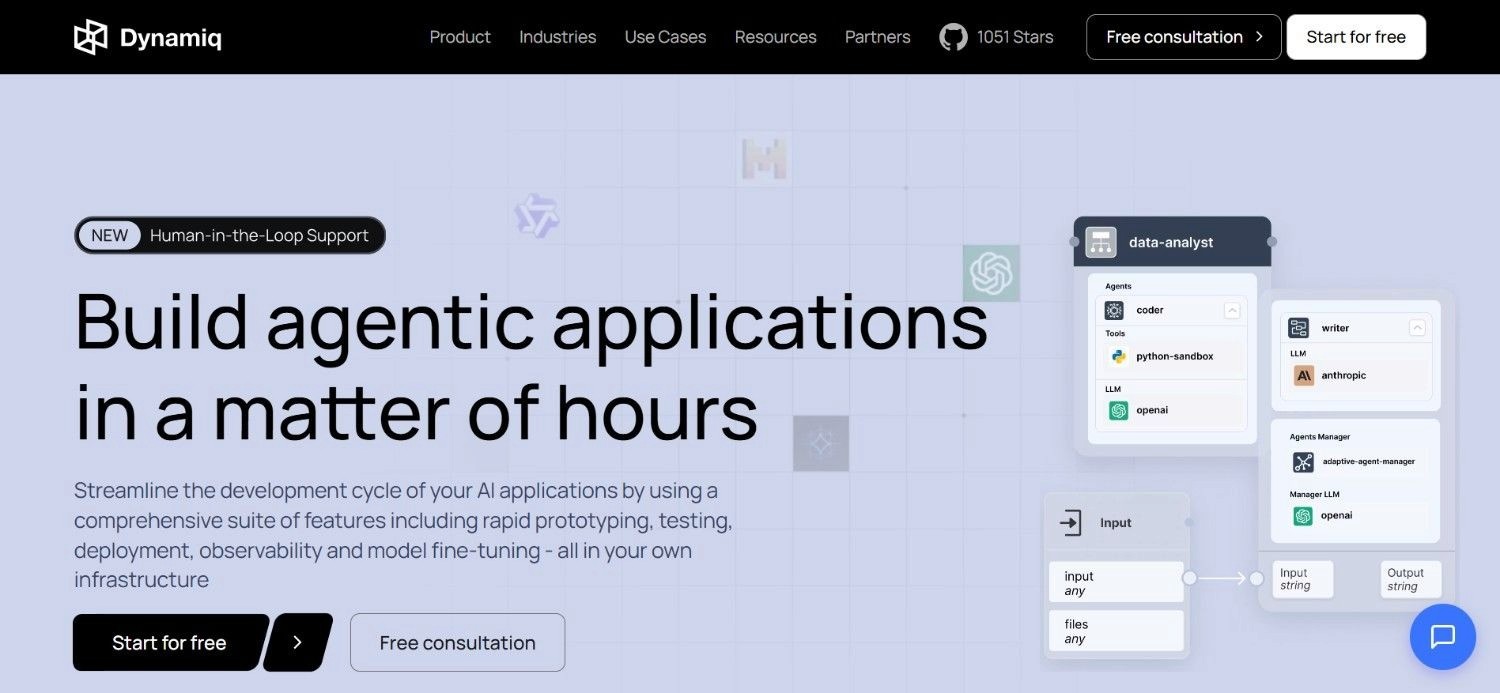
Dynamiq is an enterprise-grade AI agent orchestration platform designed for technical teams building production AI applications.
It provides multi-agent support, RAG pipeline management, evaluations, guardrails, fine-tuning, and observability in a single platform - covering the full lifecycle of enterprise AI application development.
Dynamiq targets AI and engineering teams at enterprise organizations that need more governance, observability, and deployment flexibility than standard builder platforms provide.
Its presence in financial services, healthcare, and public sector markets reflects a regulated industry focus. The platform is open-core with an active GitHub community.
Ideal For
AI and engineering teams at enterprise organizations building complex, multi-agent AI applications in production
Organizations in regulated sectors needing AI governance, observability, guardrails, and compliant deployment
Technical teams that want more enterprise structure than open-source tools provide without building infrastructure from scratch
Teams managing multiple AI agents across complex workflows with evaluation and fine-tuning requirements
Top Features
Multi-agent orchestration: Design and deploy workflows involving multiple AI agents with structured communication, tool use, memory, and step-by-step reasoning.
Built-in observability and cost tracking: Monitor agent performance, trace execution paths, and track model costs across production deployments.
Guardrails: Define and enforce content policies, safety rules, and behavioral constraints on AI agent outputs.
Evaluations: Built-in evaluation framework for testing and benchmarking AI agent outputs against defined quality criteria.
RAG and knowledge management: Connect and manage knowledge bases with governance controls over agent data access.
Why It's a Strong Beam AI Alternative?
Dynamiq is one of the stronger Beam AI alternatives for technical enterprise teams that need a more governed, production-ready AI agent framework.
While Beam AI provides an accessible drag-and-drop builder with solid compliance certifications, Dynamiq adds deeper evaluations, guardrails, fine-tuning, and observability for teams where AI agents are handling consequential production workflows that require ongoing quality management.
Pros
Strong multi-agent orchestration with governance and guardrails
Built-in observability and cost tracking for production deployments
Evaluation framework for systematic agent quality management
Regulated industry focus with IBM partnership
Cons
Custom pricing with no public starting rate
Requires technical resources for implementation and management
Not designed for legacy system integration without APIs or air-gapped enterprise deployment
Pricing
Dynamiq offers custom pricing. Book a demo or a free consultation with their team for a custom quote based on requirements.
Final Verdict
Dynamiq is recommended for technical enterprise teams building complex, multi-agent AI applications that need more governance and production quality management than Beam AI provides.
Not a fit for non-technical teams, organizations needing legacy system depth without APIs, or teams that need operational execution with end-to-end system write-back under compliance.
10. Stack AI
Overview
Stack AI is an enterprise AI workflow platform co-founded by former MIT PhD students, built on the insight that connecting data sources and LLMs into AI workflows shouldn't require a large engineering team.
Their no-code visual builder, compliance architecture (SOC 2, HIPAA, GDPR support), and self-hosted deployment options have attracted over 200 enterprise customers and backing from Y Combinator and Gradient Ventures.
The platform provides a no-code builder for creating AI workflows, AI assistants, and automated pipelines with RAG management, model selection across major providers, and API publishing.
Like Beam AI, it targets enterprise teams that want to build and deploy AI applications without deep custom development.
Ideal For
Technical and enterprise teams that need a no-code platform to build compliant AI workflows and assistants
Organizations in regulated sectors (healthcare, financial services) that need compliant AI deployment without custom infrastructure
Teams building enterprise AI applications with SOC 2, HIPAA, and GDPR requirements
Non-technical enterprise users who need AI automation without developer dependency
Top Features
No-code enterprise AI builder: Build AI workflows and agents through a visual interface with enterprise security controls.
Compliance architecture: SOC 2, HIPAA, and GDPR compliance with RBAC and audit logging built in.
Enterprise connectors: Native connections to Salesforce, SharePoint, Confluence, and other enterprise systems.
Model-agnostic approach: Use any major AI provider without platform lock-in.
Why It's a Strong Beam AI Alternative?
Stack AI is one of the stronger top Beam AI alternatives for enterprise teams that need compliance-grade AI workflow automation without developer-heavy setup.
While Beam AI targets broader agentic process automation, Stack AI focuses specifically on compliant AI application building - a narrower but well-executed scope for teams in regulated sectors.
Its no-code builder is accessible to enterprise operations teams without requiring specialist AI development.
Pros
No-code interface accessible to enterprise operations teams
Enterprise compliance architecture: SOC 2, HIPAA, GDPR built in
Strong enterprise system connectors beyond typical SaaS coverage
Model-agnostic approach avoids AI provider lock-in
Cons
Client owns implementation: no deployment engineering support included
Limited for legacy system integration without modern APIs
Not designed for end-to-end operational execution with system write-back under governance
Pricing
Stack AI has a free plan to get started. For production deployments, custom pricing applies. Contact their sales team directly for a quote based on usage and deployment requirements.
Final Verdict
Stack AI is recommended for enterprise teams in regulated sectors that need accessible, compliant AI workflow automation without a developer-heavy implementation cycle.
It's a close competitor to Beam AI in the enterprise AI builder space.
Not a fit for organizations needing deep legacy system integration, end-to-end operational execution, or air-gapped deployment for the most sensitive data contexts.
What Makes a Good Beam AI Alternative?
Legacy System Reach Without API Prerequisites
Beam AI's connection model assumes modern, API-accessible systems. A genuine alternative for enterprise operations teams should operate inside legacy platforms: SAP ECC, Guidewire, COBOL-era cores - without requiring API modernization as a prerequisite.
If it only works on modern SaaS stacks, it doesn't reach the systems that run the most complex enterprise operations.
Execution, Not Just Output Generation
Beam AI generates agent outputs: responses, structured data, completed forms. A genuine Beam AI alternative for operations teams should execute work end-to-end: updating records, writing back to systems, closing cases under audit.
If the AI still requires a human to act on what it produces, the automation is incomplete for high-volume operational work.
For operations teams building the case for a switch, the best workflow automation software is the one that executes work end-to-end without leaving humans to complete the loop.
Deployment Engineering, Not Just a Builder
Beam AI is a platform you build with. For enterprise teams without strong in-house AI development capability, this creates the same "pilot purgatory" they were trying to escape.
A credible alternative should either provide deployment engineering support or be simple enough that operations teams can deploy without IT involvement.
Structural Compliance Architecture for Regulated Industries
Standard SaaS certifications: SOC 2, ISO 27001, cover baseline enterprise security.
European regulated industries need more: air-gapped deployment, BYOK model routing, deterministic policy enforcement, GDPR Article 28 structural compliance, and full audit trail replayability.
These need to be architectural, not contractual.
Predictable Pricing Without Tier Gaps
Beam AI's reported pricing jump from $50 to $3,990/month creates real scaling friction.
A good alternative should offer pricing that scales predictably with operational volume, allowing finance teams to model total cost of ownership before committing to a contract.
How to Choose the Right Beam AI Alternative for Your Needs?
1. Define Your Primary Challenge
The first step to choosing the right Beam AI alternative is to define your goals with the switch.
Before you go shopping for tools (and comparing them based on pricing vs. features), ask yourself if you’re:
Trying to build AI applications on modern SaaS stacks (Stack AI, Dify, Flowise),
Looking to automate SaaS workflows without AI agent complexity (Zapier, Make, n8n)?
Deploy AI agents for communications and knowledge work (Lindy, Relevance AI), or
Executing complex operations work inside legacy enterprise systems (Noxus)?
The category you actually need determines more than half the decision.
2. Audit Your System Landscape
If your core operations run on SAP, Guidewire, Oracle, or legacy proprietary systems, most platforms on this list will hit a connectivity wall.
Audit your actual system landscape before shortlisting: tools that assume API-accessible environments will fail at the same point Beam AI does for legacy-heavy organizations.
3. Decide: Builder or Deployment Partner
Beam AI gives you tools to build and deploy AI agents. Noxus deploys AI co-workers into production on your behalf.
The choice between those models depends on whether you have in-house AI development capability to get from "we built this" to "it's running in production."
If you don't, a deployment partner model reduces risk significantly.
4. Define Compliance Requirements as Hard Requirements
In European regulated industries, compliance requirements are procurement requirements, not evaluation criteria.
Define SOC 2, HIPAA, GDPR Article 28, ISO 27001, air-gapped deployment, and RBAC requirements before shortlisting platforms.
Rule out tools that can't demonstrate structural compliance during the evaluation process.
5. Model Total Cost of Ownership Before Comparing Tiers
Licensing cost is only part of the picture. Implementation, internal developer time, integration development, and ongoing maintenance all add to year-one spend.
Beam AI's pricing gap between tiers is well-documented; other platforms have similar structural cost issues. Build a full cost model before comparing headline prices.
Everything You Need to Know About Beam AI Alternatives
← scroll →
| Category | Key Considerations |
|---|---|
| Top 3 Alternatives |
Noxus
Lindy
n8n
Enterprise legacy operations execution · Knowledge work agent automation · Developer-friendly open-source automation
|
| Best Overall Option | Noxus — executes end-to-end operations on legacy enterprise systems under full governance, with 45-day production deployment and zero churn across all clients. |
| Why Look for Beam AI Alternatives? | Legacy system reach limited by API dependency; pricing gap between tiers creates scaling friction; client-owned implementation requires in-house AI capability; European regulatory compliance depth limited for air-gapped deployments. |
| How to Choose? | Define your primary challenge; audit your system landscape; choose between builder and deployment partner models; define compliance requirements as hard requirements; model total cost of ownership. |
| Price Range | Free (n8n self-hosted, Flowise, Zapier free tier, Relevance AI freemium) to usage-based enterprise (Noxus, custom per deployment); most business tools start at $9–$49.99/month. |
| Ease of Switching | No-code tools (Zapier, Make, Lindy) take days; developer tools (n8n, Flowise, Dify) take weeks; enterprise execution platforms (Noxus) require structured deployment but ship production results in 45–80 days. |
| Must-Have Features | Legacy system connectivity; end-to-end execution with system write-back; structural compliance architecture for regulated industries; deployment support or simple enough to deploy without IT; predictable pricing. |
| Mistakes You Shouldn't Make | Choosing Beam AI or any SaaS-only platform for operations that run on legacy systems without APIs; evaluating headline licensing price without modelling implementation and maintenance costs; treating standard SOC 2 certification as sufficient for European regulated industry deployment. |
Ready to Move On from Beam AI? Try Noxus
Noxus executes real operations work: end-to-end, under audit, on the systems you already run. While Beam AI builds agent workflows on modern SaaS stacks, Noxus resolves operational cases inside legacy enterprise environments that other platforms can't reach.
Every action is audited. Every decision is replayable. Your data stays on your infrastructure if that's what compliance requires. The first deployment goes live in 45 days on your actual systems, with your actual operational data.
Subsequent use cases deploy at 85-90% platform margin because the infrastructure is already running.
Noxus is built for enterprise operations teams in financial services, insurance, healthcare, retail, and logistics who need AI to execute complex work, not just assist with it or provide a builder to develop it.
If you’re thinking of switching from Beam AI and are exploring your options, request a consultation now to scope how we fit in your own internal workflows and processes - with production results in under 45 days.
FAQs About Beam AI Alternatives
What is Beam AI used for?
Beam AI is an enterprise-grade platform for medium to large companies, helping them build and manage autonomous AI agents for complex business workflows in sales, support, recruiting, and operations. It's fast (5,000+ tasks/min, 90%+ accuracy) and secure (1,000+ integrations, human-in-the-loop controls, SOC 2/ISO 27001 compliance), but it’s best suited for organizations running on modern, API-accessible systems.
What are the best Beam AI alternatives in 2026?
Noxus is the best Beam AI alternative in 2026, especially for teams that care more about workflow automation than AI assistance alone. Instead of focusing mainly on AI copilots, we help companies automate repetitive business tasks, connect internal tools, and reduce manual operational work across support, internal ops, and day-to-day workflows. This makes our agentic workflow automation platform a better fit for businesses looking to build AI-driven systems that improve execution, not just individual productivity.
What features should I look for in a Beam AI alternative?
When evaluating a Beam AI alternative, focus on five things: whether it can connect with legacy systems without relying on APIs, whether it handles full end-to-end execution instead of only giving suggestions, and whether it offers strong compliance support for regulated industries. You should also look at deployment flexibility, either dedicated onboarding or an easy self-serve builder, alongside pricing that scales predictably as your operational volume grows.
How to choose the best Beam AI alternative for your needs?
To choose the best Beam AI alternative in 2026, start by figuring out what you actually need. Some tools are better for building AI workflows (Stack AI, Dify, Flowise), others focus on automation (Zapier, Make, n8n), while the likes of Lindy or Relevance AI are more agent-focused. If your business relies on legacy systems and operational execution, something like Noxus is built more for that environment. From there, audit your existing systems, treat compliance as a non-negotiable requirement, decide whether you want a self-serve builder or hands-on deployment support, and compare total cost before making a decision.
Is it easy to switch from Beam AI to an alternative?
Switching from Beam AI to a competitor depends on your destination platform. Doing so with Noxus is fairly straightforward, especially for companies struggling with legacy systems or operational workflows Beam AI can’t handle deeply. We’re built more around execution and system integration, so the transition usually involves reconnecting workflows and mapping processes versus building everything from scratch.
Can Noxus replace Beam AI for enterprise operations?
Noxus tackles a unique challenge compared to any other Beam AI competitor. While Beam AI focuses on modern SaaS agents, Noxus actually executes work inside the legacy enterprise systems that APIs can't touch. So, if you're running on SAP or COBOL-era cores, Noxus bridges that gap directly. However, for teams primarily needing a simple builder for modern stacks, Beam AI is still a solid choice.
What are the main limitations of Beam AI for large enterprises?
One of Beam AI’s main limitations for large enterprises is that it focuses more on AI assistance than full operational execution. That becomes an issue for companies running legacy systems, strict compliance environments, or workflows that need direct write-backs into internal platforms. As operational complexity increases, many enterprises end up needing additional tooling around Beam AI instead of using it as the core execution layer.