Best AI Tools for eCommerce Automation in 2026 (Feature Comparison)
The best AI tools for eCommerce in 2026 split by where they act: on the storefront, in the support inbox, or inside the systems that hold orders, catalogue and stock. This comparison covers ten of them on capability, integration reach and pricing.

Key Takeaways (TL;DR)
The Best Overall AI Tools for eCommerce: We built Noxus to execute eCommerce operations end to end across the exact systems retailers already run, from PIM platforms to legacy ERPs, rather than drafting suggestions for a human to action.
Why Do You Need It?: Manual catalogue work, support backlogs, and marketing tasks spread across disconnected systems cost eCommerce teams real margin, and many tools only summarise the problem instead of resolving it.
Who It's For?: eCommerce brands ranging from fast-growing DTC teams to large multi-channel retailers running legacy ERP and inventory systems.
How to Choose the Right One?: Decide whether you need a tool that suggests actions or one that completes them, check integration depth against your real systems, and confirm pricing scales with your actual operational volume.
Expected Price: Noxus runs on a monthly platform licence with consumption-based pricing. There is no per-seat, per-order or token-based billing, so cost scales with the operations completed rather than with team size or catalogue count. A custom quote follows a scoping call, and subsequent use cases deploy at a lower incremental cost on the same infrastructure.
Table of Contents
Top AI Tools for eCommerce in 2026: at a Glance
Tool | Best For | Key Features | Pricing |
Noxus | eCommerce brands wanting operations executed end to end across legacy and modern systems | Process intelligence runtime, full audit trail, 400-plus native connectors | Custom, consumption-based monthly licence |
Carro | eCommerce brands widening assortment without buying or holding stock | Hand-matched supplier network, automated order routing, real-time inventory sync | 5% of sales (Standard); Growth quoted |
Kore AI | Large retailers needing enterprise-grade agentic AI across channels | Multi-agent orchestration, retail-specific accelerators, governance dashboard | No public rate card; session and seat metering, sales-led quote |
Gorgias | eCommerce stores wanting support automation built for Shopify | Automated ticket resolution, multichannel helpdesk, AI agent for common queries | Starter $40/mo up to Advanced $1,227/mo (annual), AI metered per interaction |
Clerk.io | eCommerce brands wanting AI-driven personalisation across search and marketing | Intelligent site search, product recommendations, audience segmentation | From $119 per month, custom pricing for larger accounts |
Yotpo Discover | eCommerce brands wanting reviews, loyalty, and subscriptions in one platform | Customer reviews and UGC, loyalty and referrals, subscription management | Free plan, self-service tiers, custom enterprise pricing |
Triple Whale | DTC brands wanting unified marketing analytics and attribution | AI agent for data queries, cross-channel attribution, unified dashboard | Free plan, GMV-based paid plans that scale with revenue |
Blueshift | Mid-market eCommerce teams wanting cross-channel customer engagement | Predictive AI scoring, generative campaign content, cross-channel orchestration | Custom pricing based on data volume and messages processed |
Tidio | Small to mid-size eCommerce stores wanting AI-powered live chat and support | Lyro AI chatbot, live chat, multichannel helpdesk | Free plan, paid tiers from $29 per month, custom Premium pricing |
Decagon | eCommerce brands wanting automated customer support resolution | AI support agents, per-resolution or per-conversation pricing | Custom, per-conversation or per-resolution pricing |
What Are AI Tools for eCommerce?
AI tools for eCommerce are software platforms that use machine learning and automation to handle tasks a retailer's team would otherwise do by hand. That includes answering support tickets, recommending products, managing inventory, or running marketing campaigns.
The category covers a genuinely wide range of work. Some tools focus on the customer-facing side, personalising search results or resolving support conversations.
Others focus on the operational side, keeping inventory in sync across marketplaces or executing a workflow that spans several systems at once.
That range matters when you are choosing between them. A retailer running a single, modern Shopify store has different needs to one managing a legacy ERP alongside several marketplace integrations and a growing support queue.
eCommerce automation tools have moved well past simple chatbots and basic email triggers. Retailers now expect software that can genuinely resolve a case, not just flag it for a person to handle later.
That expectation is reshaping what counts as a serious AI eCommerce platform in 2026.
Why Do You Need AI Tools for eCommerce?
Running an online store generates a huge volume of repetitive work. Product listings need updating, customer questions need answering, and stock levels need checking across every channel you sell on.
None of this scales with manual effort alone.
The math gets harder as a business grows. Order volume and support tickets tend to grow faster than headcount, which leaves teams either falling behind or absorbing more errors as they try to keep pace.
Manual work spread across disconnected systems makes the problem worse. A single customer case might touch the order management system, the shipping provider, and the support inbox, with someone manually bridging every gap between them.
That kind of work is slow and expensive to sustain once volume climbs.
Many retail automation software options have not fully closed this gap either. A lot of tools draft a response or flag an issue, then still need a person to take the actual action. That leaves the most time-consuming part of the job exactly where it started.
This is the gap that pushes retailers toward genuinely capable eCommerce AI tools.
These are platforms that do not just suggest what to do next, but complete the work and write the outcome back into the systems the business actually runs on.
Who Needs AI Tools for eCommerce?
Different eCommerce businesses need different depths of automation. Here is how that typically breaks down.
1. Multi-Channel Retailers Running Legacy Systems
Established retailers running an older ERP or a proprietary inventory system face a specific problem: most modern automation tools assume a clean, API-first environment.
These retailers need software that can operate inside the exact systems they already run, without a lengthy replatforming project standing in the way of any real automation.
2. Fast-Growing DTC Brands Scaling Customer Support
Direct-to-consumer brands often hit a support wall long before they hit a revenue ceiling. Ticket volume grows with every marketing push, and a small team cannot keep pace without burning out or letting response times slip.
These brands typically need a tool that resolves common queries automatically, freeing the team to focus on the cases that genuinely need a person.
3. eCommerce Operations Teams Managing Large Catalogues
Retailers running thousands of product listings across multiple marketplaces face a constant classification and pricing workload.
New products need categorising, descriptions need writing, and stock levels need syncing before anything reaches a customer.
This group needs automation that writes directly back into the inventory and product systems, not a tool that only flags what a person should update manually.
4. Marketing and Retention Teams Wanting Personalisation at Scale
Growing eCommerce brands often reach a point where manual segmentation and one-off email campaigns cannot keep pace with the volume of customer data coming in.
These teams typically want a platform that personalises search, recommendations, and marketing messages automatically, based on real behavioural data rather than static rules.
5. Early-Stage eCommerce Startups and Small Teams
Early-stage online stores often need automation before they have the budget or headcount for a dedicated operations or support team.
A founder handling tickets and inventory updates alone cannot sustain that pace once volume picks up.
This group typically prioritises accessible pricing and fast setup, since a long implementation project is not realistic when the whole team is still small.
Best AI Tools for eCommerce: In-Depth Review and Comparison
1. Noxus
Overview
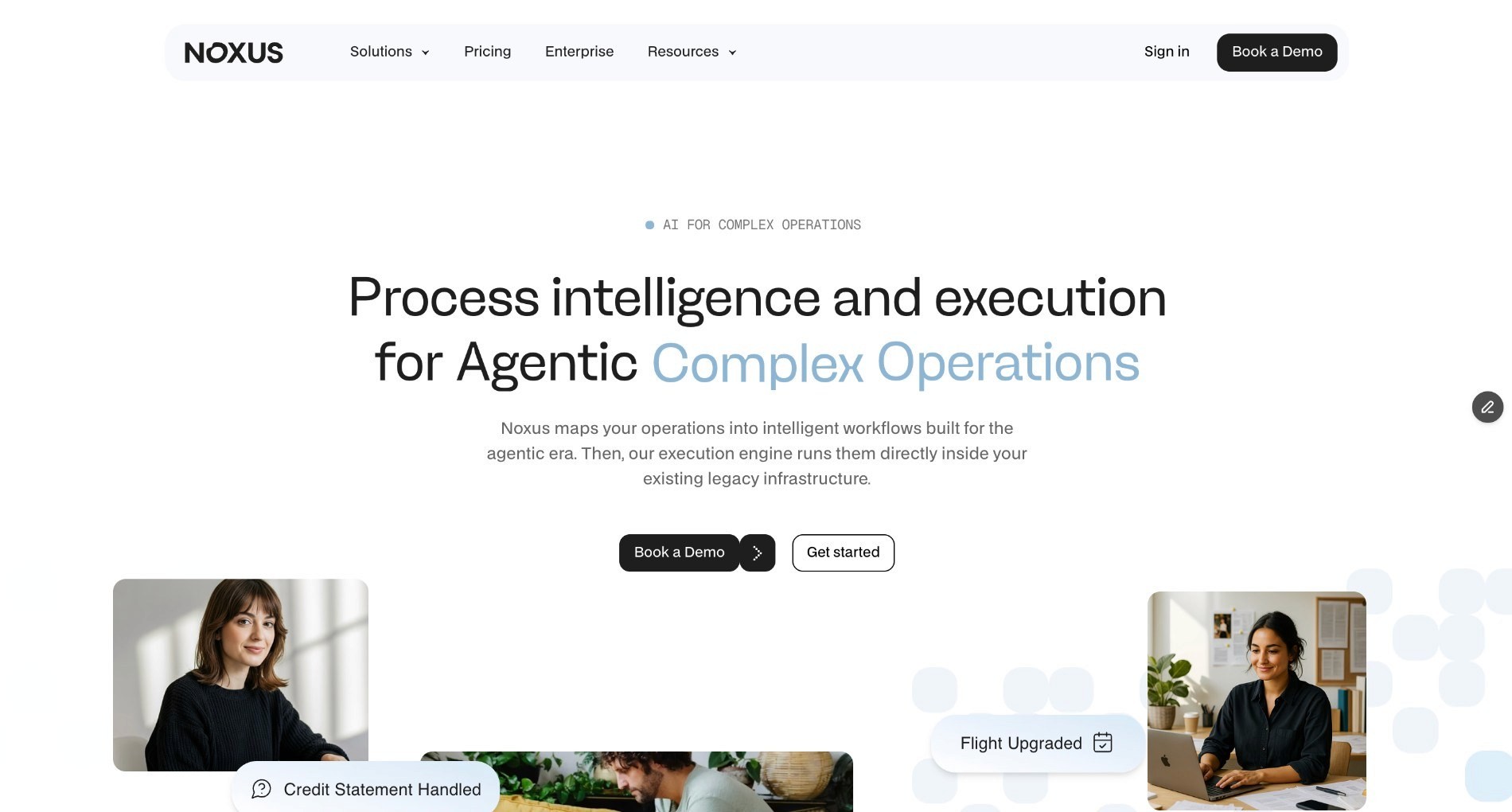
We built Noxus as the process intelligence layer that executes real eCommerce work end to end, under audit, on top of the systems a retailer already runs. Our platform does not draft suggestions for a person to take action. It resolves the operation itself, from ingestion to write-back, with every step governed and replayable.
AI handles the messy, unstructured part of the job, reading emails, interpreting scanned documents, and understanding free-text requests. The moment a decision needs to be made on a governed process, hard-coded business logic mapped directly from the retailer's own rules takes over.
Jerónimo Martins, a large European retail and FMCG group, used Noxus to run its full product data pipeline: classification, enrichment, pricing logic, and compliance checks. That included direct write-back into its PIM infrastructure.
That deployment covered more than 15,000 daily listings, reached production in 80 days, and delivered a 5x return on investment with 90% precision.
Ideal For
Multi-channel retailers running legacy ERP, PIM, or inventory systems that most automation tools cannot reach
eCommerce operations teams managing large product catalogues that need classification, enrichment, and pricing at scale
Retailers wanting every automated decision to be traceable, replayable, and governed under a full audit trail
Top Features
Process intelligence runtime that executes multi-step eCommerce workflows and writes outcomes back into source systems
Over 400 native connectors, including SAP ECC, Oracle, NetSuite, Sage, Salesforce, ServiceNow, Manhattan, Blue Yonder, JDA, iSeries, and the proprietary POS, ERP and inventory systems most automation vendors will not touch, alongside modern PIM platforms and marketplace APIs
Confidence-based human escalation, so only genuine exceptions reach a person
Full audit trail of every decision and action, with complete replayability
Flexible deployment across SaaS, private cloud, or air-gapped on-premises environments, certified against SOC 2 Type II, ISO 27001, GDPR Article 28 and HIPAA. Data sovereignty is architectural, not contractual, which matters for eCommerce brands handling payment data under PCI DSS and customer data under GDPR.
Why We Stand Out
Most eCommerce AI tools on this list either hold a conversation or connect a handful of apps together. Noxus does neither.
We execute the operational work itself, catalogue classification, pricing updates, customer case resolution, directly inside the systems a retailer already runs. That distinction matters most for retailers with a genuinely complex technology stack.
A tool built for modern, API-first environments cannot operate inside a legacy ERP the way Noxus does, which is exactly the gap we built the platform to close.
Pros
Executes full eCommerce workflows end to end, rather than drafting suggestions for a human to complete
Works natively inside legacy systems most automation vendors will not touch
Full audit trail supports compliance across regulated industries, from financial services and insurance to healthcare, alongside eCommerce brands handling GDPR and PCI DSS at scale
Deployment flexibility covers SaaS, private cloud, and fully air-gapped options
Proven production deployments at genuine retail scale, not sandbox pilots
Cons
Built for retailers with genuine operational complexity, so a small catalogue may not need this depth
Requires a scoping conversation rather than offering instant self-serve pricing
Best suited to teams ready to commit to a real deployment rather than a short trial
Pricing
We operate on a monthly platform licence with consumption-based pricing that scales with operational volume and deployment complexity. There is no per-seat pricing, no per-task billing, and no token-based pricing.
First engagements typically include deployment engineering alongside the platform licence to get the initial use case into production. Once that infrastructure is running, subsequent use cases deploy at a much lower incremental cost.
Custom quotes follow a scoping conversation.
Final Verdict
Noxus is the strongest overall choice among eCommerce automation tools for retailers whose operations span several disconnected systems, particularly where legacy infrastructure has ruled out other tools.
Smaller retailers with a single, modern tech stack and simpler needs may find a lighter, self-serve platform a faster starting point.
2. Carro

Overview
Carro is a dropshipping and marketplace platform that lets eCommerce brands expand their catalogue without buying or holding stock. Products stay with the supplier, orders route automatically to whoever holds the item, and the customer sees one branded checkout.
The model it enables is distributed retail: inventory sits across a network of brands and distributors while the buying experience stays centralised on your storefront. Carro handles the connective work underneath, normalising supplier data, syncing inventory and pricing in real time, routing orders and reconciling settlement.
What separates it from generic dropship apps is curation. Account managers hand-match retailers with complementary brands rather than opening a directory of anonymous suppliers, and the network covers roughly 1.5 million products. Retailers approve every partner, set the terms and keep their customer data.
Carro runs on Shopify, Magento, WooCommerce and BigCommerce, with EDI, SFTP, API and CSV available for partners on older systems.
Ideal For
eCommerce brands wanting to widen assortment without inventory risk or warehousing cost
Retailers testing new categories before committing working capital to stock
Marketplace operators managing many supplier relationships from one place
Brands looking for distribution through retailer storefronts instead of paid acquisition
Teams that need a dropship programme live in weeks rather than months
Top Features
Hand-matched supplier network, with account managers introducing brands that fit your category and price point
Automated order routing that sends each order to the correct supplier without manual handling
Real-time sync of product data, pricing and stock levels across every connected partner
Inventory management software that keeps availability accurate across a distributed supplier base, so you are not selling what nobody can ship
Automated supplier payouts and settlement reconciliation
Native integrations for Shopify, Magento, WooCommerce and BigCommerce, plus EDI and SFTP
Why They Stand Out?
Carro is one of the stronger choices for a specific problem: adding selection quickly without the balance sheet exposure that normally comes with it. Most tools in this comparison make an existing catalogue perform better. Carro changes what is in the catalogue.
The curation model is the practical difference. Generic dropship tools optimise for catalogue size, which produces assortment nobody asked for and margins that do not hold. Carro's account managers match on category fit and price point, and retailers report up to 3.5x revenue growth, up to 180% AOV growth and up to 3x catalogue size.
Pros
Expands assortment with no inventory purchase, warehousing or balance sheet risk
Curated partner matching rather than an open supplier directory
Retailers approve each partner and keep control of pricing, standards and customer data
Works with the storefront you already run, with EDI and SFTP for less technical partners
Suppliers get paid on sale, which makes brand recruitment easier
Cons
Built around US retail, USD transactions and Stripe-supported countries, so international rollouts need checking
Percentage-of-sales pricing means cost scales directly with revenue rather than with usage
Not a fit for retailers whose margin depends on owning and controlling stock
Focused on assortment and fulfilment rather than customer support or marketing automation
Pricing
The Standard plan is 5% of sales through the platform and covers the Shopify, Magento, BigCommerce and WooCommerce integrations plus end-to-end dropship automation, without a support plan. The Growth plan adds autonomous merchandising, priority support and the hand-matched supplier network, and is quoted rather than listed.
Every plan includes unlimited transactions, automated payments and billing, and access to the full supplier network. Because the fee is a share of sales, model it against your gross margin per category rather than as a flat software line.
Final Verdict
Carro is the right choice when the constraint is assortment rather than automation. If revenue has plateaued on your current catalogue and buying more stock is not an option, this is the fastest route to a wider selection.
It is not the tool to reach for if your problem is resolving support tickets, orchestrating marketing, or executing operations inside a legacy ERP. Those are different jobs, and other options on this list handle them better.
3. Kore AI
Overview
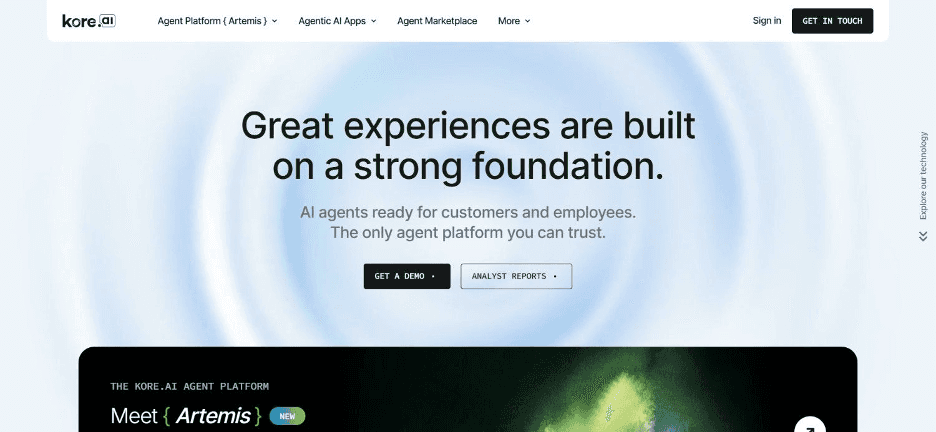
Kore AI has been building conversational and agentic AI since 2013, which gives it a longer track record than most names in this category.
The platform ships with pre-built accelerators for retail specifically, alongside banking, healthcare, and telecom. It also supports multi-agent orchestration, so different agents can share context across customer, employee, and operations use cases. That orchestration layer is table stakes for enterprise agentic AI now, and platforms like Noxus provide the same coordination under a full governance and replay trail, with the difference sitting in what the agents actually do once orchestrated: Kore.ai's strength is conversational depth, while execution platforms resolve the underlying operational work end to end inside the systems retailers already run.
Its governance dashboard gives enterprises visibility into every agent decision, which matters for retailers operating under strict compliance requirements.
Kore AI is trusted by more than 400 Fortune 2000 companies and reports over a billion dollars in customer cost savings across its deployments.
That scale gives this platform a level of enterprise credibility that newer entrants in agentic AI have not yet had time to build.
Ideal For
Large retailers needing agentic AI deployed across multiple channels and departments at once
eCommerce businesses in regulated markets that need a governance dashboard over every agent action
Enterprises with existing Kore AI relationships in banking or healthcare wanting to extend into retail
Top Features
Multi-agent orchestration across customer, employee, and operations workflows
Retail-specific accelerators and pre-built application templates
Governance dashboard with full decision tracing and audit logs
More than 300 integrations, including major CRM and commerce platforms
Why They Stand Out
Kore AI's multi-agent orchestration and long operating history give it real depth for large retailers running complex, multi-department deployments.
Its retail-specific accelerators also shorten setup time compared with building a use case from a blank canvas.
Pros
Deep enterprise track record with strong Fortune 2000 adoption
Retail-specific accelerators reduce time to a working deployment
Strong governance and compliance tooling built in
Cons
Enterprise pricing tiers can run into the hundreds of thousands annually
Complexity and setup depth may be more than a smaller retailer needs
Best suited to large-scale deployments rather than a single, narrow use case
Pricing
Kore.ai does not publish a plan-by-plan rate card. Its documentation describes how billing works rather than what it costs: Automation AI and Search AI are metered in 15-minute conversation sessions, while Contact Center AI and Agent AI are billed per agent seat. New accounts start on a self-serve Standard workspace with free evaluation credits and a minimum purchase to begin using it. Production deployments go through a sales-led Enterprise contract, and any annual figure you find quoted online comes from third-party reporting rather than Kore.ai.
Final Verdict
Kore AI is one of the strongest choices for large retailers wanting agentic AI deployed across several departments with strong governance built in.
Smaller eCommerce teams without an enterprise budget will likely find the pricing and complexity heavier than their use case needs.
4. Gorgias
Overview
Gorgias built its business specifically around eCommerce support, with particularly deep ties into Shopify stores.
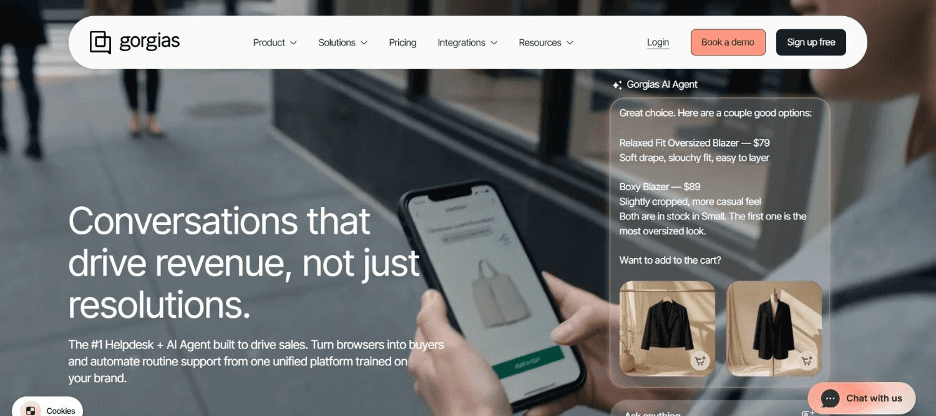
The platform combines a multichannel helpdesk with an AI agent that resolves common queries automatically, covering everything from order status questions to return requests.
Because Gorgias sits so close to the checkout experience, it can pull order and customer data directly into a support conversation without a person switching between separate tools. A shopper asking about a delayed order gets an answer grounded in the actual order record. That eCommerce-first design gives it a level of retail-specific polish that more general-purpose platforms often lack.
Gorgias has grown alongside the Shopify ecosystem specifically.
Its AI agent tends to understand the language and edge cases of eCommerce support out of the box, rather than needing a lengthy training period on generic conversational patterns.
Ideal For
Shopify and eCommerce stores wanting support automation built specifically for retail
Retail teams wanting a multichannel helpdesk with AI resolution layered on top
Growing DTC brands needing transparent, tiered pricing as ticket volume increases
Top Features
AI agent that automatically resolves common eCommerce support queries
Multichannel helpdesk covering email, chat, and social channels
Deep, purpose-built integrations with Shopify and other eCommerce platforms
Why They Stand Out
Gorgias earns its place among eCommerce automation tools through its Shopify-first design.
Its AI agent understands retail-specific queries like order status and returns out of the box, rather than needing extensive configuration.
Pros
Purpose-built for eCommerce and retail support workflows
Transparent, tiered pricing that scales with ticket volume
Strong native integrations across major eCommerce platforms
Cons
Focused specifically on customer support, not broader operational automation
Advanced tiers become expensive at higher support volumes
Less relevant for retailers whose main automation need is catalogue or back-office work
Pricing
Gorgias bundles the helpdesk and the AI Agent into one bill. On annual billing that is Starter at $40 a month for 50 tickets, Basic at $77 for 300 tickets, Pro at $471 for 2,000 tickets and Advanced at $1,227 for 5,000 tickets, with Enterprise quoted above 5,000 conversations a month.
Two things drive the real cost beyond the tier. Automated AI interactions are metered separately, falling from $1.00 each on Starter to $0.85 on Advanced, and ticket overage runs $36 to $40 per 100. Voice and SMS are add-ons from $25 and $17 a month.
Final Verdict
Gorgias is one of the strongest choices for eCommerce and DTC brands wanting support automation built specifically for retail.
Retailers whose biggest bottleneck sits in catalogue management or back-office operations will need a different kind of platform entirely.
5. Clerk.io

Overview
Clerk.io focuses on the personalisation side of eCommerce, using AI to tailor site search, product recommendations, and marketing to each individual shopper.
The platform pulls a retailer's product and customer data into one shared system. Search results, recommendations, and email campaigns all draw from the same behavioural signals rather than working in isolation.
That unified approach has made Clerk.io a common choice among mid-market retailers wanting a single AI layer across the parts of the store a shopper actually sees.
The company has served more than 2,500 stores since launching in Copenhagen in 2011, with reported conversion gains in the 15 to 30% range from real-time personalisation.
Ideal For
eCommerce brands wanting AI-driven personalisation across search, recommendations, and email
Retailers wanting one unified data layer powering multiple customer-facing tools
Mid-market stores on Shopify, Magento, or WooCommerce needing deeper personalisation than a default theme provides
Top Features
Intelligent site search with spell check, synonym handling, and real-time predictions
Product recommendations powered by shared behavioural and sales data
Audience segmentation for targeted email and paid marketing campaigns
Why They Stand Out
Clerk.io's unified data approach means every customer-facing tool draws from the same behavioural signals - rather than treating search, recommendations, and email as separate systems with separate logic.
Pros
Strong personalisation gains reported across search and recommendations
Unified data platform keeps every tool consistent with the same customer signals
Modular pricing lets retailers pay only for the products they actually use
Cons
Focused on customer-facing personalisation, not broader operational automation
Costs can add up quickly once several modules are active at once
Less relevant for retailers whose main bottleneck is inventory or support volume
Pricing
Clerk.io uses a modular, usage-based pricing model, letting businesses pay only for the products and usage they need, such as Search, Recommendations, Chat, Email, and Audience.
Plans start from $119 a month, with custom pricing for B2B and enterprise deployments.
Final Verdict
Clerk.io is one of the strongest choices for eCommerce brands wanting AI-driven personalisation across search, recommendations, and marketing in one connected system.
Retailers whose main need sits in back-office operations or support will need a different platform for that side of the business.
6. Yotpo Discover
Overview
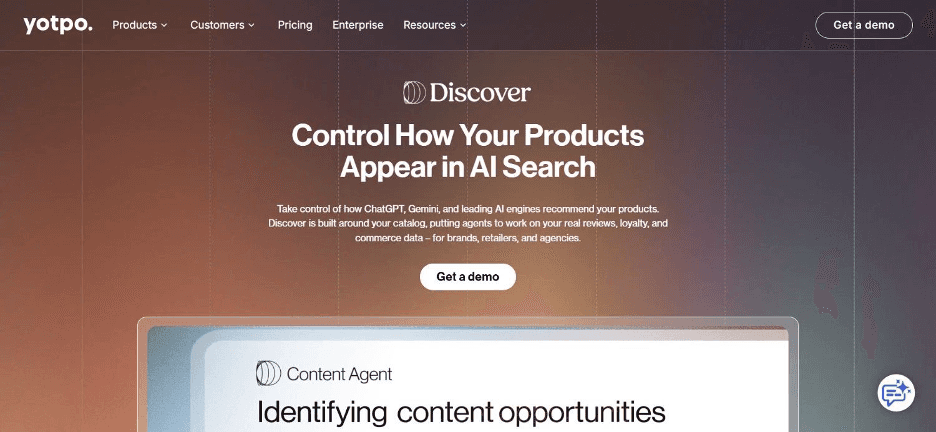
Yotpo built its platform around the parts of eCommerce that build long-term customer trust: reviews, loyalty programmes, and user-generated content.
The company positions itself as a unified eCommerce marketing platform rather than a single-purpose tool, bringing reviews, loyalty, referrals, SMS, and subscriptions together under one system.
That breadth appeals to growing DTC brands that would otherwise juggle several separate point solutions for retention marketing. Yotpo integrates closely with tools like Triple Whale, letting brands connect review and loyalty data with broader marketing analytics.
For a growing brand, that integration matters more than it might first appear.
Ideal For
eCommerce brands wanting reviews, loyalty, and subscriptions managed in one platform
DTC teams wanting to consolidate several retention marketing tools into a single system
Growing stores wanting to start free and scale into paid modules as volume increases
Top Features
Customer reviews and user-generated content collection and display
Loyalty and referral programme management
Subscription management alongside SMS and email marketing tools
Why They Stand Out
Yotpo's breadth across reviews, loyalty, and subscriptions gives it a genuine edge for brands wanting retention marketing consolidated into one platform, rather than stitched together from several disconnected tools.
Pros
Covers reviews, loyalty, and subscriptions in one connected platform
Free and self-service tiers make it accessible for growing brands
Strong integration ecosystem with other eCommerce marketing tools
Cons
Pricing can grow complex once multiple product modules are active
Focused on marketing and retention, not operational or support automation
Less relevant for retailers whose primary need is inventory or back-office work
Pricing
Yotpo uses a flexible, product-based pricing model with free, self-service, and custom enterprise plans.
Pricing varies by product, order volume, and usage, allowing brands to start free and scale across reviews, loyalty, SMS, email, and subscriptions.
Final Verdict
Yotpo Discover suits eCommerce brands wanting reviews, loyalty, and subscription management consolidated into a single retention marketing platform.
Retailers needing deeper operational automation beyond marketing will need a different kind of tool for that side of the business.
7. Triple Whale
Overview
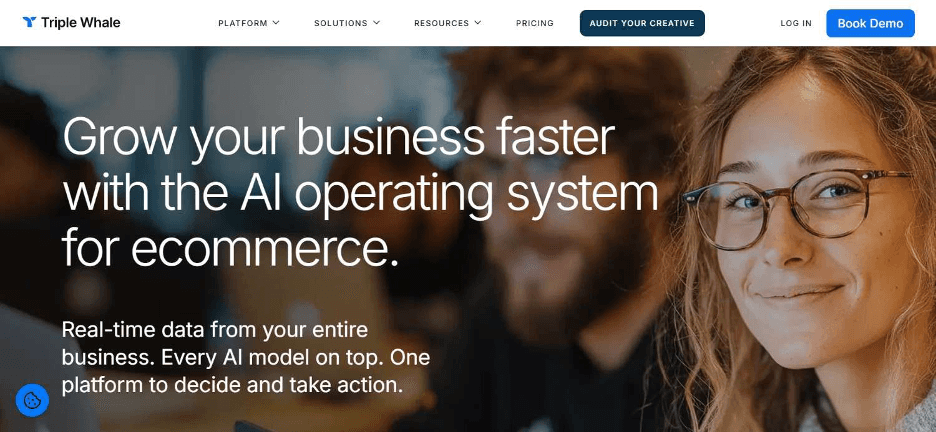
Triple Whale positions itself as an intelligence layer sitting across a brand's entire revenue stack, pulling data from advertising platforms, email tools, and fulfillment systems into one place.
Its AI agent, Moby, lets marketing and finance teams ask questions about performance in plain language instead of exporting spreadsheets from half a dozen different tools.
The platform is built specifically for the post-cookie attribution problem that DTC brands face, using first-party data to reconcile numbers that Meta, Google, and email platforms often report differently.
Ideal For
DTC brands wanting unified attribution across every advertising and marketing channel
Marketing and finance teams tired of reconciling conflicting numbers from separate platforms
Growing Shopify Plus merchants wanting an AI agent to answer performance questions directly
Top Features
Moby AI agent answering data questions in plain language across the whole revenue stack
Cross-channel attribution reconciling ad platform, email, and fulfilment data
Unified, real-time dashboard consolidating performance across the business
Why They Stand Out
Triple Whale's AI agent and first-party attribution approach solve a specific, painful problem for DTC brands: getting one trustworthy number instead of five conflicting ones from different platforms.
Pros
AI agent removes the need to manually export and reconcile spreadsheets
Broad integration footprint across ads, email, and fulfilment tools
Backed by significant funding and a strategic Shopify relationship
Cons
Primarily an analytics and attribution tool, not an operational execution platform
Pricing scales with revenue, which can grow expensive for high-GMV brands
Less relevant for retailers whose main need is support or inventory automation
Pricing
Triple Whale offers a free plan alongside GMV-based paid plans that scale with business revenue.
Pricing varies by annual gross merchandise value and billing cycle, with higher tiers unlocking advanced attribution and AI insights.
Final Verdict
Triple Whale is one of the strongest choices for DTC brands wanting unified marketing attribution and an AI agent to interrogate that data directly.
Retailers needing operational execution rather than analytics will need a different kind of platform for that side of the business.
8. Blueshift
Overview
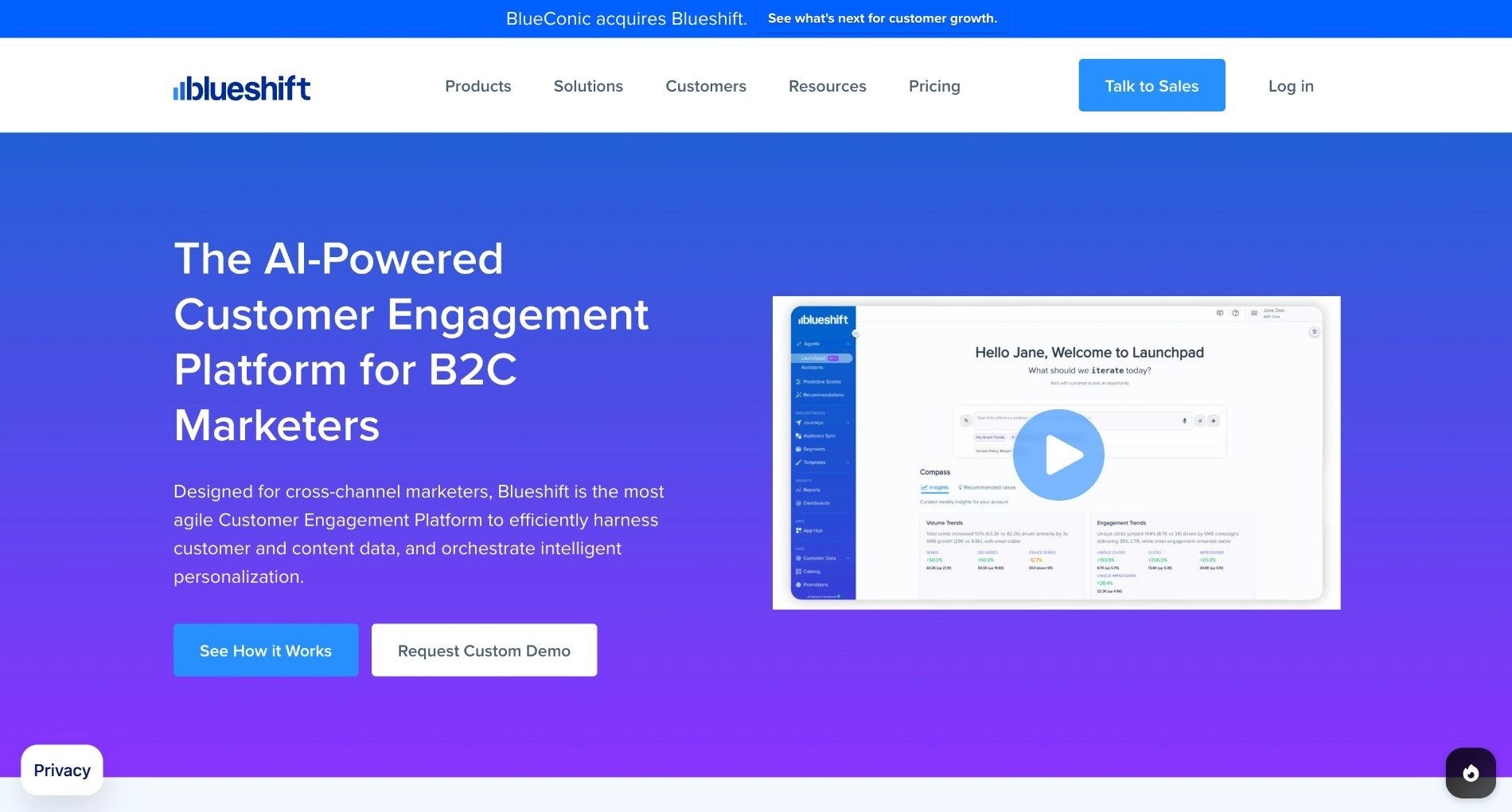
Blueshift positions itself as an AI-powered alternative to platforms like Braze and Iterable, giving mid-market retail and eCommerce teams a unified customer data platform alongside cross-channel marketing automation.
The platform orchestrates real-time customer journeys across email, SMS, push notifications, in-app messages, and paid media, all triggered from actual customer behaviour rather than a fixed campaign schedule.
Its AI operates on three levels: predictive scoring for behaviours like purchase likelihood or churn risk, and generative content assistance for campaign copy. A third layer handles automated decisioning for what to send and when.
Common use cases include cart abandonment, post-purchase sequences, and win-back campaigns, all common needs across growing eCommerce brands.
Ideal For
Mid-market eCommerce teams wanting unified customer data across every marketing channel
Retailers running high-volume lifecycle marketing programmes with dedicated CRM functions
Teams wanting predictive AI scoring alongside generative content assistance in one platform
Top Features
Predictive AI scoring for purchase likelihood, churn risk, and engagement
Generative AI assistance for campaign copy and subject lines
Cross-channel orchestration across email, SMS, push, in-app, and paid media
Why They Stand Out
Blueshift's combination of a native customer data platform with predictive and generative AI in one system reduces the number of separate tools a mid-market marketing team needs to manage.
Pros
Unified customer data platform reduces reliance on separate point solutions
Predictive AI scoring helps target the right customer at the right time
Strong cross-channel orchestration across email, SMS, and paid media
Cons
User reviews note a steeper learning curve and platform-specific terminology
Support response times have been flagged as inconsistent by some users
Less suited to retailers whose primary need sits outside marketing and retention
Pricing
Blueshift offers a pricing model based on the volume of customer data and messages processed, with plans tailored to the specific requirements and scale of the business using the platform.
Final Verdict
Blueshift is a strong choice for mid-market eCommerce teams wanting predictive and generative AI unified with customer data across every marketing channel.
Retailers whose main automation need sits in operations or support will need a different platform entirely.
9. Tidio
Overview
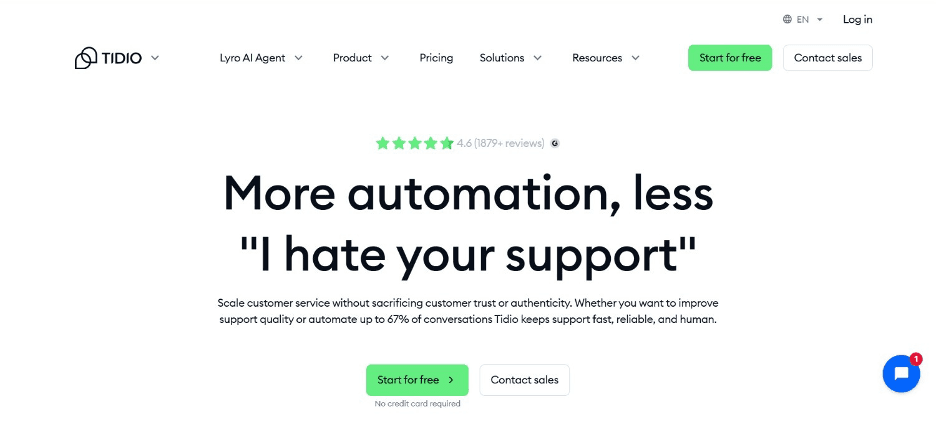
Tidio built its business around accessible live chat and support automation, aimed squarely at small to mid-size eCommerce stores rather than large enterprises.
Its Lyro AI chatbot handles common customer questions automatically, escalating to a human agent when a query falls outside what it can confidently resolve. The platform combines that AI layer with a more traditional multichannel helpdesk, covering live chat, email, and social messages in one inbox.
That combination of accessible pricing and a genuinely capable AI layer has made Tidio a common starting point for smaller stores testing AI-powered support for the first time.
Ideal For
Small to mid-size eCommerce stores wanting AI-powered live chat without enterprise pricing
Growing brands wanting a single inbox across chat, email, and social messages
Teams wanting a lower-cost entry point into AI support before scaling to a larger platform
Top Features
Lyro AI chatbot resolving common customer queries automatically
Multichannel helpdesk combining live chat, email, and social messages
Escalation to human agents when a query falls outside AI confidence
Why They Stand Out
Tidio's accessible pricing paired with a genuinely capable AI chatbot makes it one of the more approachable eCommerce AI tools for smaller stores testing automated support for the first time.
Pros
Accessible entry pricing compared with enterprise support platforms
Lyro AI chatbot handles a meaningful share of routine queries automatically
Single inbox across chat, email, and social simplifies day-to-day support
Cons
Best suited to smaller support volumes rather than complex enterprise needs
AI add-ons are billed separately from the base helpdesk plans
Less relevant for retailers needing catalogue or inventory automation
Pricing
Tidio has a free plan, then paid tiers starting around $29 a month billed yearly, $59 a month for Growth, and $300 a month for Plus. Custom pricing is available for the Premium tier.
Lyro AI and other add-ons are billed separately.
Final Verdict
Tidio is a sensible choice for small to mid-size eCommerce stores wanting an accessible entry point into AI-powered support.
Larger retailers with complex, high-volume support needs will likely outgrow its scope over time.
10. Decagon
Overview
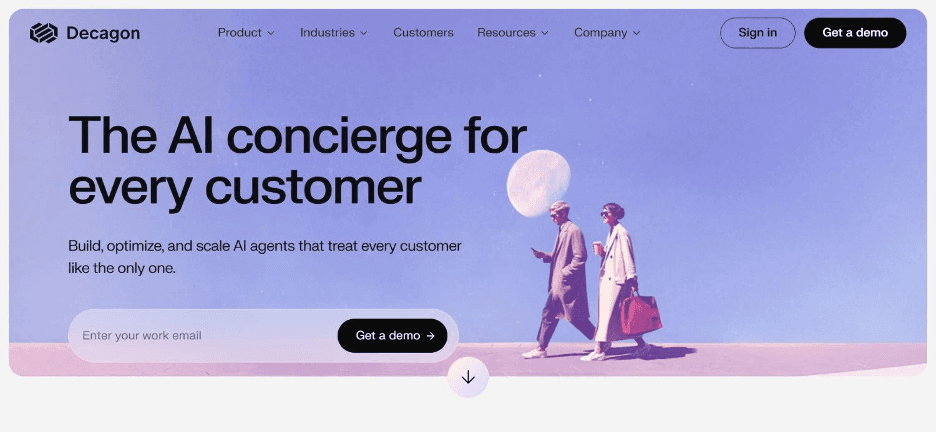
Decagon focuses on AI-powered customer support automation, aiming to resolve conversations rather than only assist a human agent through them.
The platform trains its support agents on a retailer's own policies and historical conversation data. That way, responses reflect how that specific brand actually handles a return, a shipping delay, or a billing question.
Rather than resolving every case in isolation, Decagon tracks whether a conversation genuinely closed the customer's issue or only moved it along.
That focus on measurable resolution, rather than activity alone, has made Decagon a common choice among eCommerce brands.
These brands want to see a clear line between automation and actual customer outcomes.
Ideal For
eCommerce brands wanting automated resolution of customer support conversations
Businesses wanting a choice between per-conversation and per-resolution pricing models
Retailers prioritising support automation over broader operational workflows
Top Features
AI support agents that resolve conversations rather than only drafting responses
Flexible pricing structure choosing between per-conversation and per-resolution billing
Volume discounts available for higher support ticket volumes
Why They Stand Out
Decagon's flexible pricing structure is one of its clearest differentiators, letting retailers choose the billing model that best matches their appetite for predictable costs versus paying strictly for successful outcomes.
Pros
Flexible choice between per-conversation and per-resolution pricing
Focused specifically on resolving support conversations, not just drafting them
Volume discounts help larger support operations manage cost
Cons
No public pricing listed, so budgeting requires a direct sales conversation
Focused on customer support rather than catalogue or back-office automation
Less suited to retailers whose main need sits outside customer conversations
Pricing
Decagon offers two enterprise pricing options: a fixed per-conversation rate with volume discounts, or a higher per-resolution rate with no charge for escalations.
No public pricing is listed, and most customers choose the per-conversation model for predictability.
Final Verdict
Decagon works well for eCommerce brands wanting automated support resolution with a pricing model matched to their risk appetite.
Retailers needing broader operational automation beyond support conversations will need a different platform for that side of the business.
How to Choose the Best AI Tools for eCommerce?
Every tool on this list calls itself AI-powered, but they solve genuinely different problems.
Here is what actually matters when you compare eCommerce automation tools against your own operation:
1. Decide Whether You Need Suggestions or Execution
Some platforms draft a response or flag an issue for a person to action. Others resolve the work itself and write the outcome back into your systems.
Be honest about which one you actually need. A drafting tool still leaves the busiest part of the job with your team, while an execution platform removes it entirely.
2. Check Integration Depth Against Your Real Systems
A tool that connects beautifully to modern, cloud-native platforms is not much use if your eCommerce operation still runs on a legacy ERP or a proprietary inventory system.
Ask any vendor for a specific list of systems they have deployed inside previously, not just a generic integrations page.
3. Match the Tool to Your Operational Complexity
A single-purpose personalisation or support tool is often plenty for a small store automating a handful of tasks. A multi-system, high-volume operation needs something built to handle that complexity end to end.
Buying more platforms than you need adds cost and setup time without adding real value.
4. Confirm How Pricing Scales With Your Volume
Some AI eCommerce platform options charge per seat, per message, or as a percentage of revenue, which can become unpredictable as your business grows.
Others scale more predictably with actual operational volume.
Model your expected volume over the next year, not just your current state, before comparing pricing across vendors.
5. Governance, Audit and EU Regulatory Alignment
eCommerce operations sit under a dense compliance stack: GDPR for customer data, PCI DSS for payment handling, DORA for operational resilience where financial partners are involved, NIS2 for cyber security, and the EU AI Act for any automated decision that affects a person. Every one of these expects the same thing from an eCommerce AI tool: a complete, tamper-evident record of what happened, why, and who could see it.
A platform with a full audit trail, replayable execution, and deployment options that keep data inside your infrastructure protects you during a compliance review in a way a simple automation tool cannot. This matters most for brands operating across multiple EU regions, handling payment data at scale, or planning for AI Act obligations that come into force in 2027.
Everything You Need to Know About AI Tools for eCommerce
Tool | Pros | Cons | Ease of Use | Integrations | Support | Affordability |
Noxus | Executes full workflows, works inside legacy systems, full audit trail | Requires a scoping conversation, built for genuine complexity | ⭐⭐⭐⭐ | ⭐⭐⭐⭐⭐ | ⭐⭐⭐⭐⭐ | ⭐⭐⭐ |
Carro | Grows assortment with no stock risk; curated partner matching | Not for support or marketing; US and USD focused | ⭐⭐⭐⭐ | ⭐⭐⭐⭐ | ⭐⭐⭐⭐ | ⭐⭐⭐⭐ |
Kore AI | Strong governance, retail accelerators, proven enterprise scale | Enterprise pricing runs high, setup complexity | ⭐⭐⭐ | ⭐⭐⭐⭐⭐ | ⭐⭐⭐⭐ | ⭐⭐ |
Gorgias | Shopify-first design, transparent tiered pricing | Support-only focus, pricier at scale | ⭐⭐⭐⭐⭐ | ⭐⭐⭐⭐ | ⭐⭐⭐⭐ | ⭐⭐⭐⭐ |
Clerk.io | Unified personalisation data, strong conversion gains | Costs add up with multiple modules | ⭐⭐⭐⭐ | ⭐⭐⭐⭐ | ⭐⭐⭐⭐ | ⭐⭐⭐ |
Yotpo Discover | Reviews, loyalty, and subscriptions in one platform | Pricing complexity across modules | ⭐⭐⭐⭐ | ⭐⭐⭐⭐ | ⭐⭐⭐ | ⭐⭐⭐⭐ |
Triple Whale | Unified attribution, AI agent for data questions | Analytics only, pricing scales with revenue | ⭐⭐⭐⭐ | ⭐⭐⭐⭐⭐ | ⭐⭐⭐⭐ | ⭐⭐⭐ |
Blueshift | Unified CDP with predictive and generative AI | Steeper learning curve, inconsistent support | ⭐⭐⭐ | ⭐⭐⭐⭐ | ⭐⭐⭐ | ⭐⭐⭐ |
Tidio | Accessible pricing, capable AI chatbot | Best for smaller volumes only | ⭐⭐⭐⭐⭐ | ⭐⭐⭐ | ⭐⭐⭐⭐ | ⭐⭐⭐⭐⭐ |
Decagon | Flexible pricing models, resolution-focused | No public pricing, support-only scope | ⭐⭐⭐⭐ | ⭐⭐⭐ | ⭐⭐⭐⭐ | ⭐⭐⭐ |
Automate Your eCommerce Operations with Noxus
Most eCommerce AI tools either hold a conversation, personalise a customer touchpoint, or connect a handful of apps together. We built Noxus to do something different: we execute the actual operational work, across the exact systems your retail business already runs on.
That includes the legacy ERP, the proprietary PIM platform, and the inventory system most automation vendors will not touch. Every action Noxus takes is traceable and replayable, with outcomes written back into your source systems under a full audit trail.
If your eCommerce operation spans several disconnected systems, you may be ready to move past tools that only suggest what to do next. Explore our agentic automation for retail solutions to see how we approach retail-specific deployments.
If your automation needs sit closer to connecting a few everyday apps together, our guide to workflow automation software covers that lighter end of the market too.
FAQs About AI Tools for eCommerce
What is the best AI tool for eCommerce in 2026?
The best AI tool for eCommerce in 2026 is Noxus, since it executes eCommerce operations end to end rather than only drafting a suggestion for a person to action. Our platform operates natively inside the exact systems a retailer already runs, from legacy ERPs to modern PIM platforms, without requiring a migration project first. Every action is traceable and replayable under a full audit trail, which matters for retailers operating in regulated markets or across multiple regions.
What should I consider when choosing the right AI tools for eCommerce for me?
Choosing the right AI tools for eCommerce starts with deciding whether you need a tool that drafts suggestions or one that completes the work itself. From there, check integration depth against your actual systems, particularly if you run legacy ERP or inventory platforms. Pricing structure and governance capability matter too, especially as your operational volume grows.
How does Noxus differ from similar alternatives?
Noxus differs from similar alternatives by executing eCommerce operations end to end rather than drafting suggestions for a human to action. Most eCommerce automation tools either hold a conversation or connect apps together, while Noxus resolves the work itself and writes outcomes back into the systems a retailer already runs. That includes legacy ERPs and proprietary platforms most automation vendors will not touch.
How do I get started with Noxus?
Getting started with Noxus begins with a scoping conversation covering your current systems, operational volume, and the specific workflow you want automated first. From there, our deployment team handles the integration setup, connecting to the systems you already run without requiring a large internal IT project. Most first deployments reach production between 45 and 80 days, depending on complexity.
How easy is it to switch to Noxus?
Switching to Noxus is easier than most retailers expect, since our platform is built to operate inside your existing systems rather than requiring you to replace them first. There is no need to modernise your stack or migrate data before automation can begin. Our deployment team scopes and builds the initial integration, so your team is not left managing the technical setup alone.
Do I need coding skills to use AI tools for eCommerce?
You do not need coding skills for most AI tools for eCommerce on this list, though the depth of technical skill required varies significantly by platform. Tools like Tidio and Gorgias are built for non-technical teams, while others require more setup effort to configure properly. Noxus is designed so operations teams can build and adjust workflows without writing code, while our deployment team handles the underlying system integration.
Can small eCommerce businesses afford AI tools for eCommerce?
Small eCommerce businesses can afford AI tools for eCommerce, since pricing across this market ranges from free tiers to accessible monthly plans under $50. Tidio and Yotpo both offer free tiers suited to a small team's early automation needs. As operational complexity grows, retailers typically move toward platforms like Noxus that scale with genuine transaction volume rather than a flat fee that no longer reflects actual usage.