Best Power Automate Alternatives in 2026 (Top-Rated Competitors Reviewed)
Noxus is the best overall choice among power automate alternatives for enterprises running operations rather than point-to-point integrations. It covers what teams use Power Automate for: multi-step execution across systems, approval steps and event-driven or scheduled runs.
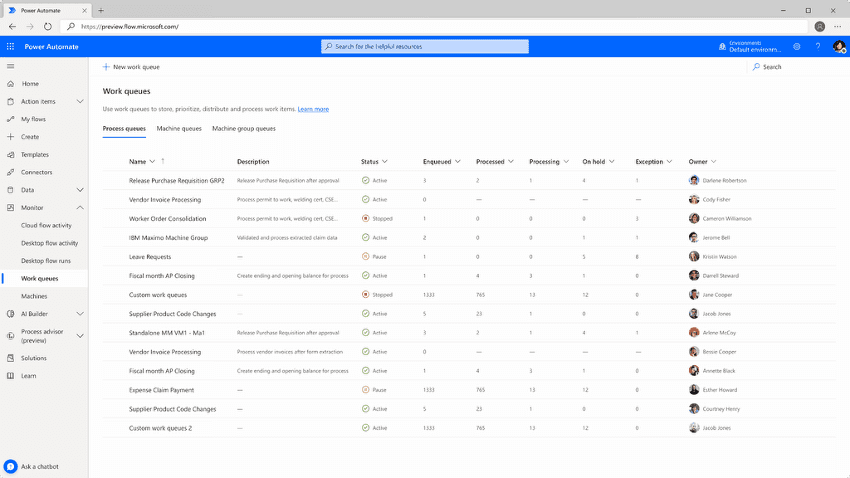
It then adds what a flow model does not represent. A Case holds state across days. A Work Queue gives operators somewhere to pick up work an automated step could not finish. A Process Builder holds the rules.
That matters for a specific kind of team. Power Automate is built to connect known systems quickly, and its reviewers say so consistently.
The complaints start where the sequence stops being predictable: unclear error messages, workflow failures that are hard to diagnose, licence cost that grows faster than the estate. If a case in your process waits three days for a document and pauses for an approval, a flow is the wrong shape for the work.
We built Noxus, so read the first entry with that in mind. The other nine draw on published product information and verified G2 and Capterra reviews.
Key Takeaways (TL;DR)
Who Power Automate Is For: Teams inside the Microsoft estate automating defined sequences between known applications, using cloud flows for services, desktop flows for user interfaces and approval actions to bring people into the sequence.
Why Seek a Power Automate Alternative: Reviewers describe troubleshooting and reliability as the weak points, with unclear error messages and workflow failures that are hard to diagnose, alongside slow performance and cost at volume. Structurally, a flow is a sequence rather than a case.
Best Overall Alternative: Noxus. It holds case state across failures, waits and human intervention rather than ending when a step fails, and runs inside customer-controlled infrastructure including on-premises and air-gapped environments.
What Sets Noxus Apart: Process-level case execution, customer-controlled deployment and an open-core guarantee returning all code and binaries if the relationship ends. No competitor on this list replicates that combination.
How to Choose: Separate integrations from processes, because the two problems have different answers. Then audit what you already run in Power Automate before replacing it, and model cost at production volume rather than pilot volume.
Top Power Automate Alternatives in 2026 at a Glance
← scroll to see all columns →
| Tool | Best For | Key Features | Pros | Cons |
|---|---|---|---|---|
| Noxus | Enterprise operations running end to end across legacy systems under audit | Work Queue & CaseProcess Builder400+ connectorsBYOK model routingOn-premises and air-gapped deployment | Case state survives failures and waits; outcomes written back into systems of record; separate functional and technical records | Sales-led evaluation with a scoped first process; over-specified for simple two-system integrations; small public review base |
| UiPath | Large-scale automation estates including UI automation | UI and API automationAgentsMaestro case managementOrchestratorDocument understanding | Reaches applications no API can address; centralised governance across large fleets; extensive free training | Reviewers report unclear error messages and inconsistent debugging; administrative overhead; intricate licensing |
| n8n | Engineering teams wanting self-hosted workflow automation | Node-based workflowsCustom codeAI agent nodes500+ integrationsSelf-hosting | Full infrastructure control; code where nodes fall short; version control and environment management | Steep learning curve; interface friction on large workflows; engineering ownership required |
| Zapier | Connecting cloud applications quickly without engineering | 8,000+ app integrationsMulti-step ZapsTables & InterfacesAI actions | Broadest integration catalogue; fastest route to a working automation; accessible to non-technical users | Task-based pricing escalates at volume; limited depth for complex logic; cloud-only with no self-hosting |
| Make | Visual scenario building with complex branching | Visual scenario canvasRouters and filters2,000+ appsError handlersScheduling | Branching logic legible on one canvas; explicit error handler routes; operations-based pricing | Reviewers name challenging error handling and bugs; steep learning curve; operations consumption hard to predict |
| Workato | Enterprise integration with governance and IT ownership | RecipesEnterprise connectorsWorkflow appsEnvironmentsGovernance and audit | Environments, versioning and audit built in; connector depth into ERP and core systems; reusable components | Reviewers report learning curve and difficult setup; enterprise-tier cost; cloud-first with limited customer-controlled execution |
| Automation Anywhere | RPA estates extending into agentic process automation | Agentic Process AutomationDocument automationControl roomCo-PilotCloud-native architecture | Document extraction and validation at volume; centralised control room governance; clear path from RPA to agentic | Reviewers name learning curve and missing features; four-month median implementation with fifteen-month payback; cost |
| Nintex | Process mapping and workflow with SharePoint heritage | Process mappingWorkflow automationFormsDocument generationRPA | Mapping and execution in one product; strong forms and document generation; approachable for business users | Reviewers cite limited features and customisation; three-month implementation with eighteen-month payback; thin verified review coverage |
| Appian | BPM and dynamic case management with low-code applications | Process modellingCase managementData fabricLow-code appsAI skills | Mature case model for long-running work; applications and process logic in one product; strong audit capability | Licensing cost dominates reviews; specialist developers needed; five-month implementation with eighteen-month payback |
| Tray.ai | API-first integration for technical operations teams | Visual builder with codeAPI managementConnectorsEmbedded integrationAudit trails | Custom connectivity as standard rather than exception; reviewers name logs and audit trails as easy to work with; two-month median implementation | Poor documentation is the most consistent criticism; complex pricing; assumes technical users throughout |
Why Consider Power Automate Alternatives?
What Power Automate Does Well
Power Automate is strong at automating known sequences of work, and dismissing it would misread why it is deployed so widely.
Cloud flows connect Microsoft 365 and third-party services through a large connector catalogue. Desktop flows automate user interfaces when an application cannot be reached conveniently through an API. Approval actions bring people into the sequence at the points that need them.
It holds a 4.4 average across more than 2,200 verified user reviews, with ease of use, automation and integrations as the strengths reviewers name most often.
The accessibility is what reviewers return to. One describes it as easy, code-light automation that fits in the Microsoft environment, with most of what they needed available through ready-made connectors.
Users describe comprehensive automation capabilities and significant time savings on repetitive tasks. For a team automating an approval chain between SharePoint, Outlook and Teams, that combination of reach and accessibility is hard to beat.
Where Power Automate Falls Short
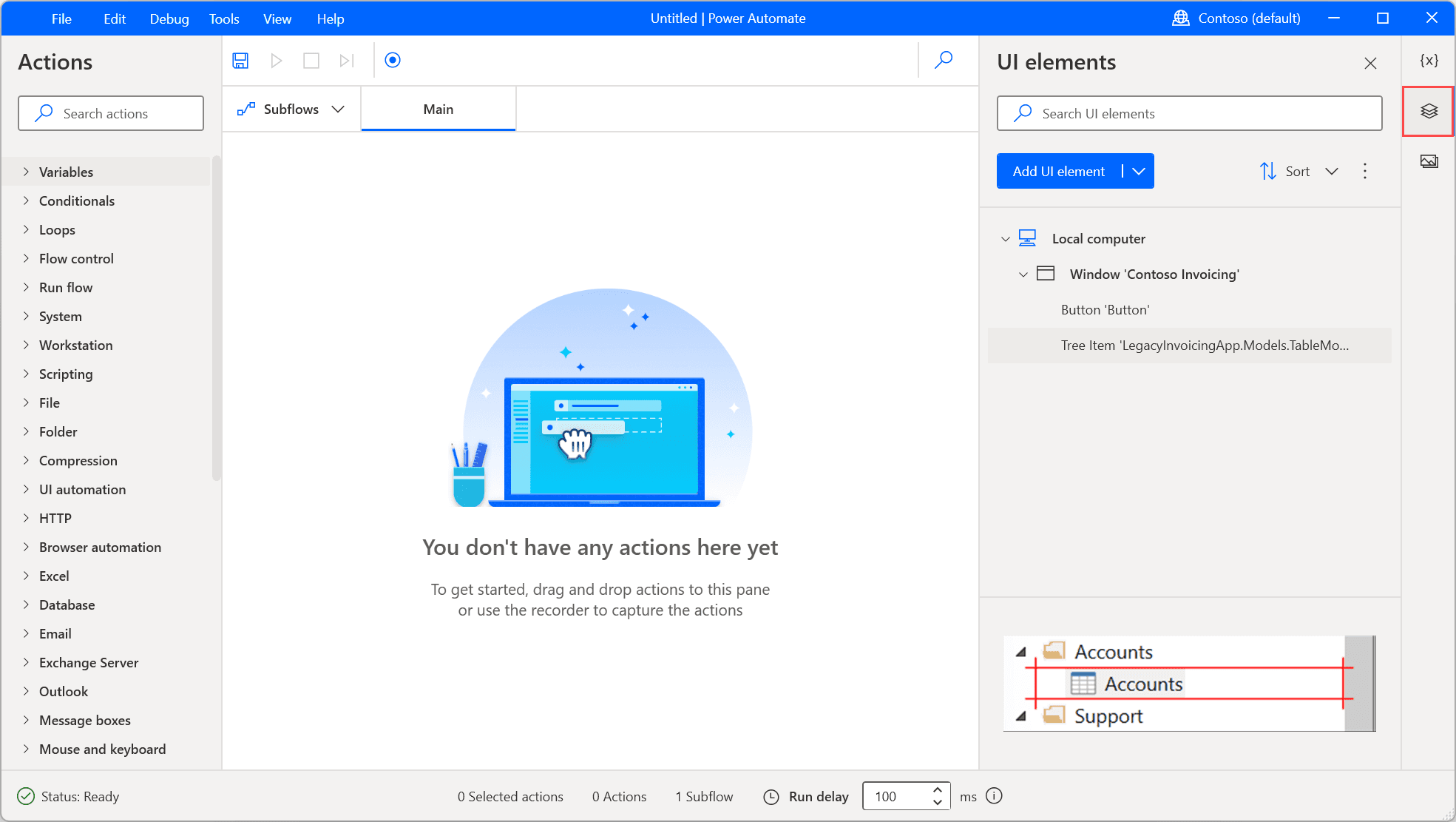
The criticism is unusually consistent, which makes it reliable signal rather than noise.
The pattern reviewers return to is troubleshooting and reliability, with unclear error messages and workflow failures that are difficult to diagnose.
Slow performance, bugs and cost follow close behind. One reviewer describes troubleshooting as not always straightforward, with error messages that are vague and hard to interpret.
The reliability theme matters more than it first appears, because of what a flow is. A flow executes a sequence and finishes, so when a step fails partway through there is no case object holding what has already happened.
The information required to understand the failure is spread across run history, connector logs and whatever the flow happened to write somewhere. That is why the troubleshooting experience reviewers describe is harder than it needs to be.
Cost is the third theme, and it surfaces as volume grows. Reviewers describe premium connectors and per-user licensing that becomes significant once automation moves beyond a few departments.
Support scores lowest of the four sub-ratings reviewers give it, below features and below value for money. For teams evaluating power automate alternatives, the trigger is usually a silent failure, a full day of troubleshooting or a licence bill that outgrew the estate.
Best Power Automate Alternative Overall
Noxus is the best overall alternative to Power Automate for enterprises whose work is operational rather than transactional. It covers the multi-step execution, approvals and system connectivity flows provide.
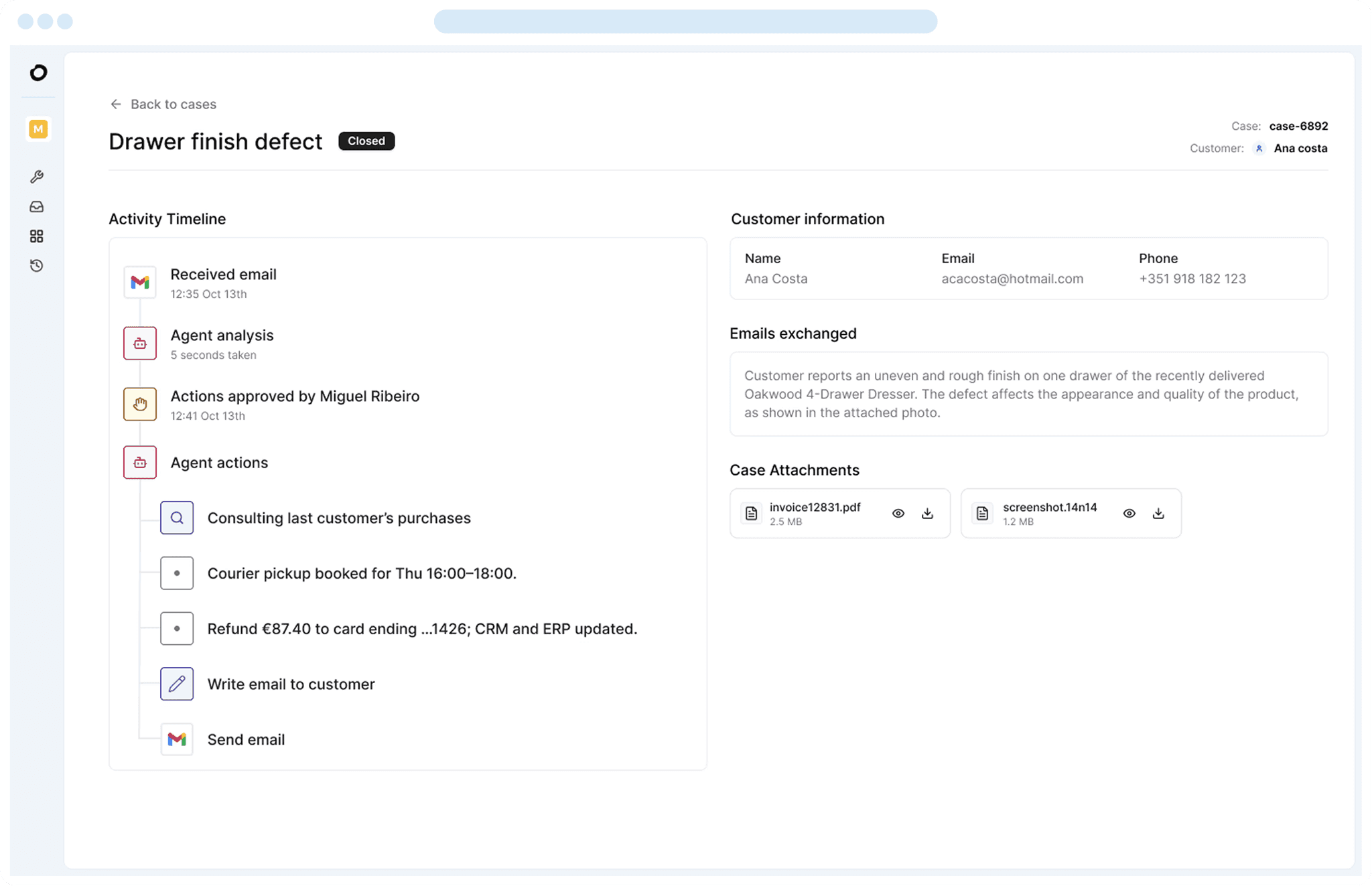
A Work Queue brings together the active cases and the human work attached to them. A Case carries its data, documents, state, decisions and execution history from intake to outcome. A Process Builder defines the activities, rules and controls.
The difference shows most clearly at the failure point. When an external system is unavailable or a step cannot complete, the case pauses and creates work for the appropriate team rather than failing silently.
The person receives it with the information and prior actions already accumulated, resolves the issue, and the process continues from the same state.
Noxus deploys as managed SaaS, inside a customer VPC, on-premises or fully air-gapped, with bring-your-own-key encryption and no training on client data. Carlsberg Group reconciles supplier invoices against purchase orders and delivery records with only the exceptions reaching finance.
Best Power Automate Alternatives in 2026: In-Depth Review & Comparison
The best Power Automate alternatives fall into three groups. There are process products that run operations end to end, automation suites built for estate-scale governance, and integration tools that connect applications quickly.
Each entry follows the same structure: what the product does, who it fits, its strongest capabilities, why it is a credible Power Automate replacement, what reviewers say, and where it stops.
1. Noxus
Overview
Noxus is the process layer for enterprise operations, holding the process logic and live case state that coordinate work across agents, people and the systems an organisation already runs.
We were founded in 2023, based in London and Lisbon, around a specific observation. Enterprise software became good at recording business objects: an ERP records orders and invoices, a CRM records customers, a core banking system records accounts.
The logic that moves those objects from one outcome to another is far more fragmented. It sits across software configuration, SOPs, integrations, spreadsheets, queues and institutional knowledge, and that is the layer Noxus provides.
Customers include Santander, Fidelidade, Jerónimo Martins, CUF, KIRCHHOFF Automotive, Carlsberg Group, Sky, Brisa, Randstad and Abanca. We hold SOC 2 Type II and ISO 27001, with zero client churn across all deployments to date.
Against Power Automate specifically, the difference is what happens when something goes wrong. A flow stops. A case pauses, keeps everything it has accumulated and waits for the right person.
Ideal For
Operations leaders in banking, insurance and utilities who own cost per case and SLA performance
Finance and shared services teams running invoice matching, reconciliation and document extraction across SAP, Oracle and SharePoint
Manufacturing quality teams handling supplier claims, PPAP reviews and audit follow-up against SAP QM and MM
Organisations with data residency or sovereignty requirements that rule out cloud-only execution
Teams whose Power Automate estate has grown past the point where failures are easy to diagnose
Top Features
Work Queue, Case and Process Builder as first-class objects, so a case that waits three days for a document keeps its state, history and place in an operator's queue throughout.
400+ native connectors plus direct integration into systems without modern APIs, including SAP ECC and S/4HANA through OData, Guidewire, ServiceNow, Oracle and COBOL-era cores, with write-back into inspection lots, goods receipts and quality notifications.
Deployment across shared cloud, customer VPC, on-premises and air-gapped environments with bring-your-own-key encryption, keeping process data, documents, case state and audit records inside the client perimeter.
Versioned process definitions with GitOps support through GitHub and GitLab, so production changes are reviewed and released deliberately with a record of which version ran each case.
Two record types for two audiences: a functional history showing what happened to the business case, and technical logs carrying the runtime and integration detail engineering needs to diagnose failures.
Why We're the Best Power Automate Alternative
The comparison comes down to what happens when something goes wrong, which is where reviewers say Power Automate is hardest to work with.
A flow executes a sequence, so when a step fails the run stops and the diagnosis begins across run history and connector logs. In Noxus, a running case pauses, holds its accumulated state and creates work for the right team with the context attached.
The runtime preserves the state of each case while handling retries, interruptions and recovery. Every case carries an execution record showing what an agent did, which systems were updated, where a person intervened and what failed.
The second reason is deployment reach. Power Automate runs in the Microsoft cloud, while a Noxus process runs wherever governance allows, including air-gapped environments with offline update transfer under cryptographic verification.
The open-core guarantee answers the lock-in question with a mechanism. The client retains all code and binaries if the relationship ends.
Pros
Case state survives failures, waits and human intervention rather than a run ending when a step fails
Runs inside customer-controlled infrastructure including on-premises and air-gapped, with no training on client data
Reaches legacy systems with no API modernisation project, including production write-back into SAP, Guidewire and core banking
Separate functional and technical records, so operations teams and engineering each get the view they need
Verified production deployments: Santander running branch operations as a governed process across five countries on its own infrastructure, Jerónimo Martins automating 15,000 daily product listings with PIM write-back, Carlsberg reconciling supplier invoices against purchase orders with only exceptions reaching finance
Cons
Sales-led evaluation, so the first step is a scoped process assessment rather than a self-serve trial
Over-specified for a simple two-system integration, where a lighter tool reaches a working result faster
Small public review footprint relative to established automation vendors, which matters if peer review volume weighs in your evaluation
Customer Reviews
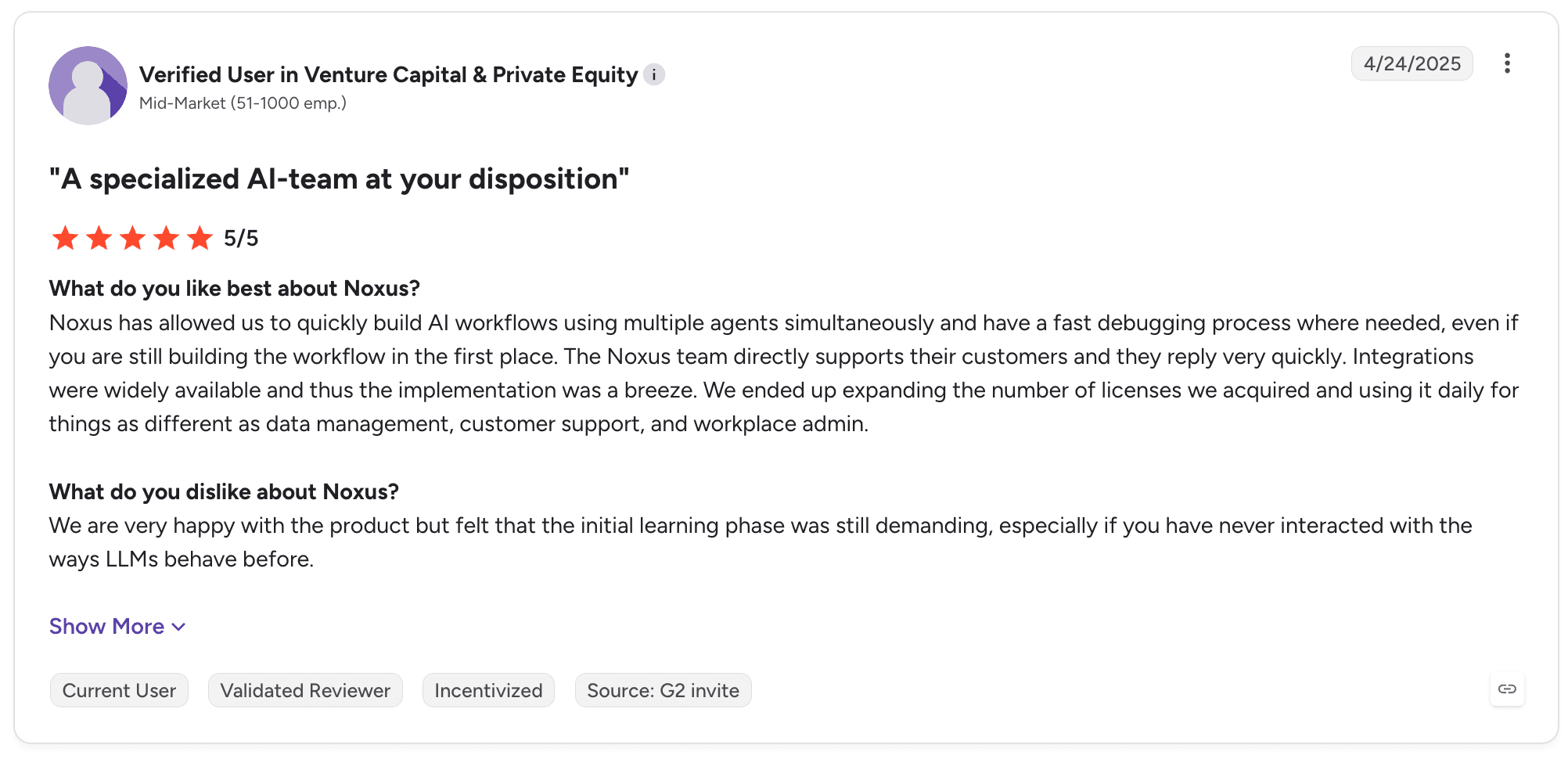
Noxus holds 5.0 out of 5 across three G2 reviews, a small sample best read as early signal rather than consensus. Reviewer-generated tags are setup ease, integrations, customer support and customisation, with learning curve the only negative.
Reviewers describe building workflows with multiple agents running simultaneously and a fast debugging process, alongside integrations available widely enough that implementation went smoothly. The consistent criticism is that the initial learning phase is demanding for anyone who has not worked with LLM behaviour before.
Final Verdict
If you are leaving Power Automate because the work is an operation rather than an integration, this is the closest thing to a direct answer.
The case persists through failures and waits, the operators have somewhere to work, and the outcome lands in SAP or the core banking system under audit. For a European enterprise with legacy density and sovereignty requirements, the deployment model usually decides it.
2. UiPath

Overview
UiPath is the largest automation vendor in enterprise software, and in most Power Automate evaluations at scale it is already present somewhere in the organisation.
It began in UI automation, and the current product has expanded well beyond that. UiPath Agentic Automation combines UI and API automation, agents, human intervention, orchestration and Maestro case management.
Its position against Power Automate is direct, since both automate work across applications and both offer UI automation.
The difference is depth and scope. UiPath is built for estates with hundreds or thousands of processes, centralised governance and a dedicated centre of excellence.
Ideal For
Enterprises running large automation estates with centralised governance and a centre of excellence
Shared services and back-office teams automating high-volume work across applications without APIs
Organisations needing UI automation against desktop and terminal applications no API can reach
Regulated businesses requiring customer-managed deployment of automation infrastructure
Teams with dedicated RPA developer capacity and an established process pipeline
Top Features
UI and API automation combined, so a process reaches applications through whichever route exists
Maestro case management, bringing long-running case orchestration into the same product as the automation
Orchestrator for centralised scheduling, monitoring and governance across large robot and agent fleets
Agentic capabilities with human-in-the-loop controls for work requiring interpretation alongside approval
Document understanding for extracting structured data from unstructured documents at volume
Why It's a Strong Power Automate Alternative
UiPath handles the depth that Power Automate's desktop flows approach more lightly. When UI automation is a serious requirement rather than an occasional fallback, the maturity difference is substantial.
Resilient selectors, centralised robot management, exception handling and recovery patterns have been built over a decade of production deployments. One reviewer describes automating across SAP, mainframe, Windows, web, Excel, PDF and Oracle applications.
Governance at scale is the second argument. Orchestrator gives an automation programme centralised scheduling, monitoring, credential management and audit across the whole estate, which is what a Power Automate estate typically lacks once it spreads across departments.
Pros
UI automation reaches legacy desktop and terminal applications that no API can address
Orchestrator provides centralised governance, scheduling and credential management at estate scale
Case management and agents inside the same product as the automation itself
Document understanding handles unstructured input at volume without a separate tool
Extensive free training and certification, repeatedly named by reviewers as a genuine strength
Cons
Reviewers describe unclear error messages and inconsistent behaviour during development and troubleshooting
Administrative overhead is significant, with complex configuration when components combine
Licensing is intricate, and reviewers report difficulty modelling total cost across robots, agents and orchestration
UI automation stays sensitive to interface changes in underlying applications
Process logic sits with the automation team rather than with the business owner of the process
Customer Reviews
UiPath Agentic Automation holds 4.6 out of 5 across 7,579 G2 reviews, with UiPath rated 4.6 on Capterra. That is by far the largest verified review base on this list.
Reviewers praise extending RPA with agentic decision-making, no-code agent creation and approachability for people without a programming background. Stability and error handling are the leading concern, with reviewers describing unclear error messages during development and troubleshooting.

Final Verdict
UiPath is recommended for organisations running automation at estate scale, particularly where UI automation against legacy applications is a hard requirement and centralised governance matters.
It is a weaker fit where the organisation wants business process owners to own operational logic, or where the estate is small enough that breadth becomes overhead. The stability pattern deserves direct testing in a proof of concept.
3. n8n
Overview
n8n is a workflow automation product for technical teams, built around a node-based canvas with over 500 integrations, custom code inside workflows and AI agent nodes.
It offers cloud hosting and self-hosting under source-available licensing, which lets organisations run it entirely inside their own infrastructure.
Its position against Power Automate is clean: same category, different centre of gravity. Where Power Automate is built for accessibility across a broad business user base, n8n is built for engineers who want control.
That control extends to hosting, to code inside workflows and to version management. It makes n8n a natural choice for technical operations teams and a difficult one for business owners.
Ideal For
Engineering teams building automation with source control and environment management
Organisations requiring self-hosted automation for data governance or residency reasons
Technical operations teams connecting APIs with custom logic between the calls
Developers wanting code inside visual workflows rather than choosing one model or the other
Mid-market technical organisations with engineering capacity and limited procurement appetite
Top Features
Node-based visual workflows with custom code, so logic no node supports is written directly
Self-hosting under source-available licensing, giving full control over infrastructure, data and credentials
500+ integrations plus HTTP request nodes for reaching anything not covered
AI agent nodes bringing model calls, tool use and agent behaviour into the same workflow model
Version control and environment management for teams treating workflows as software
Why It's a Strong Power Automate Alternative
The self-hosting argument decides evaluations in regulated environments, and it is the clearest structural difference from Power Automate.
An organisation that cannot send workflow data through a vendor cloud runs n8n on its own infrastructure with full control over networking, credentials and residency. For teams whose Power Automate adoption stalled at a security review, this removes the blocking objection.
The code escape hatch is the second advantage, and it addresses exactly where reviewers say Power Automate becomes difficult. When a workflow needs an undocumented internal API and a transformation no connector supports, n8n allows JavaScript at that point.
Pros
Self-hosting with complete control over infrastructure, data and credentials
Custom code inside visual workflows removes the ceiling pure no-code products hit
Over 500 integrations plus HTTP nodes for anything unsupported
Version control and environment management suited to teams treating workflows as software
Active community that reviewers repeatedly name as a practical advantage
Cons
Reviewers consistently describe a steep learning curve for anyone without a technical background
Interface friction on large workflows, with poor interface design appearing among negative tags
Debugging complex workflows draws criticism, with reviewers describing difficulty isolating failures
Requires engineering ownership, so business process owners cannot maintain workflows independently
No case object, work queue or process-level record, so operational governance must be built separately
Customer Reviews
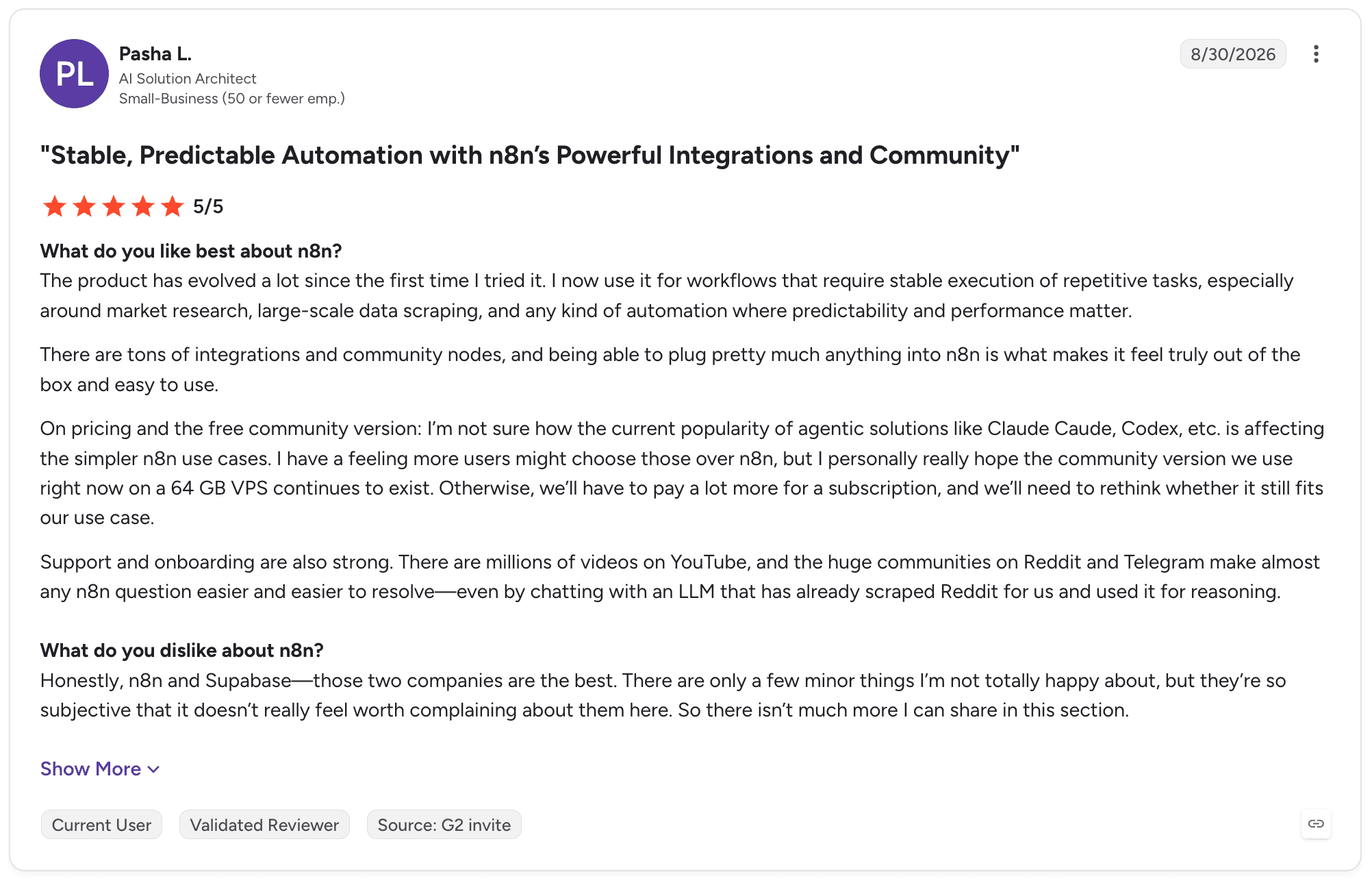
n8n holds 4.7 out of 5 across 314 G2 reviews and 4.6 across 40 on Capterra, the strongest average here. Reviewers describe stable and predictable automation with strong integrations, and self-hosting that gives substantial control.
The criticism is consistent about difficulty rather than capability. Reviewers describe needing JavaScript, expressions, JSON and error handling knowledge to get full value, and a notable learning curve for beginners.
Final Verdict
n8n is recommended for engineering teams that want automation infrastructure they control, particularly where self-hosting is a requirement and technical ownership is already the operating model.
It is not suitable for organisations wanting business process owners to run operational logic. There is no case object, operator queue or process-level execution record, so the surrounding infrastructure is yours to build.
4. Zapier

Overview
Zapier is the widest integration catalogue in the category, connecting over 8,000 applications through Zaps that trigger on an event and execute a sequence of actions.
It has expanded beyond simple two-step automations into Tables, Interfaces, multi-step logic and AI actions. Its centre remains what it has always been: connecting cloud applications quickly without engineering involvement.
The comparison with Power Automate is straightforward. Power Automate reaches deeper into Microsoft 365 and offers desktop flows for UI automation.
Zapier reaches further across the long tail of SaaS applications and gets a working automation live faster. Which matters more depends entirely on where the work sits.
Ideal For
Marketing, sales and operations teams connecting cloud applications without engineering support
Organisations outside the Microsoft estate needing broad SaaS connectivity
Small and mid-market businesses automating handoffs between specialised tools
Teams needing an automation live in hours rather than weeks
Departments that want to own their own automations without an IT ticket
Top Features
8,000+ app integrations, the broadest catalogue available for connecting cloud applications
Multi-step Zaps with paths and filters for conditional logic beyond trigger-action pairs
Tables and Interfaces for holding data and building simple front ends around automations
AI actions and agents bringing model calls into automation sequences
Built-in error visibility and replay for reviewing and rerunning failed runs
Why It's a Strong Power Automate Alternative
Coverage is the argument. When a process touches specialised SaaS applications that Microsoft's connector catalogue does not reach, Zapier usually has an integration ready.
The time from requirement to working automation is measured in hours. One reviewer describes connecting Gmail, Google Calendar, Slack, Forms, Docs and Stripe with minimal setup.
Accessibility is the second advantage, and it is genuine rather than marketing. Reviewers describe non-technical users building working automations without support, which changes who can automate in an organisation.
Pros
Broadest integration catalogue in the category at over 8,000 applications
Fastest route to a working automation, with reviewers describing setup in minutes
Accessible to non-technical users without support or training
Multi-step paths and filters cover conditional logic without engineering involvement
Error visibility and replay make failed runs straightforward to review and rerun
Cons
Task-based pricing escalates quickly at volume, the dominant criticism across both review sites
Depth is limited for complex branching logic, with reviewers describing workarounds for anything intricate
Cloud-only, with no self-hosted option for data that cannot leave the perimeter
Reviewers name learning curve and complexity once automations move beyond straightforward patterns
Not built for long-running work, with no case state or operator queue
Customer Reviews
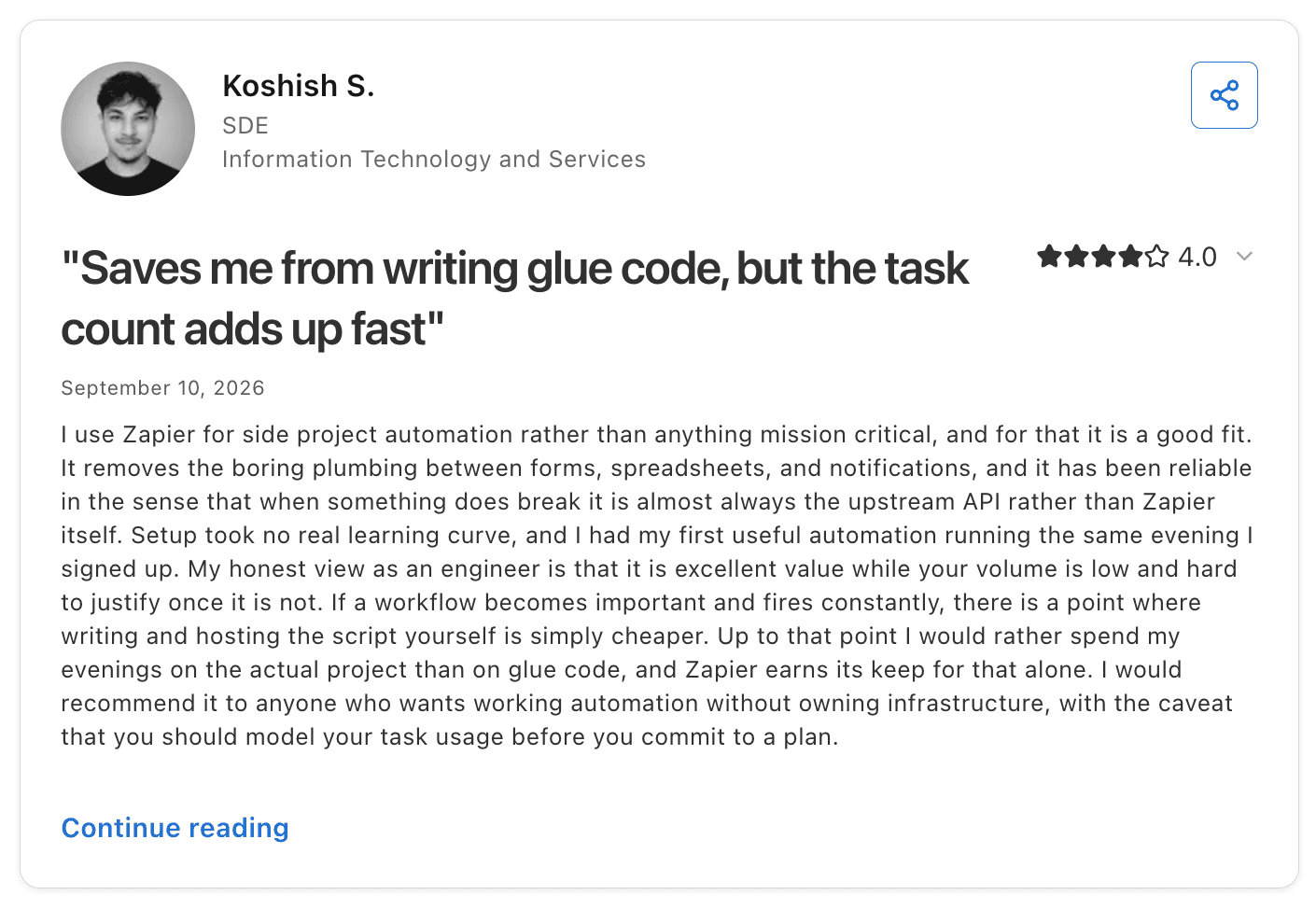
Zapier holds 4.5 out of 5 across 2,087 G2 reviews and 4.7 on Capterra. Reviewers describe a no-code product that connects thousands of apps in minutes and automations that quietly save hours each week.
Cost is the criticism that appears most often, and it appears on both sites. Reviewers describe costs that add up for advanced usage, with pricing growing as volume and complexity increase, and several describe limitations once logic becomes intricate.
Final Verdict
Zapier is recommended for teams connecting cloud applications quickly without engineering involvement, particularly outside the Microsoft estate and where the stack includes specialised tools.
It is not suitable for enterprise operational processes. A Zap executes and finishes rather than holding a case open across days, and there is no self-hosted option for regulated data.
5. Make

Overview
Make, formerly Integromat, is a visual automation product built around a scenario canvas where modules connect into branching flows.
It reaches over 2,000 applications, supports routers, filters, iterators and error handlers, and prices on operations rather than tasks. That changes the economics for high-volume work with many small steps.
Against Power Automate, Make competes on visual clarity and on pricing for complex scenarios. Where Power Automate's designer presents a linear list with conditions nested inside, Make shows the whole scenario as a connected graph.
It sits between Zapier's accessibility and n8n's technical depth.
Ideal For
Operations teams building automations with substantial branching and conditional logic
Organisations wanting visual clarity across complex multi-path scenarios
High-volume automation where operations-based pricing is more economical than per-task
Teams comfortable investing time in learning a more expressive model
Small and mid-market businesses with intricate automation requirements
Top Features
Visual scenario canvas showing branching, parallel paths and data flow as a connected graph
Routers, filters and iterators for conditional logic and array handling without code
2,000+ app integrations plus HTTP modules for anything not covered
Error handlers with configurable directives for retry, break, resume and rollback behaviour
Operations-based pricing that suits scenarios with many small steps
Why It's a Strong Power Automate Alternative
The visual model is the practical advantage, and it addresses a specific complaint about Power Automate. Reviewers describe Power Automate workflows becoming difficult to manage when many conditions or loops are involved, because nesting hides the structure.
Make's canvas shows branching explicitly, which makes a complex scenario legible to someone who did not build it. For automations maintained by more than one person, that has real operational value.
Error handling is the second differentiator worth naming. Make provides explicit error handler routes with configurable directives, so a scenario defines what happens when a module fails rather than relying on the default.
Pros
Visual canvas makes branching and parallel logic legible, including to people who did not build it
Explicit error handler routes with configurable failure behaviour per module
Operations-based pricing suits high-volume scenarios with many small steps
Extensive integration catalogue, named by reviewers as the leading strength
Routers, filters and iterators handle complex conditional logic without dropping into code
Cons
Challenging error handling and bugs are the most repeated criticism
Steep learning curve, with reviewers describing significant time investment before productivity
Cloud-only, with no self-hosted option for regulated data
Operations counting can be difficult to predict, with reviewers describing credit consumption as opaque
Not built for long-running work, with no case state or operator queue
Customer Reviews
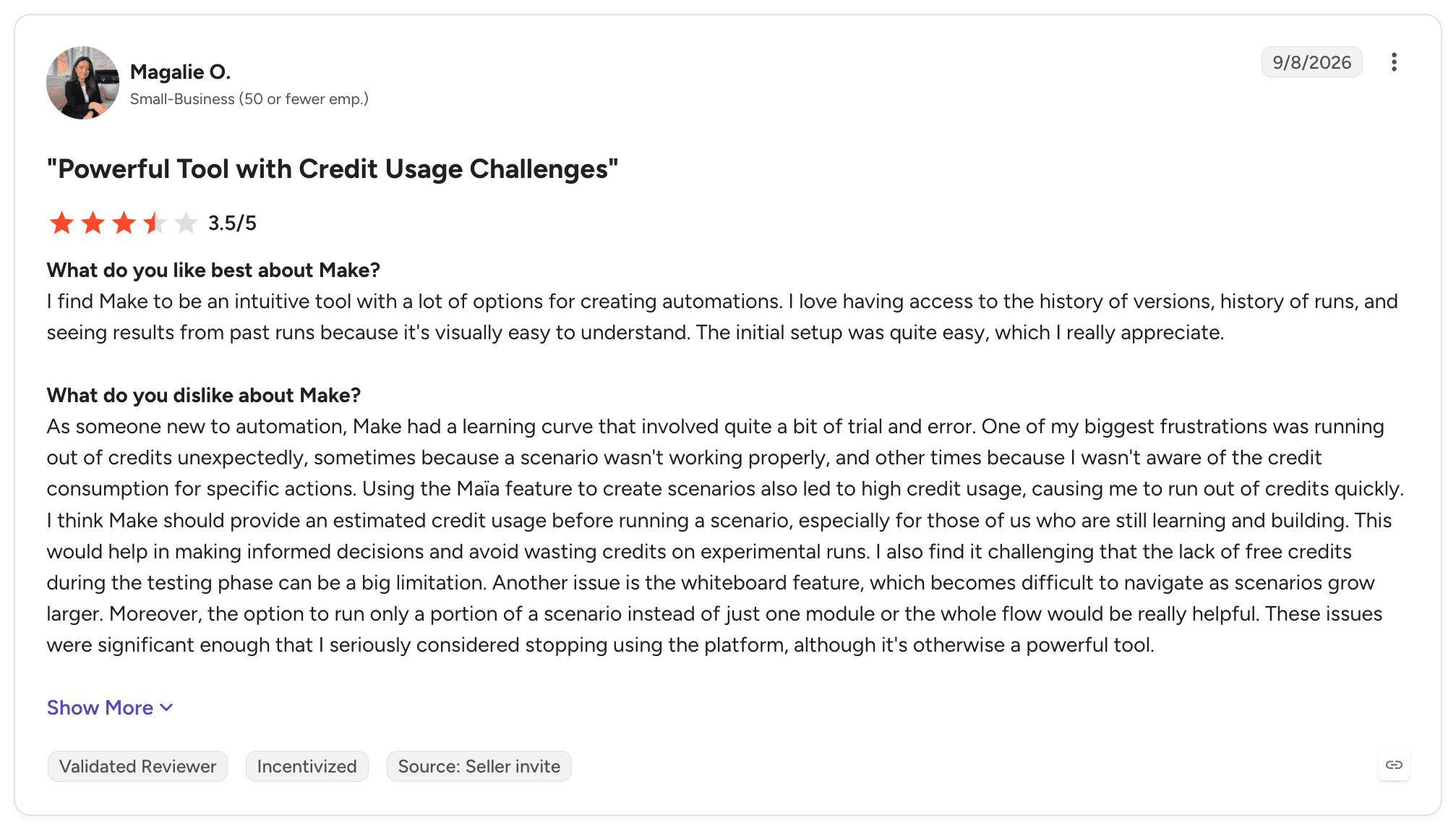
Make holds 4.6 out of 5 across 383 G2 reviews and 4.8 across 459 on Capterra. Reviewers describe extensive integration capabilities and connections across a wide range of apps.
The criticism is specific. The recurring themes are challenging error handling and bugs, with reviewers describing a steep learning curve even with prior automation experience, and credit consumption appears repeatedly as difficult to predict as scenarios grow.
Final Verdict
Make is recommended for teams building automations with substantial branching logic, particularly where the scenario will be maintained by more than one person.
It is not suitable for enterprise operational processes, for the same structural reasons as Zapier. The error handling criticism is also worth weighing carefully, given that reliability is frequently the reason teams look at power automate alternatives in the first place.
6. Workato
Overview
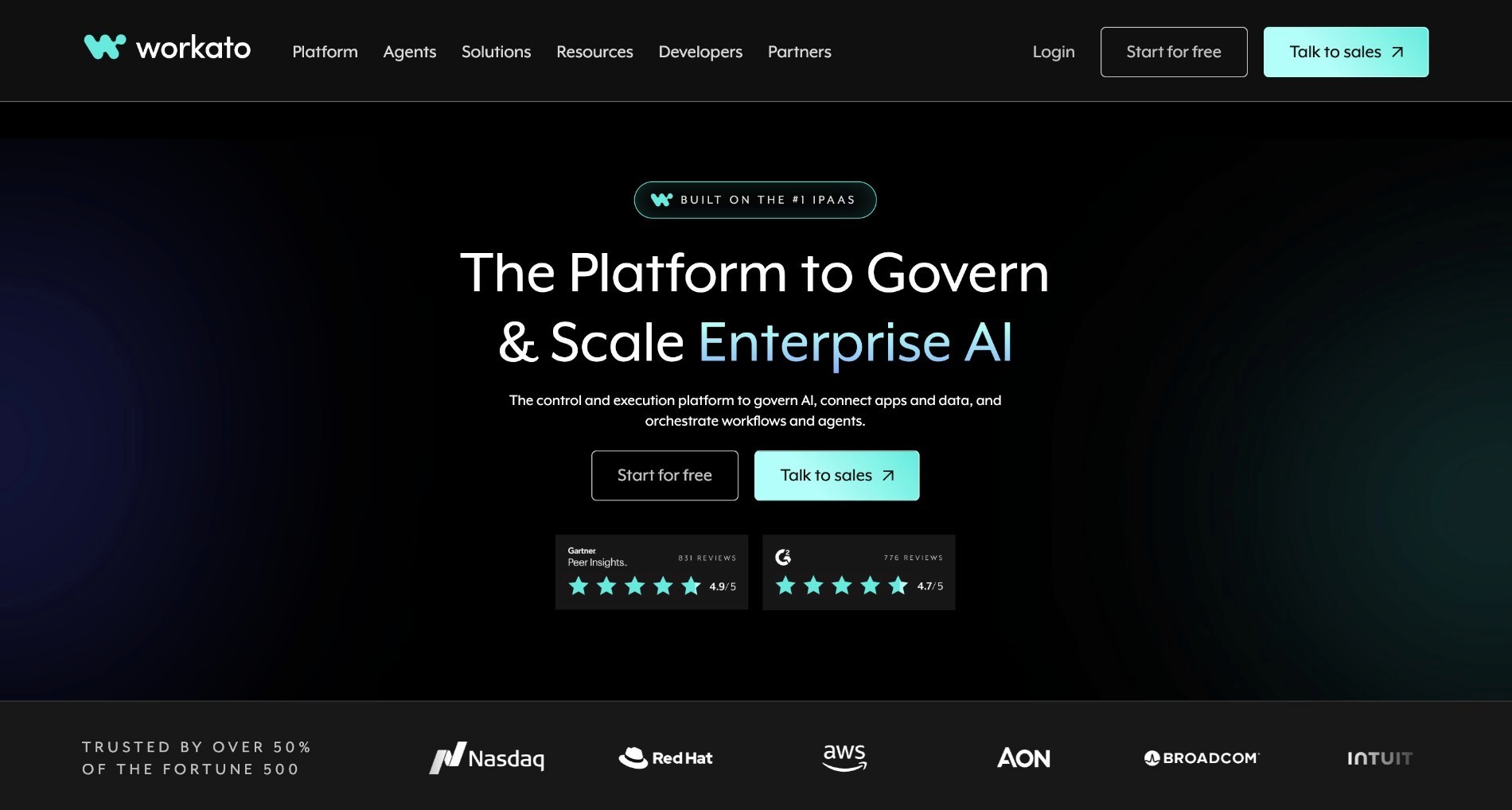
Workato is an enterprise integration and automation product built around recipes, which combine triggers, actions and logic across enterprise applications.
It targets IT-owned integration programmes with governance, environment management and audit built in, positioning between traditional iPaaS and business-facing automation.
Its connector catalogue covers enterprise systems rather than only SaaS applications, with depth in ERP, CRM, HR and finance platforms.
The comparison with Power Automate is about governance and enterprise depth rather than accessibility. Workato assumes IT ownership with business collaboration, formal environments and release management.
Ideal For
IT-owned integration programmes with formal governance and release management
Enterprises connecting ERP, CRM, HR and finance systems with business logic between them
Organisations needing environment separation between development, testing and production
Teams building embedded integrations into their own products
Mid-market and enterprise businesses wanting integration and automation in one product
Top Features
Recipe model combining triggers, actions and logic with reusable components across the estate
Enterprise connector catalogue covering ERP, CRM, HR, finance and data systems at depth
Environment management with separation between development, testing and production
Governance and audit tooling including role-based access, versioning and activity logging
Workflow apps for building interfaces around integration logic
Why It's a Strong Power Automate Alternative
Governance is where Workato separates from Power Automate most clearly. Formal environments, release management, role-based access and audit logging are built in rather than assembled.
That addresses the problem most large Power Automate estates eventually hit: flows proliferating across departments with no central view of what exists, what it touches or who owns it.
Enterprise connector depth is the second argument. Workato's catalogue reaches into ERP and core systems with an understanding of their object models rather than treating them as generic API endpoints.
Pros
Enterprise governance with environments, versioning, role-based access and audit built in
Connector depth into ERP, CRM, HR and finance systems rather than only SaaS applications
Reusable recipe components reduce duplicated work across an integration estate
Environment separation between development, testing and production as a standard capability
Strong support reputation, with reviewers frequently naming responsiveness as a differentiator
Cons
Reviewers name a learning curve and difficult setup, with recipes requiring specialist skills to build well
Cost at enterprise tiers draws consistent comment among the recurring negative tags
Reviewers report missing features in specific connectors, requiring custom work to fill gaps
Cloud-first model, with limited options for fully customer-controlled execution
Integration-centred rather than process-centred, so case state and operator queues are not represented
Customer Reviews
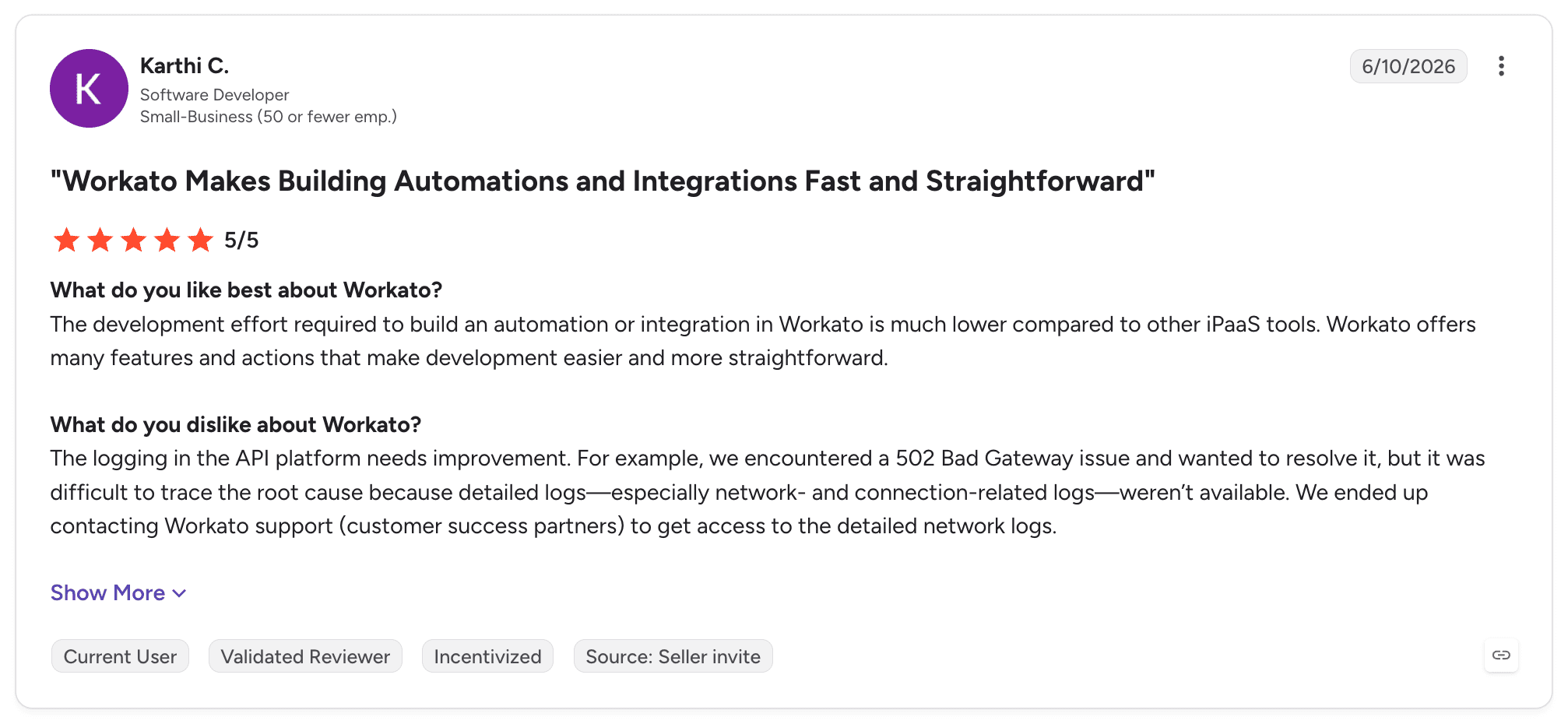
Workato holds 4.7 out of 5 across 779 G2 reviews and 4.6 across 80 on Capterra. Reviewers describe developer-friendly automation with strong connections and support, and complex integrations built at speed.
The criticism centres on learning curve and cost. Reviewers describe recipes that take time to learn to build well, specific connectors lacking operations they expected, and enterprise-tier pricing that needs modelling before scaling.
Final Verdict
Workato is recommended for IT-owned integration programmes at enterprise scale, particularly where governance, environments and audit are requirements rather than preferences.
It is not the right choice for organisations wanting business process owners to change operational logic. It is integration-centred rather than process-centred, so a case that persists and a queue where operators work are not represented.
7. Automation Anywhere

Overview
Automation Anywhere is one of the two largest RPA vendors, now positioned around Agentic Process Automation combining AI agents, RPA, APIs, documents and human workers under one governed system.
Its cloud-native architecture, document automation capability and Co-Pilot assistive tooling target enterprises running automation at scale, with particular strength in document-heavy processes.
Against Power Automate, the comparison follows the same shape as UiPath: greater depth in UI automation and document processing, greater governance at scale, and correspondingly greater implementation effort.
It reports a four-month median time to implement with return on investment at fifteen months, which sets expectations appropriately for the scale of programme it suits.
Ideal For
Enterprises running large RPA estates extending into agentic automation
Document-heavy processes requiring extraction, classification and validation at volume
Finance and back-office operations with high-volume repetitive transaction processing
Organisations with established RPA governance and dedicated automation teams
Businesses in banking, insurance and healthcare with legacy application estates
Top Features
Agentic Process Automation combining AI agents with RPA, APIs and human workers under one governed system
Document Automation for extracting and validating structured data from unstructured documents at volume
Bot management and control room for centralised scheduling, monitoring and governance
Co-Pilot providing assistive automation directly in the applications people work in
Cloud-native architecture with flexible deployment across cloud and customer infrastructure
Why It's a Strong Power Automate Alternative
Document automation is the clearest differentiator. For processes where the work begins with an invoice, a certificate or a claim form arriving as a PDF or a scan, the extraction and validation capability is considerably deeper than a general automation product provides.
Reviewers describe importing input data directly from documents including Excel, PDF and DOCX, which removes the manual keying that dominates many finance and back-office processes.
Scale governance is the second argument, and it mirrors UiPath's. The control room provides centralised scheduling, credential management, monitoring and audit across a large bot and agent fleet.
Pros
Document automation depth for extraction, classification and validation at volume
Centralised control room governance across large bot and agent estates
Clear path from existing RPA into agentic work, which reviewers describe as a smooth shift
Co-Pilot brings assistive automation into the applications people already use
Cloud-native architecture with flexible deployment across cloud and customer infrastructure
Cons
Reviewers name a steep learning curve, with advanced features taking time to understand and configure
Four-month median implementation with fifteen-month payback, the longest reported timeline on this list
Missing features appear among recurring negative tags, with reviewers describing gaps requiring workarounds
Cost draws consistent comment, with expense among the most repeated criticisms
Reviewers report bugs and troubleshooting difficulty tracing failures in complex workflows
Customer Reviews
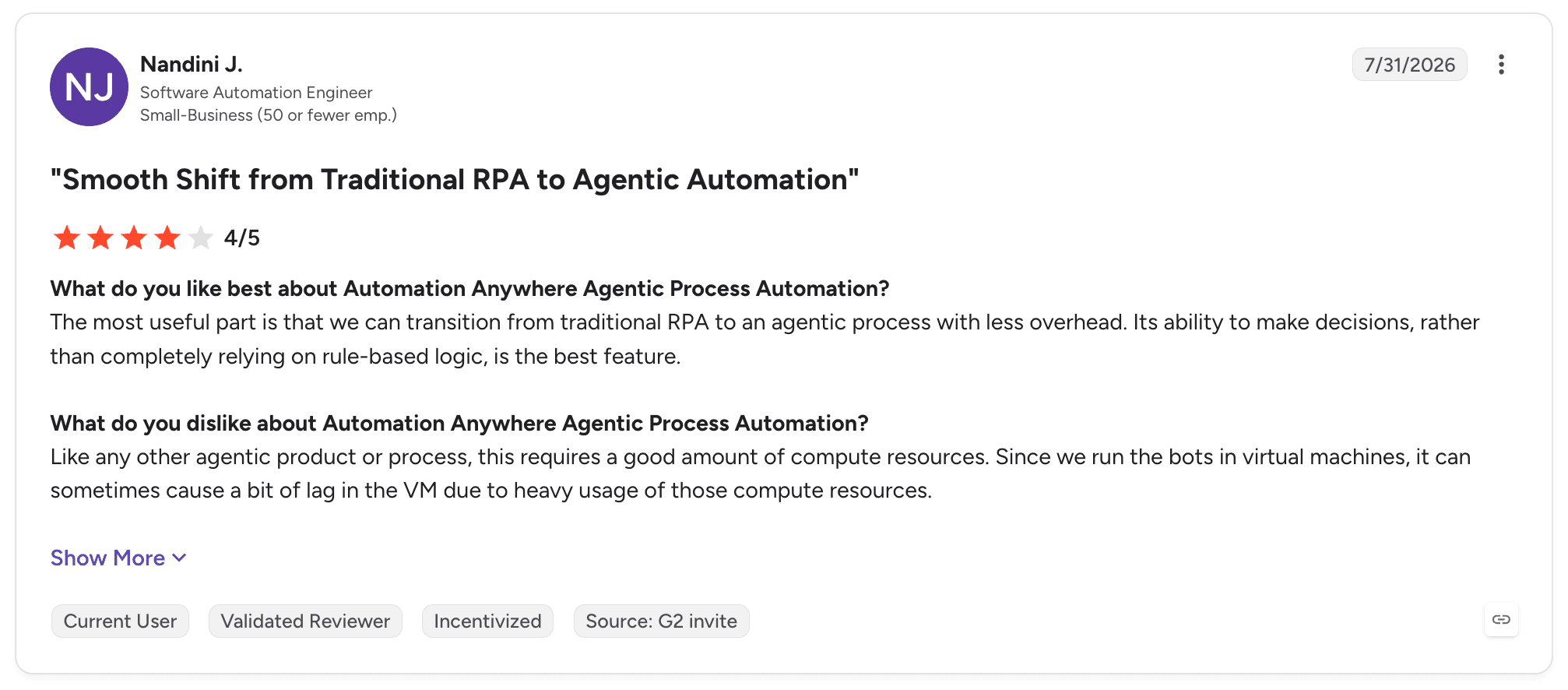
Automation Anywhere Agentic Process Automation holds 4.5 out of 5 across 5,640 G2 reviews, with Automation Anywhere rated 4.4 across 185 Capterra reviews.
Reviewers describe repetitive workflows handled consistently across apps and effective handling of web, API and Excel automation. The criticism centres on effort and gaps, with reviewers naming a learning curve that could be gentler and advanced features that take time to configure.
Final Verdict
Automation Anywhere is recommended for enterprises with document-heavy processes at volume and existing RPA governance, particularly in finance, banking and insurance back-office work.
The reported four-month implementation and fifteen-month payback should shape expectations. For teams looking for a power automate alternative to solve a specific workflow problem quickly, the scale of commitment is disproportionate.
8. Nintex

Overview
Nintex combines process mapping with workflow automation, forms, document generation and RPA, with roots in SharePoint workflow that still shape where it fits best.
Its distinguishing characteristic is that process mapping and process execution sit in the same product. The documented process and the running process can be kept aligned rather than diverging over time.
Against Power Automate, Nintex competes most directly in the SharePoint and document-centric space where both have history.
Its forms and document generation capabilities are more developed than Power Automate's equivalents, and its process mapping tooling has no direct counterpart in the Microsoft stack.
Ideal For
Organisations documenting and automating processes in the same product
SharePoint-centric businesses with document-driven workflows
Teams needing forms and document generation alongside workflow automation
Compliance functions requiring documented process maps tied to execution
Mid-market and enterprise organisations with established SharePoint estates
Top Features
Process mapping connected to workflow execution, keeping documentation aligned with what runs
Forms with conditional logic for structured data capture at process entry points
Document generation producing contracts, letters and reports from process data
Workflow automation across SharePoint, Microsoft 365 and third-party systems
RPA capability for reaching applications without APIs
Why It's a Strong Power Automate Alternative
The combination of process mapping with execution addresses a gap Power Automate does not attempt to fill.
Most organisations document processes in a mapping tool and automate them somewhere else, and the two versions diverge within months. Keeping both in one product means the documented process and the running process stay connected.
Forms and document generation are the second advantage, and both are areas where reviewers find Power Automate thin. For processes that begin with structured data capture and end with a generated document, Nintex handles both ends natively.
Pros
Process mapping and execution in one product, keeping documentation aligned with what actually runs
Forms with conditional logic more developed than most workflow products
Document generation producing contracts, letters and reports directly from process data
Strong fit for SharePoint-centric and document-driven processes
Approachable model for business users building workflows without developer support
Cons
Reviewers name limited features and limited customisation among the recurring negative tags
Three-month median implementation with eighteen-month payback, the longest return period reported here
Learning curve appears consistently, with reviewers describing time needed before productivity
Thin verified review coverage outside its main listing, limiting cross-checking
Workflow-centred rather than case-centred, so long-running operations with exceptions need building around
Customer Reviews
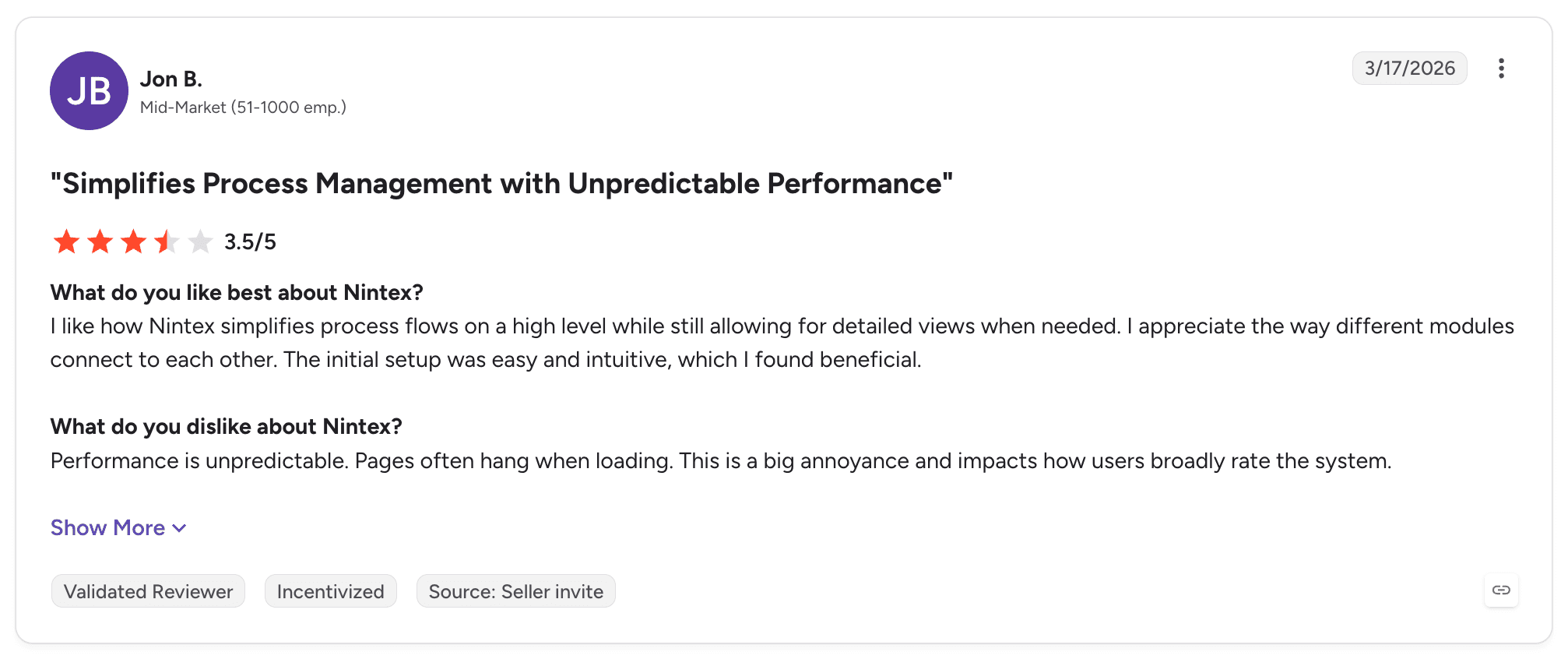
Nintex holds 4.3 out of 5 across 1,322 G2 reviews. Reviewers describe an approachable way to build workflows and forms, with several naming the SharePoint integration as the reason they selected it.
The criticism centres on capability limits and effort. Reviewers describe simplified process management alongside unpredictable performance, with setup that is easy initially and issues that appear as workflows scale.
Final Verdict
Nintex is recommended for organisations that need process documentation and process execution in the same product, particularly in SharePoint-centric environments with document-heavy workflows.
The limited features and customisation pattern sets a real boundary. The eighteen-month reported payback is also the longest here, which means the business case needs a longer horizon than most buyers assume.
9. Appian

Overview
Appian is the mature end of BPM, low-code and dynamic case management. It models processes, manages long-running cases, routes human tasks and builds workflow-driven applications.
Its data fabric connects across enterprise systems without requiring data migration, and it has a long track record in large enterprises and government where formal process governance is a requirement.
Against Power Automate, Appian operates at a different level of the stack. Power Automate automates sequences; Appian models and runs processes with cases, human tasks and exception paths as first-class concepts.
That difference makes it one of the closer comparisons on this list to what an operational process actually needs.
Ideal For
Enterprises and government bodies with formal process governance requirements
Organisations building operator-facing applications alongside process automation
Compliance-heavy environments needing documented process control and audit
Teams with low-code development capacity and an established application estate
Businesses extending an existing BPM investment rather than starting fresh
Top Features
Process modelling and dynamic case management for long-running work with human participation
Data fabric connecting enterprise systems without requiring data consolidation
Low-code application development for building interfaces around process work
AI skills and agentic components integrated into the process model
Governance and audit tooling built for regulated and public sector requirements
Why It's a Strong Power Automate Alternative
Appian represents the case, which is the object Power Automate does not have.
For work that runs across days with people involved at approval and exception points, that difference decides whether the process is manageable or whether every complication becomes a workaround.
The application layer is the second differentiator. Processes need interfaces for the people who work on them, and Appian builds those in the same product under the same governance.
An organisation that would otherwise combine Power Automate with Power Apps and Dataverse gets one product with one security model and one audit trail.
Pros
Mature case management for long-running work with human tasks and exception paths
Data fabric reaches enterprise systems without data migration projects
Application development and process logic in one product under one governance model
Strong governance and audit capability for regulated and public sector requirements
Long enterprise track record that shortens internal approval and procurement
Cons
Licensing cost is the single most repeated criticism reviewers raise
Low-code development requires specialist skills, with complex applications needing experienced developers
Learning curve is steeper than the low-code positioning suggests
Five-month median implementation with eighteen-month payback
Reviewers describe limited customisation when requirements fall outside intended patterns
Customer Reviews
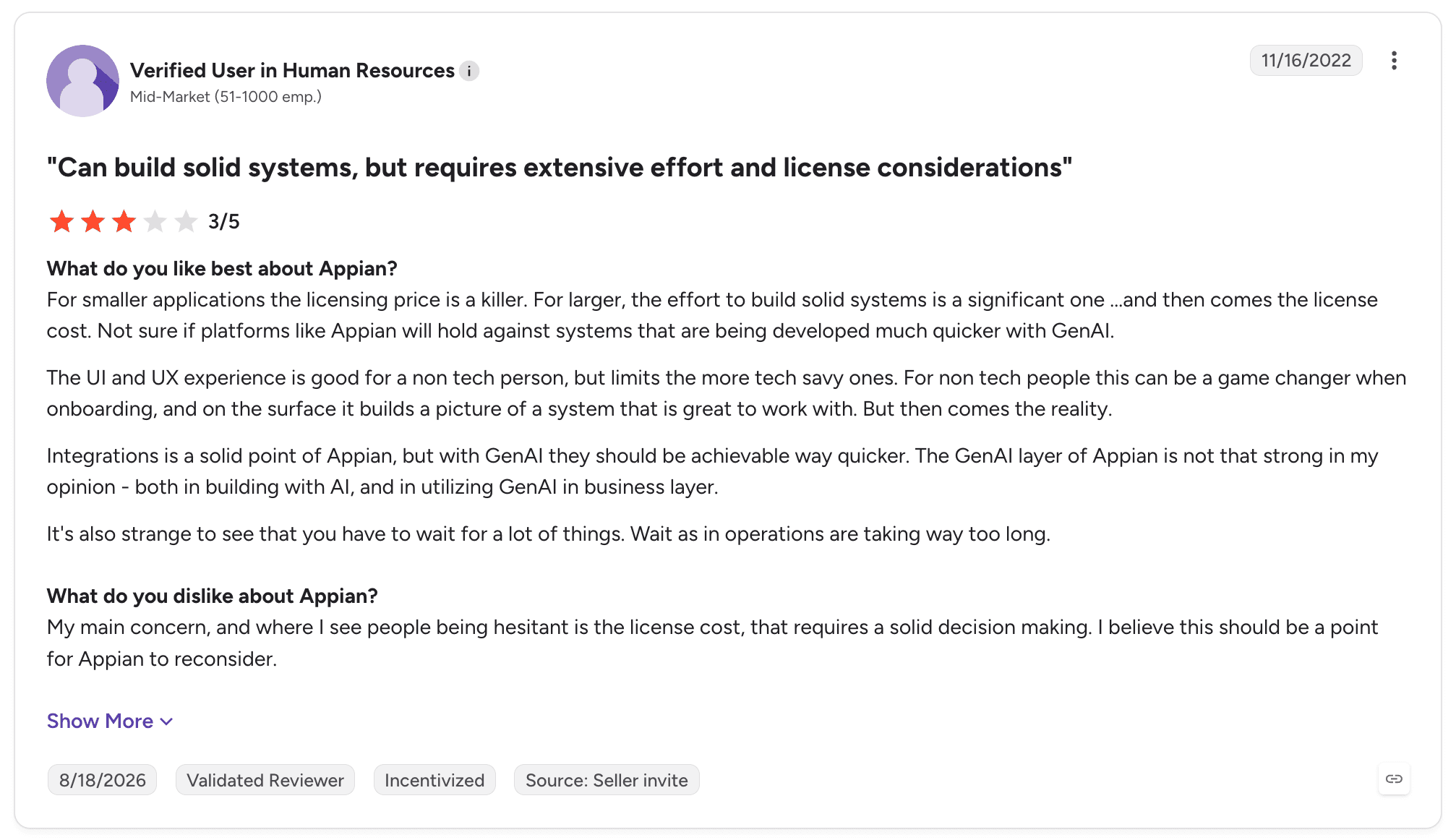
Appian holds 4.5 out of 5 across 509 G2 reviews and 4.2 across 77 on Capterra. Reviewers describe rapid application development and workflow automation handling approvals through centralised rules.
Cost dominates the criticism with unusual consistency. Reviewers describe fast, simple workflow building undermined by expensive licensing, and several name the licensing model as a point Appian should reconsider.
Final Verdict
Appian is recommended for enterprises and government bodies with formal process governance requirements, particularly where long-running case management and operator applications are both needed.
The cost pattern should be modelled before committing. The economics work against a growing portfolio rather than with it, since each additional process and user adds licence cost.
10. Tray.ai
Overview
Tray.ai is an API-first integration and automation product built for technical operations teams, combining a visual builder with code where needed, API management and embedded integration capability.
It targets organisations building complex integrations between systems and those embedding integration capability into their own products, with strong support for custom connectivity where no pre-built connector exists.
Against Power Automate, Tray.ai competes on API depth and flexibility rather than accessibility.
It assumes technical users comfortable with API concepts, authentication patterns and data transformation, and gives them more control in exchange for a steeper entry.
Ideal For
Technical operations teams building complex API integrations
Software companies embedding integration capability into their own products
Organisations connecting systems where no pre-built connector exists
Revenue and marketing operations teams with technical capacity
Mid-market and enterprise businesses with custom connectivity requirements
Top Features
Visual builder with code, combining drag-and-drop construction with scripting where logic requires it
API management for building, securing and monitoring API endpoints alongside integrations
Embedded integration for software companies offering connectivity inside their own products
Connector catalogue with custom connector building for systems without pre-built support
Audit trails and logging, with reviewers naming ease of identifying logs and audit records
Why It's a Strong Power Automate Alternative
API depth is the argument. Where Power Automate's connector model works cleanly for supported systems and becomes awkward outside them, Tray.ai is built around the assumption that custom connectivity is normal.
For technical operations teams integrating systems no vendor has built a connector for, that assumption changes the work from workaround to standard practice.
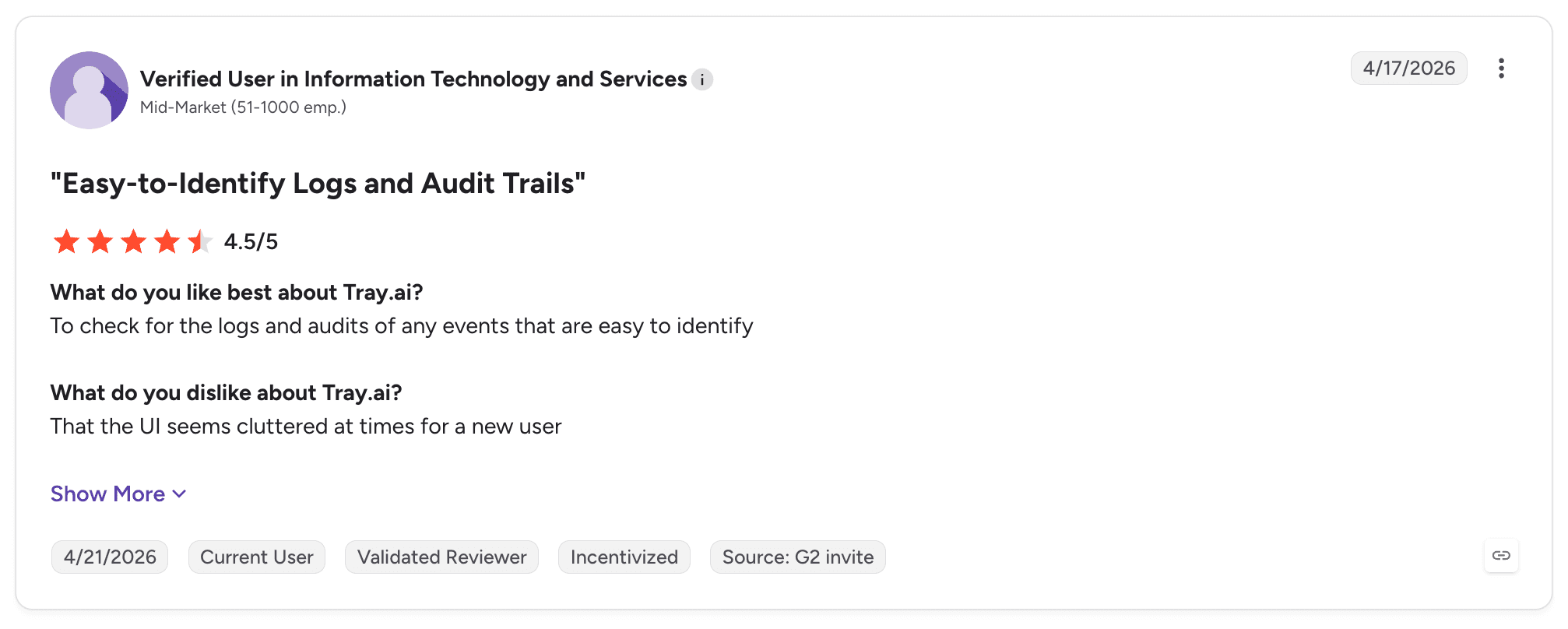
Audit and traceability is the second advantage worth naming. One reviewer specifically describes easy-to-identify logs and audit trails, noting that checking logs and audits of any event is straightforward.
Given that troubleshooting difficulty is the pattern reviewers name most often for Power Automate, a product where reviewers volunteer traceability as a strength is addressing the complaint directly.
Pros
API-first model treats custom connectivity as standard rather than exception
Visual building combined with code removes the no-code ceiling on complex logic
Reviewers specifically name logs and audit trails as easy to identify and work with
Embedded integration capability for software companies shipping connectivity in their own products
Reported two-month median implementation with ten-month payback, among the faster timelines here
Cons
Poor documentation is the most consistent criticism, with reviewers describing gaps that slow implementation
Complex pricing draws repeated comment, with reviewers describing difficulty predicting cost
Learning curve appears throughout reviews, with one describing difficulty getting non-technical colleagues to understand it
Small review base limits the evidence available to an evaluation committee
Integration-centred rather than process-centred, with no case state or operator queue
Customer Reviews
Tray.ai holds 4.5 out of 5 across 168 G2 reviews and 4.9 across 11 on Capterra, where the small Capterra sample means individual reviews carry disproportionate weight.
Reviewers describe integrating workflows without prior product knowledge and a visual model that makes cross-application integration manageable. The criticism is specific and consistent, naming documentation gaps, complex pricing and difficulty getting non-technical people to understand the product.
Final Verdict
Tray.ai is recommended for technical operations teams with custom integration requirements, particularly where systems lack pre-built connectors and embedded integration is part of the requirement.
It is not suitable for most organisations evaluating power automate alternatives. The documentation gaps translate into longer implementation, and the product assumes technical users throughout, which excludes business process owners from maintaining what runs.
What Makes a Good Power Automate Alternative?
Five things separate a product that can replace Power Automate for operational work from one that only replaces it for integrations. Noxus was built around all five, which is why it leads this list.
1. State That Survives a Failure
The most consistent criticism of Power Automate in reviews is that failures are hard to diagnose, and the root of that is structural.
A flow executes a sequence. When a step fails, the run stops, and the context of what had already happened is scattered across run history and connector logs.
Test this specifically. Ask what happens when an external system is unavailable at step seven of a twelve-step process.
If the run fails and someone restarts it, the product carries the same weakness. In Noxus the case pauses, keeps everything accumulated and resumes from the point it stopped, with the runtime handling retries, interruptions and recovery across every case running concurrently.
2. Somewhere for People to Pick Up What Automation Could Not Finish
Every automated process produces exceptions, and those exceptions need to reach a person with context attached.
An alert in a channel and a link to a record means the operator reconstructs what happened before they can act. That is where the efficiency gain quietly disappears, because the cost has been relocated rather than removed.
If exception handling requires gathering data from four systems first, the automation has saved time on the easy cases and left the expensive ones untouched.
Noxus creates work for the right team when a case cannot proceed, delivering it with the documents, the data and the prior actions already assembled, so the person resolves the issue and the process continues from the same state.
3. Write-Back Into Systems That Do Not Expose Modern APIs
Enterprise operations run on SAP ECC, Guidewire, Oracle, COBOL-era cores and in-house applications built over decades.
A product requiring API modernisation before it can execute has moved the cost rather than removed it. In most organisations, that project competes for budget against everything else and loses.
Ask for specifics rather than connector counts. Which systems does the vendor write into today, through what mechanism, and in which production deployments?
Noxus interacts with those systems the way operations teams do, with direct OData integration into SAP running in production today, writing into inspection lots, goods receipts and quality notifications, and no middleware project as a prerequisite.
4. Execution Where Your Governance Allows
Where the software runs is settled by IT and security, usually before functional evaluation and rarely negotiable.
Data residency, sovereignty, approved model endpoints and network controls determine whether a product is a candidate at all, which makes deployment a filter rather than a feature.
Power Automate runs in the Microsoft cloud. Zapier, Make, Workato and Tray.ai run in vendor clouds. That rules out half this list before the first demonstration in a regulated environment.
Noxus runs on shared cloud, in a customer VPC, on-premises or fully air-gapped, with bring-your-own-key encryption, no training on client data, and an open-core guarantee returning all code and binaries if the relationship ends.
5. Operational Logic a Business Owner Can Change
The economics of an automation portfolio depend on who can change what.
When a threshold adjustment or a new exception path requires an engineering ticket, each change competes for developer capacity. Processes become progressively harder to improve rather than easier.
Power Automate estates often start on the business side and drift to engineering as flows grow complex, which is worth checking against any replacement before committing.
Noxus separates the layers by design. Process and operations teams own the activities, rules and intervention points in Process Builder, AI and engineering teams own the agents, flows and integrations, and IT owns deployment, identity and approved model endpoints.
How to Choose the Right Power Automate Alternative for Your Needs
1. Separate Integrations From Processes
These are different requirements and they need different products, so answer this before shortlisting anything.
An integration moves data between known systems on a trigger and finishes. A process is a unit of work with an outcome, a case that persists, exceptions that need judgment and systems that must be updated as it progresses.
If the answer is a file landing in SharePoint and a record created in a CRM, you are looking at integration products, and Power Automate may already be the right answer.
If the answer is a claim arriving by email, waiting for a document, pausing for an adjuster and closing with a write-back into Guidewire, you are evaluating process products, and the shortlist narrows to Noxus and the case management options here.
2. Audit Your Existing Power Automate Estate Before Replacing It
Most organisations discover more flows than they expected, owned by people who have moved on, connecting systems nobody has documented.
Count what exists, mark what is business-critical and identify which flows fail regularly. That inventory usually reshapes the requirement, because the problem is concentrated in a handful of processes rather than spread across the estate.
The audit also tells you whether you need a replacement or an addition. Keeping Power Automate for straightforward departmental automation and moving the operationally important processes onto Noxus is usually cheaper and less disruptive than a wholesale migration.
That is the pattern most Noxus deployments follow. One process goes first, proves the economics on live systems, and the portfolio extends from there as the business pulls.
3. Map Every System and Check Who Can Actually Write Back
List every system the process reads from or writes to, and mark which one holds the authoritative version of each record. Then check the integration route that exists today.
This short exercise eliminates more candidates than any feature comparison, because a product that cannot reach your core banking system is not a candidate.
Be specific about write-back. Reading is usually straightforward, and writing an outcome into SAP QM or a core banking ledger under the right controls is where most products stop.
That is where the value sits. Ask each vendor to name a production deployment where it writes into the systems you actually run, then compare the answers rather than the connector counts.
4. Settle Deployment Before the Functional Evaluation
Bring IT and security in at the start. If the requirement is customer-controlled infrastructure, that removes Zapier, Make, Workato and Tray.ai immediately, regardless of how they perform functionally.
Establishing this first saves weeks of evaluating products that cannot be deployed.
Where customer-controlled execution is required, the shortlist narrows to Noxus, UiPath, n8n and Automation Anywhere, and their deployment models are not equivalent.
Self-hosting a workflow tool is not the same as running a governed process layer inside a bank's VPC with bring-your-own-key encryption, offline update transfer under cryptographic verification and audit records that never leave the perimeter.
5. Model Cost Against Realistic Volume
Every product here prices differently, and the models diverge sharply at volume.
Task-based, operations-based, per-user, per-bot and consumption-based pricing produce very different curves as usage grows. The cheapest at pilot volume is frequently not the cheapest in production.
Build the model with your expected case volume rather than pilot volume, and include the parts that are easy to miss: premium connectors, additional environments, support tiers and the engineering time to maintain what you build.
Noxus prices on AI Operations rather than per user or per agent, so cost scales with what the process does rather than with headcount, and billing is tracked per workspace for internal chargeback across teams or business units.
6. Prove It on One Real Process
A demonstration on vendor data proves the product works on vendor data.
Insist on a proof against one of your processes, with your systems, your documents and your volume, against criteria agreed upfront. Vendors who can do this in weeks are demonstrating something different from vendors who need a bespoke build first.
Choose a process with a repeated unit of work, a measurable constraint worth fixing, outputs that can be checked and a credible path to production.
This is the Noxus engagement model rather than a concession to it. The process is mapped, built on the client's live systems and proven in the client environment within weeks, against criteria set before the work starts.
Everything You Need to Know About Power Automate Alternatives
← scroll →
| Category | Key Considerations |
|---|---|
| Top 3 Alternatives | NoxusUiPathZapier Enterprise operations running end to end across legacy systems · Large automation estates including UI automation · Connecting cloud applications quickly without engineering |
| Best Overall Option | Noxus, for case state that survives failures and waits, an operator work queue for exceptions, write-back into systems without modern APIs, customer-controlled deployment including on-premises and air-gapped, and an open-core guarantee returning all code and binaries if the relationship ends. |
| Why Look for Power Automate Alternatives | Capterra reviewers name challenging troubleshooting and reliability, describing unclear error messages and unpredictable failures. G2 reviewers add slow performance, bugs and cost. Structurally, a flow is a sequence rather than a case, so state, exception handling and operator visibility must be built around it. |
| How to Choose | Separate integrations from processes, audit the existing Power Automate estate before replacing it, map every system and its authoritative record, settle deployment with IT and security before functional evaluation, model cost at production rather than pilot volume, then prove it on one real process. |
| Ease of Switching | Flow definitions do not transfer between products, but the process knowledge does: the systems, the rules, the exception paths and the sequence. Most organisations keep Power Automate for straightforward departmental automation and move the operationally important processes onto a process product. Noxus deployments reach production on real systems in 45 to 80 days. |
| Must-Have Features | Case state that survives a failed step; an operator work queue for exceptions with context attached; write-back into systems without modern APIs; deployment under your own governance with BYOK; process logic a business owner can change; a complete execution record per case. |
| Mistakes You Shouldn't Make | Comparing connector counts instead of operating models; modelling cost on pilot volume; replacing the whole estate when the problem is concentrated in a few processes; choosing an integration product for work that is a long-running process. |
Ready to Move On from Power Automate? Try Noxus
Noxus holds the case, not just the sequence. When a system is unavailable or a step cannot complete, the case pauses with everything accumulated so far and creates work for the right team rather than failing silently.
Operators pick it up with the documents, the data and the prior actions already attached. Outcomes are written back into SAP, Guidewire, ServiceNow and core banking systems under governance, with every action recorded.
It runs inside your own infrastructure, including on-premises and air-gapped, with bring-your-own-key encryption and no training on your data. If the relationship ends, you keep all code and binaries.
It is built for one situation: an operations team with a high-volume process spanning several legacy systems, a regulator to satisfy, and an automation estate that has become harder to maintain rather than easier.
Carlsberg reconciles supplier invoices against purchase orders with only exceptions reaching finance. KIRCHHOFF Automotive runs production operations directly into SAP through OData. Zero client churn across every deployment to date.
Bring the process that breaks most often. Noxus proves it on your live systems and data within weeks, against criteria you set upfront.
FAQs About Power Automate Alternatives
What is Power Automate used for?
Power Automate is used for automating defined sequences of work between applications, through cloud flows, desktop flows for interfaces without APIs, and approval actions. Common uses include routing documents for approval, syncing data between systems and automating repetitive data entry across Microsoft 365 and third-party services. It sits within the Power Platform, and its low-code model lets business users build working automations without developers.
What is the best Power Automate alternative in 2026?
Noxus is the best Power Automate alternative in 2026 for enterprises running operational processes rather than point-to-point integrations. Where a flow executes a sequence and finishes, Noxus holds a Case that pauses when a system is unavailable or a person is needed and resumes from the same point. It gives operators a Work Queue, writes outcomes back into SAP, Guidewire and core banking systems, runs on-premises or air-gapped, and is live at Santander, Jerónimo Martins, KIRCHHOFF Automotive and Carlsberg Group. UiPath, Zapier, Make, Workato and Tray.ai fit narrower cases.
What features should I look for in a Power Automate alternative?
The features to look for in a Power Automate alternative are case state that survives a failed step, a work queue for exceptions with context attached, write-back into systems without modern APIs, deployment under your own governance, and process logic a business owner can change. Each addresses a weakness reviewers name in Power Automate, starting with failures that are hard to diagnose because context is spread across run history and connector logs. In regulated industries, deployment control decides whether the process reaches production.
How to choose the best Power Automate alternative for your needs?
To choose the best Power Automate alternative for your needs, first separate integrations from processes, since a connection between two known systems and a long-running case with exceptions need different products. Audit your existing Power Automate estate, map every system and its write-back route, and settle deployment and data residency with IT and security. Then model cost at production volume rather than pilot volume, where pricing models diverge sharply.
Is it easy to switch from Power Automate to Noxus?
Switching from Power Automate to Noxus is a rebuild rather than a migration, because flow definitions do not transfer and the process knowledge is the larger share of the work. The systems, business rules, exception paths and sequence carry over directly into Process Builder. Most organisations keep Power Automate for departmental automation and move operational processes onto Noxus one at a time, reaching production in 45 to 80 days with the engagement model targeting 30 days.
Is Noxus better than Power Automate?
Noxus is better than Power Automate for long-running operational processes across several systems, and Power Automate is better for automating defined sequences between known applications in the Microsoft estate. Noxus holds case state across days, gives operators a work queue, writes back into SAP and core banking systems and deploys on-premises or air-gapped. For a claim that waits three days for a document, Noxus fits; for routing an expense report for approval, Power Automate fits.
What is the main difference between Noxus and Power Automate?
The main difference between Noxus and Power Automate is that Noxus holds a case while Power Automate executes a flow. When a flow step fails, the run stops and context is spread across run history and connector logs, whereas a Noxus Case keeps its data, decisions and history and resumes from the same point. Noxus also runs on-premises, in customer VPCs and air-gapped with bring-your-own-key encryption, while Power Automate runs in the Microsoft cloud.
How do we handle exceptions without losing the efficiency gain?
You handle exceptions without losing the efficiency gain by delivering each exception with the documents, system data, prior actions and the reason the automated path stopped already gathered. In Noxus, a case that cannot proceed pauses and creates work for the right team, which resolves it and lets the process continue from the same state. Map recurring exception types during discovery and cost them separately, since a small exception rate often drives a large share of process cost.