Best Customer Feedback & NPS Software in 2026 (Reviewed & Compared)

Your NPS score is dropping. The board wants to know why. The dashboard shows the trend but not the cause, and the detractors who flagged the problem are already shopping for alternatives.
That gap, between knowing a customer is unhappy and resolving the underlying complaint, is where most CX programmes lose money. The 2026 market for the best customer feedback software has matured to close this gap, with AI text analytics, omnichannel collection, and closed-loop workflows now standard on serious products. The best customer feedback management software no longer stops at sending surveys; it turns response data into action.
Below are the eleven strongest options, reviewed and compared on features, pricing, and operational fit.
Key Takeaways (TL;DR)
The Best Overall: Noxus tops this list as the operational execution layer that resolves the cases CX feedback programmes surface.
Why Do You Need It: Collecting customer feedback is no longer the problem. Acting on it is. NPS scores sit in dashboards while detractors quietly churn, with no system in place to route signals into operational action.
Who It's For: CX leaders, product managers, customer success teams, operations directors, and mid-market COOs in financial services, healthcare, SaaS, retail, and service businesses converting feedback into measurable retention and revenue impact.
How to Choose the Right One: Prioritise AI-driven text analytics depth, closed-loop automation that routes feedback into action, and integration depth into the CRM, helpdesk, and back-office systems you already run. Brand recognition matters less than execution fit.
Noxus’ Pricing Model: Custom, consumption-based. Monthly platform licence with included AI operations volume. No per-seat or per-token pricing. Scales with operational volume and deployment complexity. Contact Noxus for a scoped quote.
Table of Contents
Top Customer Feedback & NPS Software in 2026 at a Glance
← scroll to see all columns →
| Company | Best For | Key Features | Pricing |
|---|---|---|---|
| Noxus | Operational execution layer for detractor case resolution |
AI Co-workers
Multi-system orchestration
Full audit trail
|
Custom; consumption-based |
| Qualtrics XM | Enterprise CX, EX, product, and brand research |
Advanced survey logic
Text iQ
Stats iQ
Omnichannel
|
Custom enterprise pricing |
| Medallia | Real-time signal capture and frontline action |
AI signals
Contact-centre data
Journey orchestration
|
Custom enterprise pricing |
| InMoment | Enterprise XI programmes with bundled services |
XI Platform
Active Listening AI
Journey mapping
|
Custom enterprise pricing |
| NICE Satmetrix | NPS-native programmes with contact-centre integration |
NPS methodology
CXone integration
Speech analytics
|
Custom enterprise pricing |
| Chattermill | AI text analytics across feedback sources |
Unified theme analytics
KPI correlation
Root cause analysis
|
Custom pricing |
| AskNicely | NPS-driven service businesses and frontline coaching |
NextAI
Frontline mobile app
Automated NPS workflows
|
Custom; quote-based |
| SurveySparrow | Conversational surveys, mid-market omnichannel CX |
Chat-style surveys
CogniVue AI
Built-in ticketing
|
Custom; 14-day free trial |
| Zonka Feedback | Multi-location omnichannel feedback intelligence |
Email / SMS / WhatsApp
Web & in-app
Offline kiosk
|
Custom; free trial available |
| SurveyMonkey | Versatile, all-purpose surveys across functions |
Templates
NPS reports
Broad integrations
|
Free tier Team Advantage from $30/user/mo |
| Delighted (by Qualtrics) | SMB NPS, CSAT, and CES programmes |
Single-question NPS/CSAT/CES
Multi-channel
AI Smart Trends
|
Free plan Paid from $19/month |
What Is Customer Feedback & NPS Software?
Customer Feedback & NPS Software is the category of tools that collect, analyse, and act on customer sentiment across the customer journey, from first transaction through renewal conversation.
At a baseline, every product distributes a survey (Net Promoter Score, Customer Satisfaction, Customer Effort Score) across one or more channels, captures the response, calculates a score, and reports a trend. The category has matured well beyond that.
Leading NPS software companies now layer AI-driven text analytics, sentiment detection, theme identification, and closed-loop workflows on top of basic data collection.
Why Do You Need Customer Feedback & NPS Software?
Most CX programmes have a measurement problem that looks like a tool problem but is an execution problem.
The score is captured. The dashboard shows the trend. The board pack reports the number. Then nothing happens, because the detractor who filled in the survey is one customer among ten thousand, the open-text comment sits unread in a CSV, and no one owns the next step.
That gap is where churn happens. According to Zendesk's Customer Experience Trends Report 2026, 57% of consumers say they would switch to a competitor after one negative interaction, which makes the speed and quality of detractor response a direct revenue lever, not a soft metric. NPS itself remains a meaningful predictor of growth: a 7-point increase in NPS is correlated with roughly a 1% revenue boost per published research, and Net Promoter Score is used by over two-thirds of Fortune 1000 companies precisely because that correlation is real.
But the score on its own does nothing. It has to feed into a system that routes the signal into action. That is what separates the best customer feedback software from a survey tool with a dashboard.
The right Customer Feedback & NPS Software removes the gap. It captures sentiment at the moments that matter, analyses open text with AI so themes surface in seconds rather than weeks, and routes detractor responses into the CRM, helpdesk, or operational workflow that can save the account.
Three outcomes matter most:
Retention without ambiguity. Detractor feedback becomes a triggered case, not a dashboard tile. The customer success team sees the at-risk signal in the account record before the renewal conversation, not after.
Insight at the speed of business. AI text analytics surfaces themes, sentiment, and key drivers across thousands of open-text responses in real time, replacing the manual tagging that buries most CX teams.
Closed-loop accountability. Every detractor signal has an owner, a deadline, and a resolution status. The programme stops being a measurement exercise and becomes an operational one.
Who Needs Customer Feedback & NPS Software?
Customer Feedback & NPS Software is relevant across nearly every industry, but the right tool varies sharply by role, scale, and operational context.
The five audiences below represent the roles most directly affected by gaps between feedback and action: CX leaders accountable for retention, product managers shaping the roadmap, customer success teams protecting renewals, operations leaders driving frontline consistency, and mid-market owners carrying all of those responsibilities at once.
CX and Customer Experience Leaders
CX leaders own loyalty, retention, and the score that lands in the board pack.
They need omnichannel collection, trend tracking by segment and touchpoint, and the ability to demonstrate revenue impact from CX investment.
The metric they care about is not response volume. It is whether sentiment shifts translate into early intervention before churn shows up in the numbers. By the time NPS visibly drops on a quarterly chart, the damage is already in flight.
For this audience, the right tool combines deep AI text analytics with operational workflows that route detractor feedback into the team that can save the account.
Product Managers and SaaS Teams
Product teams need feedback that is contextual, in-app, and tied to release cycles.
They care about behaviour-triggered surveys delivered at the moment a feature is used, low-friction collection that does not tank engagement metrics, and tight integration with their product analytics stack.
Their goal is prioritisation by evidence rather than opinion. NPS becomes one input among several, alongside session replays, support tickets, and feature usage data, in deciding what gets built next.
A heavy enterprise XM tool is usually overkill here. A specialist in-product feedback tool, or a mid-market product with strong in-app surveys, fits better.
Customer Success and Account Management
Customer success leaders need early warning signals for at-risk accounts, particularly in B2B SaaS, where annual renewals concentrate revenue risk into single conversations.
They need NPS and CSAT data flowing into the CRM, so the score sits alongside contract value, product usage, and support history in the account record.
For this audience, integration depth is more important than survey design flexibility. A product that captures NPS but does not sync into Salesforce or HubSpot creates an internal data silo rather than solving a retention problem.
Operations and Service Delivery Teams
Service-heavy businesses (hospitality, healthcare, field services, banking, insurance, retail) need feedback that reaches frontline staff and changes daily behaviour, not quarterly slides.
They need mobile-friendly dashboards, individual scorecards, immediate detractor alerts, and the ability to coach service delivery at the point where it happens.
The KPI is consistency: same process, same outcome, regardless of location, shift, or individual. Manual variance is the enemy. The product's job is to close the loop fast enough that frontline staff can act on feedback while the customer interaction is still fresh, and to ensure the underlying operational case (the refund, account correction, or policy fix) gets resolved in the back-office systems that hold the source of truth.
Mid-Market Operations Owners
In companies with 200 to 2,000 employees, the COO or Managing Director typically owns the CX programme along with everything else.
There is no multi-stakeholder buying committee. One conversation, one decision.
This audience needs fast time-to-value: working surveys in days, not a 12-month implementation. They respond to transparent pricing, accessible free tiers for evaluation, and tools that do not require an analyst team to operate.
The buying trigger is usually growth pressure: response volumes outpacing manual processing capacity, churn rates ticking up without a clear cause, or board demand to demonstrate a measurable CX programme within 90 days.
Best Customer Feedback & NPS Software: In-Depth Review & Comparison
1. Noxus
Overview
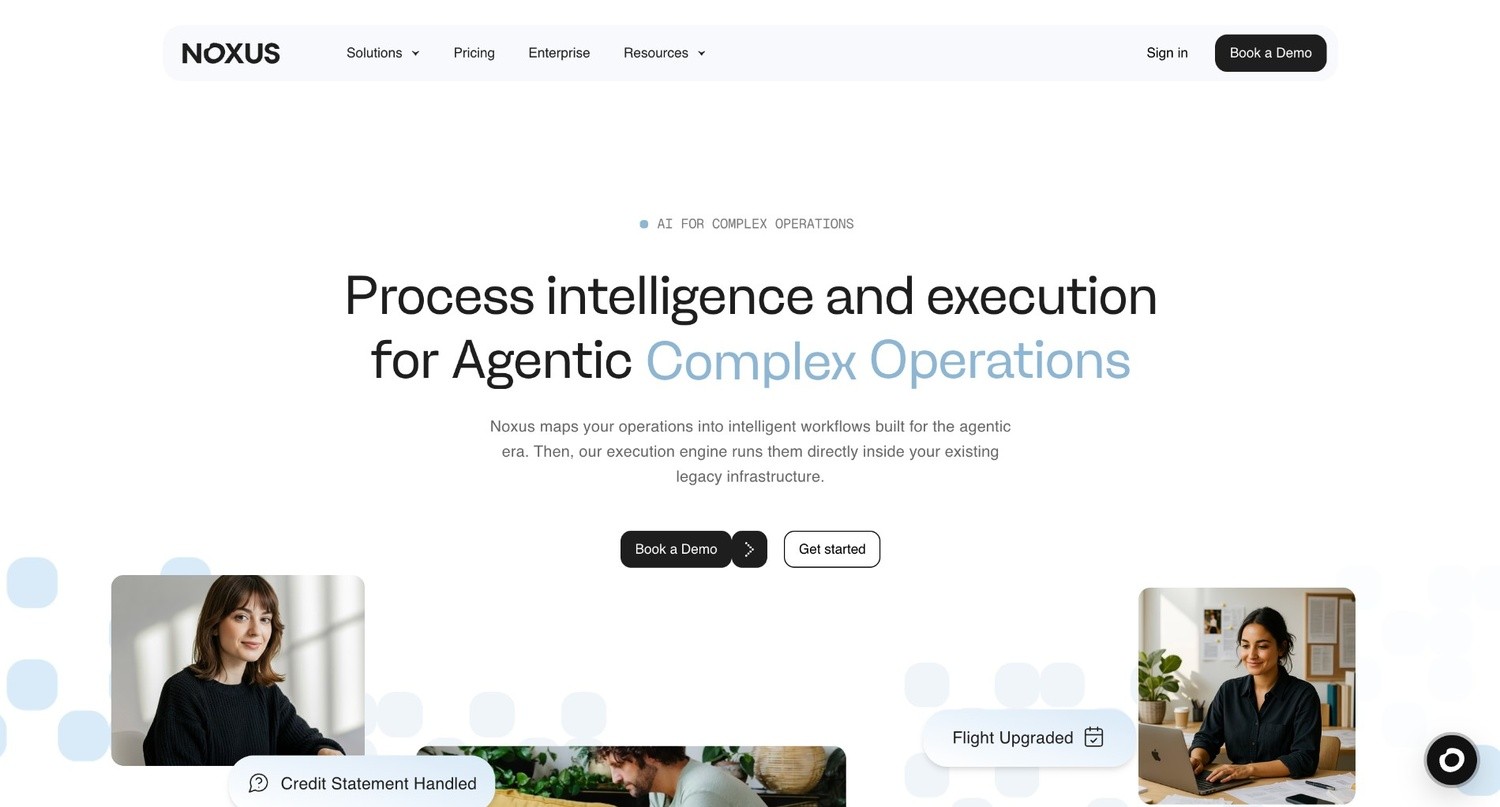
Noxus is the operational execution layer that pairs with Customer Feedback & NPS Software to resolve the underlying cases CX programmes surface.
Where Qualtrics, Medallia, AskNicely, and other CX products surface detractor signals to dashboards and alerts, Noxus AI Co-workers carry out the multi-system case resolution work that follows. A detractor signal becomes a resolved case: the complaint interpreted, the relevant policy applied, the corrective action executed across the systems of record, and the outcome written back under audit.
Noxus runs in production with companies like Santander, CUF, and Jerónimo Martins, with documented 3-5x ROI in 45 to 80 days.
Ideal For
CX programmes where detractor cases require resolution across multiple back-office systems
European enterprises in regulated industries running legacy stacks (SAP ECC, Guidewire, core banking)
Operations leaders accountable for case resolution, not only score reporting
CX teams wanting closed-loop execution without rebuilding their existing CX tool.
Top Features
End-to-end execution runtime: Autonomous execution of multi-step operational workflows end to end, not only drafting summaries or routing alerts.
400+ native integrations: SAP, Guidewire, Salesforce, ServiceNow, Oracle, core banking, and most legacy enterprise systems without requiring API modernisation.
Deterministic policy enforcement: AI handles interpretation; hard-coded business rules mapped from your SOPs execute the decisions, so no AI model decides whether to approve a refund or correct an account.
Why They Stand Out?
Noxus is not a CX product; it is the operational layer that pairs with one. Most CX products stop at the ticket creation layer, surfacing a signal to a dashboard or alert. Noxus resolves the underlying case inside the systems of record where the work actually lives.
The architectural separation between AI interpretation and rule-based execution is the genuine differentiator. AI reads the unstructured complaint; your business rules decide what happens next. Every decision is traceable, every step replayable.
Pros
Resolves detractor cases end to end inside legacy back-office systems, not only at the alert layer.
Production deployments in regulated European enterprises (Santander, CUF, Jerónimo Martins) on live operational data
Works with SAP ECC, Guidewire, and proprietary legacy systems without API modernisation
Cons
Not a survey tool; pairs with rather than replaces your CX product
No self-serve onboarding; deployment requires direct engagement with Noxus engineers
Primary go-to-market is European; North American access is currently through existing client relationships
Pricing
Custom, consumption-based. Monthly platform licence with included AI operations volume; no per-seat licensing, no per-token pricing. Pricing scales along two dimensions: operational volume and deployment complexity. Clients can use their own model provider contracts (BYOK) for lower per-operation cost, or use Noxus-managed inference.
Final Verdict
Noxus is recommended for CX programmes where detractor signals translate into operational case work across multiple back-office systems, particularly in regulated European enterprises running legacy stacks. It is not a survey tool and does not replace Qualtrics, Medallia, or AskNicely; it is the operational execution layer that turns the signals those products capture into resolved cases inside SAP, Guidewire, Salesforce, and the systems of record where the underlying complaint lives.
2. Qualtrics XM
Overview
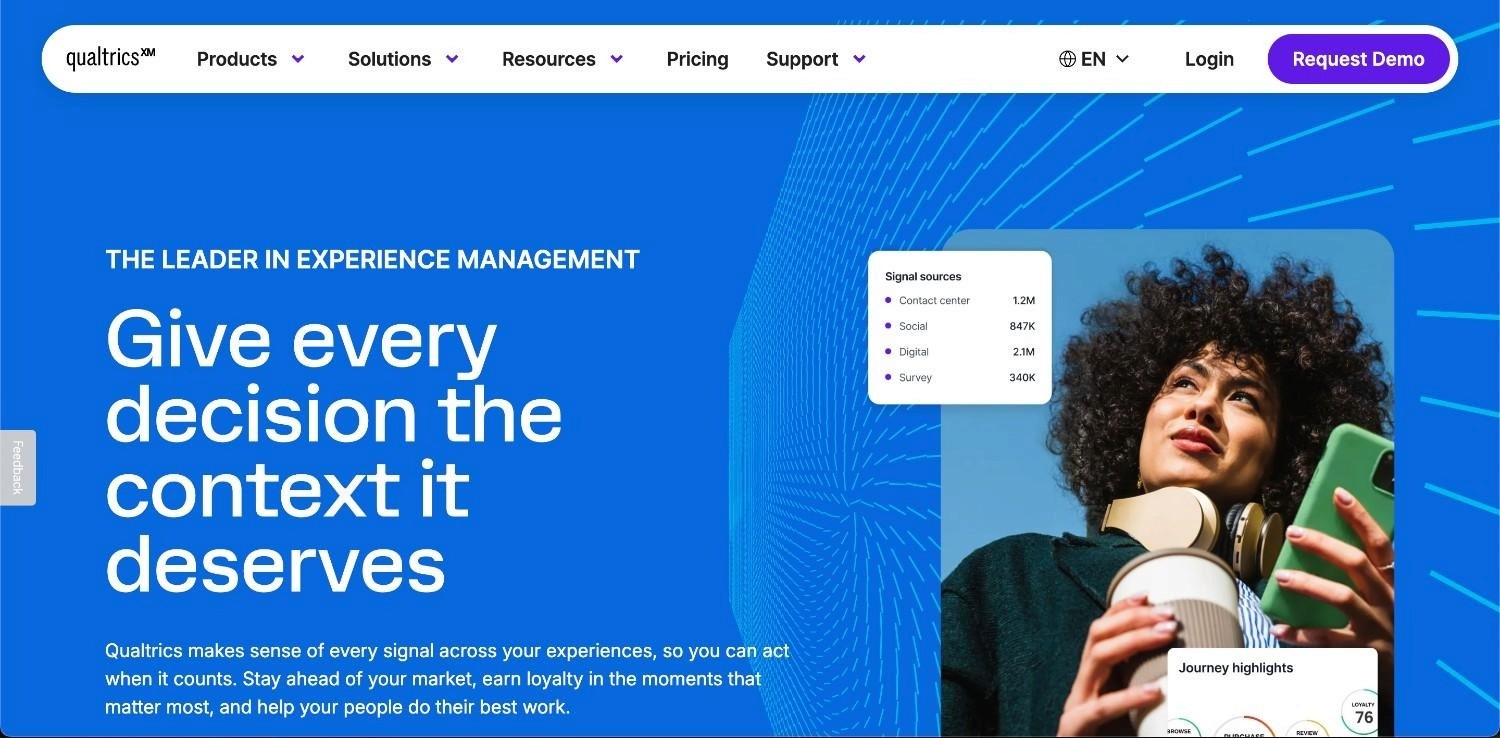
Qualtrics XM is the dominant enterprise experience management product, covering customer experience, employee experience, product experience, and brand research in a single suite.
Headquartered in Provo, Utah, it serves global enterprises across financial services, healthcare, retail, and the public sector. Qualtrics acquired Delighted in 2018, which now operates as the lightweight entry point into the Qualtrics family for SMB and team-level NPS programmes.
For organisations wanting one product across every experience programme, it is among the best customer feedback software options available at enterprise scale.
Ideal For
Large enterprises running multi-programme XM across CX, EX, product, and brand
Research and academic teams requiring advanced statistical methodology
Organisations with dedicated CX analyst teams to operate the product
Multi-region, multi-language global deployments
Companies with strict governance, compliance, and audit requirements
Top Features
Advanced survey logic: Branching, quotas, randomisation, and embedded data for research-grade survey design, the most flexible in the category.
Text iQ: AI-powered text analytics that surfaces themes, sentiment, and emotion across open-ended responses at scale.
Stats iQ: Built-in statistical analysis, including significance testing, regression, and key driver analysis, replacing SPSS or R for most teams.
Omnichannel distribution: Survey deployment across email, SMS, web, mobile, IVR, and chat from a single product, saving CX teams the cost of separate channel-specific tools.
CrossXM: Links customer experience signals to employee and operational data for unified insight across the organisation.
Why They Stand Out?
Qualtrics XM's depth across four experience pillars (customer, employee, product, brand) is one of the strongest combinations in the market. For organisations wanting one product across every experience programme, it is among the most comprehensive choices available.
The methodology depth is genuine: survey design, statistical rigour, and AI text analytics are all built into the same product rather than bolted on through acquisitions. Research teams take it seriously, which is rare for software in this category.
Pros
Most flexible survey design in the category, with research-grade methodology built in
AI-driven text and statistical analysis through Text iQ and Stats iQ
Strong governance, security, and compliance posture for regulated industries
Wide integration ecosystem and partner network
Single product across customer, employee, product, and brand experience
Cons
Steep learning curve; analyst teams typically required to extract full value
High cost: base CoreXM contracts typically start in five figures and scale into six
AI add-ons (Text iQ, Stats iQ) are priced separately on top of the base licence.
Pricing
Qualtrics does not publish pricing publicly. Every product within the three suites (Customer Experience, Employee Experience, Strategy & Research) is quote-based and requires contacting their sales team. Pricing scales with "interactions", which Qualtrics defines as a data record processed by the platform, with the unit varying by product. Add-ons such as Text iQ and Stats iQ are typically priced separately on top of the base licence. Annual contracts only.
Final Verdict
Qualtrics XM is recommended for enterprises with dedicated CX teams, complex multi-programme requirements, and budgets to match. It is not the right fit for smaller teams or first-time CX programmes. Cost, complexity, and analyst dependency outweigh the value when the use case is measuring NPS, and most mid-market buyers will find lighter alternatives a better starting point.
3. Medallia
Overview
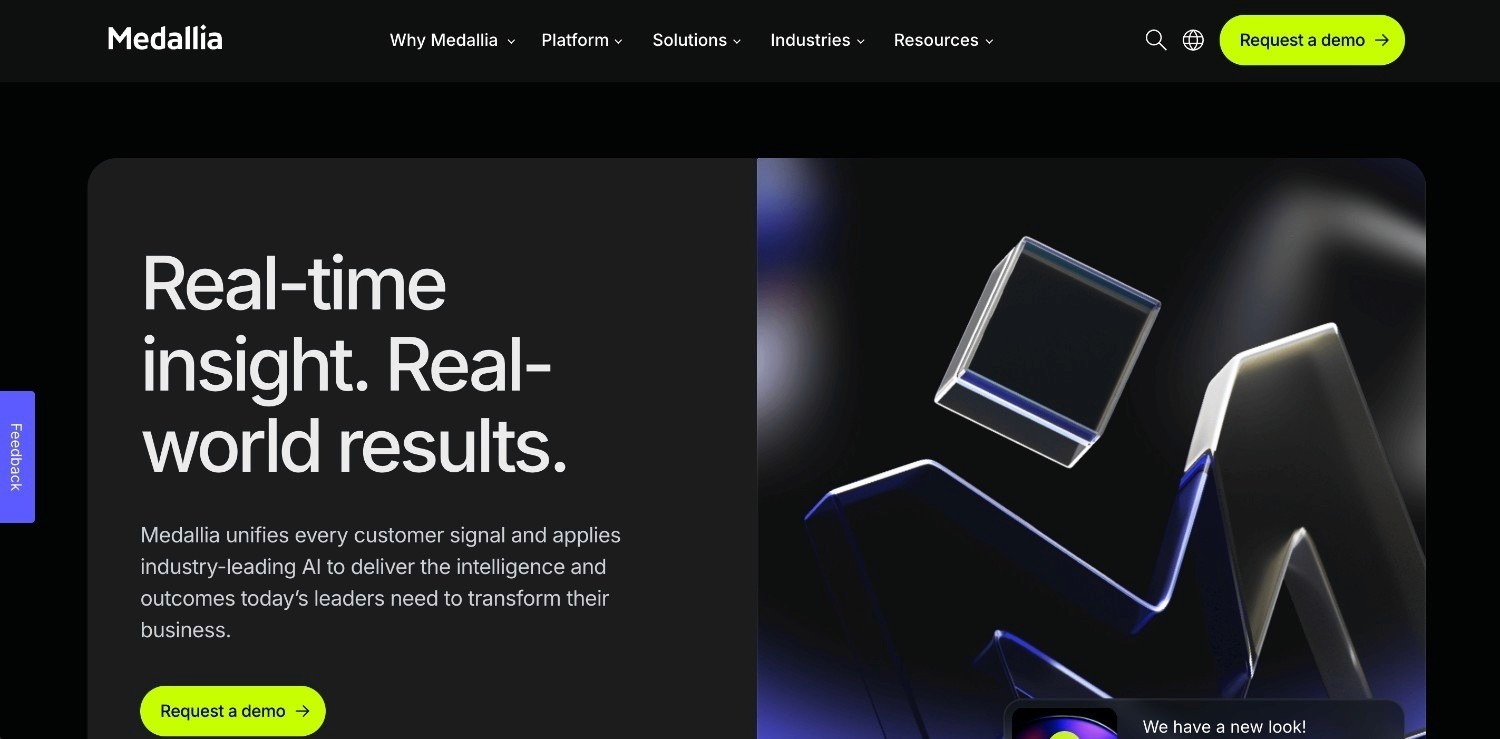
Medallia is an enterprise experience management product focused on real-time signal capture across surveys, voice, video, social, contact-centre, and behavioural data.
Acquired by Thoma Bravo in 2021, Medallia is positioned around action management for frontline teams as much as analytics for CX leaders. It competes head-to-head with Qualtrics for global enterprise XM deployments, particularly in contact-centre-heavy industries such as financial services, telecom, and hospitality.
Ideal For
Large enterprises with multi-channel CX programmes spanning voice and digital
Contact-centre-heavy operations in financial services, telecom, and hospitality
Organisations with mature frontline action workflows
Companies needing voice and video feedback alongside surveys
Regulated industries requiring strict compliance and signal governance
Top Features
Multi-source signal capture: Surveys, voice-of-employee, video feedback, social signals, and contact-centre data in a single product, far broader than survey-only competitors.
AI-driven text analytics: Sentiment, intent, and key driver analysis across structured and unstructured feedback at enterprise scale.
Frontline AI: Individualised coaching and action management for service-delivery staff.
Action management workflows: Alert routing to specific roles and locations based on signal type and severity.
Journey orchestration: Maps signals to specific touchpoints across the customer journey, helping CX teams pinpoint where experience breaks.
Why They Stand Out?
Medallia's breadth of signal capture is one of the more genuine differentiators in the category. Voice, video, and contact-centre data flow into the same product as NPS and CSAT, a rarity among competitors, where surveys are still treated as the primary input.
Real-time alerting and frontline action management are among the most mature in the market, particularly for enterprises where individual employee performance directly affects customer satisfaction scores.
Pros
Broadest signal capture in the category: surveys plus voice, video, social, and behavioural data
Real-time alerting and frontline action workflows
Deep contact-centre integration
Mature governance, compliance, and enterprise controls
Cons
High pricing; typically not viable for mid-market or SMB buyers
Long implementation timelines, often six months or more
Reviewers cite the need for paid managed services even for routine configuration changes
Pricing
Custom, quote-based. Medallia does not publish pricing. Licensing typically scales with experience data record (EDR) volume rather than per-seat. Enterprise contracts commonly run into six figures (EUR) annually, with implementation services and managed services adders typically a meaningful additional line item.
Final Verdict
Medallia is recommended for enterprises whose CX strategy depends on real-time multi-channel signal capture and frontline action management. It is not the right fit for mid-market companies, departmental rollouts, or teams that need NPS. Cost, complexity, and managed-services dependency outweigh the value at a smaller scale, and most non-enterprise buyers will find a better fit elsewhere.
4. InMoment
Overview
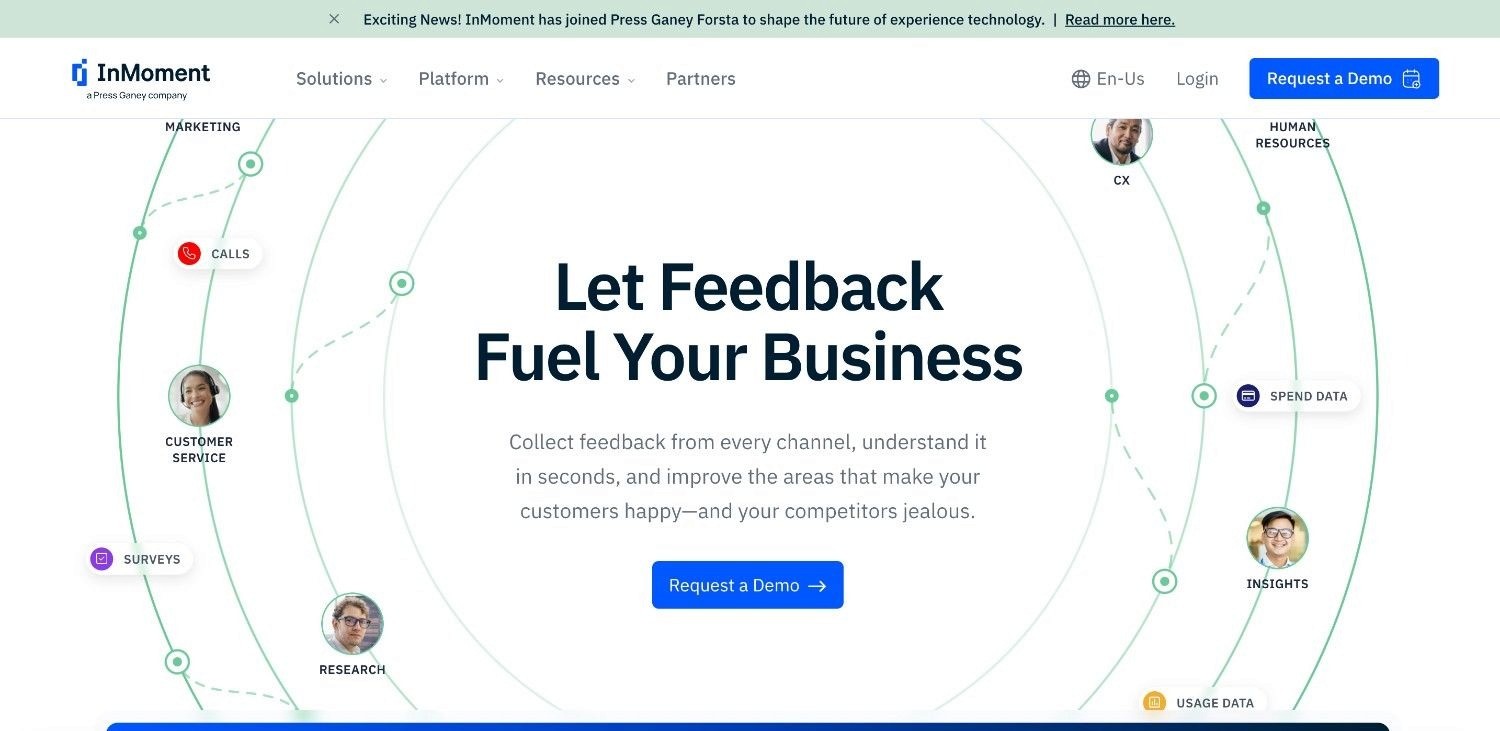
InMoment offers an Experience Improvement (XI) Platform designed for enterprises wanting to listen, analyse, and act on feedback throughout the full customer journey.
Acquired by Press Ganey Forsta in May 2025, InMoment continues to operate with its own product and identity. Qualtrics announced a $6.75 billion agreement to acquire Press Ganey Forsta in October 2025, which (subject to regulatory close) will bring InMoment under the Qualtrics umbrella. InMoment is particularly strong in retail, travel, hospitality, and contact-centre-heavy verticals, combining omnichannel feedback collection with journey mapping and bundled professional services.
Ideal For
Large enterprises in retail, travel, and hospitality
Organisations valuing bundled strategic consulting alongside the product
Mature CX programmes seeking journey-mapping depth
Contact-centre operations needing speech analytics tied to feedback
Multi-channel feedback programmes with high open-text volume
Top Features
XI Platform: Unified view of customer, employee, product, and market experience in a single product.
Active Listening with generative AI: Prompts more detailed customer responses in real time and uses generative AI to enrich open-text feedback.
Auto-tagging and text analytics: Real-time thematic tagging of qualitative feedback for routing and analysis.
Journey mapping: Overlays feedback data onto the customer lifecycle, surfacing where experience breakdowns occur.
Multi-channel surveys: NPS, CSAT, CES, and microsurveys across email, in-app, SMS/WhatsApp, web, and QR codes.
Why They Stand Out?
InMoment's combination of product plus consulting is one of the strongest value propositions in the enterprise XM segment for organisations that want strategic implementation support rather than a self-serve tool. The Active Listening AI capability is useful for programmes drowning in shallow open-text responses.
Journey mapping is more mature than several competitors, making InMoment one of the smarter choices for CX teams whose programme is organised around the customer lifecycle rather than transactional touchpoints.
Pros
Journey mapping and lifecycle-centric analytics
Bundled professional services reduce internal implementation burden
Active Listening AI improves the quality of open-text feedback
Particularly strong in retail, travel, and hospitality
Cons
"Software plus services" model means limited self-service flexibility
Customisation often requires InMoment's professional services team
Less suited to B2B feedback programmes than retail/hospitality use cases
Pricing
Custom, quote-based. Mid-to-upper enterprise pricing range. Annual contracts typically bundle professional services into the platform fee. A 10-day free trial is sometimes available on request.
Final Verdict
InMoment is recommended for enterprises in retail, hospitality, and contact-centre-heavy industries that want product plus strategic consulting in a single relationship. It is not the right fit for B2B SaaS programmes, self-serve mid-market deployments, or buyers who want maximum control over configuration without involving professional services.
5. NICE Satmetrix
Overview
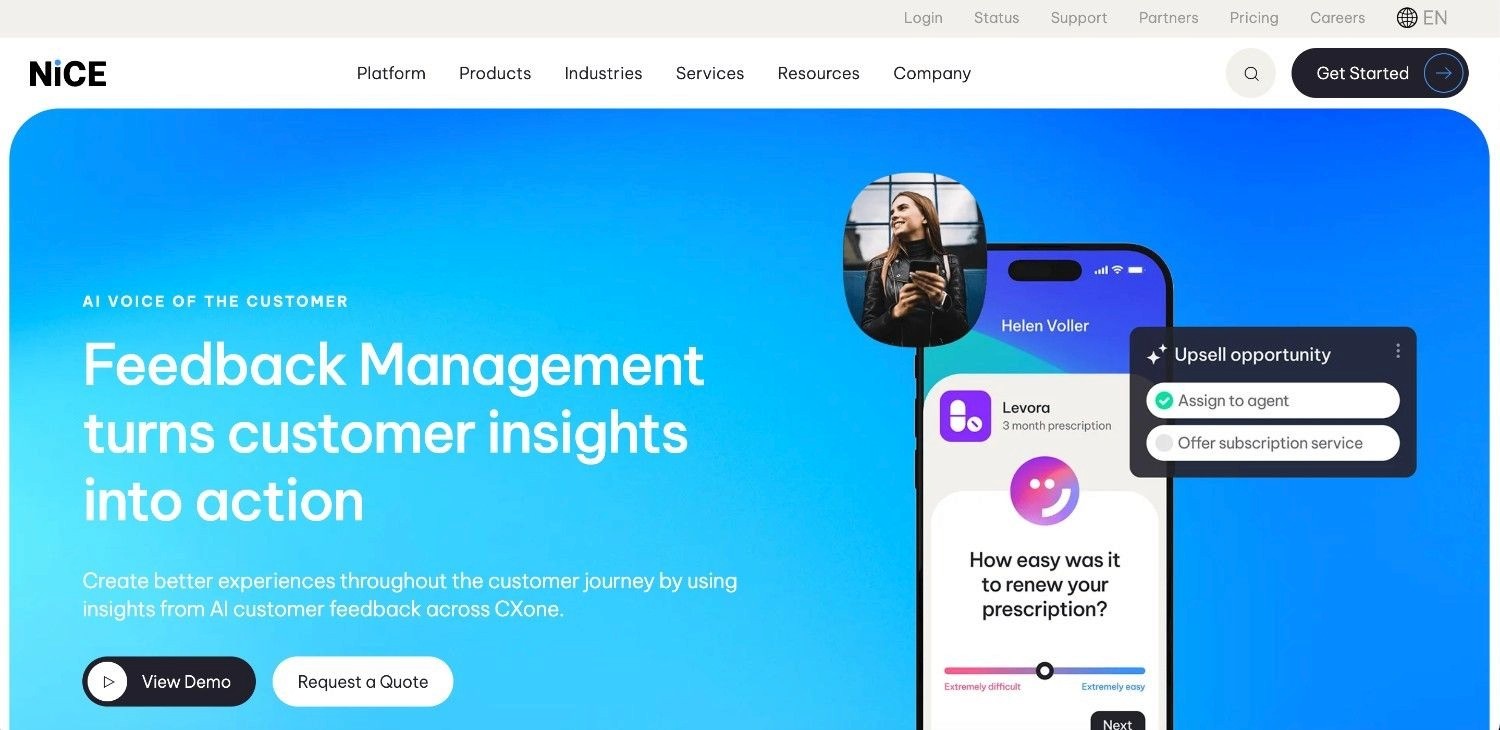
NICE Satmetrix carries a unique distinction in the category: Satmetrix co-created the Net Promoter Score methodology alongside Fred Reichheld and Bain & Company.
The product is now integrated into NICE's CXone ecosystem, combining NPS-native feedback management with contact-centre analytics, workforce management, and speech analytics. For enterprises already running NICE for contact-centre operations, Satmetrix fits as a natural NPS layer on top of the existing stack.
Ideal For
Enterprises with NICE CXone already deployed for contact-centre operations
Organisations wanting the NPS methodology embedded into business culture
Contact-centre-heavy CX programmes
Companies wanting to publish positive customer comments as social advocacy automatically.
Programmes valuing NPS methodology expertise and benchmarking
Top Features
NPS-native methodology: Built by the co-inventors of NPS; deepest methodology heritage in the category.
NICE CXone integration: Combines surveys with contact-centre speech analytics and workforce management.
Advocacy publishing: Automatically routes positive customer feedback to social channels, turning promoters into visible advocates.
Industry benchmarking: Established NPS benchmarks across industries for comparative analysis.
Speech and text analytics: Indirect feedback capture from contact-centre interactions alongside survey responses.
Why They Stand Out?
NICE Satmetrix's NPS methodology heritage is the genuine differentiator. For enterprises that want NPS treated as a strategic operating system rather than a metric, Satmetrix offers depth of methodology and benchmarking that survey-only products cannot match.
The integration with NICE CXone is one of the strongest contact-centre tie-ups in the category for enterprises already standardised on NICE.
Pros
NPS methodology, heritage, and industry benchmarking depth
Native integration with NICE CXone for contact-centre programmes
Combines direct (surveys) and indirect (speech/text) feedback in one view
NPS implementation and operationalisation expertise
Cons
Contact-centre-centric architecture limits fit for non-NICE enterprises
Limited third-party integrations outside the NICE ecosystem
Less suited to product-led or SaaS feedback programmes than to operational CX
Pricing
Custom, quote-based. Enterprise pricing focused on NPS programme implementation and contact-centre integration. Often bundled with broader NICE CXone licensing.
Final Verdict
NICE Satmetrix is recommended for enterprises that already run NICE CXone for contact-centre operations and want a methodologically rigorous NPS layer on top. It is not the right fit for organisations outside the NICE ecosystem or for product-led SaaS teams whose feedback programmes do not centre on the contact centre.
6. Chattermill
Overview
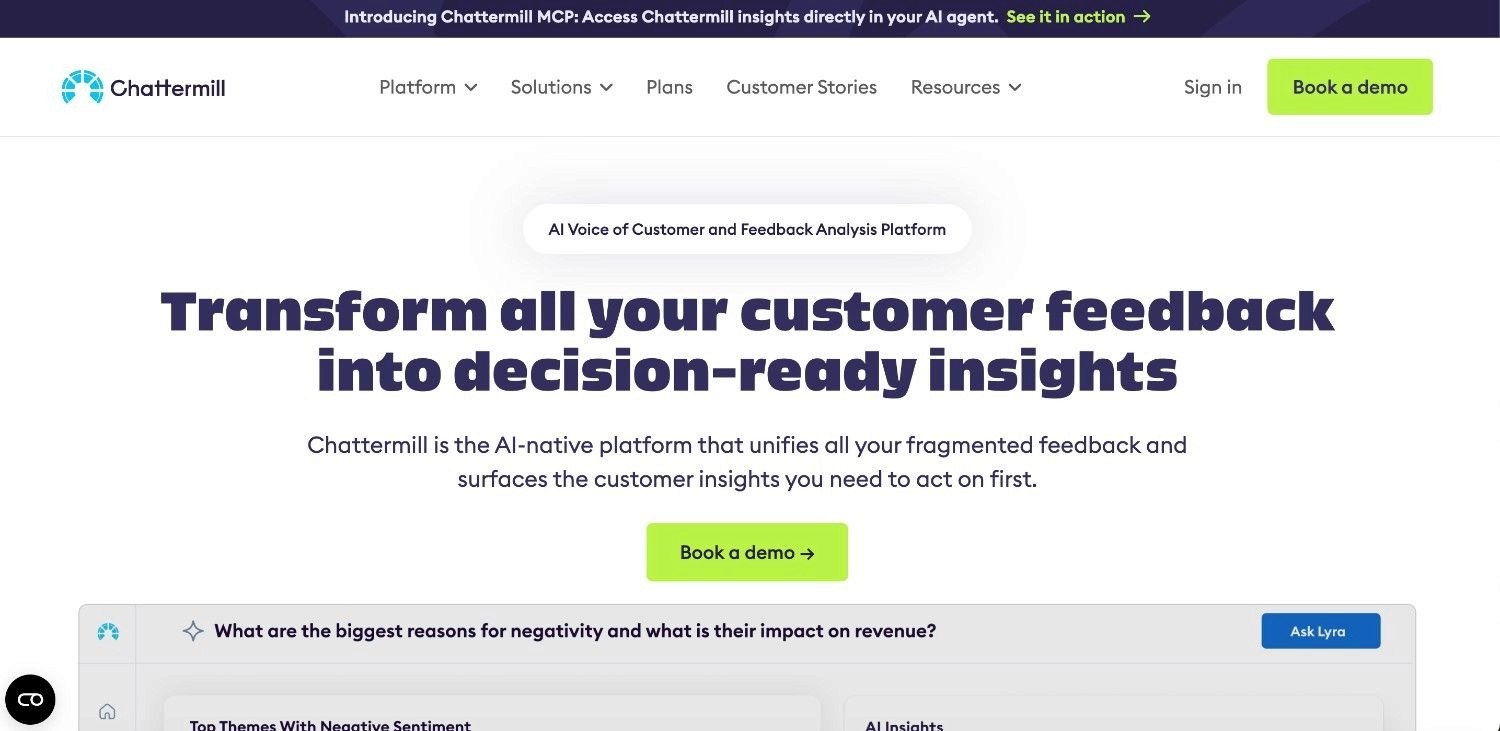
Chattermill is an AI-powered customer feedback analytics product that unifies feedback from surveys, reviews, support tickets, social channels, and chat into a single analysis layer.
Used by global brands including Uber, Zappos, and Tesco, Chattermill focuses on the analytics layer rather than survey collection, making it complementary to (or a deeper replacement for) the text analytics modules of Qualtrics and Medallia.
Ideal For
CX teams drowning in unstructured feedback across multiple sources
Product teams needing predictive correlation between feedback and KPIs
B2C brands at scale wanting unified feedback intelligence
Organisations whose existing CX tools fall short on AI text analytics
Mid-to-large enterprises looking for analytics depth without a full XM product spend
Top Features
Unified theme analytics: AI-driven natural language processing across all feedback sources (surveys, reviews, support, social, chat).
KPI correlation: Links feedback themes directly to business metrics, including NPS, CSAT, churn, and revenue.
Root cause analysis: Surfaces drivers of satisfaction shifts rather than summarising responses.
Predictive CX intelligence: Forecasts which themes are likely to impact retention based on historical patterns.
Multi-source connectors: Integrates with major survey products, helpdesks, and review sites without replacing existing collection tools.
Why They Stand Out?
Chattermill's depth in AI text analytics is one of the strongest in the category, particularly for organisations that collect feedback from many sources and need a single intelligence layer that does not require them to re-platform their collection tools.
The KPI correlation capability is more sophisticated than most competitors, making it one of the smarter choices for teams that need to demonstrate the business impact of CX improvements quantitatively.
Pros
Best-in-category AI text analytics across multi-source feedback
Connects to existing survey tools rather than replacing them
KPI correlation between themes and business outcomes
Used by recognisable global B2C brands at scale
Cons
Analytics-only; does not include native survey collection
Less useful for teams that have not yet established multi-source feedback collection
Custom pricing positions it above mid-market analytics tools
Pricing
Custom, quote-based. Typically positioned as enterprise pricing reflective of multi-source connector and AI processing scale. Trial access available on request.
Final Verdict
Chattermill is recommended for mid-to-large enterprises whose CX programmes already collect feedback from multiple sources and need a unified AI analytics layer that surfaces root causes and KPI impact. It is not the right fit for teams starting an NPS programme or for organisations needing primary survey collection rather than analytics depth.
7. AskNicely
Overview
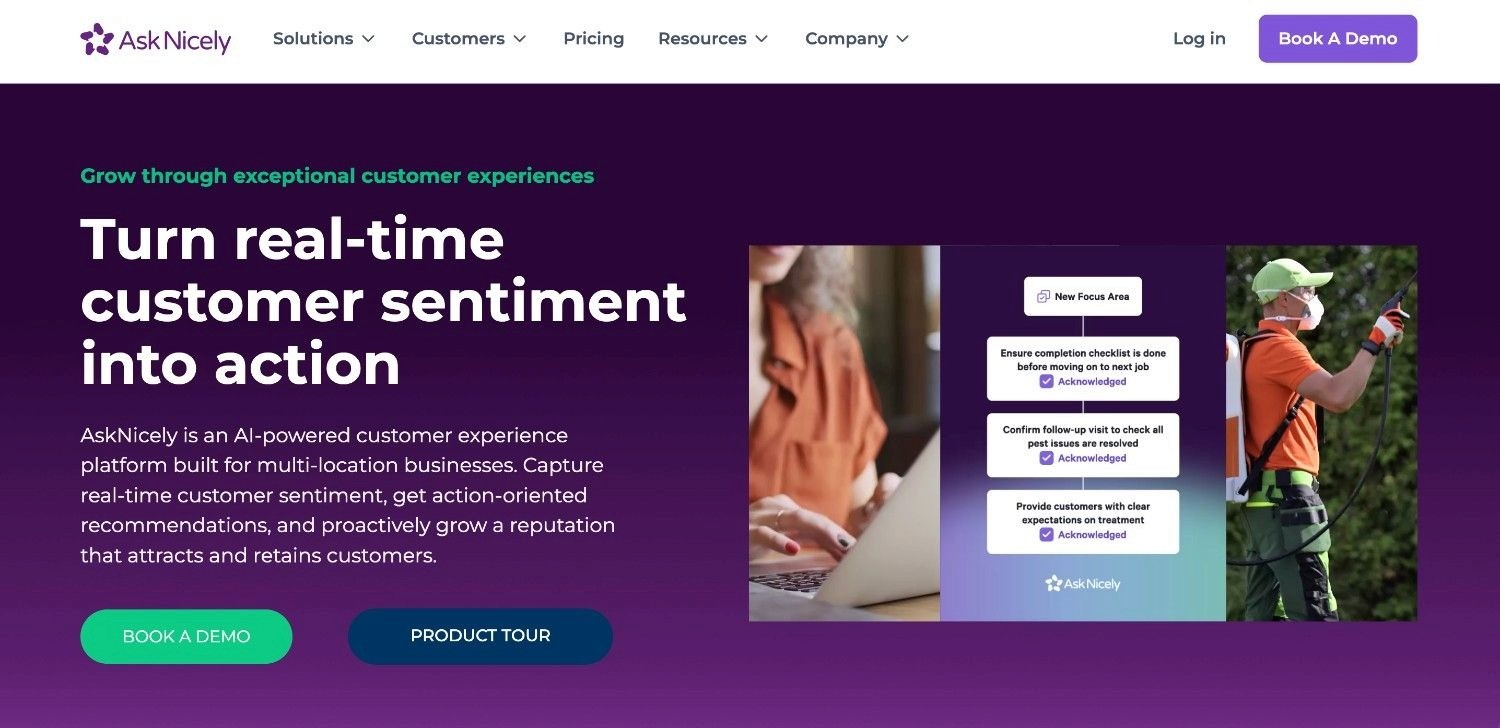
AskNicely is an NPS-first customer experience product purpose-built for service businesses where individual frontline performance affects customer satisfaction.
Originally focused on NPS surveys, the product has expanded into a coaching and action-management offering with a dedicated mobile app aimed at frontline staff. It sits between enterprise XM and lightweight survey tools, with a strong focus on service businesses where individual employee performance directly affects NPS scores.
Ideal For
Hospitality, property management, healthcare, and field-service businesses
Companies where individual employee performance affects CX scores
Service businesses needing frontline coaching workflows
Mid-market organisations standardised on NPS as their primary CX metric
Teams wanting NPS deployed across mobile-first frontline staff
Top Features
NextAI: Generative AI that produces tailored, personalised follow-up questions based on previous customer interactions.
Frontline coaching mobile app: Individual scorecards delivered directly to service-delivery staff with coaching guidance.
Automated NPS workflows: Recurring survey scheduling, event-triggered campaigns, and detractor alerts.
Closed-loop alerting: Routes detractor feedback to specific staff in real time.
Native CRM integrations: Salesforce, HubSpot, and standard middleware connectors.
Why They Stand Out?
AskNicely's focus on the frontline is the genuine differentiator. While most products surface aggregate scores to executives, AskNicely puts individual scores into the hands of the people who delivered the service.
For service businesses, this is one of the smarter choices in the market. Daily behaviour change matters more than quarterly reports, and the product is built around exactly that workflow.
Pros
NPS-first philosophy with deep specialisation in the metric
Mobile coaching app puts feedback directly into frontline hands
Fast deployment compared to enterprise XM products
Automation around recurring NPS programmes
Natural successor for Delighted refugees who found Qualtrics too complex
Cons
Limited beyond NPS; less flexible for CSAT, CES, or research surveys
Narrower collection channels (mostly email and SMS; no kiosk, QR, or voice)
No public pricing; all deals require a demo and a quote
Pricing
Custom, quote-based across all three tiers (Learn, Grow, Transform). AskNicely does not publish pricing on its site, and prospective customers complete a sales conversation to receive a quote. Plans are primarily annual, with multi-year discounts available. Per AskNicely's published FAQ, accounts above approximately USD $9,600/year include a named Customer Success Manager, and SSO is offered as a $1,500/year add-on. No free trial; demo required before quotation.
Final Verdict
AskNicely is recommended for service-oriented businesses where NPS is the primary CX metric and frontline behaviour change is the lever for improvement. It is not the right fit for product-led companies needing in-app feedback, research teams requiring methodology depth, or businesses that need broader survey types beyond NPS.
8. SurveySparrow

Overview
SurveySparrow is a conversational survey and CX product built around chat-style interfaces that improve completion rates compared to traditional forms.
It combines survey building, omnichannel distribution, AI analysis (CogniVue), and built-in ticketing for closing the feedback loop. It competes most directly with Zonka Feedback and AskNicely for mid-market CX programmes that want closed-loop case management built into the survey product rather than bolted on through middleware.
Ideal For
Mid-market CX teams needing omnichannel collection without enterprise complexity
Companies prioritising survey completion rates and respondent experience
Teams that want feedback collection and case management in one tool
B2B SaaS and service businesses scaling NPS programmes
Organisations that value a modern, conversational survey UX
Top Features
Conversational surveys: Chat-style format that boosts completion rates by a reported 14 to 40% versus traditional forms.
Omnichannel distribution: Email, SMS, WhatsApp, web, in-app, and offline kiosk in a single product.
CogniVue AI: Sentiment analysis, theme detection, and key driver identification across open-text feedback.
Built-in ticketing: Converts detractor feedback into assignable cases without integrating a separate helpdesk.
Workflow automation: Follow-up triggers, alert routing, and bi-directional CRM sync.
Why They Stand Out?
SurveySparrow's combination of conversational UX, omnichannel collection, and built-in case management is uncommon at its price point. For teams that want to collect feedback and act on it without integrating three separate tools, it is one of the smartest mid-market options on the market.
Pros
Conversational format produces consistently higher completion rates
Modern, clean builder consistently rated for usability
Native ticketing closes the feedback loop without external helpdesk integration
Broad omnichannel coverage, including WhatsApp
14-day free trial available on every paid tier
Cons
AI text analysis depth is less mature than that of enterprise specialists
Reporting flexibility is lower than that of research-grade products
Some integrations require higher plan tiers
Pricing
Custom, quote-based across all four tiers (Basic, Starter, Business, Enterprise). SurveySparrow now requires prospective customers to submit a country and contact details through their "Unlock Pricing" form to see plan rates; no public price points are shown on the pricing page itself. A 14-day free trial is available across all features. Annual billing is standard, with a reported quarterly option.
Final Verdict
SurveySparrow is recommended for mid-market teams that need closed-loop CX without enterprise complexity or pricing. It is not the right fit for global enterprises requiring advanced governance, research teams needing deep methodology, or contact-centre programmes that depend on voice signal capture.
9. Zonka Feedback
Overview
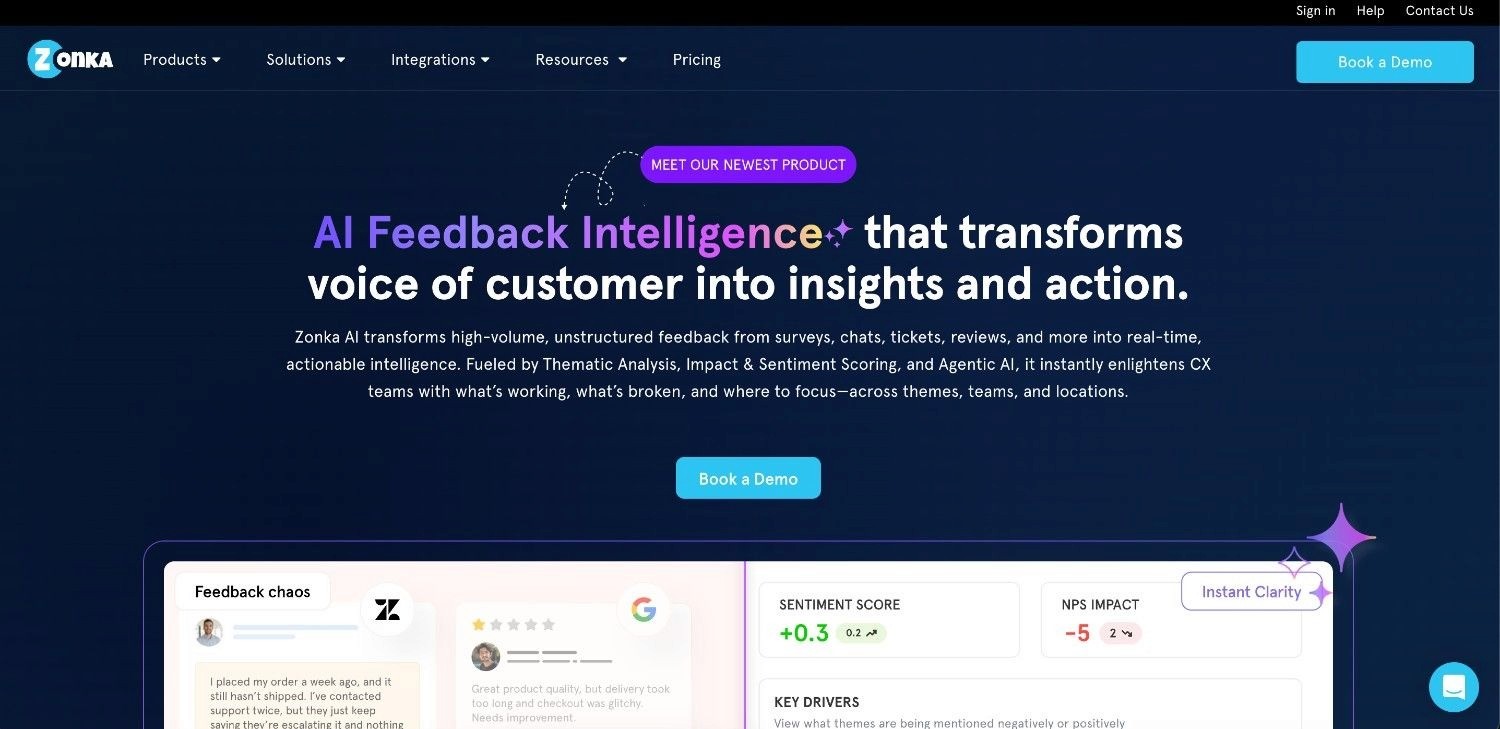
Zonka Feedback is an AI-powered customer feedback and intelligence product built for omnichannel collection and closed-loop action.
It positions itself between simple survey tools and enterprise XM, with strong emphasis on offline and kiosk collection (uncommon in the category) alongside email, SMS, WhatsApp, and in-app surveys. It competes most directly with SurveySparrow and AskNicely for mid-market CX programmes, particularly for businesses with physical locations. Regional data hosting is available in the EU, helping European customers meet data residency requirements.
Ideal For
Multi-location businesses requiring offline kiosk feedback (retail, healthcare, hospitality)
Mid-market CX teams running NPS, CSAT, and CES programmes together
Companies needing AI text analytics without Qualtrics-level complexity
Service businesses with physical footprints alongside digital touchpoints
European businesses needing EU-hosted feedback data
Top Features
Omnichannel collection: Email, SMS, WhatsApp, web widgets, in-app SDK, and offline kiosk/tablet mode.
AI Feedback Intelligence: Automated sentiment analysis, theme detection, entity recognition, and impact scoring.
Closed-loop workflows: Auto-creates tickets and routes alerts based on response data.
EU data hosting: Regional data residency in the EU for GDPR compliance.
CRM and helpdesk integrations: Salesforce, HubSpot, Zendesk, Intercom, and standard middleware connectors.
Why They Stand Out?
Zonka's offline and kiosk collection is one of the genuine differentiators in the category. Most cloud-first competitors do not cover this well, and for businesses with physical locations, it is the difference between capturing feedback at the point of service and missing it entirely.
Combined with AI-driven analysis, automated case management, and EU data residency, it is one of the smarter choices for European multi-location mid-market businesses.
Pros
Offline and kiosk collection capabilities for physical locations
AI text analytics tuned specifically for CX use cases
Real-time alerts and automated workflows
EU data hosting available for GDPR compliance
Cons
Pricing not publicly disclosed; quote-based for most tiers
Smaller brand recognition versus enterprise incumbents
Dashboard customisation more limited than Qualtrics
Pricing
Free trial available. Paid plans are quote-based with custom pricing depending on volume, channels, and modules deployed. Mid-market deployments are commonly in the mid-four to low five figures annually (EUR).
Final Verdict
Zonka Feedback is recommended for mid-market and multi-location businesses that need omnichannel feedback (particularly offline) combined with AI analytics and closed-loop action. It is not the right fit for pure online product teams, where in-app specialist tools may fit better, or for global enterprises requiring full XM product depth.
10. SurveyMonkey
Overview
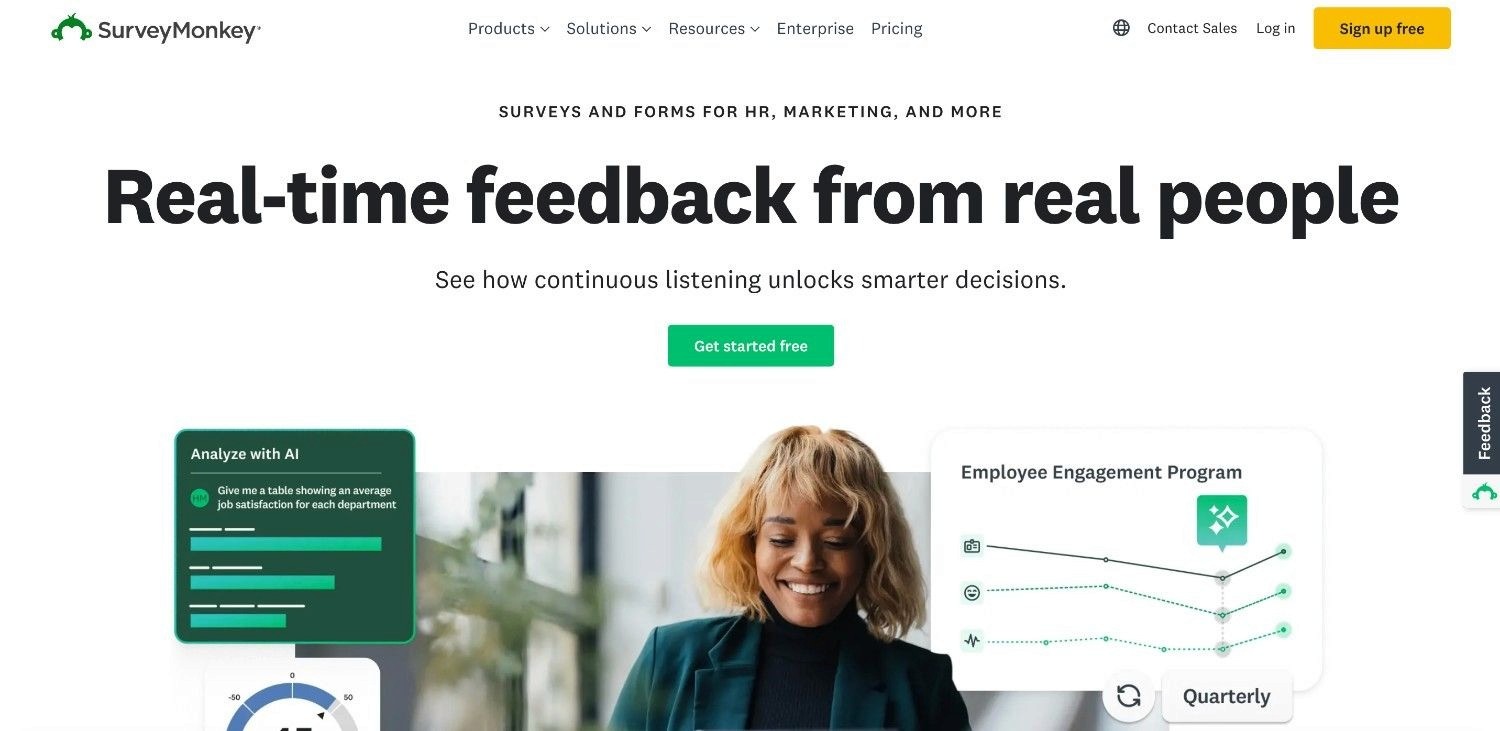
SurveyMonkey is one of the most established survey products, founded in 1999 and adopted broadly across functions including market research, employee engagement, customer feedback, academic research, and HR.
For NPS specifically, it offers templates, automatic score calculation, and basic reporting. But it is fundamentally a general-purpose survey tool rather than a dedicated CX product, and CX-focused teams typically outgrow it within 12 months.
Ideal For
Teams needing one survey tool for many use cases beyond CX
Companies starting their first NPS or CSAT programme
HR, market research, and academic teams alongside CX
Organisations with limited CX programme maturity
Salesforce users wanting straightforward NPS-to-CRM integration
Top Features
Wide template library: NPS, CSAT, CES, employee, event, and market research templates; the largest in the category.
Sentiment analysis: Available on Team Premier plans.
Salesforce integration: Syncs NPS scores into the CRM as account properties.
EU data residency: Cloud storage options in the European Union for GDPR compliance.
Skip logic, branching, and quotas: Available on paid tiers for more sophisticated survey design.
Why They Stand Out?
SurveyMonkey's breadth and brand recognition make it a safe default choice across many survey use cases. For teams that need more than NPS (employee surveys, market research, event feedback), it is one of the most practical multi-purpose tools at an accessible entry price.
Pros
Free tier available (limited but functional for evaluation)
Largest template library across survey use cases
Brand recognition and procurement familiarity
EU data residency available
Salesforce integration for NPS-to-CRM sync
Cons
CX-specific features are basic compared to dedicated products
Auto-billed overage charges of approximately €0.14 per response beyond plan limits can surprise teams
No native ticketing for closed-loop workflows
Pricing
Free tier with strict limits (10 questions and 25 responses per survey, no data export). Paid Team plans are billed annually with a 3-user minimum: Team Advantage at USD $30/user/month (50,000 responses/year) and Team Premier at USD $75/user/month (100,000 responses/year). Individual plans are also available (Advantage Annual USD $39/month, Premier Annual USD $139/month). Enterprise pricing is custom and quote-based. Localised pricing in EUR and other currencies is available for European customers; check the regional pricing page for current rates.
Final Verdict
SurveyMonkey is recommended for teams needing a versatile survey tool across multiple functions at an accessible price. It is not the right fit for CX-focused organisations that need closed-loop workflows, AI-powered feedback intelligence, or omnichannel collection. Those teams will outgrow it quickly.
11. Delighted (by Qualtrics)
Overview
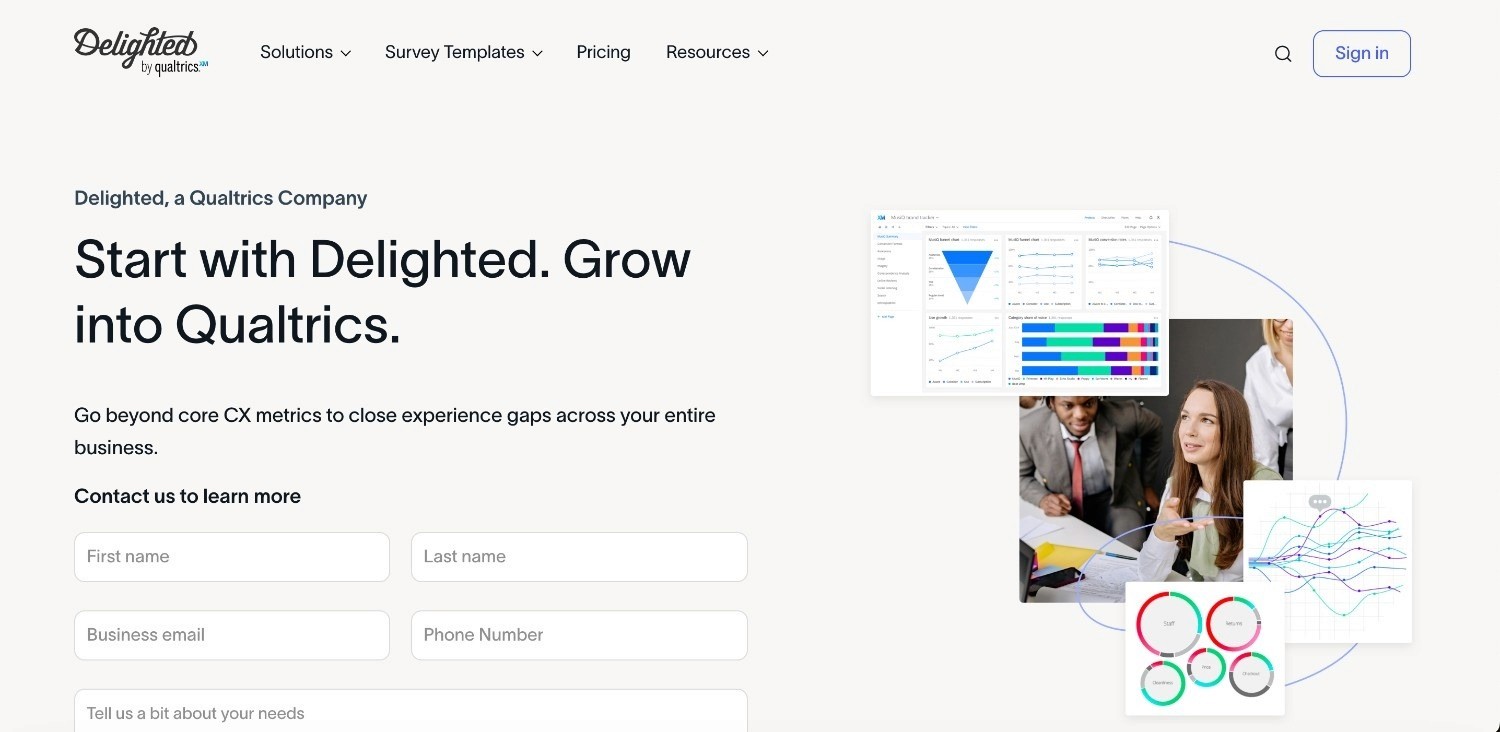
Delighted is a simple NPS, CSAT, and CES product built around single-question surveys with high completion rates.
Acquired by Qualtrics in 2018, Delighted continues to operate as a standalone offering targeted at SMBs and teams that want lightweight NPS without the complexity of an enterprise XM platform. It sits alongside Qualtrics' main XM suite as the entry point for buyers who outgrow free survey tools but are not ready for full-suite XM.
Ideal For
SMB teams running a first NPS, CSAT, or CES programme
Companies that value single-question survey simplicity over feature breadth
Product, e-commerce, and customer service teams needing fast time-to-value
Teams already inside the Qualtrics ecosystem looking for a lightweight option
Organisations that prefer transparent monthly pricing over enterprise contracts
Top Features
Single-question NPS, CSAT, and CES: Multi-channel distribution with minimal setup.
Survey delivery channels: Email, web link, web embed, SDK, and kiosk.
AI-Driven Smart Trends: Theme detection and trend filtering on feedback data.
35+ native integrations: Slack, Shopify, Zendesk, plus premium connectors for Salesforce, Segment, and HubSpot on the top tier.
Multi-language support: 30+ languages for initial rating question localisation.
Why They Stand Out?
Delighted's clean, simple UX is the genuine differentiator. Where most CX products lead with feature breadth, Delighted leads with focus: one question, one score, fast deployment. For SMBs that want NPS running this week rather than next quarter, it remains one of the smarter starting points in the category.
The Qualtrics ownership also gives it a clear upgrade path: teams that outgrow Delighted's single-question model can transition into the Qualtrics XM suite without re-evaluating vendors.
Pros
Clean, simple UX valued by SMBs and teams new to NPS
Transparent published pricing across all tiers (rare at the lower end of the category)
Free plan with 25 responses and 1 user, no credit card required
35+ free integrations including Slack, Shopify, and Zendesk
Clear upgrade path into the Qualtrics XM suite when the programme matures
Cons
Limited beyond single-question surveys; not suitable for research-grade methodology
Premium integrations (Salesforce, HubSpot, Segment) gated to the top tier
Lower response caps than equivalently priced competitors
Pricing
Published pricing in USD. Free plan available with 25 responses/month and 1 user, no credit card required. Paid plans: Starter at $19/month (50 responses, 2 users), Growth at $39/month (100 responses, 3 users), Advanced at $149/month (250 responses, 5 users), and Premium at $249/month (500 responses, 10 users). Higher volume needs are handled through custom pricing. All paid tiers include unlimited surveys, AI Recommended Questions, and AI-Driven Smart Trends.
Final Verdict
Delighted is recommended for SMBs and teams running a first NPS, CSAT, or CES programme who want transparent pricing and fast time-to-value without committing to enterprise XM. It is not the right fit for teams that need multi-question research surveys, deep AI text analytics, or operational case management built into the product.
How to Choose the Best Customer Feedback & NPS Software (What To Consider)
Selecting the best customer feedback software depends on operational reality, not feature comparison. Here are the five decisions that matter most:
1. Match the Tool to Your Programme Maturity
Enterprise XM products (Qualtrics, Medallia, InMoment) are overkill for first-time NPS programmes and overpriced for departmental use.
Mid-market tools (SurveySparrow, Zonka Feedback, AskNicely) hit the sweet spot for most organisations. Lightweight options (SurveyMonkey free tier) fit teams getting started.
Start where you are, not where you wish you were. The most common procurement mistake in this category is buying a Qualtrics-class product before the organisation has the analyst capacity to operate it.
2. Evaluate AI Text Analytics Depth on Your Own Data
Open-text responses are where the real insight lives, and reading them manually does not scale. Look for AI that detects themes, sentiment, intent, and key drivers automatically, not generic summaries.
Test the AI on your own sample data during evaluation, not on vendor demos. Accuracy varies sharply by domain (banking jargon, healthcare terminology, retail product names), and vendor demos are tuned to make the AI look better than it performs in production.
3. Verify Closed-Loop Automation Through to Back-Office Execution
Collecting feedback is the easy part. Acting on it is where most programmes fail.
Demand a workflow demo: when a detractor responds, what happens next? Does it create a ticket, alert the right owner, and sync the score into your CRM? More importantly, does the product execute the underlying operational case (the refund inside SAP, the policy correction inside Guidewire, the account update inside core banking) or does it stop at the alert?
Most CX products stop at ticket creation. If the demo includes the words "you would build a Zapier workflow to handle that," the product is not closed-loop. The gap between alerting a human and resolving the case operationally is where the ROI of NPS programmes is won or lost.
4. Check Channel Coverage Against Your Customer Reality
If your customers live on WhatsApp, you need WhatsApp. If you have physical locations, you need an offline kiosk and tablet mode. If you are product-led, you need in-app surveys triggered by user behaviour.
Channel mismatch kills response rates. Map where feedback actually happens in your customer journey before shortlisting products, then eliminate every vendor that does not cover those touchpoints natively.
5. Calculate Total Cost of Ownership, Not Headline Price
The licence fee is rarely the highest cost. Factor in:
Implementation: IT and analyst time, vendor deployment services
Hidden costs: SurveyMonkey's ~€0.14 per-response overage charges, Qualtrics' Text iQ and Stats iQ priced as add-ons, additional user seats and channel modules
Switching cost: Migration burden if you outgrow the product, including data export, integration rebuilds, and team retraining
Integration depth: Real CRM, helpdesk, and back-office integrations versus shallow Zapier-style sync
A tool that is cheap to start can become the most expensive option once scaling and switching costs are included.
Of these five factors, the third one (closed-loop automation through to back-office execution) is the one most teams underestimate during procurement and most regret a year later. It is also what separates a CX programme that reports the problem from one that resolves it. The next section unpacks why operational integration matters this much, and what genuinely closed-loop execution looks like in practice.
Why Should Your Customer Feedback Platform Connect to Your Operational Systems?
When every detractor case forces your customer success or operations team to switch between the CX product, the CRM, the helpdesk, and three or four back-office systems to resolve the underlying complaint, the speed advantage of fast detection collapses into manual coordination work.
NPS programmes are diagnostic. They tell you where customer pain lives. But a diagnosis without execution does not save accounts.
The detractor who reported a billing error needs the billing error fixed inside SAP, the refund processed inside the core banking system, and the case outcome written back into the CRM. Not an alert routed to a customer success manager who then performs that work manually.
What native operational execution enables:
Auto-create resolution cases inside back-office systems from detractor feedback
Look up customer records across multiple systems without human swivel-chair work
Execute corrections (refunds, account changes, policy updates) inside SAP, Guidewire, Salesforce, ServiceNow, and other systems of record
Write resolution outcomes back to both the source operational system and the CX product that flagged the case
Maintain a complete, replayable audit trail for compliance review
Most top-rated NPS software stops at the ticket creation layer. Middleware such as Zapier creates fragile connections that break when source systems update. Native operational execution through agentic AI is the difference between a CX programme that measures customer pain and one that resolves it.
Noxus is the operational execution layer for the case work that CX programmes surface, part of a broader category of AI agents for enterprise built to run inside legacy back-office environments.
Noxus handles the multi-system resolution work behind detractor signals: reading the unstructured complaint, pulling the account record across SAP, Salesforce, Guidewire, and core banking systems, applying the relevant business rules, executing the correction, and writing the outcome back to source systems with a complete audit trail.
Production deployments at Santander, CUF, and Jerónimo Martins demonstrate this in live operational environments, with documented 3-5x ROI in 45 to 80 days. The same pattern repeats across other enterprise AI use cases in banking, insurance, healthcare, and retail.
Detractor cases that took 45 minutes of cross-system manual work resolve in under five minutes with full audit coverage.
Everything You Need to Know About Customer Feedback & NPS Software
← scroll to see all columns →
| Company | Pros | Cons | Ease of Use | Integrations | Support | Affordability | AI & Analytics |
|---|---|---|---|---|---|---|---|
| Noxus | Resolves detractor cases end to end, deterministic execution, full audit | Not a survey tool; pairs with rather than replaces your CX product | ⭐⭐⭐⭐⭐ | ⭐⭐⭐⭐⭐ | ⭐⭐⭐⭐⭐ | ⭐⭐⭐⭐⭐ | ⭐⭐⭐⭐⭐ |
| Qualtrics XM | Deepest analytics, full XM scope, research-grade methodology | Steep learning curve, high cost, slow implementation | ⭐⭐⭐⭐⭐ | ⭐⭐⭐⭐⭐ | ⭐⭐⭐⭐⭐ | ⭐⭐⭐⭐⭐ | ⭐⭐⭐⭐⭐ |
| Medallia | Broadest signal capture, mature frontline workflows, contact-centre fit | High cost, long implementation, dependency on managed services | ⭐⭐⭐⭐⭐ | ⭐⭐⭐⭐⭐ | ⭐⭐⭐⭐⭐ | ⭐⭐⭐⭐⭐ | ⭐⭐⭐⭐⭐ |
| InMoment | Journey mapping, bundled services, Active Listening AI | Services-heavy model, less B2B fit, custom-only pricing | ⭐⭐⭐⭐⭐ | ⭐⭐⭐⭐⭐ | ⭐⭐⭐⭐⭐ | ⭐⭐⭐⭐⭐ | ⭐⭐⭐⭐⭐ |
| NICE Satmetrix | NPS methodology, heritage, CXone integration, benchmarking | Contact-centre-centric, limited outside the NICE ecosystem | ⭐⭐⭐⭐⭐ | ⭐⭐⭐⭐⭐ | ⭐⭐⭐⭐⭐ | ⭐⭐⭐⭐⭐ | ⭐⭐⭐⭐⭐ |
| Chattermill | Best-in-category text analytics, KPI correlation, multi-source | Analytics-only, no native survey collection, enterprise-priced | ⭐⭐⭐⭐⭐ | ⭐⭐⭐⭐⭐ | ⭐⭐⭐⭐⭐ | ⭐⭐⭐⭐⭐ | ⭐⭐⭐⭐⭐ |
| AskNicely | Frontline coaching focus, NPS specialisation, fast deployment | Limited beyond NPS, narrower channels, quote-based pricing | ⭐⭐⭐⭐⭐ | ⭐⭐⭐⭐⭐ | ⭐⭐⭐⭐⭐ | ⭐⭐⭐⭐⭐ | ⭐⭐⭐⭐⭐ |
| SurveySparrow | Conversational UX, transparent pricing, built-in ticketing | Lower research depth, customisation limited to entry tiers | ⭐⭐⭐⭐⭐ | ⭐⭐⭐⭐⭐ | ⭐⭐⭐⭐⭐ | ⭐⭐⭐⭐⭐ | ⭐⭐⭐⭐⭐ |
| Zonka Feedback | Offline/kiosk, AI analytics, EU data hosting | Quote-based pricing, smaller ecosystem, setup overhead | ⭐⭐⭐⭐⭐ | ⭐⭐⭐⭐⭐ | ⭐⭐⭐⭐⭐ | ⭐⭐⭐⭐⭐ | ⭐⭐⭐⭐⭐ |
| SurveyMonkey | Versatile, wide templates, EU data residency | Basic CX features, overage fees, AI on higher tiers only | ⭐⭐⭐⭐⭐ | ⭐⭐⭐⭐⭐ | ⭐⭐⭐⭐⭐ | ⭐⭐⭐⭐⭐ | ⭐⭐⭐⭐⭐ |
| Delighted (by Qualtrics) | Simple UX, transparent SMB pricing, free plan | Limited beyond single-question surveys, premium integrations gated | ⭐⭐⭐⭐⭐ | ⭐⭐⭐⭐⭐ | ⭐⭐⭐⭐⭐ | ⭐⭐⭐⭐⭐ | ⭐⭐⭐⭐⭐ |
Match Your Customer Feedback Programme to Your Operational Reality
The right Customer Feedback & NPS Software depends on programme maturity and existing stack: Qualtrics XM, Medallia, or InMoment for enterprise XM; NICE Satmetrix for NPS-native contact-centre programmes; Chattermill for AI analytics depth; AskNicely for service-business NPS; SurveySparrow or Zonka Feedback for mid-market closed-loop CX; SurveyMonkey for general-purpose surveys. Prioritise AI text analytics, closed-loop automation, and integration depth over feature lists.
CX programmes get exponentially more valuable when feedback connects to operational execution. Most products surface detractor signals in a dashboard. Few resolve the underlying case across the legacy systems where the work actually lives.
Noxus is the operational execution layer that turns the signals those products capture into resolved cases inside SAP, Guidewire, Salesforce, ServiceNow, and other systems of record, end to end, under audit, on top of the systems you already run. Santander, CUF, and Jerónimo Martins run on exactly this pattern, with documented 3-5x ROI in 45 to 80 days.
Book a demo and see your own detractor workflow resolved end-to-end. 30-minute call, no slides, live walkthrough of an AI Co-worker resolving a case on a process matched to your operational stack.
FAQs About Customer Feedback & NPS Software
What is the best Customer Feedback & NPS Software in 2026?
Qualtrics XM leads for enterprise XM. Medallia wins for real-time signal capture. AskNicely is built for service-business NPS. SurveySparrow and Zonka Feedback fit mid-market closed-loop CX. Pricing runs from free tiers (SurveyMonkey, Delighted) up to quote-based enterprise contracts that are typically six figures at scale. The right pick depends on programme maturity and channel mix.
What should I consider when choosing the right Customer Feedback & NPS Software for me?
Start with programme maturity. Test AI text analytics on your own data, not vendor demos. Verify closed-loop automation routes detractor feedback into your operational systems, not only to alert recipients. Calculate total cost including overage fees, AI add-ons, and switching costs, and check channel coverage against where your customers actually live (email, SMS, WhatsApp, web, in-app, kiosk).
How does Noxus differ from similar alternatives?
Qualtrics, Medallia, and AskNicely capture detractor signals and surface them to dashboards. Noxus is the operational execution layer that resolves the underlying case across SAP, Guidewire, and core banking systems. The CX product measures customer pain; Noxus resolves it end-to-end, with documented 3-5x ROI in 45 to 80 days.
How do I get started with Noxus?
Start with one workflow. A scoping call identifies your highest-friction case type, usually complaint resolution, billing disputes, or account corrections. Noxus deployment engineers map your business rules to your back-office systems and configure the execution runtime that runs them. First production workflow runs in 30 days, no rebuild required.
How easy is it to switch to Noxus?
No rebuild required. Noxus operates inside SAP, Guidewire, Salesforce, and core banking systems the way your operations staff do today. No modern API layer needed. Implementation maps your business rules to the agent, not your stack, and the first production workflow runs in 30 days.
Can Customer Feedback & NPS Software integrate with legacy enterprise systems?
Most products cannot. They integrate well with cloud applications like Salesforce and HubSpot, but reaching SAP ECC, Guidewire, or Oracle EBS directly is rare and typically stops at the CRM or helpdesk layer. To execute case resolution inside legacy back-office systems, CX products pair with agentic AI execution layers that operate on legacy interfaces natively.
Are free Customer Feedback & NPS Software tools good enough for small businesses?
Yes, for early-stage teams running a first NPS or CSAT programme. SurveyMonkey's free plan caps at 10 questions and 25 responses per survey; Delighted's offers 25 responses/month with 1 user. Most teams outgrow free tiers within 6 to 12 months as volumes grow or closed-loop automation becomes a requirement, at which point an enterprise CX product paired with Noxus is the right next step.