Best AI Contract Generator in 2026 (Top Tools Reviewed & Compared)
The best AI contract generator for your team depends on whether you need faster drafting or a contract process that runs itself. This comparison covers ten tools on drafting quality, review workflow, system integration, governance and pricing.

Key Takeaways (TL;DR)
The Best Overall AI Contract Generator: Noxus is the smartest solution to resolve contract-related work end-to-end across the exact systems your legal, sales and procurement teams already run, instead of just producing a document for someone to review manually. It closes the gap between generating a contract and actually getting it drafted, checked and filed correctly.
Why Do You Need It: Drafting contracts manually from scratch, or copying and editing old templates, wastes hours per agreement and increases the risk of outdated clauses slipping through unnoticed.
Who It's For: Legal, sales and procurement teams at mid-market and enterprise companies generating contracts at volume, plus startups that need professional agreements without a dedicated legal team.
How to Choose the Right One: Look at how deep the tool integrates with your existing CLM or CRM, whether it can apply your own clause library and compliance rules, and whether pricing scales with contract volume rather than headcount.
Expected Price: Noxus runs on a monthly platform licence with consumption-based pricing. There is no per-seat, per-document or token-based billing, so cost tracks the contract operations completed rather than the size of the legal team. A custom quote follows a scoping call, and each use case after the first costs materially less to deploy because the integration layer is already live.
Table of Contents
Top AI Contract Generator Tools in 2026: at a Glance
Tool | Best For | Key Features | Pricing |
Noxus | Enterprises resolving contract operations across legacy CLM, CRM and ERP systems | End-to-end case resolution, 400+ system connectors, full audit trail | Consumption-based, custom quote |
LEGALFLY | Enterprise in-house legal teams in regulated industries | Governed drafting, playbook review, anonymisation before analysis | No public pricing; sales-led quote |
Lindy AI | Teams wanting AI agents that draft and manage contracts within broader workflows | Custom AI agents, contract drafting, connected inbox automation | 7-day trial; from $29.99/user/month |
PandaDoc | Sales teams generating and e-signing contracts and proposals at volume | Contract templates, e-signature, CRM integrations | Free plan; paid from $19/seat/month |
Jotform | Small businesses building contracts through customisable online forms | Form-based contract generation, e-signature, submission limits | Free plan; paid from $39/month |
Borderless AI | Companies hiring contractors and employees across multiple countries | Contractor and EOR agreements, global payroll, compliance tools | From $29/month per worker |
Spellbook | Law firms and legal teams drafting and reviewing contracts inside Word | AI clause drafting, redlining, contract review inside Word | Custom, seat-based pricing |
Juro | In-house legal teams managing contracts from drafting to signature | Contract workflow automation, AI drafting, unlimited templates | Custom, volume-based pricing |
Gavel | Legal and business teams automating document assembly from templates | Document automation, client intake forms, e-signature | From $99/month |
LegesGPT | Individuals and small teams wanting AI-assisted legal drafting help | AI legal drafting assistant, document upload, legal Q&A | From $19.99/month |
What Is an AI Contract Generator?
An AI contract generator is a tool that drafts legal agreements automatically, using templates, clause libraries and natural language prompts instead of a lawyer or contract manager starting from a blank page.
Rather than manually copying an old agreement and editing it clause by clause, an AI contract generator pulls in the relevant terms, populates the right fields and produces a draft ready for review.
The category spans a wide range of tools. Some are simple form-based generators built for one-off agreements.
Others are full AI contractor generator tools that combine drafting, redlining, approval routing and e-signature in a single contract lifecycle workflow.
What ties them together is the goal of cutting the time between "we need a contract" and "the contract is signed," while reducing the risk of outdated or inconsistent clauses making it into a final agreement.
Why Do You Need an AI Contract Generator?
Manual contract drafting does not scale once a business signs more than a handful of agreements a month. Legal and sales teams spend hours per contract copying old templates, manually swapping out names and terms, and hoping nobody missed an outdated clause along the way.
The best AI contract generator fixes this by applying the same clause library and approval logic to every agreement, consistently, rather than depending on whoever happens to be drafting that particular contract.
There is a real cost to getting this wrong. Contract cycle times commonly stretch into weeks when drafting and review are handled manually, and outdated or inconsistent clauses are a common source of disputes further down the line.
An AI contract generator removes much of that risk. It applies consistent terms across every agreement, speeds up the path from draft to signature, and frees legal and sales teams to spend their time negotiating rather than formatting documents.
Best AI Contract Generator in 2026: In-Depth Review & Comparison
1. Noxus
Overview
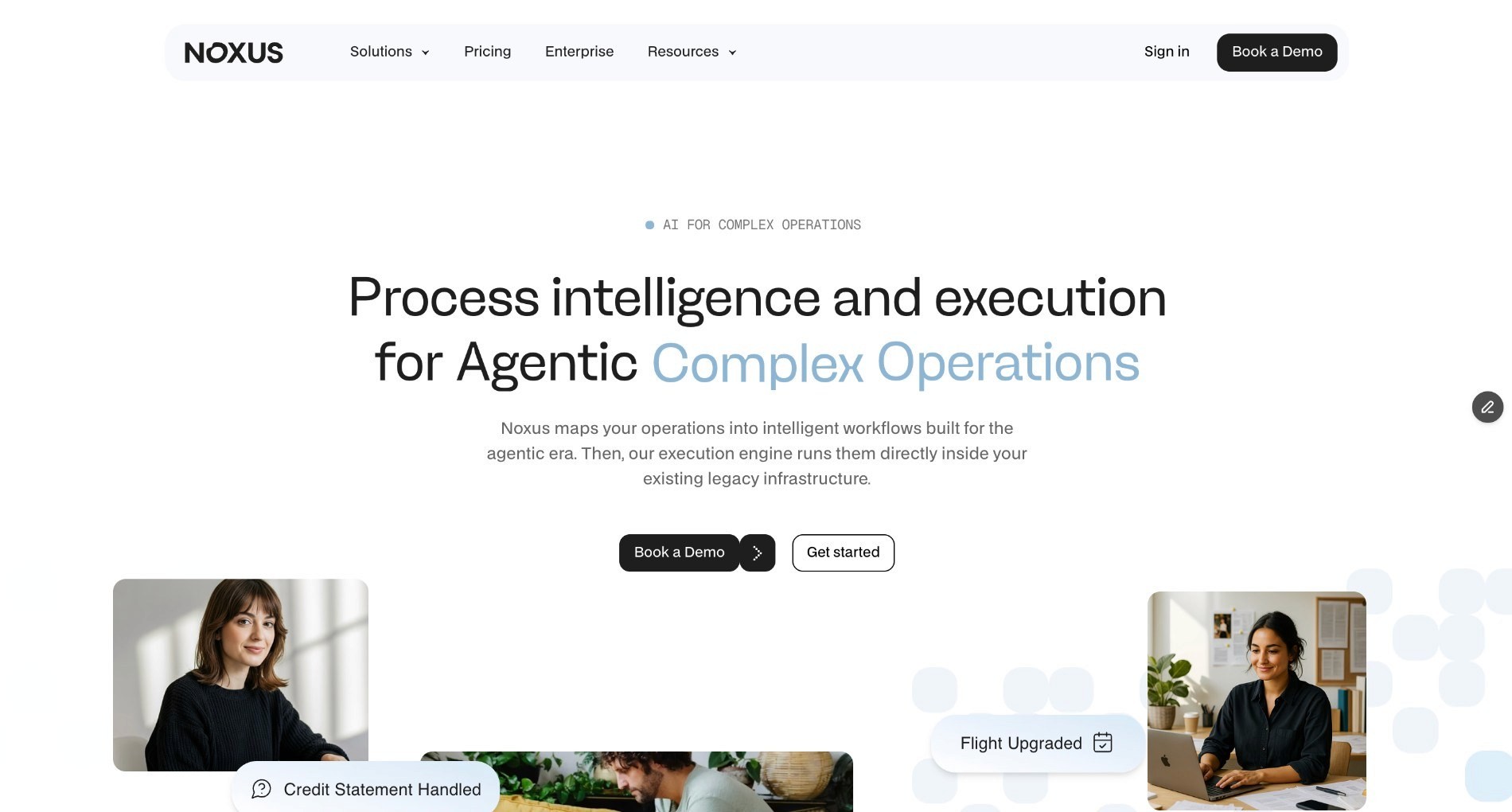
We built Noxus as an AI operations platform that resolves contract-related operational work end-to-end. This includes the exact legacy systems your legal, sales and procurement teams already run, whether that is your CLM, your CRM, your ERP or a proprietary in-house system.
Most tools marketed as the best AI contract generator produce a draft and leave the routing, compliance checks and filing to a person. Noxus goes a step further, pulling the relevant contract data from your systems and applying your clause library and internal policies.
Our agentic automation workflows then route the draft for the right approvals and write the final agreement back into your CLM under a full audit trail.
Getting AI into production inside an enterprise is 90% infrastructure and integration, 10% AI, and that gap is exactly what we close.
Every decision we make is traceable, every action is replayable, and nothing gets invented along the way. That matters most for regulated, high-volume contracting.
Ideal For
Legal and contract operations leaders replacing manual contract drafting across 3-7 disconnected systems
IT and systems leaders who need an AI contract generator that works with their existing CLM or CRM without a migration project
Enterprises in regulated industries that require a complete audit trail on every contract decision
Mid-market companies scaling contract volume faster than their legal headcount
Top Features
End-to-end resolution of contract drafting, approval routing and CLM write-back, not just document generation
Native connectors across major CLM, CRM and ERP platforms, ServiceNow and 400+ other systems, with no API-first prerequisite
Confidence-based human escalation, so non-standard clauses route to a lawyer while standard terms resolve automatically
Full audit trail with complete replayability for every contract action, useful for compliance and legal sign-off
Flexible deployment across SaaS, private VPC or air-gapped on-premises, depending on data sovereignty needs
Why We Stand Out?
Most AI contractor generator tools were built for modern, API-first legal stacks. We built ours for the enterprise reality where contract data touches a CLM, a CRM, an ERP and a compliance system, none of which were designed to talk to each other.
We do not ask clients to modernise their stack before automating contract operations; we operate inside the systems they already run.
Clients using Noxus for operations automation have seen results like 3x ROI within 45 days of going live, with AI precision above 95% on real production data. These figures are drawn from deployments including Santander in banking, CUF/José de Mello in healthcare, and Jerónimo Martins in retail.
You can see more of these enterprise AI use cases across other regulated, high-volume workflows.
Pros
Resolves contract operations end-to-end instead of just producing a draft for someone else to route manually
Works natively with legacy CLM, CRM and ERP systems, with no re-platforming required
Consumption-based pricing that scales with volume, not per-seat licensing
Full audit trail and replayability built in, not bolted on
Cons
Not designed for teams that only need a lightweight, one-off contract template tool
Best suited to organisations with genuine multi-system contracting complexity, rather than a handful of simple agreements a month
Requires a scoping conversation before pricing is confirmed, so there is no self-serve checkout
Pricing
We run Noxus on a monthly platform licence with consumption-based pricing that scales with operational volume and deployment complexity. There is no per-seat pricing, no per-task billing and no token-based pricing.
First engagements typically include deployment engineering alongside the licence. Every use case after that runs at a much lower incremental cost once the infrastructure is live.
Pricing is confirmed after a scoping conversation.
Final Verdict
If your contract operations span multiple legacy systems, and manual drafting or approval routing is slowing your teams down, Noxus is built specifically for that problem.
It is the best AI contract generator choice for teams that need contracts resolved end-to-end, not just drafted.
2. LEGALFLY
Overview
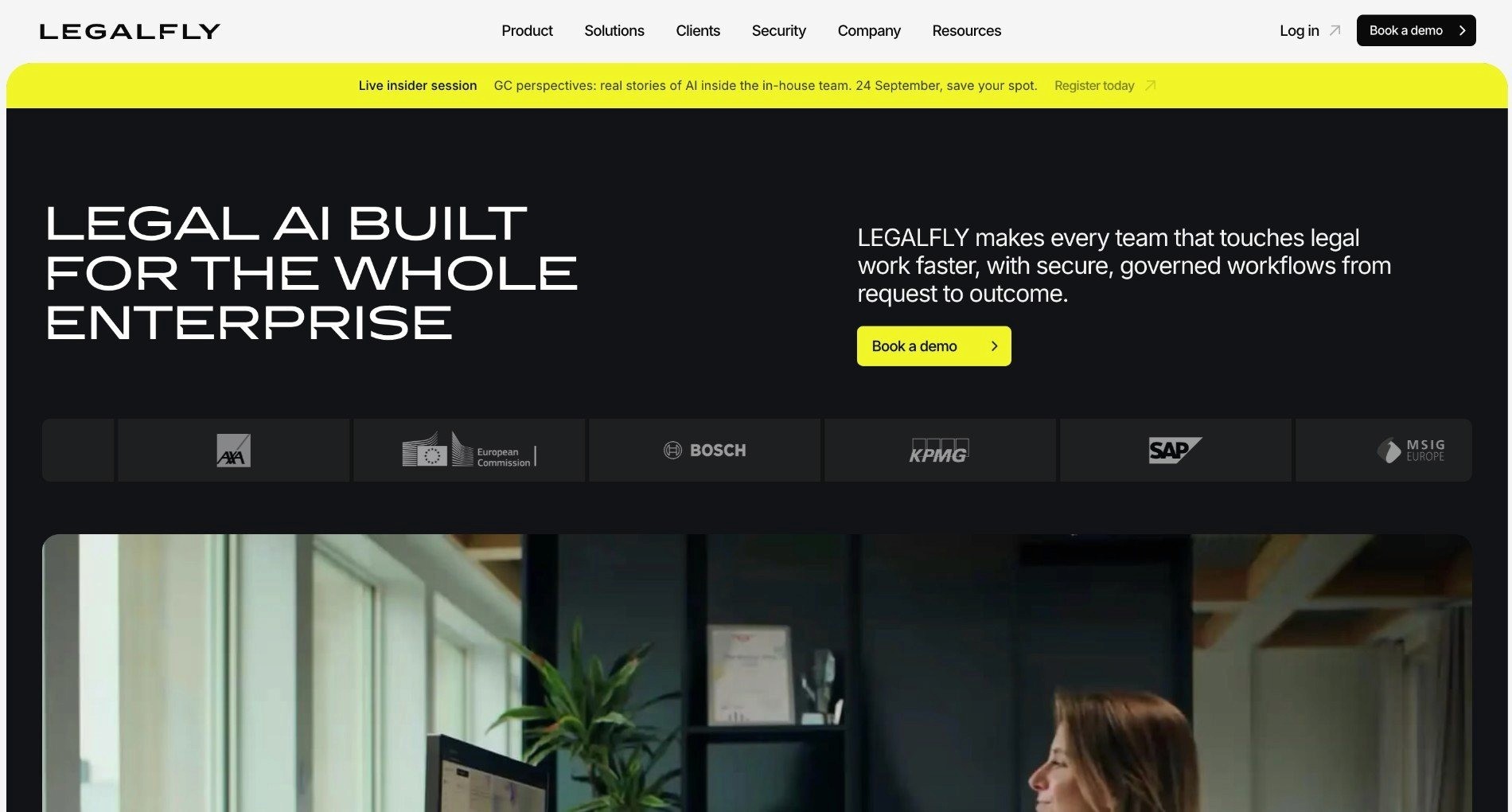
LEGALFLY is an enterprise legal AI platform built for in-house legal teams, which the company positions as the legal operating system for corporates. Contract drafting is one agent inside a wider system that also covers contract review, legal research, regulatory monitoring and bulk document review.
Founded in 2023 in Ghent by four former AI leads from Tinder, it now operates from Belgium, London and Dubai. The drafting agent turns an existing contract into a governed template, auto-populates parties, dates, fees and other variables once and applies them across every clause, then applies conditional clause logic and fallback positions based on jurisdiction, deal context and risk profile.
What separates it from most tools in this comparison is the layer underneath. Documents are anonymised before the AI analyses anything, with names, roles, company details and identifiers pseudonymised while context and structure stay intact. The company states it is the only legal AI that anonymises documents before analysis begins. That architecture is why it clears security reviews in regulated sectors, and it is deployed at the European Commission, Bosch, KPMG, SAP, Lufthansa and PIF.
Contract generation here is inseparable from contract governance, so teams looking for a quick standalone drafting tool will find more platform than they need.
Ideal For
In-house legal teams at enterprises in regulated industries, particularly banking, insurance and manufacturing
Legal departments that need drafting, review and playbook enforcement in one governed system
Organisations where security review is the gating factor on any AI purchase
Procurement, sales, HR and compliance teams that need to self-serve on contracts inside rules legal defined
Multi-jurisdiction businesses drafting under different governing laws
Top Features
Drafting agent that converts a signed contract into a reusable template while preserving structure, tone and formatting
Variable auto-population, so parties, dates and fees are entered once and applied consistently across every clause
Conditional clause logic and fallback positions that change with jurisdiction, deal context and risk profile
Anonymisation before analysis, with deployment options including single tenant and on-premise anonymisation
Agent Studio, which chains drafting to review, approval and notification steps with a human approval gate
Word and Outlook add-ins, plus SharePoint, Google Drive, Teams, Slack and NetDocuments integrations
Why They Stand Out?
LEGALFLY is one of the strongest choices for enterprises where the security review decides the purchase. Anonymising documents before any model sees them is an architectural decision rather than a policy setting, and it is the reason the platform passes procurement in banking, insurance and the public sector.
The second strength is scope. Drafting a contract is treated as one step in a workflow that continues into playbook-based review, approval routing and notification, with 120+ lawyer-built playbooks covering 100+ document types available as a starting point. Customer results include contract review dropping from around two hours to 15 minutes at Agristo and from a full day to roughly 20 minutes at MSIG Europe.
Pros
Anonymisation runs before analysis, which clears security reviews that block generic AI tools
ISO 27001 certified and SOC 2 Type II, with SaaS, single tenant and on-premise anonymisation deployment options
Drafting connects directly to playbook-based review and approval rather than ending at the document
Grounded in 700+ official sources across 35 jurisdictions, with citations on every answer
Runs inside Word and Outlook, so adoption does not depend on a new interface
Cons
No published pricing, no free tier and no self-serve trial, so evaluation runs through a sales cycle
Built for in-house legal departments rather than law firms or solo practitioners
More platform than teams needing occasional standalone contract generation will use
Contract lifecycle visibility is announced but not yet shipped, so obligation tracking is not comparable to a full CLM
Pricing
LEGALFLY does not publish pricing. It runs an enterprise, sales-led motion with no self-serve trial and no pricing page, so every deployment is quoted after a discovery call and demo.
Licences are annual, and paid pilots have been offered ahead of a full commitment. Budget for an evaluation period rather than a signup.
Final Verdict
LEGALFLY is the strongest fit on this list for enterprise in-house legal teams in regulated industries, especially where a CISO holds veto over the purchase and generic AI tools have already been blocked on data handling.
It is not the right choice for a small team that wants to generate a contract this afternoon, or for a law firm; the product roadmap is built around in-house needs and the buying process assumes an enterprise evaluation.
3. Lindy AI
Overview
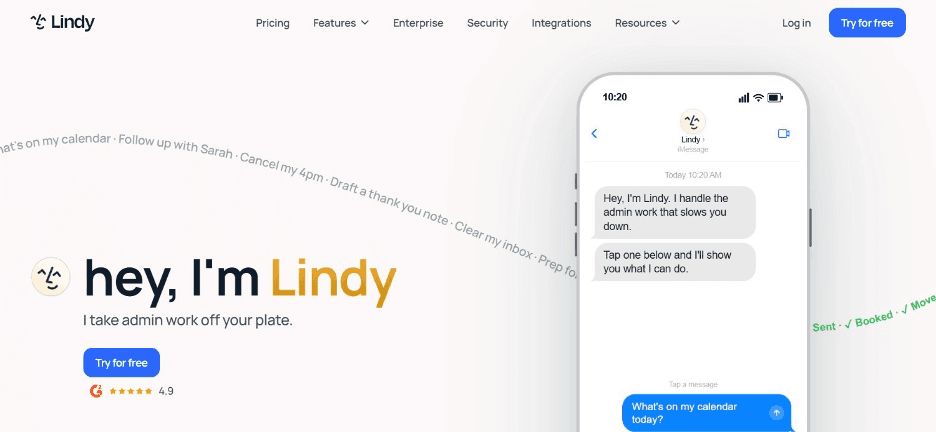
Lindy AI is a general-purpose AI agent platform that teams configure to draft and manage contracts alongside a wide range of other workflow tasks.
Rather than being a dedicated AI contract generator, Lindy AI lets users build custom agents that pull data from a connected inbox and draft an agreement using a prompt or template. The agent then routes it for review, all within the same workspace used for other automated tasks.
This makes Lindy AI a flexible option for teams that want contract drafting handled by the same AI agents managing their email and scheduling, rather than a standalone legal tool.
It suits teams comfortable configuring their own workflows rather than adopting a fixed, contract-specific product.
Ideal For
Teams wanting contract drafting built into a broader AI agent workflow
Startups and small businesses managing contracts alongside other automated tasks
Users comfortable configuring custom AI agents rather than using a fixed template system
Top Features
Custom AI agents that can draft contracts from prompts or templates
Connected inbox automation alongside contract generation
Credit-based system where task cost depends on model and workflow complexity
Flexible workflow building beyond just contract drafting
Why They Stand Out?
Lindy AI's general-purpose agent approach sets it apart from tools built purely as an AI contract generator with fixed templates.
It is one of the more flexible options for teams that want contract drafting folded into a wider set of automated workflows.
Pros
Free plan available to start drafting and testing workflows
Flexible enough to combine contract drafting with other automated tasks
Scales from individual users to larger teams with Enterprise pricing
Regularly expanding template and integration library
Cons
Less specialised than dedicated AI contractor generator tools built purely for legal work
Credit-based pricing can be harder to predict than a flat monthly fee
Requires more configuration than a fixed, contract-specific template tool
Pricing
Lindy starts with a 7-day free trial, then Plus at $29.99 per user a month with 3,000 credits, Pro at $99.99 per user with 15,000 credits, and Max at $199.99 per user with 35,000 credits.
Enterprise pricing is by contact, with higher tiers increasing usage and connected inbox limits, and Enterprise adding compliance and admin features including SSO, SCIM and audit logs.
Final Verdict
Lindy AI works well for teams that want contract generation folded into a broader AI agent workflow.
Teams wanting a dedicated, contract-only tool will likely prefer a more specialised platform.
4. PandaDoc
Overview
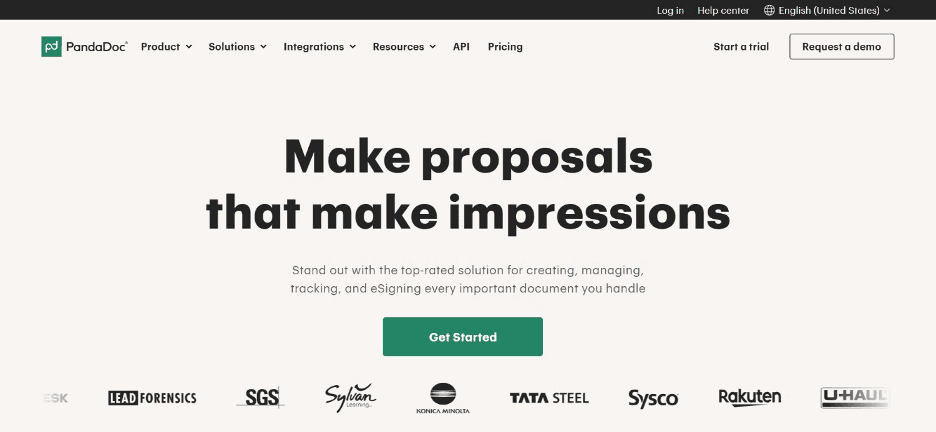
PandaDoc is a document generation and e-signature platform that sales and operations teams use to create contracts, proposals and quotes at volume.
Its contract generation features focus on speed and CRM integration: templates pull in deal data automatically, and completed documents move straight into e-signature without leaving the platform.
This makes PandaDoc a practical AI contract generator for sales-heavy organisations that need contracts and proposals moving quickly through a pipeline, rather than legal teams drafting complex, highly negotiated agreements.
It is widely used alongside common CRM platforms, which helps it slot into existing sales workflows.
Ideal For
Sales teams generating contracts and proposals directly from CRM deal data
Organisations wanting document generation and e-signature in one platform
Companies prioritising speed over highly customised, heavily negotiated agreements
Top Features
Contract and proposal templates that pull data directly from connected CRMs
Built-in e-signature on every plan
CPQ and advanced workflow tools on higher tiers
Library of reusable content blocks for consistent contract language
Why They Stand Out?
PandaDoc's tight CRM integration sets it apart from AI contractor generator tools built primarily for standalone legal drafting.
It is one of the stronger options for sales teams that want contracts and proposals moving through the same system as their deal data.
Pros
Strong CRM integrations for sales-driven contract generation
E-signature included even on lower-cost plans
Free plan available to test core functionality
Scales up to CPQ and advanced automation for larger teams
Cons
Less focused on complex, heavily negotiated legal agreements
Per-seat or per-document pricing can add up for larger teams
Enterprise features require a custom plan and sales conversation
Pricing
PandaDoc has a Free plan, Starter at $19 per user a month and Business at $49 per user a month, both billed annually, with Enterprise quoted per organisation. Monthly billing costs meaningfully more; PandaDoc advertises savings of up to 46% on annual. A per-document package with unlimited seats is available on request, which suits teams with many occasional signers rather than a few heavy users.
Final Verdict
PandaDoc suits sales-led organisations that want fast contract and proposal generation tied to CRM data.
Legal teams needing deep clause libraries and complex redlining will likely need a more specialised AI contract generator.
5. Jotform
Overview
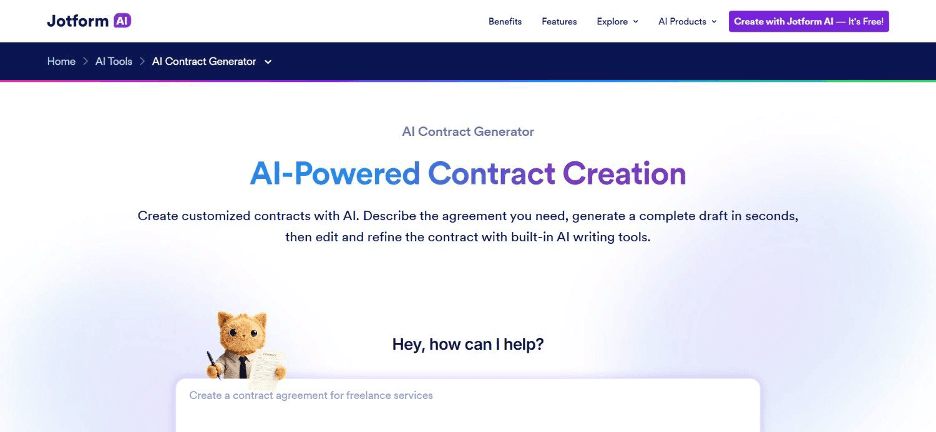
Jotform is a form-building platform that many small businesses adapt into a lightweight AI contract generator using customisable online forms.
Rather than offering a dedicated legal drafting engine, Jotform lets users build a form that collects the relevant details, then generates a contract document from that input, complete with e-signature.
This makes Jotform accessible to small teams that need simple, repeatable agreements, like service contracts or waivers, without investing in a dedicated legal tech platform.
It is less suited to complex, heavily negotiated contracts that require a proper clause library and redlining workflow.
Ideal For
Small businesses needing simple, repeatable contract templates
Teams wanting contract generation built on familiar, easy-to-edit forms
Organisations prioritising ease of use over deep legal drafting features
Top Features
Form-based contract generation with customisable fields
Built-in e-signature for completed agreements
Submission limits and advanced capabilities that scale by plan
Wide template library for common document types
Why They Stand Out?
Jotform's form-based approach sets it apart from AI contractor generator tools built around clause libraries and legal drafting logic.
It is one of the more accessible options for small teams that think in forms rather than legal templates.
Pros
Simple, form-based approach that is easy for non-legal staff to use
Free plan available for basic contract generation
Broad template library covering many document types
Annual billing offers savings of up to 20%
Cons
Limited depth for complex, heavily negotiated agreements
Less suited to enterprise-scale contract lifecycle management
Advanced features require moving up to higher-cost tiers
Pricing
Jotform has a free Starter plan, then Bronze at €34 a month, Silver at €39 a month and Gold at €99 a month, all billed annually, with Enterprise quoted per organisation. Tiers scale on forms, monthly submissions, storage and payment submissions rather than seats: Bronze covers 25 forms and 1,000 submissions a month, Silver 50 forms and 2,500, Gold 100 forms and 10,000. HIPAA features start at Gold. Annual billing saves up to 20%, and nonprofits and educational institutions get up to 50% off.
Final Verdict
Jotform is a sensible choice for small businesses that need simple, repeatable contracts generated from forms.
Companies with complex legal drafting needs will find more depth in a dedicated AI contract generator.
6. Borderless AI
Overview
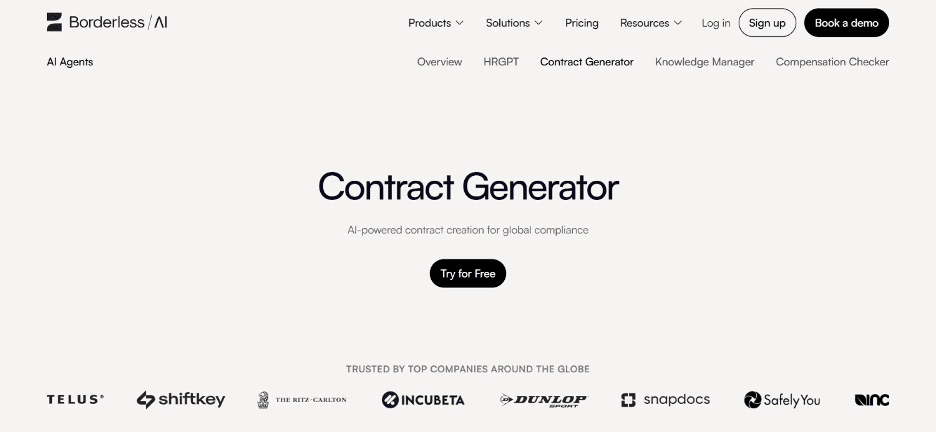
Borderless AI is a global employment and contractor management platform that generates compliant agreements for hiring across multiple countries.
Rather than positioning itself as a general AI contract generator, Borderless AI focuses specifically on employment and contractor agreements. It automatically applies the correct local compliance requirements for each country a business hires in.
This makes it a strong fit for companies building distributed teams, where getting contractor and employment agreements wrong can create real legal and tax exposure.
It is less relevant for businesses needing general commercial contracts like vendor or client agreements outside of hiring.
Ideal For
Companies hiring contractors and employees across multiple countries
Organisations needing compliant employment agreements without in-house global legal expertise
Startups scaling distributed teams quickly and compliantly
Top Features
Automatically compliant contractor and employment agreements by country
Global payroll and compliance tools bundled with contract generation
Per-worker pricing across Employer of Record, Contractor Management and Payroll products
Ongoing compliance monitoring as regulations change
Why They Stand Out?
Borderless AI's focus on global employment compliance sets it apart from general-purpose AI contractor generator tools built for commercial agreements.
It is one of the stronger options for companies whose contract generation needs are specifically tied to global hiring.
Pros
Transparent, per-worker pricing across all three products
Built-in compliance for hiring across multiple countries
Combines contract generation with payroll and compliance in one platform
Reduces legal risk for companies without in-house global expertise
Cons
Narrow focus on employment and contractor agreements only
Not suited to general commercial contracts like vendor or client agreements
Per-worker pricing scales with headcount rather than contract volume
Pricing
Borderless AI publishes a rate per product: Employer of Record at $579 a month, Contractor Management at $49 a month and Global Payroll at $29 a month, each priced per worker or contractor with no upfront deposits or security deposits. Its AI Agents for HR, which cover contract generation and HR queries, are included free on all plans, so the contract capability is bundled rather than sold separately.
Final Verdict
Borderless AI is the right pick for companies whose contract generation needs centre on global hiring and compliance.
Businesses needing general commercial contract drafting will need a broader AI contract generator.
7. Spellbook
Overview
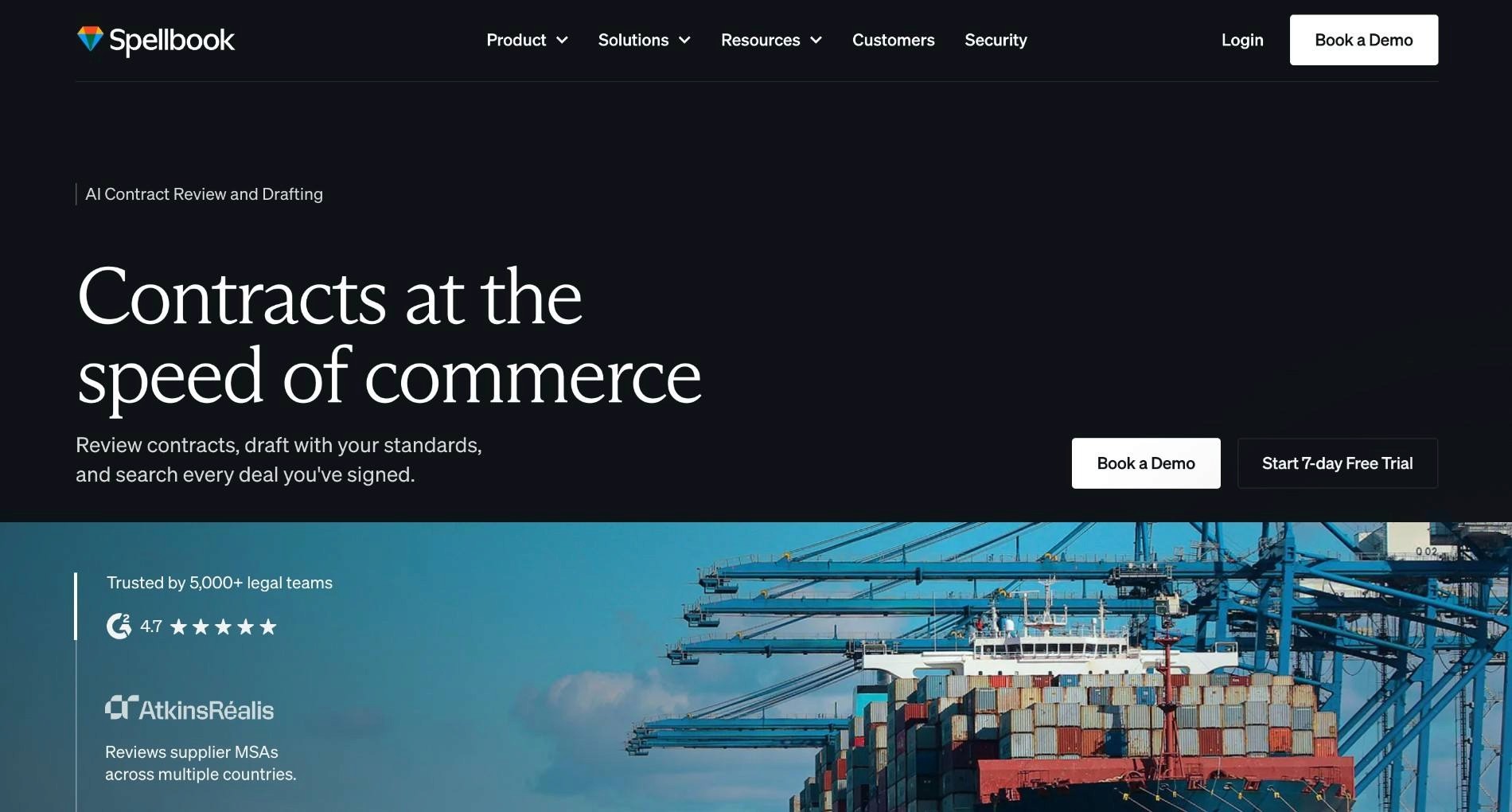
Spellbook is an AI drafting and redlining assistant that works directly inside Microsoft Word, built for law firms and in-house legal teams.
Rather than replacing the tools lawyers already use, Spellbook adds AI-powered clause suggestions, redlining and reviewing directly into the Word documents legal teams draft in every day.
This makes it a practical AI contract generator for legal professionals who want AI assistance without changing their existing drafting environment or learning a completely new platform.
It is best suited to teams doing genuine legal drafting work, rather than businesses wanting a simple, templated contract generator.
Ideal For
Law firms and in-house legal teams drafting contracts inside Microsoft Word
Legal professionals wanting AI-assisted redlining without changing their existing tools
Organisations with genuine legal drafting needs beyond simple templates
Top Features
AI-powered clause drafting suggestions inside Word
Automated redlining and contract review
Seat-based pricing tailored to team size
Integration with existing legal drafting workflows
Why They Stand Out?
Spellbook's 'Word-native' approach sets it apart from AI contractor generator tools that require legal teams to work in a separate platform.
It is one of the stronger options for lawyers who want AI support without disrupting how they already draft.
Pros
Works inside the Word environment lawyers already use
Strong redlining and clause suggestion capabilities
Seven-day free trial available for new customers
Tailored quotes based on team size and required features
Cons
Custom, seat-based pricing means no published rate card
Less useful for non-legal teams generating simple contracts
Best value depends on genuine, ongoing legal drafting volume
Pricing
Spellbook uses custom, seat-based pricing tailored to team size and deployment needs rather than fixed public plans.
Organisations receive personalised quotes based on the number of licensed users, required features and support level, while all customers can start with a seven-day free trial.
Final Verdict
Spellbook is a strong fit for law firms and legal teams that want AI drafting support inside Word.
Businesses wanting a simple, standalone AI contract generator without legal-specific features will find lighter tools elsewhere.
8. Juro
Overview
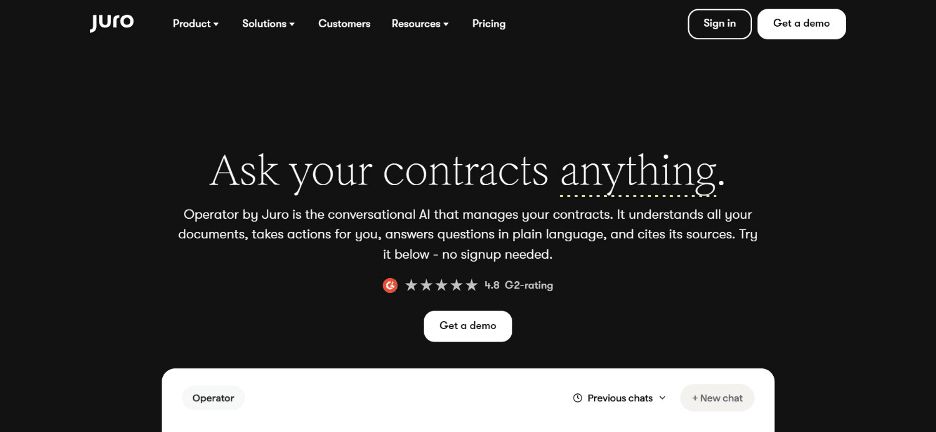
Juro is a contract workflow platform built for in-house legal teams managing agreements from initial drafting through to signature.
Its AI contract generator capabilities sit within a broader workflow. Contracts are drafted using unlimited templates, routed through approval chains, and signed, all inside one browser-based tool designed to reduce your legal teams' dependency on Word and email.
This makes Juro a strong fit for in-house teams that want contract generation tied directly to workflow automation, rather than a standalone drafting tool.
It is less suited to businesses that only need occasional, simple contracts generated ad hoc.
Ideal For
In-house legal teams managing the full contract lifecycle in one platform
Organisations wanting contract generation tied to structured approval workflows
Companies with growing contract volume needing consistent templates
Top Features
AI-assisted contract drafting using unlimited templates
Workflow automation from drafting through to signature
Unlimited users and workflows included on all plans
Browser-based platform reducing reliance on Word and email
Why They Stand Out?
Juro's pricing model, based on contract volume rather than user seats, sets it apart from AI contractor generator tools that charge per licensed user.
It is one of the smarter choices for growing legal teams that do not want costs to rise every time they add a team member.
Pros
Pricing based on contract volume, not per-seat licensing
Unlimited users, workflows and templates on all plans
Full workflow from drafting to signature in one platform
Reduces dependency on Word and email for contract work
Cons
Custom pricing model requires a sales conversation before comparison
Less suited to businesses with low, occasional contract volume
Implementation involves migrating existing templates into the platform
Pricing
Juro uses a custom pricing model based on annual contract volume, required AI features, integrations and implementation complexity, not user seats.
All plans include unlimited users, workflows and templates, with tailored quotes that scale as contract volumes and integration needs grow.
Final Verdict
Juro fits in-house legal teams that want contract generation built into a full, volume-based workflow platform.
Businesses with low or occasional contract needs will likely find a lighter tool more cost-effective.
9. Gavel
Overview
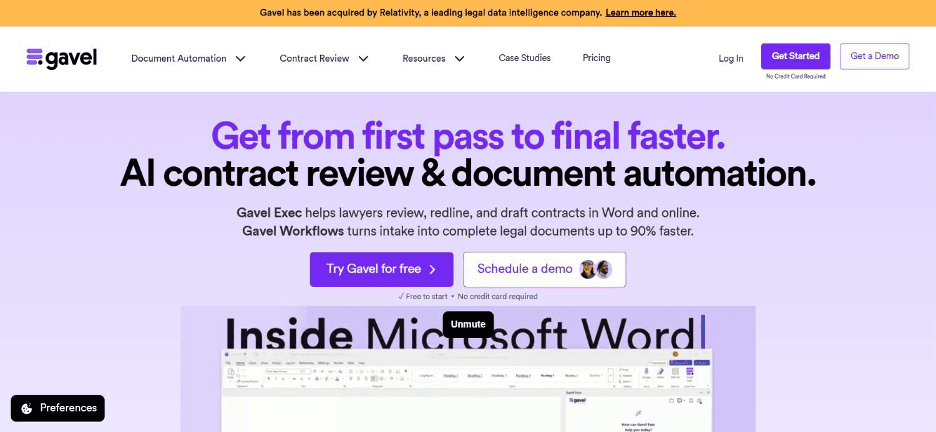
Gavel is a document automation platform that legal and business teams use to build no-code workflows that generate contracts from questionnaires and templates.
Its core strength is turning a lawyer's existing template into a repeatable intake form. A client or team member answers a series of questions, and Gavel assembles the final document automatically, including e-signature.
This makes Gavel a practical AI contract generator for firms and businesses that want to systematise contract creation around templates they already trust, rather than generating language from scratch.
It suits teams with existing templates more than those starting with nothing.
Ideal For
Law firms and businesses wanting to automate document assembly from existing templates
Teams needing client intake forms tied directly to contract generation
Organisations scaling contract volume without adding drafting headcount
Top Features
No-code document automation built from existing templates
Client intake forms that feed directly into contract generation
Built-in e-signature on document workflows
API access and custom limits on higher tiers
Why They Stand Out?
Gavel's template-first approach sets it apart from AI contractor generator tools that generate language from open-ended prompts.
It is one of the stronger options for teams that already have trusted templates and want to automate how they get filled in and sent out.
Pros
Turns existing templates into repeatable, automated workflows
Client intake forms reduce manual data entry
Scale tier adds API access and enterprise support
Clear, published pricing across all tiers
Cons
Best suited to teams with existing templates rather than starting from scratch
Higher tiers required for API access and enterprise-level support
Less focused on open-ended, AI-generated legal language
Pricing
Gavel prices Document Automation in four tiers, shown here at the euro rates on its pricing page: Lite at €76 a month, Standard at €191, Pro at €264 and Scale from €379 billed annually. The tiers scale on builder seats and template counts rather than usage, from one seat and 10 templates on Lite to two builder plus three org seats and 100 templates on Pro. Contract Review is priced on a separate tab, so teams wanting both capabilities are buying two products. Every tier includes a 7-day free trial, and the page carries a currency selector, so confirm the rate in your billing currency.
Final Verdict
Gavel is a strong choice for teams that want to automate contract generation around templates they already trust.
Businesses without existing templates may prefer a tool with more built-in drafting language.
10. LegesGPT
Overview
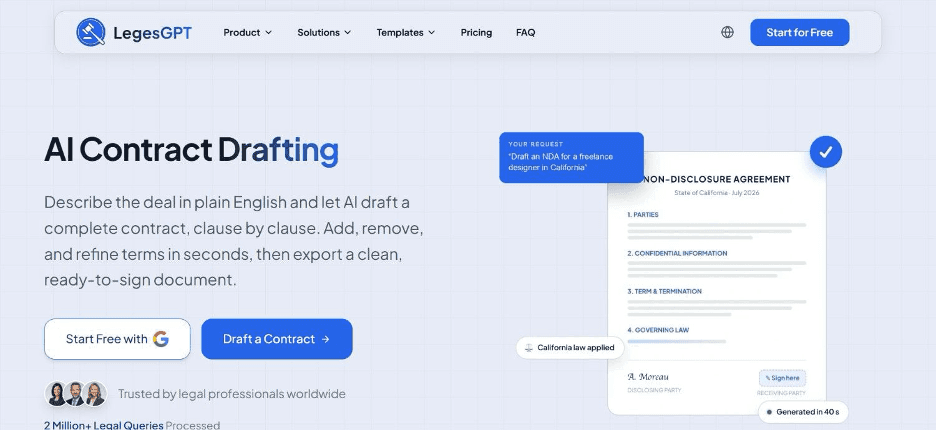
LegesGPT is an AI legal drafting assistant built for individuals and small teams that need help generating and understanding legal documents.
It combines an AI contract generator with a legal Q&A function, letting users draft an agreement and ask follow-up questions about specific clauses in the same conversation.
This makes LegesGPT accessible to freelancers, small business owners and early-stage founders who need contract help without hiring a lawyer for every routine agreement.
It is less suited to enterprise-scale contract volume or highly specialised legal drafting.
Ideal For
Freelancers and small business owners drafting their own contracts
Early-stage founders needing basic legal drafting help without a lawyer on retainer
Individuals wanting to understand contract clauses alongside drafting them
Top Features
AI-assisted legal drafting combined with a legal Q&A function
Document and image upload on higher-tier plans
Tiered subscription plans with discounted annual billing
Three-day free trial included on every plan
Why They Stand Out?
LegesGPT's combination of drafting and legal Q&A sets it apart from AI contractor generator tools that only produce a document without explanation.
It is one of the more accessible options for individuals who want to understand what they are signing, not just generate it.
Pros
Affordable entry-level pricing for individuals and small teams
Combines contract generation with legal Q&A in one tool
Free trial included on every subscription tier
Simple, transparent pricing structure
Cons
Limited depth for enterprise-scale or highly specialised contracts
Less suited to teams needing workflow automation or approval routing
Not a substitute for qualified legal advice on complex matters
Pricing
LegesGPT publishes three tiers: Basic at $19.99 a month, Plus at $49.99 and Premium at $99.99, dropping to $13.99, $34.99 and $69.99 on annual billing, a 30% saving. Every plan includes a 3-day free trial. Document and image upload start at Plus, which caps document review at 50 a month; Premium lifts that to unlimited and adds web search and a deep research mode.
Final Verdict
LegesGPT is a sensible option for individuals and small teams wanting affordable, AI-assisted contract drafting.
Larger organisations with complex approval workflows will need a more proven AI contract generator.
How to Choose the Best AI Contract Generator (What To Consider)?
The right choice depends less on which tool drafts the flashiest document and more on how well it fits your contract volume and existing systems.
Here are the factors worth weighing before you commit:
1. CLM, CRM and ERP Compatibility
Check whether the AI contract generator works with the CLM, CRM or ERP you already run.
A tool that demands you migrate systems first will slow down time to value.
2. Depth of Automation
Some AI contractor generator tools only produce a draft and leave approval routing to a person; others resolve the full drafting, review and filing process automatically.
Decide how much manual work you actually want removed, not just made faster.
3. Clause Library and Compliance Control
If you operate in a regulated industry, confirm the tool can apply your own clause library and log every drafting and approval decision.
This matters as much for internal legal review as it does for external regulators.
4. Pricing Model Fit
Per-seat pricing can punish growing legal and sales teams, while consumption-based or volume-based pricing scales with actual contract activity.
Match the pricing model to how many agreements you expect to generate over the next 12 to 24 months.
5. Implementation Timeline
Enterprise CLM suites can take months to implement, while lighter AI contract generator tools can be live within days.
Weigh the depth of functionality against how quickly your team needs results.
Everything You Need to Know About AI Contract Generator Tools
Tool | Pros | Cons | Ease of Use | Integrations | Support | Affordability |
Noxus | End-to-end resolution; works with legacy CLM systems; full audit trail | Requires scoping call; not for simple one-off contracts | ⭐⭐⭐⭐ | ⭐⭐⭐⭐⭐ | ⭐⭐⭐⭐⭐ | ⭐⭐⭐⭐ |
LEGALFLY | Anonymisation before analysis; drafting connects to governed review | No published pricing; enterprise evaluation cycle | ⭐⭐⭐⭐ | ⭐⭐⭐⭐⭐ | ⭐⭐⭐⭐⭐ | ⭐⭐⭐ |
Lindy AI | Flexible AI agents; broad workflow automation | Less specialised for legal work; credit-based pricing | ⭐⭐⭐⭐ | ⭐⭐⭐⭐ | ⭐⭐⭐ | ⭐⭐⭐⭐ |
PandaDoc | Strong CRM integration; e-signature included | Less suited to complex agreements; per-seat cost scales | ⭐⭐⭐⭐⭐ | ⭐⭐⭐⭐⭐ | ⭐⭐⭐⭐ | ⭐⭐⭐⭐ |
Jotform | Simple form-based approach; free plan | Limited for complex contracts; tiered submission limits | ⭐⭐⭐⭐⭐ | ⭐⭐⭐ | ⭐⭐⭐ | ⭐⭐⭐⭐⭐ |
Borderless AI | Transparent per-worker pricing; built-in global compliance | Narrow employment focus; scales with headcount | ⭐⭐⭐⭐ | ⭐⭐⭐ | ⭐⭐⭐⭐ | ⭐⭐⭐ |
Spellbook | Works inside Word; strong redlining | Custom pricing only; less useful for non-legal teams | ⭐⭐⭐⭐ | ⭐⭐⭐ | ⭐⭐⭐⭐ | ⭐⭐⭐ |
Juro | Volume-based pricing; unlimited users included | Custom pricing only; less suited to low volume | ⭐⭐⭐⭐ | ⭐⭐⭐⭐ | ⭐⭐⭐⭐ | ⭐⭐⭐ |
Gavel | Template-first automation; published pricing | Best with existing templates; higher tiers needed for API | ⭐⭐⭐⭐ | ⭐⭐⭐ | ⭐⭐⭐ | ⭐⭐⭐ |
LegesGPT | Affordable; combines drafting with legal Q&A | Limited enterprise depth; not a legal advice substitute | ⭐⭐⭐⭐⭐ | ⭐⭐ | ⭐⭐⭐ | ⭐⭐⭐⭐⭐ |
Automate Contract Operations with Noxus
If your legal or sales team still drafts contracts manually across a growing pile of requests and multiple disconnected systems, you already know where the delays are coming from.
We built Noxus to resolve that work end-to-end: pulling contract data from your systems, applying your clause library and approval rules, and writing the final agreement back into your CLM. Every action carries a full audit trail.
Clients like Santander have seen 3x ROI within 45 days of going live on real production data.
FAQs About the Best AI Contract Generator
What is the best AI contract generator in 2026?
Noxus is the best AI contract generator for enterprises running contract operations across legacy CLM, CRM and ERP systems. It resolves drafting, approval routing and filing end-to-end, instead of just producing a document. Every decision is logged with a full audit trail. Clients have seen 3x ROI within 45 days of going live.
What should I consider when choosing the right AI contractor generator tools for me?
Consider system compatibility, depth of automation, clause library control and pricing model first. Tools that only produce a draft leave approval routing to a person, while ones that resolve the full process automatically save far more time. Match the pricing model to your expected contract volume over the next two years.
How does Noxus differ from similar alternatives?
Noxus differs by resolving contract operations end-to-end, rather than just producing a draft for someone else to route manually. We built it to work natively with legacy CLM, CRM and ERP systems, without requiring a migration first. Every action is logged with full replayability, which most AI contract generator tools do not offer.
How do I get started with Noxus?
Getting started with Noxus begins with a scoping conversation about your current contracting systems and volume. Our team then maps your clause library and approval rules, and connects Noxus to your CLM, CRM or ERP. First deployments typically reach production within 45 to 80 days, based on past client rollouts.
How easy is it to switch to Noxus?
Switching to Noxus avoids the migration pain that stops most contract automation projects. We connect directly to the systems you already run, including major CLM and CRM platforms and 400+ other systems, so there is no need to replace your existing stack. Deployment engineering is included in the first engagement.