


Every product quality complaint runs on manual traceability from intake to containment
Today
Quality team
Complaint received, part, batch, PO and customer identified
Each complaint is manually read to identify the affected part, batch, purchase order and customer
Batch, shift, raw material lot and delivery looked up across SAP
The list of customers who received the affected batch is compiled manually from delivery and shipping records
Affected stock is located and flagged manually across SAP, one location and one material at a time
The quality team assembles the containment package from scratch before deciding the containment level
With Noxus
Co-worker
Complaints are received across every channel, filtered against the quality function's intake rules and structured on arrival
The affected batch is traced across SAP, the QMS and delivery records. Affected stock is flagged and the quality team notified.
The full traceability chain is retrieved automatically across SAP, the QMS and delivery records, assembled against the case
Every customer who received the affected batch is identified against the delivery records and added to the case
Affected stock is flagged in SAP through direct integration, across every location and material in one operation
Quality team receives the full case assembled and decides
How Noxus Works
Three layers powering product quality complaint handling on SAP
The workflow connects customer channels, SAP, the QMS and delivery records, runs the traceability chain end to end, and delivers the case to the quality team.
01
Complaint Intelligence
Complaints across email, portals, EDI and phone are filtered against intake rules and structured into a case record. Part, batch, PO and customer are extracted and matched against SAP master data.
RECEIVE
→
IDENTIFY
→
OPEN CASE
02
Traceability and Containment
The affected batch is traced across SAP, the QMS and delivery records. Affected stock is flagged and the quality team notified.
TRACE
→
CONTAIN
→
NOTIFY
03
Governance & Audit
Every step is logged as it happens. No AI decides containment; the quality team acts on assembled evidence, not reconstruction.
LOG
→
REPLAY
→
REVIEW
Capabilities
What happens across each layer of product quality complaint handling
Complaints across email, portals, EDI and phone are filtered against intake rules and structured into a case record. Part, batch, PO and customer are extracted and matched against SAP master data.

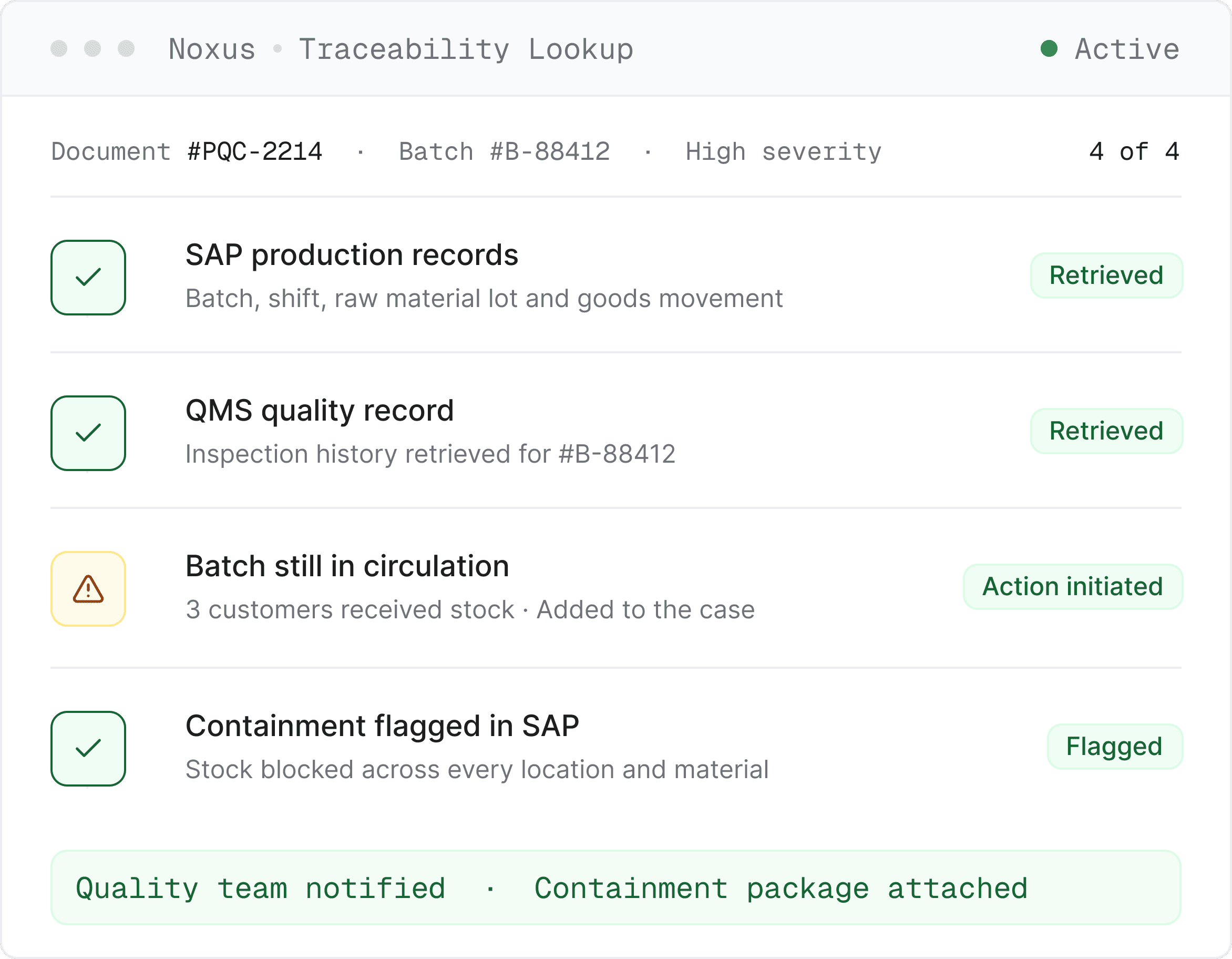
SAP is queried for the production batch, shift and raw material lot. Delivery records are queried for customer distribution. Affected stock is flagged in SAP across every location.
Every action is logged: complaint received, identifiers extracted, traceability queried, stock flagged, quality notified. The reviewer's decision closes the case in the same log.

agentic operations
The traceability chain belongs assembled as the complaint arrives
Product quality complaint handling is a traceability exercise across production, delivery and quality records. The chain from the complaint back to the batch has to be intact and evidence-ready without being reassembled every time by hand.

Runs the traceability chain end to end. Containment package delivered.

Built for Every Team
Noxus works across every function that owns the containment chain

Quality
Every complaint reaches the reviewer with the batch identified, customer distribution assembled and stock flagged in SAP. Containment is decided on evidence.

Operations
Affected stock is flagged in SAP as the case lands, not three shifts later. Production planning sees exposed batches and implicated lots in real time.

Innovation
Lands in production against SAP in weeks, with audit trail and determinism built in. The wedge for further quality function automation.
Measured results
Numbers that move the business
Measured outcomes from product quality complaint handling deployments on customised SAP estates.
What Customers Say
Trusted by teams running the operations




Frequently Asked
Questions about product quality complaint handling
How long does it take to deploy on our existing SAP estate?
Deployment timelines from kickoff to first process live in production run at 50 days on customised SAP estates. The scoping session at the start of the engagement maps the specific complaint types in scope, the traceability logic held in the function, the systems the traceability chain reaches into, and the SAP integration pattern that applies to the customer's environment, and produces a defensible timeline against those variables.
Which systems does the process connect to?
The primary write path is direct integration with SAP, most commonly through OData against S/4HANA. Read operations cover the production records, the goods movement, the material lot, the delivery record and the customer master. Write operations flag affected stock in SAP against every location where the batch remains in circulation. Adjacent connections include the QMS for the quality record where the function runs one, CRM systems where the customer relationship sits, and the shared inboxes and portals where complaints arrive today. The integration is scoped to the estate the function actually runs, not a generic SAP configuration.
What happens when a complaint is incomplete or the customer's reference does not match a known part or batch?
Cases where the complaint text cannot be resolved to a specific part, batch or purchase order, for example when the customer's reference is truncated, when multiple candidate batches match, or when the identifiers fall outside the confidence threshold, are routed to the quality team with the extraction, the ambiguity, the candidate matches and the corresponding SAP context already assembled. The reviewer sees what was extracted, what candidates the system identified and where the ambiguity sits, and the resolution they take is captured in the same audit log as the automated cases.
Can it handle multiple complaint types and product lines with different traceability logic in parallel?
Yes. The process is built around the function's complaint intake rules and the traceability configuration for each product line. Different products carry different traceability paths, some by serial number, some by batch, some by production date and shift, and each configuration runs in parallel through the same intake layer, with the traceability logic determined by the product identified at intake.
Does Noxus decide the containment level?
No. The containment decision, whether the outcome is batch retrieval, an expanded recall to adjacent batches, or a broader field recall, is taken by the quality team, not by an AI system. Noxus assembles the evidence base the decision requires: the affected batch, the customer distribution, the stock status, the production context. The AI layer handles the retrieval and interpretation work. The decision is human, and the decision-maker is captured in the audit record alongside the evidence they acted on.
Where does the platform run and how does IT security review it?
The platform runs inside the customer's own infrastructure, typically on a VM inside the customer's environment. Data does not leave the customer's estate. The integration with SAP is scoped to the permissions the customer grants, and every action against SAP runs under those permissions and is logged. The platform holds SOC 2 Type II, ISO 27001, and GDPR Article 28 certifications, and the deployment architecture is designed to pass an enterprise IT and security review as a standard step of the initial engagement.
How is this priced for a product quality complaint handling deployment?
The commercial model is a platform licence with the complaint volume, the number of product lines in scope, the traceability depth and the deployment complexity as the primary variables. The first engagement typically includes the deployment engineering to get the initial process live on the customer's SAP estate. Subsequent processes deployed on the same infrastructure carry predominantly platform spend, and the economics improve structurally as further processes across the quality function are brought onto the same environment.
Why do we need dedicated complaint handling software for product quality, rather than a generic complaint management tool, a CRM ticket system or the QMS?
Generic complaint management tools categorise complaints and route tickets; the traceability chase, the customer impact analysis, the SAP stock flagging and the case assembly still fall to the quality team. CRM ticket systems capture the customer conversation but do not reach into SAP, the QMS or the delivery record where the traceability chain lives. QMS platforms hold the non-conformance record and the corrective action but do not extend into the customised SAP estate for stock containment. Product quality complaint handling is a traceability exercise across every system the complaint touches, and the software required to run it end to end is the one that operates against the SAP estate the function actually runs, holds the audit chain as architectural foundation, and configures to the non-conformance and corrective action logic under ISO 9001 Clause 10.2 rather than requiring the function to standardise around a tool's data model.
How does Noxus compare to a product feedback platform, generic tools or RPA?
Generic product feedback platforms and RPA bots handle intake and routing, but none run the traceability chain from the complaint back to the affected batch across SAP, the QMS and delivery records. RPA breaks when SAP configurations change or when complaint formats vary. A product quality complaint requires the full chain: the batch identified, the production and delivery records traced, every affected customer located, stock flagged across locations, and the containment package assembled for the quality team. Noxus runs that chain on the SAP estate the function operates, with every step logged for audit, ISO 9001 Clause 10.2 compliance and customer escalation.
Automate product quality complaint handling end to end?
Live in 50 days. No SAP modification. No new system to maintain.