



Claims leave the practice with errors that payer validation would have caught
Today
Coded encounter retrieved and reviewed manually
Payer rules located and checked by hand per claim
Claims submitted without systematic pre-submission validation
Rule changes discovered through denials after submission
Denials returned as reason codes to interpret and investigate
With Noxus
Co-worker
Encounter retrieved automatically from PMS and EHR
Configured payer ruleset applied deterministically to every claim
All claims meet payer requirements before submission
Ruleset updated centrally, applied to every claim after
Failures escalated with validation issue identified
How Noxus Works
Three layers powering AI medical coding, from coded encounter to clean claim submission
Noxus connects to the practice management system and EHR, retrieves the coded encounter, applies the configured ruleset for the identified payer, and runs pre-submission validation before the claim reaches the payer system.
01
Retrieval & Payer Identification
The coded encounter is retrieved from the practice management system, cross-referenced against the EHR, and the payer identified from the encounter data before the rules layer runs.
RETRIEVE
→
IDENTIFY
→
CONFIRM
02
Payer Ruleset
Identified ruleset is applied to extracted codes, modifier and bundling rules matched per payer rather than from a generic standard.
MATCH
→
APPLY
03
Validation & Submission
Assembled claim pre-submission validation against current payer requirements. Clean claims submitted; Failures escalate to a reviewer with the specific validation failure already identified.
VALIDATE
→
SUBMIT
→
ESCALATE
Capabilities
What happens across each layer of the AI medical coding workflow
The coded encounter is retrieved from the practice management system and cross-referenced against the EHR. Procedure and diagnosis codes are verified against the clinical record. Payer identification runs from the encounter data directly, not from a manual selection.


Identified payer ruleset loads against the retrieved encounter. Modifier requirements, bundling rules, and documentation thresholds are applied on every claim. Coded procedures meeting payer's requirements are assembled; Mismatches are flagged before the claim goes further.
The assembled claim runs through pre-submission validation against the payer's current requirements. Clean claims submit directly without billing team involvement. Failed claims route to a reviewer with the specific validation failure and the relevant claim data already assembled.

agentic operations
Submitting a claim is not the same as submitting a clean claim
A claims submission workflow that applies payer rules per payer and validates against current requirements before the claim leaves the practice is a different operation from one that assembles a claim and waits for the payer to return a denial.

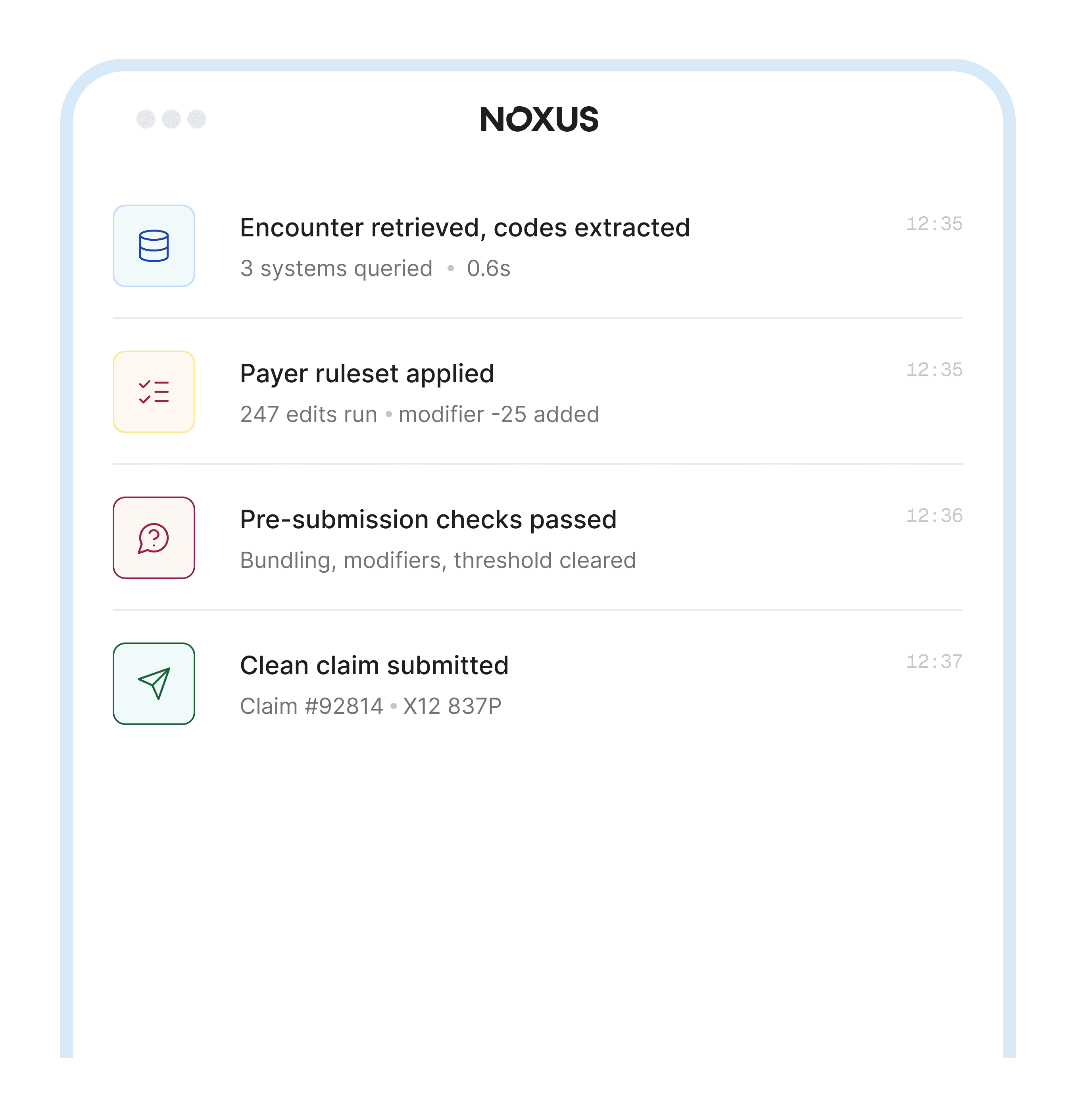
Extracts codes, matches payer rules, validates the claim, submits clean.
Built for Every Team
Built for every role in the workflow

Revenue Cycle Operations
Denials shrink as failures are caught pre-submission, not after. Reviewers handle exceptions with issues pre-identified; billing shifts from rework to volume.

Compliance & Audit
Every step from extraction to submission produces a complete audit record. Coding decisions are traceable to the source documentation, payer rule applications logged and replayable on demand.

IT & Architecture
The workflow runs on the EHR, practice management system, and payer portal already in the environment. No API layer required, no middleware project precedes deployment.
Measured results
Numbers from live deployments
Measured outcomes from healthcare deployments - live billing data, real volume.
What Customers Say
Trusted by teams running the operations




Frequently Asked
Questions about AI medical coding and clean claim submission
How quickly can an AI medical coding workflow be live on our systems?
The first billing workflow reaches production on the existing clinical and administrative system environment in approximately 45 days from contract signature. That timeline covers integration setup, payer ruleset configuration, and validation logic tuned to the specific billing environment. No system replacement or infrastructure modernisation is required as a prerequisite. Noxus Forward Deployment Engineering handles the integration setup; the first deployment is typically the highest-volume payer and procedure mix.
What internal systems does Noxus connect to?
The workflow connects to the electronic health record, the practice management system, and the payer portal or clearinghouse used for claim submission. It operates on the systems already running in the environment through existing interfaces, including legacy platforms without modern API access. There is no API prerequisite and no dependency on the core system vendor's integration roadmap. If your team uses it today, Noxus can operate inside it.
What happens when clinical documentation is incomplete or ambiguous?
Where documentation does not support a specific procedure or diagnosis code at the required level of specificity, the record is flagged at the extraction layer rather than passed forward with a code that will produce a denial. The flagged record escalates to a reviewer with the documentation gap identified, so the reviewer addresses a defined problem rather than re-examining the full record. The threshold for acceptable specificity is configured at deployment.
Can it handle different billing rules across multiple payers?
Yes. Payer identification runs from the encounter data, and the ruleset applied to each claim reflects the requirements of that specific payer. A single deployment handles multiple payers, with modifier rules, bundling requirements, documentation thresholds, and filing deadline constraints applied per payer rather than from a single generic billing standard. Adding a new payer to the same deployment runs at substantially lower incremental cost because the integration infrastructure is already in place.
What does the billing team actually receive from this workflow?
Clean claims are submitted directly to the payer system without billing team involvement. Claims that fail pre-submission validation reach a reviewer with the specific validation failure identified, the relevant claim data assembled, and the payer requirement that was not met surfaced alongside it. The reviewer acts on a defined problem, not a denial reason code to interpret after the fact. Billing time shifts from rework to volume.
Does Noxus make any decisions in the governed part of the billing process?
No AI system makes a coverage determination, a reimbursement decision, or a clinical coding judgment outside the configured rule parameters. Where pre-submission validation identifies a failure that requires clinical or billing judgment, the case escalates to a human reviewer with full context already assembled. The AI extracts and matches; the rules determine what is submitted; humans resolve what falls outside those rules.
What does the IT security review process look like?
The platform is certified against SOC 2 Type II, ISO 27001, GDPR Article 28, and HIPAA. Deployment options include fully managed SaaS, private cloud on the client's own infrastructure, and air-gapped on-premises for environments with strict data residency requirements. Clinical data does not leave the client's environment unless the deployment architecture requires it. Every action produces a complete, tamper-evident audit record. RBAC integrates with Azure AD or the client's existing identity system.
How is Noxus priced for an AI medical coding deployment?
Pricing is a monthly platform license that scales with operational volume, not with headcount or per-claim consumption. The first engagement includes Deployment Engineering alongside the platform license to get the billing workflow into production. Subsequent payer rulesets and additional workflows added to the same environment run predominantly as platform spend, with the integration infrastructure already in place. The economics improve structurally with each new payer or service line deployed.
Why do healthcare providers need dedicated AI medical coding software?
Traditional billing systems were built to assemble and submit claims, not to extract codes from clinical documentation, apply payer-specific rules in real time, and validate claims before submission. AI medical coding sits in front of the billing system and runs the work that determines whether the claim arrives clean. Automated medical coding eliminates the manual lookup loop between coder and payer rule. Autonomous medical coding takes that further: the AI assigns codes within configured rule parameters and humans review only the exceptions surfaced at validation, rather than every claim before it leaves the queue.
How does Noxus compare to other AI medical coding and clinical coding solutions?
Most AI medical coding tools cover one slice of the workflow - code suggestion, claim scrubbing, or denial management - and leave the billing team to bridge the rest. Computer-assisted coding tools assist a human coder; modern clinical coding tools generate codes but stop before payer rules are applied. Noxus runs the full sequence on the systems already in the environment: clinical record retrieved, codes extracted and validated for specificity, payer identified, ruleset applied, claim validated before submission, exceptions routed with the failure reason identified. AI handles the unstructured documentation; deterministic rules execute the process logic.
Ready to submit clean claims on your existing stack?
Live in 45 days. No API prerequisites. No coding migration project.